
An HOA enforcement letter is a formal written notice that identifies a specific rule violation, cites the governing document, and sets a firm deadline for correction. Boards and property managers who follow a clear, documented process protect their communities from legal challenges and resolve violations faster. The standard enforcement sequence covers inspection, written notice, cure period, hearing, and fine imposition. Skipping any step creates legal exposure. This guide walks you through each stage of the hoa enforcement letter step by step process, aligned with 2026 best practices under CC&Rs, state statutes, and due process requirements.
What must you prepare before drafting an HOA enforcement letter?
Preparation determines whether your letter holds up if challenged. Boards that skip documentation often lose enforcement cases before they reach a hearing. Gather everything before you write a single word.
Document the violation thoroughly
Start with a dated inspection report. Record the exact location, the nature of the violation, and the name of the person who observed it. Photograph the violation with a timestamp. These photos become your primary evidence if a homeowner contests the notice or requests a hearing. Boards should maintain detailed documentation at every step, including timestamped photos, delivery logs, and hearing minutes, because these records protect board decisions if challenged legally.

Verify ownership and contact information
Confirm the homeowner's name and mailing address through your county assessor's records or your community's ownership database. Sending a notice to the wrong person or address can invalidate the entire process. Cross-reference your records against the deed on file.
Review the governing documents
Pull the exact CC&R section, bylaw provision, or community rule that applies to the violation. Write down the full citation, including article number and section. Vague references to "community standards" do not satisfy legal notice requirements. Your enforcement process checklist should include this citation step before any letter is drafted.
Preparation documents at a glance
| Document | Purpose |
|---|---|
| Dated inspection report | Establishes when and where the violation occurred |
| Timestamped photos | Visual evidence for hearings and legal challenges |
| Ownership verification | Confirms correct recipient and mailing address |
| CC&R or rule citation | Provides legal basis for the enforcement action |
| Prior notice history | Shows pattern of communication if escalation is needed |
Pro Tip: *Keep a violation log in a shared folder accessible to all board members. Consistent record-keeping across the board prevents gaps in documentation that homeowners can exploit.*
How to write the HOA enforcement letter step by step
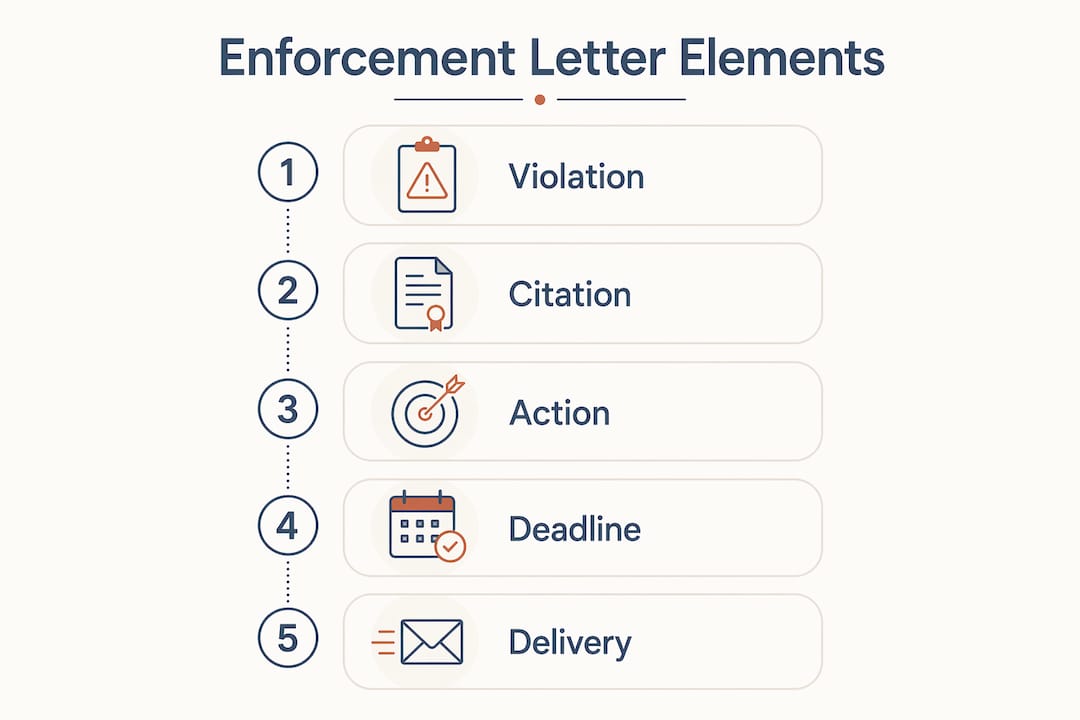
A valid HOA violation notice in 2026 must include five core elements to be legally enforceable: a specific violation description, the exact governing document citation, the required corrective action, a clear cure deadline by calendar date, and the homeowner's right to a hearing. Boards that omit any of these elements risk having fines invalidated.
The five required elements explained
1. Specific violation description. State exactly what was observed. "Overgrown lawn" is too vague. "Grass height exceeds 6 inches as measured on april 3, 2026, at 123 Maple Drive" is specific and defensible.
2. Exact governing document citation. Reference the article and section number. For example: "CC&Rs, Article IV, Section 4.3, Landscaping Standards." This ties the violation directly to the rules the homeowner agreed to follow.
3. Required corrective action. Tell the homeowner exactly what they must do. "Mow and trim lawn to comply with CC&Rs, Article IV, Section 4.3" leaves no ambiguity about what compliance looks like.
4. Cure deadline by calendar date. State a specific date, not a number of days. "You must correct this violation by april 17, 2026" is clearer and legally safer than "within 14 days." Some states mandate a minimum cure period of 14 to 30 calendar days, so verify your state's requirement before setting the date.
5. Homeowner's right to a hearing. Notify the homeowner that they may request a hearing to contest the violation before any fine is imposed. Include the contact name, address, and deadline for submitting a hearing request.
Common mistakes to avoid
- Using subjective language like "unsightly" or "inappropriate" instead of measurable descriptions
- Citing "community rules" without specifying the exact document and section
- Setting deadlines in business days instead of calendar days
- Omitting the hearing rights notice, which can nullify fines entirely
- Sending the letter before completing the inspection and photo documentation
- Using a threatening or adversarial tone that escalates conflict unnecessarily
Pro Tip: *Attach copies of the relevant CC&R sections and your timestamped photos directly to the letter. Homeowners who see the evidence upfront are more likely to comply without requesting a hearing.*
The tone of the letter matters as much as its content. A firm, factual, and respectful letter preserves community relationships and reduces the chance of a formal dispute. Avoid language that sounds punitive. The goal is correction, not confrontation. For a detailed example of calm, rule-cited language, review a structured template before drafting your own.
What are the best methods for delivering and tracking HOA enforcement letters?
Delivery method determines whether your notice is legally valid. A perfectly written letter means nothing if you cannot prove the homeowner received it.
- Certified mail with return receipt. Certified mail is the gold standard for HOA violation notice delivery. The return receipt card gives you a signed, dated record of delivery that satisfies due process requirements in virtually every state.
- Personal delivery. A board member or authorized agent can hand-deliver the letter directly to the homeowner. Document the delivery with a written log that includes the date, time, and the name of the person who delivered it.
- Email delivery. Email is acceptable only if your governing documents explicitly authorize it and the homeowner has consented in writing. Most governing documents specify certified mail or personal service as preferred methods. Relying on email without that authorization risks notice invalidation.
- Maintain a delivery log. Record every notice sent, the method used, the date sent, and the date of confirmed receipt. This log becomes critical evidence if a homeowner later claims they never received the notice.
- Build in a mailing buffer. When calculating the cure deadline, add two to three days to account for mail transit time. Starting the cure period on the postmark date rather than the delivery date is a common board error that shortens the homeowner's legally required response window.
Pro Tip: *Use a dedicated HOA management tool or a simple shared spreadsheet to track every notice, delivery confirmation, and deadline. Consistent tracking prevents missed deadlines that can reset the entire enforcement process.*
What steps to take after sending the enforcement letter?
Sending the letter is the beginning of the process, not the end. What happens next determines whether the violation gets resolved or escalates into a legal dispute.
- Allow the full cure period. Do not take further action until the cure deadline has passed. Failure to provide adequate notice time or a hearing opportunity can nullify HOA fines and enforcement actions entirely. Patience here is not optional. It is a legal requirement.
- Conduct a re-inspection. On or after the cure deadline, inspect the property and document the current condition with new timestamped photos. This re-inspection record is your basis for any further action.
- Schedule a hearing if requested. HOA members have the right to request a hearing before fines are imposed. If the homeowner submits a request, schedule it promptly and provide written notice of the date, time, and location. Document the hearing with detailed minutes, including evidence presented and the board's decision.
- Impose fines only after due process is complete. Fines are appropriate only after the cure period has expired, a hearing has been offered or held, and the violation remains uncorrected. Reference your governing documents for the authorized fine schedule.
- Escalate to liens as a last resort. Lien placement is the final step in the standard enforcement sequence and should only follow exhausting all internal processes. Consult your HOA attorney before placing a lien.
- Apply rules uniformly. Selective enforcement is the leading cause of successful legal challenges against HOAs. Boards must apply the same process to every homeowner for the same type of violation. Inconsistency creates liability, even when the underlying violation is legitimate.
The follow-up phase is where many boards lose ground. Inconsistent timelines, skipped hearings, and undocumented decisions give homeowners the legal opening they need to challenge fines. A violation notice checklist used at every stage keeps the board on track and the process defensible.
Key takeaways
A legally valid HOA enforcement letter requires five specific elements, consistent delivery documentation, and a full cure period before any fine can be imposed.
| Point | Details |
|---|---|
| Five required elements | Every letter must include violation description, rule citation, corrective action, calendar deadline, and hearing rights. |
| Certified mail is safest | Use certified mail with return receipt to create a signed, dated proof of delivery. |
| Calendar days matter | Count cure periods in calendar days, not business days, and add a mailing buffer to the deadline. |
| Document everything | Maintain timestamped photos, delivery logs, and hearing minutes at every stage. |
| Consistency prevents lawsuits | Apply the same enforcement process to every homeowner to avoid selective enforcement claims. |
The part most boards get wrong about enforcement letters
Boards treat enforcement letters as weapons. That framing causes more problems than it solves. I have seen boards draft letters that read like legal threats, and the result is almost always the same: the homeowner gets defensive, requests a hearing, and the board spends three months resolving something that could have been handled in two weeks with a respectful notice.
The most effective enforcement letters I have reviewed share one quality. They are boring. They state the violation, cite the rule, name the deadline, and explain the hearing right. No editorializing. No warnings about "further action." No language designed to signal authority. Just facts.
The tiered approach works because it matches the communication to the situation. A courtesy notice for a first offense costs nothing and resolves most violations before they require a formal letter. The official enforcement letter comes second, with all five required elements. A final notice or hearing letter comes only if the violation persists. Boards that skip the courtesy step and go straight to formal notices train their communities to treat every letter as an escalation.
Consistency is the other piece that boards underestimate. The moment you send a formal letter to one homeowner for a violation you ignored in another, you have created a selective enforcement problem. That problem does not go away when the violation is corrected. It follows the board into every future dispute. Build a written enforcement policy, follow it every time, and document that you followed it. That documentation is your defense.
> *— Blake*
Hoaletterai makes compliant enforcement letters faster
Drafting a legally valid enforcement letter from scratch takes time that most board members and property managers do not have. Hoaletterai's violation letter generator builds state-aware notices that include all five required elements automatically, with fields for your specific CC&R citation, cure deadline, and hearing rights language.

The generator produces a one-page preview before you send, so you can review the letter for accuracy without switching between tools. USPS mailing is available directly from the platform, which eliminates the extra step of printing and certifying letters yourself. For boards managing multiple properties or communities, Hoaletterai's property manager tools handle volume without sacrificing compliance. Check your state's specific notice requirements on the HOA laws by state page before generating your first letter.
FAQ
What are the five required elements of an HOA enforcement letter?
A valid HOA enforcement letter must include a specific violation description, the exact governing document citation, the required corrective action, a cure deadline stated as a calendar date, and the homeowner's right to request a hearing.
Can an HOA send enforcement letters by email?
Email delivery is only valid if the governing documents explicitly authorize it and the homeowner has consented in writing. Certified mail with return receipt remains the legally safest delivery method for enforcement notices.
How long must the cure period be?
Cure period requirements vary by state, with many jurisdictions mandating a minimum of 14 to 30 calendar days. Boards should verify their state statute and governing documents, then add a mailing buffer when calculating the deadline.
What happens if a homeowner requests a hearing?
The board must schedule a hearing and provide written notice of the date, time, and location before imposing any fine. The hearing should be documented with minutes that record the evidence presented and the board's decision.
What is selective enforcement and why does it matter?
Selective enforcement occurs when a board applies rules inconsistently across homeowners. It is the leading cause of successful legal challenges against HOAs, and boards that cannot prove uniform enforcement risk having fines and actions invalidated.
Recommended
- HOA Collection Letters: A Respectful, Step-by-Step Reminder Sequence | HOA Letter AI
- HOA Rule Enforcement Checklist for Board Members | HOA Letter AI
- Texas HOA Compliance Guide: Violation Letter Requirements Under Chapter 209 | HOA Letter AI
- New York HOA & Co-op Compliance Guide: Violation Letters and Enforcement | HOA Letter AI