
An HOA noise complaint letter is a formal written notice that documents specific noise violations, cites the relevant CC&R or community rule sections, and requests board enforcement action. Without this document, your complaint is verbal and unenforceable. With it, you trigger a legal process your HOA board is obligated to follow.
Most homeowners assume a phone call or email to the board is enough. It rarely is. The HOA complaint process is driven by paper trails, not conversations. A properly written noise complaint letter creates an official record, establishes a timeline, and puts the board on notice that inaction has consequences. This guide covers every step: documentation, letter structure, what happens after you file, and how to avoid the mistakes that get complaints dismissed.
What is an HOA noise complaint letter and why does it matter?
An HOA noise complaint letter is the formal mechanism that converts a personal frustration into a compliance matter. That distinction is everything. Once you frame the issue as a breach of contract citing a specific CC&R article, the board's fiduciary duty to enforce community rules is triggered. Framing noise as a contract breach moves the issue from neighbor dispute to rule enforcement, which is a category boards cannot legally ignore.

The governing documents most HOAs rely on include the CC&Rs (Covenants, Conditions, and Restrictions), the community bylaws, and any adopted rules and regulations covering quiet hours. These documents define what noise levels are acceptable, during which hours, and what the enforcement process looks like. Your letter must reference these documents by name and section number. A complaint that says "my neighbor is loud" gives the board nothing to act on. A complaint that says "the noise on March 4, 2026, from 11:30 PM to 1:00 AM violated CC&R Section 7.3, which prohibits disruptive noise after 10:00 PM" gives the board a clear path forward.
How to document noise disturbances before filing
Strong documentation is the foundation of every successful noise complaint. Boards hesitate to act without objective proof because they fear accusations of selective enforcement. Your job before writing a single word of your complaint letter is to build a record that removes all doubt.
The most effective documentation method is a noise log maintained over one to two weeks. Each entry should include:
- The exact date and time the noise started and stopped
- The type of noise (music, barking, power tools, loud voices)
- The duration of the disturbance
- How the noise affected you (sleep disruption, inability to work, physical discomfort)
- The weather or other conditions that might be relevant
Timestamped audio or video recordings add a layer of objectivity that written logs alone cannot provide. Consumer decibel apps are not court-grade instruments, but they provide useful reference points that boards appreciate. A reading of 75 decibels at midnight is far more persuasive than "it was really loud." If neighbors or other residents witnessed the disturbances, written statements from them strengthen your case considerably.
Pro Tip: *Keep your log entries factual and clinical. Write "music at an estimated 70 decibels from 11:00 PM to 1:30 AM" rather than "my neighbor blasted music all night and I couldn't sleep." The first version is evidence. The second is a complaint.*
Avoid emotional language in your documentation. Emotional or vague descriptions are frequently dismissed by boards that need clear, factual observations to justify enforcement action. Boards are not arbiters of feelings. They are enforcers of written rules, and your documentation needs to speak their language.
What are the key components of an effective noise complaint letter?
A well-structured noise complaint letter follows a clear format that makes it easy for the board to act. Effective noise complaints include a chronological noise log, specific CC&R citations, and timestamped evidence. Here is the structure that works:
- Your identification. Include your full name, address, unit number if applicable, and contact information at the top of the letter.
- The violating party's identification. Name the neighbor or property address where the noise originates. Be specific.
- The rule being violated. Quote the exact CC&R section or community rule that applies. Copy the language verbatim.
- A summary of your noise log. Provide a concise table or list of documented incidents with dates, times, and noise types.
- Reference to supporting evidence. Note that audio recordings, decibel readings, or witness statements are attached or available upon request.
- A specific request with a deadline. State exactly what you want the board to do. Request resolution with a firm deadline of 14 to 30 days. "Please issue a formal violation notice and enforce quiet hours by April 15, 2026" is far stronger than "please look into this."
- Your signature and date. Sign the letter and date it clearly.
Maintain a factual, respectful tone throughout. Boards respond to professionalism. A letter that reads like a legal brief gets taken seriously. A letter that reads like a vent session gets filed and forgotten.
Pro Tip: *Send your complaint via certified mail with return receipt. This creates proof that the HOA received your letter on a specific date. If the board fails to act, that receipt becomes leverage.*
For additional guidance on structuring rule-cited letters, the HOA violation letter guide at Hoaletterai covers the exact format boards expect to see.
What happens after you submit your noise complaint?
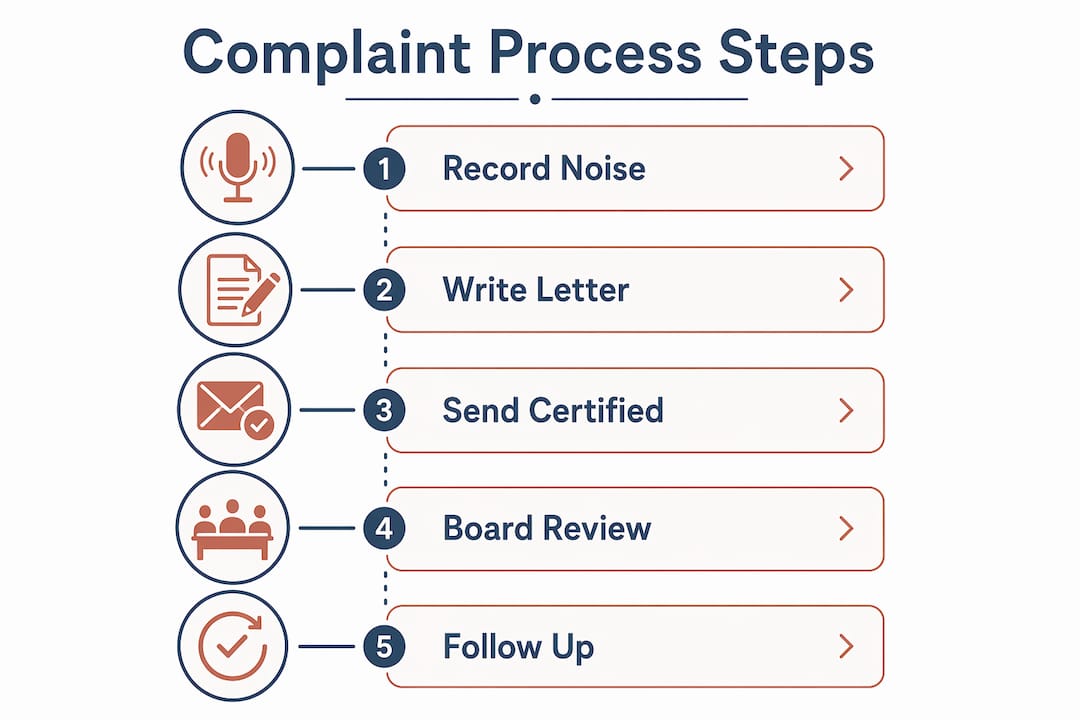
The HOA complaint process after submission follows a predictable sequence, though the timeline can feel slow. Boards typically meet monthly, so expect at least 30 days before any formal action begins. Understanding each stage helps you set realistic expectations and follow up effectively.
The typical sequence looks like this:
- Board review. The board or property manager reviews your complaint at the next scheduled meeting. They verify that the complaint includes sufficient documentation and a cited rule violation.
- Courtesy notice. First-step enforcement is often a courtesy letter sent to the neighbor. Many noise issues resolve at this stage because neighbors are genuinely unaware their noise travels as far as it does.
- Formal violation notice. If the behavior continues, the board issues a formal violation notice with a specified correction period.
- Hearing rights. Before any fine or penalty is imposed, due process requires the board to give the accused homeowner notice and an opportunity to be heard. This is a legal requirement, not a courtesy.
- Fines or further action. If the violation persists after the hearing, the board may impose fines, suspend privileges, or pursue legal remedies depending on the governing documents.
> "Homeowners are often surprised by the due process protections given to neighbors accused of noise violations. These protections exist for good reason, but they do explain why enforcement timelines stretch longer than complainants expect. Patience is not optional in this process."
If you have not heard back within 30 days of your certified mail delivery date, send a written follow-up referencing your original complaint date and the delivery confirmation number. Keep copies of every piece of correspondence.
Common challenges and tips for successful noise complaint enforcement
The single most common reason noise complaints fail is inadequate documentation. Boards that receive a one-paragraph email describing general annoyance have no paper trail to act on and no protection against a selective enforcement claim. The fix is straightforward: document everything before you write the letter.
Here are the most effective practices for getting results:
- Cite the rule, not the feeling. Reference the specific CC&R section or quiet hours policy in every communication. This frames the issue as a compliance matter, not a personal dispute.
- Use decibel readings as supporting data. Consumer apps like NIOSH SLM or similar tools provide readings that give boards an objective reference point, even if the readings are not legally certified.
- Build a paper trail from day one. Save every email, letter, and response. If the matter escalates, your records are your evidence.
- Follow up in writing only. Phone calls leave no record. Every follow-up should be a written letter or email that you keep a copy of.
- Avoid ultimatums in early letters. State your request clearly, but save escalation language for later communications if the board fails to act.
Pro Tip: *Review the common letter writing mistakes that get HOA complaints dismissed before you draft your letter. Avoiding those errors from the start saves weeks of back-and-forth.*
The table below summarizes the most common complaint pitfalls and their solutions:
| Common Mistake | Effective Alternative |
|---|---|
| Vague descriptions of noise | Specific dates, times, and decibel readings |
| No CC&R citation | Quote the exact rule section violated |
| Emotional language | Factual, clinical log entries |
| Verbal or email-only complaints | Certified mail with return receipt |
| No deadline for board action | Specific resolution deadline (14–30 days) |
| Single incident reported | Pattern of incidents over 1–2 weeks |
Realistic expectations matter here. Even a perfectly written complaint may take 60 to 90 days to produce a measurable result. The process has legal requirements that protect both parties. Persistence within the process, not pressure outside it, is what produces outcomes.
Key Takeaways
A noise complaint letter works when it frames the issue as a contract breach, cites specific CC&R sections, and provides objective, timestamped evidence that boards can act on without fear of selective enforcement claims.
| Point | Details |
|---|---|
| Frame it as a contract breach | Cite the exact CC&R section to trigger the board's fiduciary duty to enforce. |
| Document before you write | Maintain a 1–2 week noise log with dates, times, types, and decibel readings. |
| Send via certified mail | Return receipt creates proof of delivery and builds leverage if the board delays. |
| Include a firm deadline | Request specific action within 14–30 days to establish urgency and clarity. |
| Expect a 30-plus day timeline | Due process protections for the accused neighbor mean enforcement takes time. |
The part most homeowners get wrong
Most people write their first noise complaint letter the way they would write an angry text message. They describe how the noise made them feel, how long they have suffered, and how unfair the situation is. Then they wonder why the board does nothing.
The board is not your therapist. It is a governing body with legal obligations and real liability exposure. When I look at complaints that actually produce results, they share one trait: they read like a compliance memo, not a grievance letter. The homeowner identified the rule, documented the breach, and asked for a specific action by a specific date. That is the entire formula.
What surprises most people is how quickly the tone of the process shifts once you get the framing right. Boards that seemed unresponsive suddenly schedule hearings and issue notices. The reason is simple: a well-documented, rule-cited complaint puts the board on the hook. Ignoring it creates liability. Ignoring a vague complaint carries no risk at all.
One more thing worth saying plainly: be patient with the due process requirements. Your neighbor has rights too, and the board must honor them. That is not a flaw in the system. It is the system working correctly. The homeowners who get frustrated and escalate too fast often undermine their own cases. The ones who document thoroughly, write clearly, and follow up consistently tend to get results.
> *— Blake*
Write your noise complaint letter with Hoaletterai
Writing an HOA noise complaint letter that actually gets results requires the right structure, the right language, and the right rule citations for your state.

Hoaletterai generates state-compliant noise complaint letters built around your community's specific rules and your state's legal requirements. You enter the details, and the platform produces a professionally formatted letter that references the correct CC&R language, includes a clear enforcement request, and is ready to send via USPS certified mail. No legal background required. Check the HOA violation laws by state to understand the notice requirements that apply in your jurisdiction before you file.
FAQ
What is an HOA noise complaint letter?
An HOA noise complaint letter is a formal written document that cites specific community rule violations, summarizes documented noise incidents, and requests board enforcement action within a stated deadline.
How long does the HOA complaint process take?
The process typically takes 30 days or more from submission to initial board action, since boards usually meet monthly and must follow due process procedures before issuing fines.
What evidence should I include with my noise complaint?
Include a dated noise log covering one to two weeks, timestamped audio or video recordings, decibel app readings, and any written witness statements from other affected residents.
Why do noise complaints get dismissed?
Complaints fail most often because they lack objective documentation or do not cite a specific rule. Boards need a paper trail and a cited violation to act without risking a selective enforcement claim.
Should I send my HOA noise complaint by certified mail?
Yes. Certified mail with return receipt is the recommended delivery method because it creates legal proof that the HOA received your complaint on a specific date, which matters if the board fails to respond.
Recommended
- HOA Noise Complaint Response Letter (State-Compliant HOA Letter) | HOA Letter AI
- HOA Noise Complaint Letter Template — Quiet Hours & Nuisance Notice | HOA Letter AI
- HOA Trash Violation Response Letter (State-Compliant HOA Letter) | HOA Letter AI
- HOA Violation Letter Laws by State — Notice Requirements & Fine Rules | HOA Letter AI