
An HOA parking violation letter is a formal written notice that informs a homeowner or resident of a specific parking rule breach in their community, detailing the infraction and the corrective steps required. Understanding this document matters whether you are a board member drafting one or a homeowner receiving one. Get the content or procedure wrong, and the letter becomes unenforceable. Get it right, and it resolves most parking disputes before they escalate into fines or hearings.
What does an HOA parking violation letter actually include?
A well-drafted parking enforcement letter contains six core elements, and missing any one of them creates room for dispute. Typical letter contents include the specific CC&R section cited, a description of the vehicle and parking location, a cure deadline, and the next enforcement steps. That structure is not optional. It is the foundation of an enforceable notice.
Here is what every letter must contain:
- Homeowner identification and property address. The letter must name the resident and the specific unit or lot involved. Vague addressing creates disputes about who is responsible.
- Rule citation with section reference. Cite the exact CC&R or community rule section. "You violated our parking policy" is not enough. "You violated Section 4.3(b) of the CC&Rs, which prohibits commercial vehicles in residential driveways" is.
- Factual description of the violation. Include the vehicle type, license plate if visible, exact location, and the date and time observed. Specificity prevents the homeowner from claiming the letter describes someone else's vehicle.
- Required corrective action and deadline. State exactly what the homeowner must do and by when. "Remove the vehicle within 72 hours" is clear. "Please address this matter" is not.
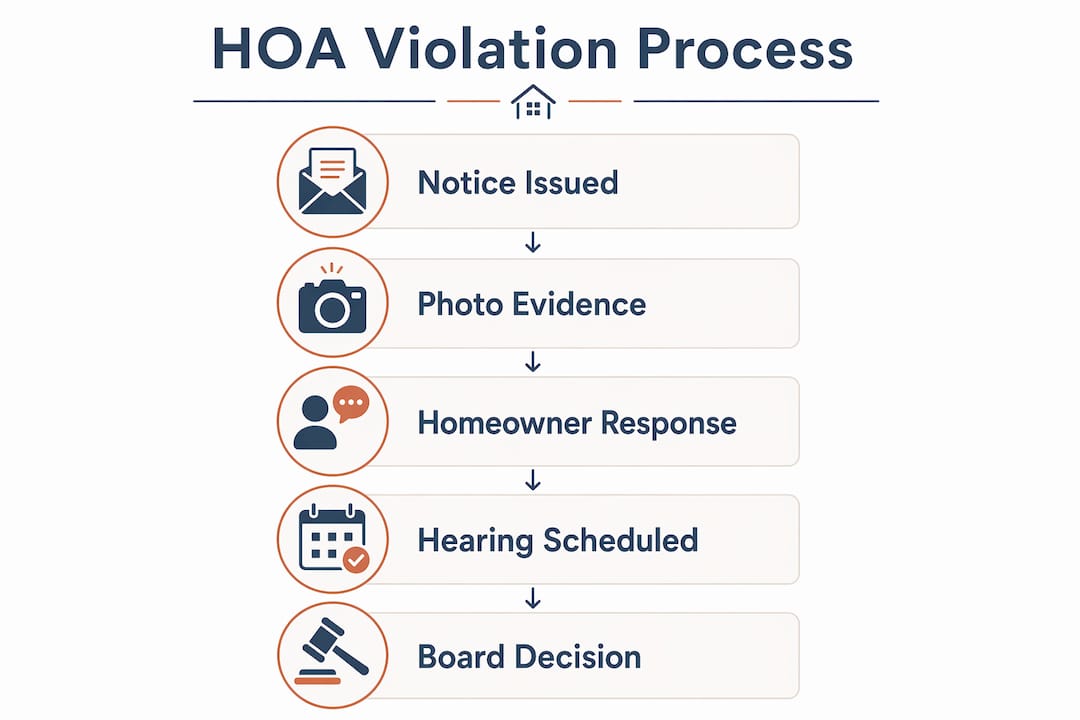
- Escalation steps. Explain what happens next if the violation is not corrected. This includes the hearing process, potential fines, and any towing authority the association holds.
Pro Tip: *Always attach a photo of the violation to the letter. It eliminates the most common homeowner objection and creates a clean record if the matter proceeds to a hearing.*
How do state laws affect HOA parking violation procedures?

State law governs the timing, content, and delivery of HOA violation notices. Two states set the clearest benchmarks: Florida and California. Boards operating in either state must follow specific statutory procedures, or their fines and enforcement actions can be voided.
| State | Statute | Notice Requirement | Hearing Rights | Decision Timeline |
|---|---|---|---|---|
| Florida | Statute 720.305 | 14 calendar days before hearing | Independent fining committee | Before fine is imposed |
| California | Civil Code §§5850–5855 | 10 days before disciplinary hearing | Homeowner may appear and present | Written decision within 14 days after hearing |
Florida law is direct on this point. Florida Statute 720.305 mandates at least 14 calendar days advance notice to homeowners, including the hearing date, time, and violation details, before any fine can be imposed. That means the clock starts the moment the letter is sent, not when the homeowner reads it. Boards that skip this step or compress the timeline produce legally void fines.
California follows a parallel structure. California Civil Code §§5850–5855 require written notice of the alleged violation, at least 10 days' notice before a disciplinary hearing, the opportunity for the homeowner to appear and present their case, and a written board decision within 14 days after the hearing. Procedural fairness in HOA violation notices builds homeowner trust and reduces legal challenges. That is not just good practice. It is the law.
One more California-specific rule boards often overlook: towing. California Vehicle Code 22658 requires HOAs to post compliant towing signs, issue a parking violation notice, and wait 96 hours before towing unless specific exceptions apply. A tow executed without meeting those prerequisites is unlawful and exposes the association to liability.
Pro Tip: *If your HOA operates in a state other than Florida or California, consult your state's nonprofit corporation act or planned community statute. Most states have analogous notice and hearing requirements that carry the same enforcement consequences.*
What are the most common parking violations in HOA letters?
The most frequently cited violations in HOA parking notices fall into five categories. Boards should describe each one with precision, because vague language in a violation notice is the single most common reason homeowners successfully dispute fines.
Common violations include:
- Commercial vehicles in residential areas. This includes work vans, box trucks, and vehicles with visible business signage. The letter should name the vehicle type, describe the signage or markings, and cite the specific rule prohibiting it.
- Boats, trailers, and RVs. Many communities prohibit these in driveways or on streets. The letter must identify the specific unit, its approximate size, and how long it has been present.
- Guest parking misuse. Residents using designated guest spots for personal vehicles is one of the most contested violations. The letter should note the dates and times the vehicle was observed and confirm it is registered to the resident.
- Inoperable vehicles. A car without current registration, flat tires, or visible disrepair qualifies in most communities. Document the condition with photos and describe it factually in the letter.
- Prohibited street or fire lane parking. These violations carry the most urgency. Cite the specific location, the rule prohibiting parking there, and any safety concern the violation creates.
The difference between a good and a poor violation description is factual specificity. A poor description reads: "Your vehicle was parked improperly." A strong description reads: "A white Ford Transit cargo van bearing the license plate [ABC-1234] and displaying commercial signage was observed parked in your driveway at 123 Oak Lane on March 4, 2026, at 9:15 a.m., in violation of Section 5.1(c) of the CC&Rs." The second version leaves no room for confusion and holds up in a hearing.
What are the best practices for boards and homeowners?
Boards and homeowners each have distinct responsibilities when a parking violation notice enters the picture. Following the right process on both sides prevents most disputes from becoming formal proceedings.
For boards, the process should follow these steps:
- Issue a courtesy notice first. A courtesy notice is not a formal fine or hearing notice. It is a friendly reminder that a rule has been broken. Separating courtesy and fine notices is required to comply with state statutes and avoid procedural defects. Conflating the two is one of the most common board mistakes.
- Document before sending. Photograph the violation with a timestamp. Log the date, time, and location in your records. This documentation supports the letter and protects the board if the homeowner disputes the notice.
- Follow the statutory timeline. Count the required notice days carefully. In Florida, that is 14 days. In California, it is 10 days. Send the letter with enough lead time to meet the deadline before the hearing date.
- Use a respectful, factual tone. Effective notices avoid threatening language and specify rule citations with practical corrective steps and deadlines. A letter that reads as punitive generates pushback. A letter that reads as informative generates compliance.
- Confirm cure before the hearing. Under Florida law, fines cannot be imposed if the violation is cured before the hearing. Document the cure with a photo or written confirmation and cancel the hearing promptly.
For homeowners receiving a parking violation notice:
Your first step is to read the letter carefully and check whether the HOA properly cited the CC&R rule and followed due process. Legal challenges frequently hinge on procedural compliance and rule citation accuracy. If the notice lacks a rule citation, a specific description, or the required notice period, you have grounds to dispute it. Respond in writing, acknowledge receipt, and either confirm you will cure the violation or state your grounds for dispute. Keep copies of everything.
Pro Tip: *If you believe the violation notice is procedurally defective, request a copy of the board's enforcement policy and compare it against what you received. Boards are required to follow their own procedures, and deviations often invalidate the notice.*
Key takeaways
A valid HOA parking violation letter requires specific rule citations, factual descriptions, and state-mandated notice periods to be legally enforceable.
| Point | Details |
|---|---|
| Core letter elements | Every notice must cite the specific CC&R section, describe the violation factually, and state a clear cure deadline. |
| State law compliance | Florida requires 14 days' notice before a fine hearing; California requires 10 days and a written decision within 14 days after. |
| Courtesy vs. formal notice | Boards must separate initial courtesy notices from formal fine or hearing notices to avoid procedural defects. |
| Homeowner dispute rights | Homeowners can challenge notices that lack proper rule citations, factual descriptions, or required notice periods. |
| Documentation protects both sides | Photos with timestamps and written records support the board's case and the homeowner's defense equally. |
Why tone and procedure matter more than most boards realize
Most boards I have worked with treat the parking violation letter as a formality. They draft it quickly, send it out, and move on. That approach creates more problems than it solves.
The letters that generate the most conflict are the ones that read like threats. When a homeowner receives a notice that leads with fine amounts and legal consequences before explaining what they actually did wrong, the natural reaction is defensiveness, not compliance. I have seen boards spend months in dispute over a single parking notice that could have been resolved in a week with a clearer, calmer letter.
The boards that handle parking enforcement well do two things consistently. First, they separate the courtesy notice from the formal fine notice and treat each as a distinct communication with its own tone and purpose. Second, they write with the assumption that the homeowner may not have known they were violating a rule. That assumption changes the tone from accusatory to informational, and it dramatically increases the rate of voluntary compliance.
The procedural requirements in states like Florida and California exist for good reason. An HOA fine imposed without the required hearing is often legally void and subject to dispute or cancellation. That means a board that skips the process does not just risk a legal challenge. It wastes everyone's time and undermines the community's trust in the enforcement system. Getting the letter right the first time is always faster than defending a defective one.
> *— Blake*
Draft compliant parking violation letters with Hoaletterai
Writing a parking violation notice that meets your state's legal requirements and holds up in a hearing takes more than a template. Hoaletterai generates state-compliant HOA violation letters in minutes, with built-in checks for notice timing, rule citation format, and required hearing language.

Boards can use Hoaletterai's parking violation letter templates for guest parking, street parking, RV and boat violations, and more. Each template includes state-specific language options and a one-page preview before sending. For homeowners who need to respond to a notice, the platform also offers a parking violation response letter that addresses procedural disputes and cure confirmations. No legal background required. Just clear, professional communication that protects your position from the start.
FAQ
What is an HOA parking violation letter?
An HOA parking violation letter is a formal written notice from a homeowners association informing a resident of a specific parking rule breach, citing the violated rule, describing the infraction, and outlining required corrective steps and enforcement consequences.
How many days' notice does an HOA need to give before a fine hearing?
Florida requires at least 14 calendar days' written notice before a fine hearing under Statute 720.305. California requires at least 10 days' notice before a disciplinary hearing under Civil Code §§5850–5855.
Can an HOA fine you without a hearing?
No. In Florida and California, an HOA fine imposed without the required hearing process is legally void. Homeowners can dispute and cancel fines that were issued without proper notice and a hearing opportunity.
What should i do if i receive an HOA parking violation notice?
Read the letter carefully, check that it cites a specific CC&R rule and includes a factual description of the violation, and respond in writing. If the notice lacks required elements or proper notice timing, you have grounds to dispute it through the parking violation appeal process.
What makes a parking violation description legally strong?
A strong description includes the vehicle type, license plate, exact location, date, and time of the observed violation, along with the specific CC&R section number. Vague descriptions like "improper parking" are the most common reason homeowners successfully challenge notices.
Recommended
- HOA Parking Violation Response Letter (State-Compliant HOA Letter) | HOA Letter AI
- HOA Parking Violation Letter Template — Guest, Street, RV & Boat Parking | HOA Letter AI
- HOA Landscaping Violation Response Letter (State-Compliant HOA Letter) | HOA Letter AI
- HOA Trash Violation Response Letter (State-Compliant HOA Letter) | HOA Letter AI