
An HOA violation letter is the official written notice from a homeowners association informing you that a specific community rule has been broken and outlining the steps required to correct it. The industry standard term is a *notice of violation*, though boards and residents commonly call it a compliance letter or violation notice. The primary purpose is corrective, not punitive. The letter creates a documented record that protects both the association and the homeowner. Most violations stem from CC&Rs (Covenants, Conditions, and Restrictions), bylaws, or community rules covering everything from lawn maintenance to parking. Misreading or ignoring these letters is one of the most common and costly mistakes homeowners make.
What is an HOA violation letter and why does it matter?
An HOA violation letter is a formal written notification that a homeowner has breached a rule defined in the association's governing documents. Those governing documents typically include the CC&Rs, bylaws, and any separately adopted rules and regulations. The letter serves as the legal starting point for enforcement. Without it, the HOA cannot legally impose fines or pursue further action under most state statutes.
The letter also protects homeowners. A written notice forces the board to be specific about what rule was broken, when it was observed, and what correction is required. Vague verbal complaints carry no legal weight. A properly written notice of violation creates accountability on both sides of the relationship.

Violation letters also help maintain property values across the community. Consistent enforcement of rules covering landscaping, exterior paint, and parking keeps the neighborhood uniform and attractive. That consistency is what justifies the HOA's authority in the first place.
What must an HOA compliance letter include?
A legally sound HOA compliance letter contains several required components. Missing even one can weaken the association's enforcement position.
- Violation description: A clear, factual account of the observed issue, including the date and location. For example: "On June 3, 2026, an uninspected fence was observed at 412 Maple Drive."
- Rule citation: The exact section of the CC&Rs or bylaws that the homeowner has violated. Citing "Section 4.2(b) of the CC&Rs" is far stronger than a general reference to "community rules."
- Photos (when applicable): Visual documentation strengthens the record and removes ambiguity about what was observed.
- Required corrective action: A specific description of what "fixed" looks like. "Remove the fence" is clear. "Address the issue" is not.
- Compliance deadline: Standard enforcement policies typically allow 10–30 days to correct violations before penalties apply. The letter must state the exact date.
- Consequences for noncompliance: A plain statement of what happens next if the issue is not resolved, such as fines, suspension of amenity access, or a formal hearing.
- Contact information: A name, phone number, or email address the homeowner can use to ask questions or request a hearing.
- Delivery method: Certified mail, email with read receipt, or hand delivery. The method matters because it establishes proof of receipt.
Pro Tip: *Always send violation letters via certified mail or a delivery method that generates a confirmation record. Proof of delivery is your first line of defense if a homeowner claims they never received the notice.*
How does the HOA violation enforcement process work?
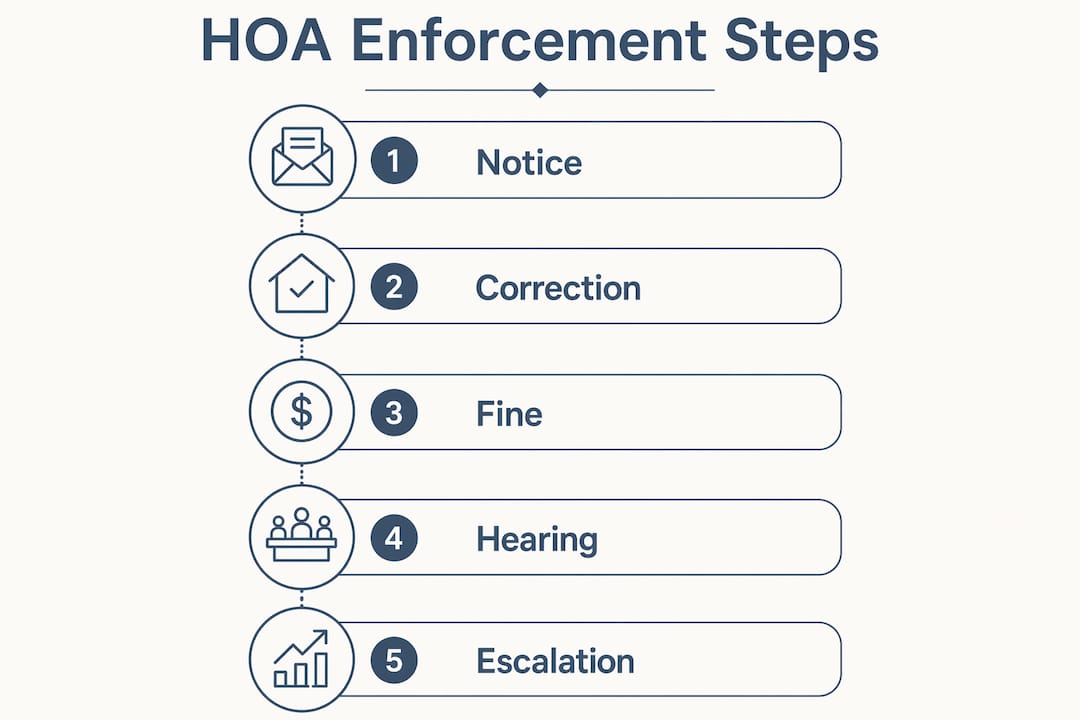
HOA violation enforcement follows a defined sequence: courtesy notice, formal violation letter, pre-fine hearing, and fine imposition if the issue remains unresolved. Skipping any step can void fines and expose the association to legal challenges. Here is how the process typically unfolds:
- Courtesy or warning notice: Many boards send an informal reminder before issuing a formal violation letter. This step is not legally required in most states, but it builds goodwill and often resolves minor issues quickly.
- Formal violation letter: This is the official notice of violation. It triggers the compliance window and starts the documented record.
- Compliance window: The homeowner has a set period, typically 10–30 days, to correct the violation. The exact timeframe depends on state law and the association's governing documents.
- Hearing notice: If the violation is not corrected, the board must notify the homeowner of a scheduled hearing. Boards must provide hearing notices at least 10–15 days in advance so the resident can prepare a response.
- Fine imposition: After the hearing, the board may impose fines if the violation persists. Fines typically escalate with each additional notice period.
- Further action: Unresolved or severe violations can lead to suspension of community privileges, liens on the property, or legal action.
The table below shows how violation severity affects the enforcement path.
| Violation Type | Example | Typical First Step | Escalation Risk |
|---|---|---|---|
| Minor | Overgrown lawn | Courtesy notice | Low |
| Moderate | Unauthorized parking | Formal violation letter | Medium |
| Structural | Unpermitted fence or addition | Formal letter with hearing | High |
| HOA common area violation | Damage to shared property | Formal letter plus cost recovery | High |
Pro Tip: *Document every step with timestamps. A board that can show a clear paper trail from courtesy notice to fine imposition is nearly impossible to challenge in arbitration or court.*
How should you respond to an HOA violation letter?
Receiving a notice of violation does not mean you are in trouble. It means the clock has started. How you respond in the next 10–30 days determines the outcome.
- Read the letter carefully. Identify the exact rule cited, the required correction, and the deadline. Many homeowners miss the deadline simply because they did not read the letter closely enough.
- Stay calm and factual. The most effective response is a written communication that addresses the specific rule cited without emotional language. Frustration in writing almost always makes disputes worse.
- Request clarification if needed. If the letter is vague or you believe it was issued in error, contact the board in writing and ask for specifics. You have the right to understand exactly what is being alleged.
- Document your corrective action. Take dated photos before and after the correction. Keep receipts if the fix required a contractor. This evidence protects you if the board claims the violation was not resolved.
- Request a hearing if you disagree. Most state laws and governing documents give homeowners the right to appear before the board before any fine is imposed. Use that right if you have a legitimate dispute.
- Send a formal follow-up. Simply correcting the violation is not always enough. Homeowners who fix the issue but fail to notify the board in writing can continue receiving fines if the board's next inspection misses the correction. Send a written notice with photos confirming the issue has been resolved.
A useful resource for crafting your reply is this HOA violation response letter guide, which walks through the structure and tone of an effective homeowner response.
What should HOA boards consider when drafting violation letters?
Boards that draft clear, fair, and respectful letters get faster compliance. Boards that write accusatory or vague notices get disputes. The difference is usually in the details.
- Use factual, neutral language. Avoid harsh or accusatory wording that puts homeowners on the defensive. State what was observed, not what you assume about the homeowner's intentions.
- Cite governing documents precisely. Reference the specific section and subsection of the CC&Rs or bylaws. This removes ambiguity and demonstrates that enforcement is rule-based, not personal.
- Include every required component. A letter missing a compliance deadline or contact information is not just unhelpful. It can be legally unenforceable.
- Apply rules consistently. Enforcing a landscaping rule against one homeowner while ignoring the same issue next door creates selective enforcement claims. Those claims can void fines in court.
- Choose the right delivery method. Certified mail creates a legal record of delivery. Email works in many states but requires the homeowner to have agreed to electronic communication in writing.
- Maintain a complete file. Boards must document each step and deliver notices per governing documents to avoid procedural challenges that could invalidate enforcement.
Pro Tip: *Before sending any violation letter, have a second board member or your property manager review it for tone and completeness. A five-minute review prevents months of dispute.*
Boards looking for state-specific guidance can review HOA violation letter laws by state, which covers notice requirements and fine rules across all 50 states.
Key takeaways
An HOA violation letter is a corrective legal tool that requires specific components, a defined process, and documented follow-through from both boards and homeowners.
| Point | Details |
|---|---|
| Corrective, not punitive | Violation letters aim to fix rule breaches, not punish residents. |
| Required components | Every letter must include the rule citation, deadline, corrective action, and contact info. |
| Defined enforcement steps | Boards must follow the full sequence from warning to hearing before imposing fines. |
| Homeowner follow-up is critical | Send written confirmation with photos after correcting a violation to stop ongoing fines. |
| Consistent enforcement protects boards | Applying rules uniformly prevents selective enforcement claims that can void penalties. |
Why violation letters are about communication, not control
I have reviewed hundreds of HOA disputes over the years, and the pattern is almost always the same. The violation itself is rarely the real problem. The problem is how the letter was written or how the homeowner responded to it.
Boards that treat violation letters as administrative paperwork tend to write cold, impersonal notices that put homeowners on the defensive immediately. Homeowners who treat the letter as an attack respond emotionally and miss the actual deadline. Both sides end up in a hearing that could have been avoided with one clear, respectful letter and one calm, written reply.
The most effective boards I have seen treat every violation letter as a communication opportunity. They write clearly, cite the rule, explain what needs to change, and leave the door open for questions. That approach resolves the majority of violations before a second notice is ever needed.
Homeowners who respond well do one thing consistently: they put everything in writing. They confirm receipt, document the correction, and notify the board formally. That paper trail is what protects them if the dispute ever escalates.
The uncomfortable truth is that most HOA conflicts are procedural failures, not substantive ones. A board that follows the enforcement ladder correctly and a homeowner who responds in writing will almost never end up in arbitration. The letter is not the problem. Ignoring the process is.
> *— Blake*
Draft and send HOA violation letters the right way
Writing a violation letter that is clear, legally sound, and respectful takes more effort than most boards expect. Hoaletterai removes that friction.

Hoaletterai generates professional HOA violation letters in minutes, with built-in checks for state-specific language, required components, and proper formatting. Boards can customize notices to reference their exact CC&Rs and community rules, preview the letter before sending, and choose USPS mailing directly from the platform. For California associations, the California HOA violation letter page covers state-specific notice requirements, fine rules, and ready-to-use templates. Whether you are a board member drafting your first notice or a property manager handling dozens of letters a month, Hoaletterai keeps the process consistent and defensible.
FAQ
What is an HOA violation letter?
An HOA violation letter is an official written notice from a homeowners association informing a resident that a specific community rule has been broken and stating what correction is required. It is also called a notice of violation or HOA compliance letter.
What does an HOA notice to correct mean?
An HOA notice to correct is a formal instruction requiring a homeowner to fix a specific rule violation within a set deadline, typically 10–30 days, before fines or further enforcement action begin.
What are the types of HOA violation letters?
The main types include courtesy or warning notices, formal violation letters, and pre-fine hearing notices. Each step in the enforcement sequence serves a distinct legal purpose and must be followed in order.
What is an HOA common area violation?
An HOA common area violation occurs when a resident damages, misuses, or improperly alters shared community property such as a pool, parking lot, or clubhouse. These violations often carry higher penalties because they affect all residents.
How should i respond to an HOA violation letter?
Respond in writing, address the specific rule cited, document your corrective action with photos, and send a formal follow-up to the board confirming the issue has been resolved. A calm, factual tone produces the best outcome.
Recommended
- HOA Violation Response Letter: Template & Tips for Homeowners | HOA Letter AI
- HOA Violation Letter Laws by State — Notice Requirements & Fine Rules | HOA Letter AI
- HOA Violation Letter Template (Free Download) — State-Aware Drafting Guide | HOA Letter AI
- HOA Trash Violation Response Letter (State-Compliant HOA Letter) | HOA Letter AI
Drafting support for HOA notices
Use the HOA letter drafter to turn this guidance into a resident-ready notice, compare reusable HOA letter templates, or review the property manager workflow for higher-volume enforcement work.