
An HOA warning letter is the official written notice from a homeowners association informing a resident that they have violated a community rule and must take corrective action by a specific deadline. This formal document, also called an HOA violation notice, carries legal weight. It is not a casual reminder. Ignoring it can trigger fines, hearings, and even liens on your property. Search interest in HOA violation letters has grown 240% over three months, which reflects how many homeowners are encountering these letters without knowing what to do next. Whether you received one or you are drafting one, understanding the HOA warning letter explained here is the first step toward resolving the issue cleanly.
***
What does an HOA warning letter contain?
A well-written violation letter includes violation details, specific corrective actions, a hearing date and time, and the homeowner's right to cure and attend hearings. Omitting any of these elements risks invalidating any fines that follow. Every section of the letter serves a legal and practical purpose.
The standard contents of an HOA warning letter include:
- Homeowner and property information. Full name, address, and lot or unit number so the notice is tied to the correct record.
- Violation description. A clear explanation of what rule was broken, including the exact CC&R section, bylaw number, or community rule being cited.
- Prior notice reference. A note indicating whether a courtesy notice was previously sent and on what date.
- Required corrective action. Specific instructions on what the homeowner must do to fix the problem, such as removing a structure, repainting a fence, or trimming overgrown hedges.
- Compliance deadline. A firm date by which the violation must be corrected. Most state laws require at least 10–14 days before any fining hearing can be scheduled.
- Hearing information. Details about when and where a hearing will occur if the violation is not corrected, along with the homeowner's right to attend and present their case.
- Fine schedule. A statement explaining what fines will begin if the deadline passes without correction.
Pro Tip: *Keep a copy of every HOA letter you receive, including the envelope with the postmark. Boards are required to document delivery, and your records may matter if a dispute goes to a hearing.*
The violation description is the most legally sensitive part of the letter. Vague language like "your yard is messy" does not satisfy due process requirements. The letter must name the specific rule and describe the specific condition that violates it.

***
How does an HOA warning letter fit into the enforcement stages?
A formal HOA violation letter is typically the second enforcement step, following an informal courtesy notice, and it establishes the legal paper trail that supports any future fines or hearings. Understanding the full sequence helps both homeowners and boards know exactly where they stand.
The enforcement process follows this documented order:
- Violation discovery. A board member, property manager, or neighbor reports a potential rule violation. The board documents it with notes and photographs.
- Courtesy notice. An informal written reminder is sent to the homeowner. This step is not legally binding in most states, but skipping it often escalates conflicts unnecessarily.
- Formal warning letter. This is the legally binding HOA violation notice. It specifies the violation, the cure deadline, and the consequences of non-compliance.
- Cure period. The homeowner has a set window to fix the problem. State laws like Florida Statute 720.305 mandate 10–14 days' written notice before a fining hearing. Failure to provide this notice can void any fines imposed.
- Hearing. If the violation is not corrected, the board schedules a hearing. The timeline from notice to final board decision is typically 4–8 weeks, with hearings usually scheduled within 30–45 days of the request.
- Fine. If the hearing confirms the violation, fines begin according to the association's schedule.
- Lien. Unpaid fines can result in a lien placed against the property, which must be resolved before the home can be sold or refinanced.
The table below shows how each stage escalates in consequence:
| Stage | Action | Consequence if ignored |
|---|---|---|
| Courtesy notice | Informal written reminder | Escalation to formal letter |
| Warning letter | Formal violation notice with deadline | Hearing scheduled |
| Hearing | Board reviews violation and homeowner response | Fine imposed |
| Fine | Monetary penalty per violation schedule | Lien on property |
| Lien | Legal claim against property title | Blocks sale or refinancing |
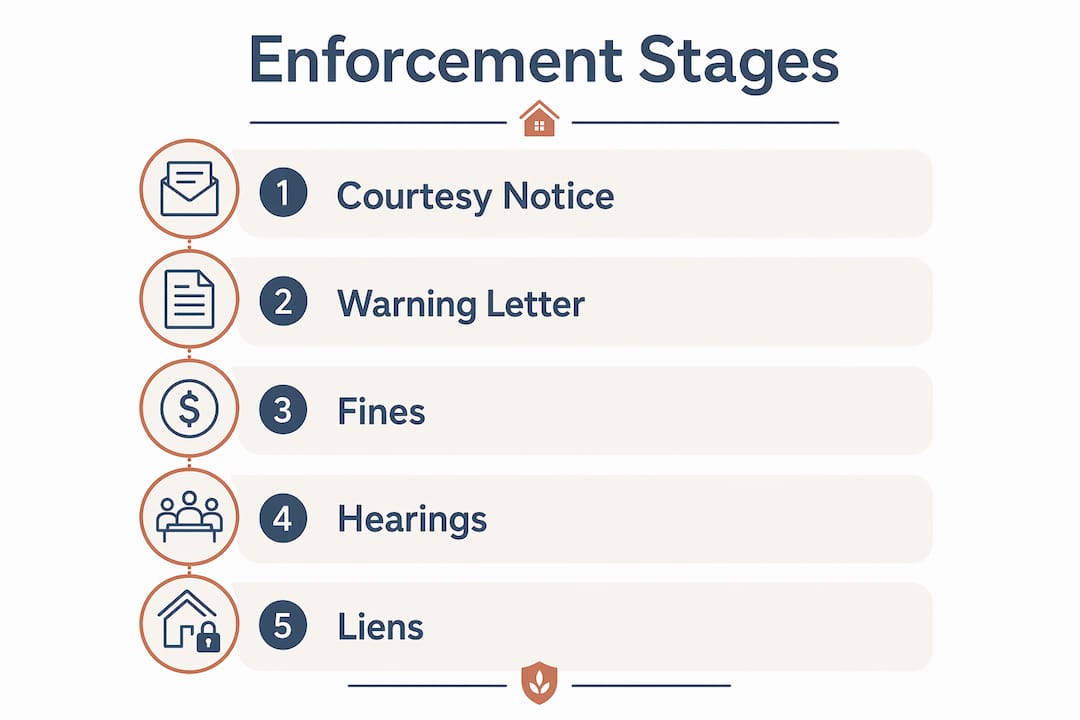
Ignoring a violation letter almost always leads to escalating actions like fines and liens, increasing costs and complications for the homeowner. Addressing the issue at the warning letter stage is always less expensive than waiting.
***
What should you do after receiving an HOA warning letter?
Effective homeowner responses to warning letters focus on factual, professional communication that references specific notices, evidence, and timelines. Emotional reactions are less effective and can damage your standing at a hearing.
Here is what to do immediately after receiving a warning letter:
- Read the letter carefully. Identify the exact rule cited, the required correction, and the deadline. Do not assume you know what it says without reading every line.
- Check the governing documents. Pull out your CC&Rs or community rules and read the section referenced in the letter. Confirm the rule exists and applies to your situation.
- Gather evidence. Take dated photographs of your property. If you believe the violation is incorrect, document why. If you already fixed the issue, photograph the correction.
- Respond in writing. Send a written reply to the board or property manager. Keep it factual and calm. Reference the specific notice date, the rule cited, and your corrective steps or your disagreement with the finding.
- Request an extension if needed. If you need more time due to contractor delays or medical circumstances, request an extension in writing before the deadline passes. Most boards will grant reasonable requests.
- Correct the violation and document it. Once fixed, photograph the result and notify the board in writing. Do not assume they will notice on their own.
- Attend the hearing if one is scheduled. Bring your written response, photographs, and any supporting documents. A clear, organized presentation carries more weight than verbal arguments alone.
Pro Tip: *If you plan to appeal a fine, review your association's appeal process before the hearing. Hoaletterai offers a detailed HOA fine appeal guide that walks you through each step with templates.*
You have the right to dispute a violation if you believe it was issued in error. Use that right through the formal process, not through confrontation at board meetings or social media posts.
***
What guidelines should HOA boards follow when issuing warning letters?
Proper HOA enforcement follows a documented sequence: violation documentation, written notice, cure period, hearing if contested, fine, and lien if unpaid. Boards that skip steps or issue vague letters expose the association to legal challenges and invalidated fines.
Boards should follow these guidelines when drafting and sending warning letters:
- Reference governing documents precisely. Name the exact CC&R article, section number, and rule. Generic references like "community standards" are not sufficient.
- Include all required elements. A legally defensible letter must contain the violation description, corrective action, compliance deadline, hearing information, and the homeowner's right to attend.
- Provide the minimum required notice period. Most states require at least 10–14 days before a fining hearing. Check your state's specific statute before setting any deadline.
- Document delivery. Send letters by certified mail or personal service and keep proof of delivery. Electronic notice is permitted in some states but must comply with state law.
- Maintain consistency. Apply rules equally to all homeowners. Selective enforcement is one of the most common grounds for successfully disputing an HOA fine.
- Avoid skipping the courtesy notice. Boards that jump straight to formal warning letters without a prior courtesy notice often face more resistance and legal pushback.
The table below compares a compliant letter against a common non-compliant version:
| Element | Compliant letter | Non-compliant letter |
|---|---|---|
| Violation description | "Fence height exceeds 6 feet per CC&R Section 4.2" | "Your fence is too tall" |
| Corrective action | "Reduce fence height to 6 feet or below" | "Fix the fence" |
| Deadline | Specific date with at least 14 days' notice | "As soon as possible" |
| Hearing info | Date, time, location, and homeowner rights | Not mentioned |
| Delivery method | Certified mail with tracking | Email only |
Boards that follow state-specific notice requirements protect the association from disputes and ensure that fines, if imposed, will hold up. Consistency and documentation are the two factors that matter most in any enforcement challenge.
***
Key Takeaways
An HOA warning letter is a legally binding document that triggers a formal enforcement timeline, and handling it correctly at the earliest stage prevents fines, hearings, and liens.
| Point | Details |
|---|---|
| Warning letter is legally binding | Unlike a courtesy notice, the formal warning letter starts the enforceable compliance clock. |
| Letter must include specific elements | Violation details, corrective steps, deadline, and hearing rights are all required for the letter to hold up. |
| Enforcement timeline is 4–8 weeks | From formal notice to final board decision, the process typically takes 4–8 weeks. |
| Homeowners should respond in writing | A factual, documented response protects your rights and creates a record for any hearing. |
| Boards must follow state notice rules | Most states require 10–14 days' minimum notice before a fining hearing or fines can be voided. |
***
Why clear communication matters more than most boards realize
Most HOA disputes I have seen escalate not because the violation was serious, but because the letter was vague, the homeowner felt blindsided, or the board skipped a step. A poorly written warning letter does not just create legal risk. It creates resentment that poisons every interaction that follows.
The boards that handle enforcement well share one habit: they treat the warning letter as a communication tool, not a weapon. They write clearly, cite the exact rule, give a fair deadline, and explain what happens next. Homeowners who receive that kind of letter almost always comply. They may not be happy about it, but they understand what is expected and they act.
Homeowners, for their part, often make the mistake of ignoring the letter or responding emotionally. I have seen homeowners lose valid disputes simply because they showed up to a hearing without documentation or sent an angry email that undermined their credibility. The process is formal. Treat it formally.
The most effective thing either side can do is slow down, read the letter carefully, and respond with facts. That single habit resolves the majority of HOA violations before they ever reach a hearing.
> *— Blake*
***
Draft state-compliant HOA letters in minutes with Hoaletterai
Writing a legally compliant HOA warning letter from scratch takes time, and errors can void your fines entirely.

Hoaletterai generates state-specific HOA violation letters that include every required legal element, from the exact rule citation to the hearing notice and cure deadline. Boards and property managers can customize letters for their community rules, preview the full document on one page, and send via USPS without switching between tools. The violation letter generator is free to preview, and property manager plans start at $15 per month for unlimited letters. If you need ready-to-use formats, the HOA warning letter template library covers the most common violation types with built-in compliance checks.
***
FAQ
What is an HOA warning letter?
An HOA warning letter is a formal written notice from a homeowners association informing a homeowner of a specific rule violation and the steps required to correct it before fines begin. It is legally binding and typically follows an informal courtesy notice.
How many days do I have to respond to an HOA violation notice?
Most state laws, including Florida Statute 720.305, require at least 10–14 days' notice before a fining hearing. Your letter should state the exact deadline, and you should respond or correct the issue before that date.
What are the consequences of ignoring an HOA warning letter?
Ignoring a warning letter leads to escalating enforcement actions including fines, hearings, and property liens. Addressing the violation at the warning stage is always less costly than waiting.
Can I dispute an HOA violation letter?
Yes. You can dispute a violation by responding in writing with evidence, attending the scheduled hearing, and using your association's formal appeal process. Factual, documented responses are more effective than verbal objections.
How long does the HOA enforcement process take?
The timeline from formal notice to final decision is typically 4–8 weeks, with hearings usually scheduled within 30–45 days of the initial request.
Recommended
- HOA Warning Letter Template — Courtesy Notice Before Fines | HOA Letter AI
- HOA Violation Response Letter: Template & Tips for Homeowners | HOA Letter AI
- HOA Violation Letter Laws by State — Notice Requirements & Fine Rules | HOA Letter AI
- Respond to an HOA Violation Letter — Free Notice Check + Response Generator | HOA Letter AI