
A violation notice is a formal written communication from an HOA board or property manager that identifies a specific rule breach, demands corrective action, and outlines the consequences of noncompliance. Writing effective violation notices is the single most important enforcement skill a board can develop. A poorly written notice can void a fine, trigger a legal challenge, or damage the relationship between the board and a resident. A well-written one resolves the issue quickly and protects the association.
What must an HOA violation notice include to be legally compliant?
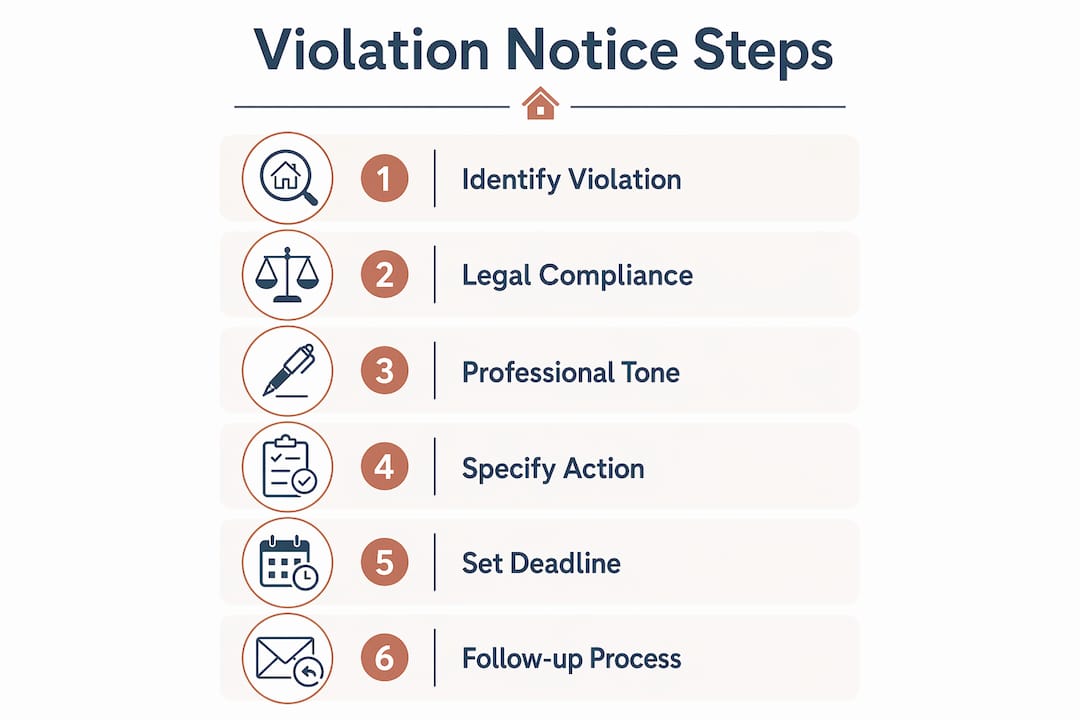
An effective HOA violation notice must clearly identify the homeowner and property, cite the exact governing rule or CC&R section violated, describe the conduct observed, specify the corrective action required, state a firm cure deadline, and explain procedural next steps including hearing rights. Each of these elements serves a legal purpose. Miss one, and the notice may be unenforceable.
The core required elements are:
- Homeowner name and property address. The notice must be tied to a specific person and location, not a generic household.
- Exact rule citation. Reference the CC&R section, bylaw number, or community rule by its precise identifier. "You violated the parking rules" is not sufficient. "You violated CC&R Section 4.3(b), which prohibits vehicles parked on front lawns" is.
- Description of the observed violation. State what was seen, when it was observed, and where. Dates and specifics matter.
- Required corrective action. Tell the homeowner exactly what they must do to cure the violation. Vague instructions like "please address this issue" create disputes.
- Cure deadline. Common cure windows are typically 10 to 30 days but must align with state statutes and governing documents. Tie the deadline to a specific calendar date, not a relative phrase like "within two weeks."
- Hearing rights and next steps. The notice must include the homeowner's right to request a hearing before fines or disciplinary actions are imposed.
Pro Tip: *Use a violation notice checklist before sending every letter. Boards that skip this step routinely omit the CC&R citation or the hearing rights language, which are the two most common procedural defects.*
The table below shows the minimum required elements and their legal purpose:
| Notice Element | Legal Purpose |
|---|---|
| Homeowner name and address | Establishes identity and property record |
| Exact CC&R or rule citation | Grounds the violation in governing documents |
| Violation description with date | Creates factual record for enforcement |
| Corrective action instructions | Defines compliance standard |
| Specific cure deadline | Prevents ambiguity in enforcement timeline |
| Hearing rights statement | Satisfies due process requirements |
How should you phrase and structure a violation notice for resident cooperation?
Tone is not a soft consideration. Using a professional and neutral tone in violation notices reduces homeowner hostility and increases the likelihood of compliance. Accusatory language puts residents on the defensive. Neutral, factual language keeps the focus on the rule and the fix.

The structure of a clear violation notification follows a logical sequence. Start with a subject line that names the property and the type of violation. A subject line like "Official Notice of CC&R Violation at 123 Maple Street" signals seriousness and aids record keeping. Follow with a brief statement of the violation, the exact rule cited, the required corrective action, the cure deadline, and the consequences of noncompliance.
Here is the difference between poor and effective phrasing:
- Poor: "You have been repeatedly ignoring community rules and your yard is a mess."
- Effective: "On june 14, 2026, the board observed that the lawn at 123 Maple Street had not been mowed and exceeded the 6-inch height limit specified in CC&R Section 5.2(a). Please mow the lawn to the required height by june 28, 2026."
The effective version names the date, the specific condition, the rule, the required action, and the deadline. It contains no judgment about the homeowner's character or intent. For a full writing example, the HOA violation letter guide at Hoaletterai walks through a calm, rule-cited sample notice step by step.
Pro Tip: *Avoid second-person accusations like "you failed to" or "you ignored." Replace them with passive or rule-centered constructions: "The lawn at [address] was observed to exceed the height limit specified in Section 5.2(a)." The violation is the subject, not the homeowner.*
What are effective timelines and follow-up processes for issuing violation notices?
Cure deadlines are part of the legal record. Vague compliance deadlines risk ambiguity and weaken enforceability. Courts and hearing panels treat a deadline as part of the enforcement narrative. A deadline that says "as soon as possible" gives the homeowner grounds to argue the timeline was unreasonable or unclear.
A practical follow-up process looks like this:
- Send the first notice with a specific cure deadline, typically 14 to 21 days for most standard violations.
- Inspect the property on or after the cure deadline to confirm whether the violation was corrected.
- Send a second notice if the violation persists. The second notice should reference the first notice by date and state that the cure period has expired.
- Issue a hearing notice at least 10 days before any scheduled disciplinary hearing, as required under California Civil Code §5855. Florida requires at least 14 days' written notice before a hearing and approval from an independent committee before imposing fines.
- Document every step. Documenting all violation notices, cure deadlines, hearing notices, and board decisions is the standard that preserves enforceability and defends against homeowner challenges.
Pro Tip: *When a homeowner contacts the board with a cure plan that requires more time, document the commitment in writing. California's cure-before-hearing doctrine requires boards to document written financial commitments or cure plans when the fix requires extended time. This protects the board if the matter escalates.*
The follow-up process is not bureaucratic overhead. It is the chain of evidence that makes enforcement stick.
How do legal considerations and state-specific rules affect violation notice writing?
State law sets the floor for HOA enforcement procedures. Boards that ignore jurisdictional requirements do not just risk losing a fine. They risk having the entire enforcement action voided. The two most commonly cited state frameworks are California Civil Code §5855 and Florida Statutes §720.305(2)(b).
The table below compares key requirements across these two states:
| Requirement | California | Florida |
|---|---|---|
| Minimum hearing notice period | 10 days before hearing | 14 days before hearing |
| Independent committee required | No | Yes, before imposing fines |
| Cure opportunity before discipline | Required | Required |
| Written board finding for health/safety fines | Required | Not explicitly mandated |
| Fine void if process skipped | Yes | Yes |
Due process in HOA enforcement has four steps: written notice, a reasonable cure opportunity, a hearing, and the right to appeal. Homeowners must receive a meaningful chance to cure violations before discipline is imposed. Skipping the cure step is the most common procedural defect boards face.
Health and safety violations carry an additional requirement in California. For fines that exceed standard caps, HOA boards must provide a written finding that clearly specifies the actual health or safety impact and its causal connection to the violation. A general statement like "poses a safety risk" does not meet this standard. The finding must name the specific hazard and explain why the violation creates it.
The board's hearing process must be meaningful, allowing homeowners to present evidence and challenge the alleged violation. A hearing that is purely ceremonial, with no real opportunity to contest the facts, weakens enforcement validity and exposes the board to legal challenge.
For boards operating in multiple states or managing properties in jurisdictions with complex rules, the HOA violation letter laws by state resource at Hoaletterai provides a state-by-state breakdown of notice requirements and fine rules. California-specific boards can also reference the California HOA compliance guide for detailed notice requirements under Civil Code §5855.
Key Takeaways
Writing effective violation notices requires combining precise legal elements, neutral professional tone, specific cure deadlines, and state-compliant procedures to produce enforceable and dispute-resistant communications.
| Point | Details |
|---|---|
| Include all required elements | Every notice needs homeowner ID, exact rule citation, violation description, corrective action, deadline, and hearing rights. |
| Use neutral, factual language | Accusatory tone increases disputes; rule-centered phrasing keeps the focus on compliance. |
| Set specific cure deadlines | Tie deadlines to calendar dates and corrective actions, not vague timeframes. |
| Follow state-specific procedures | California requires 10-day hearing notice; Florida requires 14 days and an independent committee. |
| Document every step | Records of notices, deadlines, and board decisions are the foundation of enforceable HOA action. |
What I have learned from years of watching HOA enforcement go wrong
Most enforcement failures I have seen do not start with a bad rule. They start with a bad letter. The board had a legitimate violation, a clear governing document, and the authority to act. Then someone sent a notice that said "your property is not in compliance" with no rule citation, no deadline, and no hearing information. The homeowner ignored it. The board escalated. The homeowner hired an attorney. The fine was voided on procedural grounds.
The single most underestimated element in creating violation notices is the cure deadline. Boards treat it as a formality. Courts treat it as a legal commitment. A deadline that is vague, impossible to meet, or inconsistent with state law gives a motivated homeowner everything they need to challenge the entire enforcement action. I have watched boards lose cases they should have won because the deadline said "within a reasonable time" instead of a specific date.
The second lesson is about tone. Boards that write notices in an accusatory voice are not just being impolite. They are creating conflict that costs time and money to resolve. A neutral, rule-centered notice that says "the following condition was observed" rather than "you have been violating the rules" produces faster compliance and fewer disputes. The homeowner does not feel attacked. They feel informed.
My practical advice: treat every violation notice as a legal document that a judge might read. Write it that way from the first draft. Use the HOA rule enforcement checklist at Hoaletterai before you send anything. The few minutes it takes to verify every element will save hours of follow-up and legal exposure.
> *— Blake*
How Hoaletterai helps boards draft compliant violation notices faster
HOA boards spend more time than they should drafting notices from scratch, checking state law, and formatting letters for delivery. Hoaletterai addresses all three problems in one place.

The platform generates state-compliant violation letters with built-in checks for required elements like cure deadlines, CC&R citations, and hearing rights language. Boards can select their state, input the violation details, and receive a formatted letter that reflects local legal requirements. For California boards, the California violation notice templates include Civil Code §5855 language by default. For common issues like noise or trash, Hoaletterai offers ready-to-send templates for a noise complaint notice and a trash violation letter. The platform also supports USPS mailing directly from the interface, removing the need for separate tools.
FAQ
What is an HOA violation notice?
An HOA violation notice is a formal written letter from a homeowners' association board that identifies a specific rule breach, cites the governing document section violated, and demands corrective action within a defined deadline.
How long should a cure period be in a violation notice?
Cure periods typically run 10 to 30 days, but the exact window must align with your state statutes and governing documents. California Civil Code §5855 requires at least 10 days before a disciplinary hearing.
Can an HOA fine a homeowner without sending a proper notice?
No. Both California and Florida law require written notice, a cure opportunity, and a hearing before fines are imposed. A fine issued without this process is void and can be legally challenged.
What makes a violation notice legally unenforceable?
Missing elements such as no CC&R citation, a vague cure deadline, or failure to include hearing rights are the most common defects that make a notice unenforceable or subject to challenge.
How should boards handle health and safety violations differently?
In California, fines for health and safety violations that exceed standard caps require a written board finding that names the specific hazard and explains the causal link to the violation. General statements about safety risk do not satisfy this requirement.
Recommended
- How to Write an HOA Violation Letter (With a Calm, Rule-Cited Example) | HOA Letter AI
- HOA Violation Notice Checklist for Board Members | HOA Letter AI
- HOA Rule Enforcement Checklist for Board Members | HOA Letter AI
- HOA Letter Guides — Violation Notices, State Compliance & Templates | HOA Letter AI
Drafting support for HOA notices
Use the HOA letter drafter to turn this guidance into a resident-ready notice, compare reusable HOA letter templates, or review the property manager workflow for higher-volume enforcement work.