
When an HOA sends a violation letter, the CC&Rs almost always create the underlying owner obligation, while bylaws govern how the board itself operates and rules add operational detail beneath both. Cite the CC&R clause that creates the duty, or the rule provision it authorizes, never the bylaws for a use restriction. Add whatever notice, cure period, and hearing language your state requires, and the letter holds up.
TL;DR:
- Citing the correct governing document is essential; violations usually stem from referencing bylaws for owner obligations that actually reside in the CC&Rs.
- Enforceable rules must trace back to an explicit authority in the CC&Rs or bylaws, or they risk being declared void for lacking proper legal foundation.
- State laws supersede HOA documents, so violations conflicting with statutes cannot be upheld, making accurate citations and procedures critical.
- Failure to follow statutory notice, cure, and hearing requirements can nullify enforcement actions, emphasizing the need for precise language and compliance.
- Using an automated drafting tool helps verify proper citations, incorporate statutory notice language, and reduce errors before mailing violation letters.
HOA Letter AIDraft Clearer HOA Compliance LettersCreate professional notices with guided drafting, state-specific context, community rules, built-in checks, and delivery options.Create a compliance letter
Table of Contents
- Bylaw vs Rule in HOA Letters: What Each Document Actually Covers
- Legal Hierarchy: Why State Law Beats Every Governing Document
- What This Means for Drafting an Enforceable Letter
- Common Drafting Mistakes and a Checklist That Actually Works
- How to Decide Which Document to Cite Before You Send a Letter
- Why Getting the Citation Right Changes the Outcome
- Draft Letters With the Right Citation Built In
- Authoritative Statutes and Guidance Worth Bookmarking
- Sources
- FAQ
Bylaw vs Rule in HOA Letters: What Each Document Actually Covers
Boards mix up these three documents constantly, and it shows up in sloppy letters that cite the wrong source. The declaration, commonly called the CC&Rs (covenants, conditions, and restrictions), is the recorded document that creates binding obligations on every owner: paint colors, parking limits, pet restrictions, rental caps. Bylaws, by contrast, govern the association’s internal machinery, board elections, quorum requirements, officer terms, annual meeting notice. Practitioner guidance from Moretz Law Group makes the point bluntly: bylaws run the association, CC&Rs run the owners. Confuse the two in a letter and you have cited the wrong authority for the violation.
Rules and regulations sit a level below both. A board typically adopts them under authority granted somewhere in the CC&Rs or bylaws, usually a clause reading something like “the board may adopt reasonable rules governing use of common areas.” A pool-hours rule, a trash-can-storage rule, a short-term-rental registration rule, these all need to trace back to an enabling clause. Without one, the rule is just the board’s preference dressed up as policy.
Here is how that plays out in real letter language:
- Citing a CC&R directly: “Article 6, Section 3 of the Declaration prohibits parking commercial vehicles in driveways.”
- Citing a bylaw provision: “Under Article 4 of the Bylaws, the annual meeting notice must be delivered no fewer than 10 days in advance.”
- Citing a board rule tied to its source: “Pool Rule 12, adopted under Article 9 of the Declaration, restricts pool access to posted hours.”
Notice the third example does two jobs at once: it names the rule and points back to the CC&R clause that authorized it. That habit alone prevents most of the citation errors that get letters challenged.
Legal Hierarchy: Why State Law Beats Every Governing Document
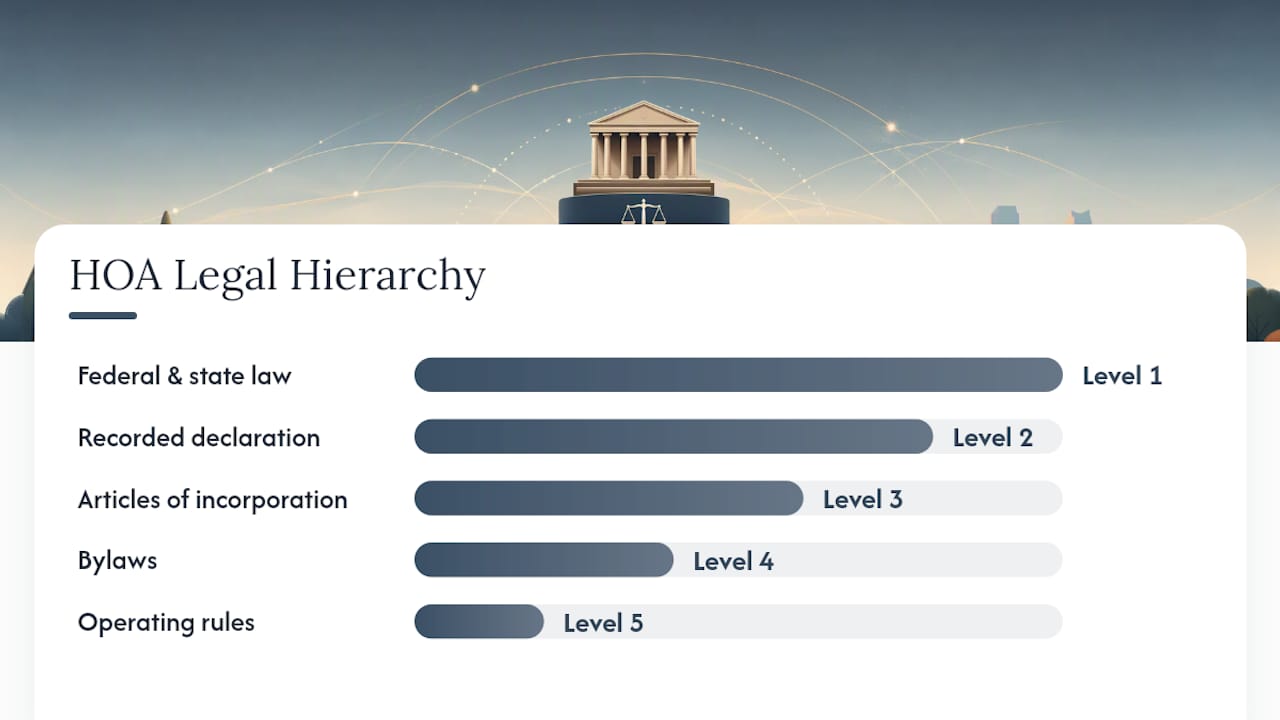
Every governing document sits inside a legal pecking order, and boards who ignore it write letters that collapse under challenge. The order runs: federal and state law first, then the recorded declaration (CC&Rs), then the articles of incorporation, then the bylaws, and finally board-adopted operating rules. A document lower on that list cannot override one above it, according to the hierarchy LegalClarity lays out for HOA governance disputes.
That ordering matters the moment a conflict shows up. A few patterns come up again and again:
- A board rule bans all fences over four feet, but the CC&R permits privacy fences up to six feet. The CC&R controls, and the rule is unenforceable as written.
- A rule restricts window signage entirely, but state law protects certain political or for-sale signage. The statute controls regardless of what the rule says.
- Bylaws set a quorum threshold that conflicts with a state nonprofit corporation statute. The statute wins.
A rule that contradicts its own enabling document is void from the moment it’s adopted, not just unenforceable in a specific dispute. That is a structural problem, not a drafting nuance, and it means a board cannot cure it by simply enforcing the rule more consistently.
This is why boards should check state statutes before leaning on a rule or bylaw in a letter. Florida’s condominium and homeowner association statutes, for instance, cap what associations can do with fines and suspensions and layer in required notice and hearing steps under Florida Statutes Chapter 718. A rule that skips those steps does not just risk a technical objection. It can void the entire enforcement action, fine and all.
What This Means for Drafting an Enforceable Letter
Once you know which document controls, the letter itself becomes a matter of sequencing. First, pin down whether the obligation lives in the CC&R directly, in a board rule authorized by the CC&R or bylaws, or in a bylaw provision about governance rather than owner conduct. Getting this wrong is the single most common reason enforcement letters get challenged, and it is entirely preventable with one extra step before you start drafting.
From there, the letter needs specific procedural elements, and skipping any one of them can undo an otherwise valid violation claim. Texas offers the clearest statutory example of why this matters.
- Describe the violation precisely. Vague language like “landscaping issues” invites a challenge. Name the specific covenant or rule and the specific conduct, with dates.
- Use the required delivery method. Under Texas Property Code Section 209.006, notice must go out by certified mail before many enforcement actions, not a courtesy email or a note on the door.
- State the cure period. Texas law requires a reasonable opportunity to fix a curable violation before fines or suspensions kick in. “Reasonable” isn’t defined by the board’s preference; check the statute and the CC&R for any stated minimum.
- Include hearing rights. Texas gives owners 30 days after the notice is mailed to request a hearing. Leave that language out, and the fine can be thrown out even if the underlying violation was real.
- Set a clear deadline. Every date in the letter, cure deadline, hearing request deadline, needs to be unambiguous and calculated correctly from the mailing date, not the drafting date.
Skip any of these and the consequences are concrete, not theoretical. A fine issued without the required notice can be voided outright. A suspension of amenity access can be blocked entirely if the hearing-request window wasn’t disclosed. A lien built on top of unenforceable fines can collapse the whole collection effort months later, often after the association has already spent money on collections counsel.
Pro Tip: Build your letter templates around the state’s statutory checklist first, then layer in the specific CC&R or rule citation. It’s much easier to catch a missing hearing-rights clause before you send fifty letters than after an owner’s attorney flags it.
Common Drafting Mistakes and a Checklist That Actually Works
The same handful of errors show up across most HOA violation disputes. Boards cite the bylaws for what is really a CC&R obligation. They describe a violation in vague terms instead of naming dates and specific conduct. They forget to state a cure period, or they state one that doesn’t match the state minimum. They cite a rule without connecting it to the CC&R or bylaw clause that authorized it in the first place, leaving the letter’s whole legal foundation exposed.
A clean process avoids nearly all of it. Run every letter through this sequence before it goes out:
- Identify the controlling authority (CC&R clause, authorized rule, or bylaw governance provision).
- Quote the specific clause or rule number, word for word.
- Describe the violation with dates, locations, and observed conduct, not generalities.
- State the cure period and the exact deadline date.
- Explain how the owner can request a hearing, including the deadline to do so.
- Document how and when the letter was delivered, since delivery proof matters as much as content if the dispute escalates.
Pro Tip: When your state’s statutory timeline and your governing documents disagree, the statute wins in nearly every case. If you’re not sure which controls, that’s the moment to loop in association counsel rather than guess.
How to Decide Which Document to Cite Before You Send a Letter
A short decision process beats guesswork every time, and it takes about five minutes once you know where to look.
- Search the CC&Rs first. Most owner-conduct issues, parking, exterior modifications, rentals, nuisance, trace back to a covenant. If you find a matching clause, that’s your citation.
- Check board rules if the CC&R is silent. Look for the rule itself and its authorizing clause in the CC&Rs or bylaws. No authorizing clause means no enforceable rule, regardless of how long it’s been on the books.
- Confirm there’s no conflict with federal or state law. Fair housing protections, political sign laws, and local ordinances can preempt an HOA rule even when the rule is otherwise properly authorized, a point HUD’s fair housing guidance spells out for housing providers generally.
Consult association counsel when the authority is genuinely ambiguous, when the remedy involves a lien or a suspension of voting rights, or when a rule might conflict with a state statute. Those are the three situations where a wrong guess costs real money.
Why Getting the Citation Right Changes the Outcome
One board handling a parking dispute nearly issued a letter citing the bylaws for a driveway restriction that actually lived in the CC&Rs. Catching that before mailing turned a shaky letter into a solid one, and the owner complied without appeal. That’s the pattern: precise citation and procedure do not just protect the board legally, they cut down on appeals, reduce legal fees, and get more homeowners to comply without a fight. Tools like HOA Letter AI’s drafting guidance exist largely to make that correct citation step faster and harder to skip.
— Blake
Draft Letters With the Right Citation Built In
Getting the CC&R clause, the rule reference, and the state’s notice language all correct by hand takes real time, and one missed cure period can unravel an entire enforcement action. HOA Letter AI is built specifically for that gap: guided drafting that pulls in state-aware notice requirements, prompts you to cite the actual authorizing clause, and gives you a one-page preview before anything goes out.
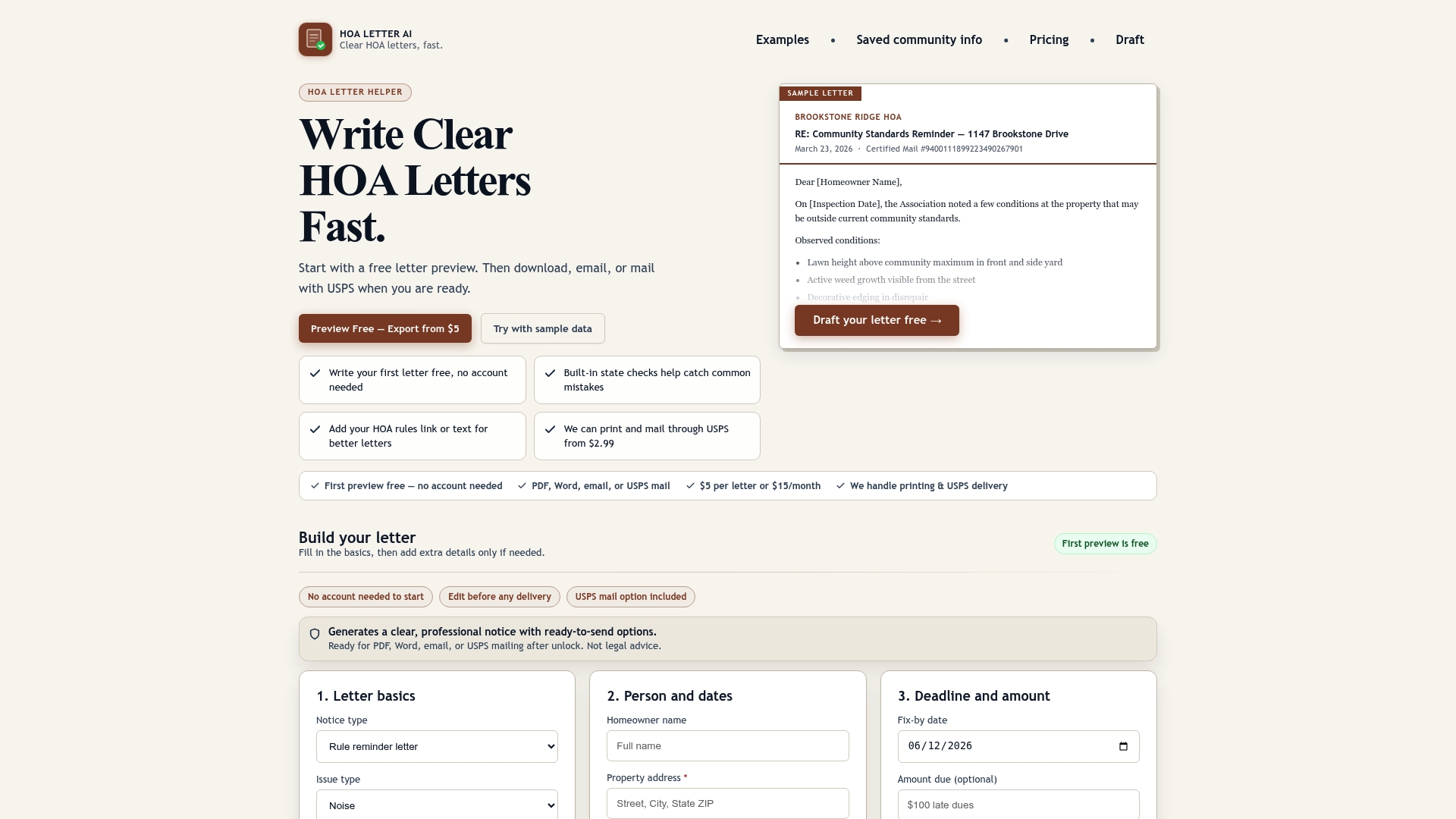
Boards handling a one-off violation can generate a single letter for $5, no subscription needed. Property management teams running letters across multiple communities get more consistent language with the PM Starter plan, which adds reusable community profiles so the same clause citations don’t have to be rebuilt every time. Need the letter physically mailed with delivery proof? Optional USPS mail fulfillment starts at $2.99 per letter, which matters in states like Texas where certified mail isn’t optional. Start with a free letter preview and see the citation and notice language before you commit to anything.
Authoritative Statutes and Guidance Worth Bookmarking
Verify your own state’s rules before relying on any general guide, since notice timelines and hearing rights vary by jurisdiction.
- Texas Property Code Section 209.006 on certified mail notice and hearing rights
- Florida Statutes Chapter 718 on fines, suspensions, and hearing procedures
- HOA governing documents hierarchy explainer from LegalClarity
- State-by-state HOA violation letter laws for notice requirements and fine rules
Sources
- Texas Property Code Section 209.006 (Justia)
- Florida Statutes Chapter 718 (The Florida Senate)
- HOA governing documents: CC&Rs, bylaws, and rules hierarchy (LegalClarity)
- Your Homeowners Association’s Governing Documents: Please Don’t Call Them Bylaws! (Moretz Law Group)
FAQ
Are HOA Rules Called Bylaws?
No. Bylaws govern how the association operates internally, board elections, meetings, officer duties, while rules are operational policies the board adopts under authority granted by the CC&Rs or bylaws. Calling a rule a “bylaw” in a letter cites the wrong document and can weaken enforcement.
What Is the Difference Between Bylaws and Rules?
Bylaws set up the association’s governance structure, while rules and regulations handle day-to-day use of common areas and owner conduct, and they must trace back to an authorizing clause in the CC&Rs or bylaws. A rule that lacks that authorization, or that conflicts with the CC&R, is void, according to the standard document hierarchy LegalClarity describes.
Do HOA Bylaws Supersede State Laws?
No. State law sits above every HOA governing document, including bylaws, CC&Rs, and rules. When a bylaw conflicts with a state statute, whether on quorum requirements, notice timelines, or fair housing protections, the statute controls.
What Makes Bylaws Invalid?
Bylaws become invalid when they conflict with state corporate or property statutes, when they were adopted without following the amendment procedure the CC&Rs or existing bylaws require, or when they attempt to impose an owner-use obligation that actually belongs in the CC&Rs. A common drafting error is treating bylaws as if they create binding use restrictions, when that authority almost always sits in the declaration itself.