

The Fair Debt Collection Practices Act (FDCPA) is a federal law that limits how third-party debt collectors pursue consumer debts. It usually does not govern an association collecting its own assessments in its own name. It does govern collection agencies and law firms that regularly collect for associations, and it can reach a management company in some situations. The safest board practice is to write every delinquency letter as if the FDCPA applied: accurate amounts, plain language, no empty threats, and state-specific notices.
TL;DR
- An association collecting its own assessments in its own name is generally a creditor, not a “debt collector,” so the FDCPA generally does not cover it. Unpaid assessments on a residence do count as consumer debts once a covered collector is involved (HOA Weekly).
- Once an account moves to a collection agency or a law firm that regularly collects consumer debts, FDCPA rules attach to that firm’s letters, including a validation notice with a 30-day dispute window.
- Management companies sit in a gray area. Coverage can turn on whether the account was already in default when the company took it on.
- State law adds its own steps, such as Colorado’s certified-mail notice and 18-month repayment plan. Federal compliance never replaces them.
- Whoever writes the letter, the same habits protect you: verify the ledger, cite the authority for every charge, and never threaten what you cannot or will not do.
Table of Contents
- Who the FDCPA covers in an HOA setting
- What a covered collector’s first letter must contain
- Contact limits that shape follow-up letters and calls
- Prohibited statements and tactics
- What changed recently
- State law adds steps the FDCPA never mentions
- A checklist before any delinquency letter goes out
- Where we stand
- Draft your letter with state-aware checks
- FAQ
- Sources
Who the FDCPA covers in an HOA setting
The Act applies only to entities that qualify as “debt collectors.” The Congressional Research Service explains that a creditor collecting on its own behalf and under its own name ordinarily does not qualify. It also explains that “debt” means an obligation incurred primarily for personal, family or household purposes, so business debts generally fall outside the Act.
Assessments on a home meet that definition. Courts have reasoned that dues used to maintain common areas still serve a household purpose, because the owner pays them as a condition of owning a home. So the sorting question is not whether the debt is covered. It is who is collecting.
The association itself
A board or association collecting its own assessments in its own name is a creditor. HOA Weekly’s overview summarizes the general rule: the association sits outside the Act.
There is one trap. A creditor that collects under a different name, in a way that suggests a third party is involved, can itself be treated as a debt collector. In a federal case, Fleming v. Greystar, a court held that a company was a debt collector because its letters came from a division with a name that presented itself as an intermediary. The takeaway for boards is simple: send letters under the association’s own name, and do not invent a “collections department” identity.
Collection agencies and attorneys
Collection agencies that regularly collect assessments for associations are generally covered. So are law firms that regularly collect consumer debts. In Heintz v. Jenkins (1995), the Supreme Court held that the Act applies to lawyers who regularly collect consumer debts even when the collection takes the form of litigation, according to HOA Weekly. The hiring association does not become a debt collector just because its lawyer is one, but the lawyer’s letters must follow the rules.
The same source notes a narrow carve-out. In Obduskey v. McCarthy & Holthus (2019), the Court held that a business doing only nonjudicial foreclosure is a debt collector just for one provision, § 1692f(6), and not for the rest of the Act.
Management companies
This is the gray area. The statute excludes a person collecting a debt that was not in default when that person obtained it. So coverage can depend on whether the account was already delinquent when the management company took it on, per the same HOA Weekly summary. Courts have also looked at a company’s principal purpose: a firm spending most of its effort on delinquent accounts looks more like a collector than one whose main job is running the community.
If your management contract hands delinquent accounts to a manager mid-default, or you are comparing what a manager takes on, review how condo association management contracts are structured and priced and ask counsel how the FDCPA exclusion applies to your arrangement.

What a covered collector’s first letter must contain
If a covered collector writes to an owner, the first communication triggers a validation notice. Under 15 U.S.C. § 1692g, the collector must send written notice within five days of the initial communication stating:
- the amount of the debt;
- the name of the creditor;
- that the debt will be assumed valid unless disputed within 30 days;
- that verification will be mailed if the consumer disputes in writing within 30 days;
- that the original creditor’s name and address will be provided on written request within that window.
If the owner disputes in writing within the 30 days, the collector must stop collecting the disputed portion until it mails verification. Not disputing is not an admission of liability.
The details are more specific under Regulation F, the CFPB’s rule implementing the Act. 12 C.F.R. § 1006.34 requires the notice to include the collector’s name and a mailing address for disputes, the consumer’s name and address, the current creditor, an account number, an itemization date and amount, an itemization of interest, fees, payments and credits since that date, the current amount, the end date of the 30-day period, and dispute prompts such as “This is not my debt” and “The amount is wrong.” Using the CFPB’s Model Form B-1 gives a safe harbor. The CFPB’s consumer guidance confirms the notice may be sent by mail or electronically.
A deadline that cancels the dispute window
The dispute period is not a formality. In Mashiri v. Epsten Grinnell & Howell, a Ninth Circuit case, a letter demanding payment within 35 days and threatening to record a lien was held to plausibly violate § 1692g, because the payment deadline could leave less than 30 days to dispute and the lien threat could overshadow the owner’s rights. The lesson for any association or collector: do not set a payment or lien deadline that crowds out the owner’s validation window.
Contact limits that shape follow-up letters and calls
For covered collectors, the rules on who and when are specific. According to the FDIC’s compliance manual, a collector may generally communicate only with the consumer, the consumer’s attorney, a consumer reporting agency where permitted, the creditor, and the attorneys of the creditor or collector. If the consumer refuses in writing to pay or asks the collector to stop, communication must stop except to say collection is ending or to name specific remedies that may be pursued.
This is why the old practice of posting a list of delinquent owners in a clubhouse is risky. Telling third parties about a debt is exactly what the contact rules restrict.
On timing and frequency, HOA Weekly reports that:
- contact is presumed inconvenient before 8 a.m. or after 9 p.m. local time;
- a collector may not contact a consumer it knows is represented by an attorney;
- under Regulation F (effective November 30, 2021), more than seven calls within seven consecutive days about a particular debt is presumptively too many.
Prohibited statements and tactics
The Act bars harassment, false representations about the amount or legal status of a debt, and threats to take action that cannot legally be taken or is not intended. Two points matter most for HOA letters.
Money must be authorized. The Act does not cap late fees, interest or collection costs. Instead, § 1692f(1) bars collecting any amount not authorized by the agreement creating the debt or permitted by law. For an association, that means the declaration and state law are the authority for every charge, and a misstated payoff figure can violate § 1692e(2)(A), according to HOA Weekly.
Threats must be real. Threatening a lien or foreclosure that cannot legally be pursued, or that nobody intends to pursue, is prohibited. Letterhead matters too. In Powell v. Aldous & Associates, the Third Circuit found that a law firm’s collection letter did not mislead because prominent disclaimers and a statement that no attorney had reviewed the account dispelled any impression of meaningful attorney involvement. Courts read the letter as a whole, from the viewpoint of the least sophisticated consumer.

What changed recently
The core rules have not moved. On May 12, 2025, the CFPB withdrew 67 guidance documents, including three FDCPA advisory opinions on medical debt, time-barred debt and pay-to-pay fees. The NCLC’s 2025 review notes that the withdrawal did not alter the FDCPA or Regulation F. None of those three opinions concerned assessment letters in particular, so the practical rules above are unchanged.
State law adds steps the FDCPA never mentions
Even where the federal Act does not apply, state law governs how an association collects. Colorado is a clear example. Its 2022 law, HB 22-1137, requires an association to:
- contact the delinquent owner first and keep records of that contact;
- send a notice of delinquency by certified mail, return receipt requested, and physically post a copy at the unit, before turning the account to a collection agency or attorney;
- offer a written repayment plan of 18 monthly installments, at least $25 each, before starting a foreclosure action.
California, Florida, Virginia, Pennsylvania and Delaware each have their own notice and fine rules. Our state-by-state HOA letter law pages summarize notice requirements and fine rules, including Colorado, California and Florida. A letter that satisfies federal standards but skips a state-mandated notice can still derail a collection.
A checklist before any delinquency letter goes out
These habits keep a letter defensible whether or not the FDCPA applies.
- Audit the ledger line by line. Confirm owner name, property and mailing addresses, assessment amount, due dates, late charges, interest, payments received and prior correspondence, and document that review before escalating, as SLPM recommends. A wrong amount or address damages credibility faster than anything else.
- Match each charge to its authority. Late fee, interest and costs should each trace to the declaration, bylaws, a board-adopted policy or state statute. Cite the provision in the letter.
- Send under the association’s own name. Avoid any name that implies an outside collector unless you really have engaged one.
- Check state notice steps first. Certified mail, posting, repayment plan offers or internal dispute resolution (California requires an offer of internal dispute resolution before recording a lien) come before escalation.
- Write plainly and without accusation. Delinquency often comes from failed automatic payments, job loss or a family emergency, so a plain-language first letter resolves more accounts than a threatening one.
- Never promise action you will not take. If the board does not intend to foreclose, the letter should not say it will.
- Handing off to a collector? Let the collector issue its own validation notice. The association’s role is to supply an accurate ledger.
For homeowners who receive a letter
Look at the letterhead first: who sent it? FDCPA protections generally apply to third-party collectors, not to the association itself. If a covered collector wrote, check for the elements listed above, especially the itemization and the end date of the 30-day dispute window. Record the date the letter arrived and how it was delivered, keep the envelope, ask for an itemized account history, compare it with your own payment records and your governing documents, and respond in writing, stating which amounts you dispute and attaching proof. If a letter mentions foreclosure, a lien, a lawsuit or an upcoming hearing, speak with a lawyer licensed in your state.
Where we stand
Most of the letters an HOA sends are not debt-collector letters, and that is exactly why they go wrong. Boards assume the federal rules do not apply to them, so nobody checks the basics: is the amount right, is the authority cited, does the notice include the language your state requires.
The FDCPA is a useful yardstick even when it does not bind you. Accurate figures, a stated basis for each charge, no empty threats and a clear way for the owner to respond are what keep a dispute from becoming a claim. They also get accounts paid sooner.
That is how we built HOA Letter AI: guided drafting with state-specific context, community rules and CC&R citations, and built-in checks for mandatory language, with a free one-page preview before anyone pays. Boards and managers get a letter that is consistent every time, in a format they can send or mail directly.
Blake
Draft your letter with state-aware checks
Our $5 letter lets a board draft, review and unlock a single notice at one clear price, and you can preview it for free with no account. Boards that send letters regularly can use the self-serve board lane at $15 per month. Property management teams can look at PM Starter at $199 per month or PM Pro at $399 per month, plus a 30-day pilot at $499 one-off. Optional USPS mailing starts from $2.99 per letter.
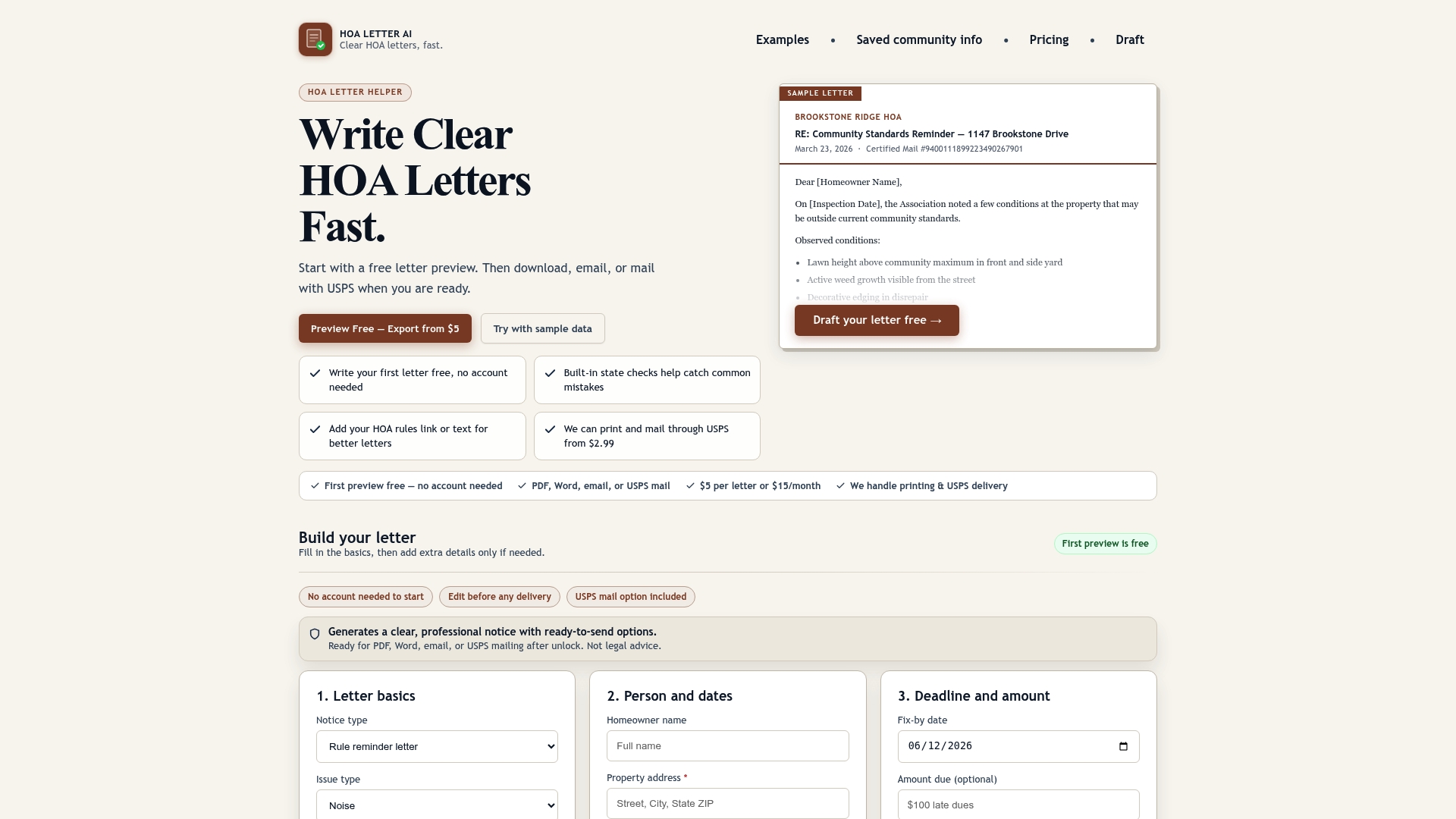
If you are starting with a past-due notice, our HOA collection letter template and past-due assessment letter template show the structure. A friendly dues reminder is a sensible first step before anything formal. Homeowners who received a notice can generate an editable response letter for $5 one-off.
FAQ
Does the FDCPA apply to my HOA board?
Generally no, when the association collects its own assessments in its own name. The Act targets third-party debt collectors. It can reach an association that uses a name suggesting an outside collector, so send letters under the association’s own name.
Does the FDCPA apply to HOA attorneys and collection agencies?
Yes, generally. Under Heintz v. Jenkins, lawyers who regularly collect consumer debts are covered even when collecting through litigation. Their first communication must be followed by a validation notice within five days, giving the owner 30 days to dispute.
What is the 30-day dispute window?
After a covered collector’s validation notice, the owner has 30 days to dispute all or part of the debt. A written dispute within that period stops collection of the disputed amount until the collector mails verification, per the CFPB. The notice states the end date.
Can a late fee or interest be added to an HOA debt?
Only if the declaration or the law authorizes it. The FDCPA sets no cap, but it prohibits collecting any amount that no agreement or law permits. Cite the governing provision in the letter.
Sources
- The FDCPA and HOA Assessment Collection, HOA Weekly
- The Fair Debt Collection Practices Act: Legal Framework, Congressional Research Service
- Fleming v. Greystar, order on summary judgment
- 15 U.S.C. § 1692g: Validation of debts
- 12 CFR 1006.34, Notice for validation of debts
- CFPB: What information does a debt collector have to give me about the debt
- CFPB: What can I do if a debt collector contacts me about a debt
- FDIC: Fair Debt Collection Practices Act compliance manual
- Powell v. Aldous & Associates, Third Circuit
- NCLC: Fair Debt Collection Practices Act, 2025 in Review
- Colorado HB 22-1137, C.R.S. 38-33.3-209.5
- Delinquent Assessment Recovery Without Destroying Community Trust, SLPM
- Condo Association Management in Detroit: Costs and Contracts
Recommended
- Florida HOA Violation Letters — Notice Requirements, Fine Rules & Templates
- Pennsylvania HOA Violation Letters — Notice Requirements, Fine Rules & Templates
- California HOA Violation Letters — Notice Requirements, Fine Rules & Templates
- Texas HOA Violation Letters — Notice Requirements, Fine Rules & Templates