
Formal notice formatting standards define the specific structural and content rules that make a written notice legally sound, professionally credible, and enforceable. For HOA board members, property managers, and homeowners, getting these standards right is not optional. A notice that lacks required elements or uses the wrong delivery method can be dismissed entirely, leaving you without legal standing. This guide covers every mandatory component, the correct block format structure, the most common drafting mistakes, and the delivery practices that hold up when disputes escalate.
What are the mandatory elements a formal notice must include?
Every formal notice must contain a defined set of components to be considered valid and effective. LegalClarity identifies six core elements that together establish the notice's legal foundation. Missing even one of these can give the recipient grounds to challenge the notice's enforceability.
Here is what every formal notice must include:
- Sender and recipient identification. Full legal names and mailing addresses for both parties. This establishes who is issuing the notice and who is responsible for responding.
- Subject line beginning with "Re:". This signals the notice's purpose immediately and is a recognized convention in legal correspondence. Example: *Re: Violation of Section 4.2 of the CC&Rs, Parking Restriction.*
- Chronological factual background. A brief, date-anchored account of the relevant events. Specific and correct use of dates anchors the record and strengthens legal enforceability. Notices that omit clear dates for agreements, breaches, and deadlines are far easier to dispute.
- Legal or contractual basis. Cite the specific bylaw, CC&R section, lease clause, or statute that the recipient has violated. Vague references to "community rules" are insufficient.
- Precise demand for action. State exactly what you are requiring the recipient to do. "Remove the unauthorized structure at 14 Maple Lane" is enforceable. "Please address the issue" is not.
- Reasonable compliance deadline. Standard response deadlines for formal notices range from 15 to 30 days. Deadlines shorter than three business days can appear as harassment and undermine your credibility.
- Statement of consequences. Clearly state what action you will take if the recipient does not comply. This might be fines, legal action, or referral to an attorney. Leaving this out removes the notice's teeth.
An HOA violation notice checklist can help board members confirm that all seven elements are present before a notice goes out.
How should a formal notice be formatted for professional readability?

Formatting is not cosmetic. A notice that is hard to read or visually disorganized signals unprofessionalism and can obscure the demands you are making. The standard for formal legal correspondence is block format, and it applies directly to HOA compliance letters and property management notices.
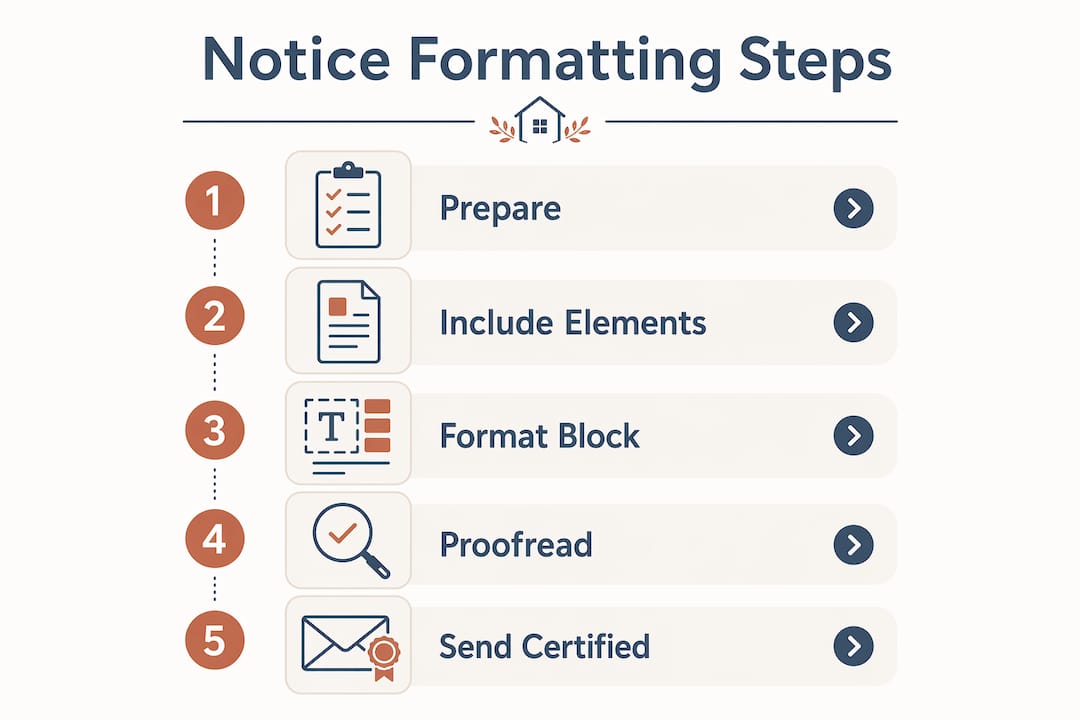
Follow these steps to format a formal notice correctly:
- Place sender information at the top left. Include the HOA name or property management company, full mailing address, phone number, and email. This block sits above the date.
- Add the date on its own line. Write it in full: *March 15, 2026.* Never abbreviate. The date is a legal anchor.
- Add recipient information below the date. Full name, unit or property address, city, state, and ZIP code. Left-aligned, no indentation.
- Write the subject line. Start with "Re:" followed by a specific description of the issue. Keep it to one line.
- Open with a direct statement of intent. The first sentence of the body should state the purpose without preamble. "This letter serves as formal notice that your property at 22 Oak Drive is in violation of Section 6.1 of the community's CC&Rs."
- Divide the body into logical paragraphs. Paragraph one states the violation and its factual background. Paragraph two states the demand and deadline. Paragraph three states the consequences. Each paragraph covers one idea.
- Close formally. Use "Sincerely" or "Respectfully," followed by a handwritten signature above the printed name and title.
- List enclosures and copies. If you are attaching photos, prior notices, or governing documents, note them at the bottom. Add "cc:" for any parties receiving copies.
Formal letters should use block format with all elements left-aligned and paragraphs separated by blank lines. The ideal length is 150 to 300 words. That constraint forces clarity and prevents the notice from becoming a grievance dump.
Pro Tip: *Review your HOA's warning letter template before drafting from scratch. A pre-formatted template eliminates layout errors and keeps your tone consistent across all notices.*
What are common mistakes and pitfalls to avoid when drafting formal notices?
Even experienced board members and property managers make drafting errors that weaken their notices. These are the mistakes that appear most often and carry the highest cost:
- Setting deadlines that are too short. A three-day deadline on a non-emergency issue reads as intimidation, not administration. Courts and arbitrators notice this.
- Including unrelated past grievances. Including every past grievance in a single notice dilutes focus and weakens the chances of resolution or enforcement. Address the current breach only.
- Using emotional or accusatory language. Emotional or personal language damages sender credibility because notices may be read aloud in court. Phrases like "you have repeatedly disrespected this community" have no place in a formal notice.
- Omitting proof of receipt. Sending a notice without a delivery method that generates a receipt leaves you unable to prove the recipient was notified.
- Ignoring governing documents. Your HOA bylaws or CC&Rs may specify exactly how notices must be delivered and how much advance notice is required. Skipping this step can invalidate an otherwise perfect notice.
- Burying the demand. Some notices run three paragraphs of background before stating what the recipient must actually do. The demand should appear no later than the second paragraph.
- Relying solely on email. Email is convenient but legally fragile. Without a read receipt or delivery confirmation, the recipient can simply claim they never saw it.
Pro Tip: *Before sending any notice, read it aloud as if you are the recipient hearing it for the first time. If it sounds angry or confusing, revise it. The goal is compliance, not confrontation.*
What practical steps ensure proper delivery and legal compliance of formal notices?
Drafting a correct notice is only half the job. Delivery determines whether the notice is legally effective. These steps protect your position:
- Check your governing documents first. HOA bylaws and contracts often specify required delivery methods. Consulting governing documents before issuing notices is critical because ignoring contractual delivery requirements can invalidate a notice even if the recipient actually received it.
- Use certified mail as your primary delivery method. Certified mail with delivery confirmation is legally preferred over email because it generates a receipt that proves delivery and overcomes disputes. Keep the green card or tracking confirmation in your records.
- Supplement with email, not replace. Email alone is often insufficient for formal legal notices. Send a hard copy by certified mail and follow up with an email copy for convenience, not as a substitute.
- Understand the mailbox rule. Under this legal principle, a notice is presumed received once it is properly mailed, even if the recipient refuses to sign or claims they never got it. Refusal does not void the notice.
- Track notice deadlines separately from legal filing deadlines. Notice periods generally last 10 to 30 days but do not pause the overall deadline for filing lawsuits or claims. Missing a statute of limitations while waiting for a notice period to expire is a costly and avoidable error.
- Have someone review the notice before it goes out. A second set of eyes catches tone problems, missing elements, and factual errors that the drafter often misses.
| Delivery method | Legal strength |
|---|---|
| Certified mail with return receipt | Highest. Generates proof of delivery accepted in court. |
| Courier with tracking confirmation | High. Provides timestamp and delivery record. |
| Personal service | High. Requires witness or process server documentation. |
| Email with read receipt | Moderate. Acceptable as a supplement, not a standalone. |
| Standard first-class mail | Low. No proof of delivery; easy to dispute. |
Key takeaways
Formal notice formatting standards require seven mandatory elements, block format structure, and certified mail delivery to be legally enforceable and professionally credible.
| Point | Details |
|---|---|
| Seven mandatory elements | Every notice needs sender/recipient info, a "Re:" subject line, dated facts, legal basis, a precise demand, a deadline, and consequences. |
| Block format is the standard | All text left-aligned, paragraphs separated by blank lines, and 150 to 300 words keeps notices clear and professional. |
| Deadlines of 15 to 30 days | Shorter deadlines undermine credibility; longer ones may delay necessary legal action. |
| Certified mail over email | Email alone cannot prove delivery. Certified mail with return receipt is the legally preferred method. |
| Track deadlines separately | Notice response periods do not pause statutes of limitations. Manage both timelines independently. |
Why I stopped treating notice formatting as an afterthought
After reviewing hundreds of HOA compliance letters, the pattern is consistent: the notices that fail are not the ones with the wrong facts. They are the ones with the right facts buried under poor structure, emotional language, or the wrong delivery method. A board member who sends a notice by email because it is faster, without checking whether the bylaws require certified mail, has done all the work and none of the protection.
The most underrated part of formal notice guidelines is tone. Boards often write notices when they are frustrated, and that frustration leaks into the language. A notice that calls a homeowner's behavior "unacceptable" or "disrespectful" shifts the document from a legal instrument to a complaint letter. That shift matters in mediation and in court. I have seen notices thrown out not because the violation was unclear, but because the language gave the recipient's attorney something to work with.
The other thing I would push back on is the idea that templates are a shortcut. A well-designed template is actually the most disciplined approach to notice writing because it forces you to fill in specific fields rather than write freely and miss something. The best practice is a template combined with a final review against your governing documents before every send. That combination catches the errors that cost boards the most.
How Hoaletterai simplifies compliant notice writing
Writing a formal notice that meets every formatting standard takes time, and one missed element can void the whole effort. Hoaletterai removes that risk for HOA boards, property managers, and homeowners.

The HOA violation letter generator produces state-compliant violation, fine, and response letters in minutes. Every letter follows the block format structure, includes all mandatory elements, and incorporates state-specific language automatically. You get a one-page preview before sending, with the option to mail directly through USPS. No separate tools, no formatting guesswork. For boards managing multiple properties or high notice volumes, Hoaletterai also offers a state-compliant fine notice template built around the exact standards covered in this guide.
FAQ
What is the standard format for a formal notice?
A formal notice uses block format with all text left-aligned, paragraphs separated by blank lines, and a total length of 150 to 300 words. It must include sender and recipient details, a "Re:" subject line, a dated factual background, a legal basis, a specific demand, a compliance deadline, and a statement of consequences.
How long should a compliance deadline be in a formal notice?
Standard response deadlines range from 15 to 30 days. Deadlines shorter than three business days can appear as harassment and may undermine the notice's credibility in a legal setting.
Can I send a formal notice by email?
Email alone is generally insufficient for formal legal notices because it cannot reliably prove delivery. Certified mail with return receipt is the legally preferred method, and email should only supplement a hard copy, not replace it.
What happens if a recipient refuses to accept a certified mail notice?
Under the mailbox rule, a notice is legally presumed received once it is properly mailed to the correct address. Refusal to sign or accept delivery does not void the notice.
What is the most common mistake in HOA formal notices?
The most common mistake is including unrelated past grievances, which dilutes the notice's focus and weakens enforceability. Each notice should address only the current breach, with a clear demand and a specific deadline.
*— Blake*
Recommended
- HOA Fine Notice Template — State-Compliant Fine Letter for HOA Boards | HOA Letter AI
- HOA Collection Letters: A Respectful, Step-by-Step Reminder Sequence | HOA Letter AI
- How to Write an HOA Violation Letter (With a Calm, Rule-Cited Example) | HOA Letter AI
- HOA Letter AI — HOA Violation Letter Generator (State-Compliant)