
Under Georgia law, HOA boards must send an initial written notice by Certified Mail or statutory overnight delivery before they may collect or be awarded attorney’s fees tied to fines or delinquent assessments. That requirement comes from SB 406 Section 7, effective July 1, 2026, and it applies specifically to that fee notice, not to every letter an association sends. GA Code § 9-10-12 treats Certified Mail as legally equivalent to registered mail for this purpose.
TL;DR:
- Sending a compliant notice requires itemized attorney’s fees, the correct mailing method, and proof of mailing, with timing starting from receipt, not mailing.
- Certified Mail and statutory overnight delivery are both valid, but only signed delivery confirmation or tracking verified by a signed receipt meet legal standards in practice.
- Mail attempts that are refused or unclaimed are still potentially valid notices if documented properly, but the association must retain detailed delivery records.
- Boards should update templates to include SB 406-specific language, verify addresses, and log proof-of-mailing to ensure enforceability of fee claims.
- HOA Letter AI simplifies compliance by providing Georgia-specific templates, integrated USPS tracking, and structured fee entry to prevent common mistakes.
Table of Contents
- What Does Georgia’s SB 406 Require for HOA Notices?
- Certified Mail vs. Statutory Overnight Delivery: Which One Actually Qualifies?
- How Should Your Board Send and Track a Certified Mail Notice?
- What Happens When Mail Is Refused, Unclaimed, or Undelivered?
- Updating Your Governing Documents and Templates for SB 406
- How HOA Letter AI Supports SB 406 Compliance
- Why Most Boards Are Overcomplicating This
- Get Your Georgia Notices SB 406 Ready Before You Mail Them
- Sources
What Does Georgia’s SB 406 Require for HOA Notices?
Section 7 of SB 406 sets a narrow but firm bar. Before an HOA can pursue or be awarded attorney’s fees connected to fines or delinquent assessments, it must first send the owner a written notice that does three specific things.
- Identifies the outstanding fines or delinquent fees by amount and description.
- Includes an itemized list of the reasonable attorney’s fees being claimed, not a lump figure.
- Gives the owner 30 days from receipt of the notice to cure the delinquency before fees escalate.
Skipping the itemization is the mistake attorneys flag most often. A vague “attorney’s fees: $850” line does not satisfy the statute; the notice needs a breakdown a homeowner could actually evaluate. That detail matters because a court reviewing a fee award later can toss the claim if the itemization was missing at the notice stage.
Timing matters just as much as content. Section 7 takes effect for actions filed on or after July 1, 2026, while other provisions of the broader Georgia Property Owners’ Bill of Rights Act phase in on January 1, 2027. An association filing a collection action in August 2026 without having sent the required notice risks losing its fee claim entirely, even if the underlying debt is legitimate.
There’s a narrow emergency exception. When a genuine public-safety or property-preservation issue demands immediate action, the pre-notice requirement can bend, though boards should treat this as a last resort, not a shortcut, and document the emergency basis clearly.
Certified Mail vs. Statutory Overnight Delivery: Which One Actually Qualifies?
Georgia law gives boards two legally valid ways to send this notice, and they are not interchangeable in practice even though the statute treats them as equivalent on paper.
GA Code § 9-10-12 makes Certified Mail an acceptable substitute anywhere state law calls for registered mail. It also defines statutory overnight delivery, but that option comes with conditions that trip up a lot of boards: the carrier’s service must guarantee next-business-day delivery, the carrier must be an eligible commercial service, and the sender must receive a signed receipt from the recipient.
Standard first-class mail can run significantly slower than tracked options during high-volume periods, which is exactly why the statute leans on trackable methods for anything tied to legal deadlines.
Here’s where the two methods diverge in real life:
- USPS Certified Mail generates an acceptance receipt at drop-off, a full tracking history, and optional return receipt service (physical green card or electronic).
- Commercial overnight carriers only satisfy the statute if you select the correct next-day service level and the recipient actually signs for the package.
- A tracking number alone, without a signed receipt, does not meet the statutory overnight delivery standard.
The most common pitfall isn’t picking the wrong method. It’s assuming an overnight shipment counts automatically, then discovering months later that no one captured a signed delivery confirmation. A second pitfall is computing the 30-day cure window from the wrong date, mailing date instead of receipt date, which can shift a deadline by a week or more and undermine the whole notice.
How Should Your Board Send and Track a Certified Mail Notice?
Turning the statute into a repeatable process protects the association if a notice ever gets challenged. Here’s the workflow that holds up.
- Confirm the notice actually falls under SB 406. Verify the debt involves fines or delinquent assessments and that attorney’s fees are part of the claim; not every collection letter needs this treatment.
- Verify the mailing address on association books. Cross-check the owner’s address against deed records or the most recent written correspondence on file, since an outdated address undermines the entire notice.
- Use counsel-reviewed notice language. Build the notice around a template that already includes the required itemized attorney-fee field so nothing gets left out under deadline pressure.
- Choose Certified Mail or a qualifying statutory overnight service. Confirm the carrier and service level actually meet the next-business-day and signed-receipt requirements under GA Code § 9-10-12 before you commit.
- Obtain the acceptance receipt and tracking number at mailing. This is your proof the notice left the post office on a specific date.
- Add return receipt service if your process supports it. A physical green card or Electronic Proof of Acceptance documents both the mailing and the delivery event.
- Log everything in a mailing register. Track dates, tracking numbers, addresses, and the specific violation or delinquency the notice covers.
- Compute the 30-day cure period from the delivery date, not the mailing date, using the receipt evidence you collected.
Pro Tip: Mail the notice a few days earlier than you think you need to. Certified Mail sometimes takes two or three delivery attempts before an owner signs, and building in that buffer keeps your 30-day clock from starting later than expected.
Save every piece of evidence together, the acceptance receipt, tracking history, return receipt, and ledger entry, in one file per notice. Boards that scatter this paperwork across email inboxes and filing cabinets are the ones who struggle when a homeowner disputes receipt months later.
What Happens When Mail Is Refused, Unclaimed, or Undelivered?
Refusal doesn’t automatically kill an association’s enforcement rights, but it does change what you need to prove. Under USPS delivery rules, refused or unclaimed Certified Mail is typically marked undeliverable and returned to the sender, yet Georgia courts often still treat a documented refusal as satisfying the statutory notice requirement, since the law generally shouldn’t reward an owner for dodging delivery.
What you keep matters more than what happened at the door.
- Retain the carrier’s event log showing delivery attempts and the final disposition.
- Keep the physical PS Form or its printed record showing the refusal or “unclaimed” endorsement.
- Save the Electronic Proof of Acceptance from the original mailing.
- Note the date of each delivery attempt in your mailing register, not just the final outcome.
If your governing documents require an alternate delivery method when Certified Mail bounces back, follow that process next, whether that’s a second attempt, a posted notice, or personal delivery. When the delivery record is ambiguous, a signature that’s illegible, a return with no clear refusal code, loop in counsel before filing any enforcement action. A shaky proof-of-notice record is one of the easiest things for opposing counsel to attack.
Updating Your Governing Documents and Templates for SB 406
Compliance isn’t a one-time mailing fix. It’s a process change, and boards that treat it that way now avoid scrambling later.
- Rewrite collection letter templates to include the required initial notice language, the itemized fee list, and the 30-day cure statement as standard fields, not optional add-ons.
- Add an address-verification step to your collections workflow, and assign one person as the mailing-log owner responsible for tracking numbers and receipts.
- Set a document-retention schedule for proof-of-mailing records, ideally matching or exceeding your state’s statute of limitations for debt collection actions.
- Train property management staff and any outside collection vendors on the new notice requirements so nothing falls through when work gets outsourced.
- Require attorney review before any contested collection proceeds to litigation, and build in an escalation rule for cases where delivery evidence is incomplete or disputed.
Boards updating architectural or governance policies around the same time, security camera rules are a common example, should apply the same discipline: put the new requirement in writing, verify who’s responsible for enforcing it, and keep a record trail. Community associations facing this kind of overlapping rule update can find useful process comparisons in guidance on HOA security camera rules.
How HOA Letter AI Supports SB 406 Compliance
Most compliance failures under SB 406 come down to the same three mistakes: a missing itemized fee list, the wrong delivery method, or incomplete proof of mailing. HOA Letter AI is built to catch all three before a notice goes out the door.
A notice missing its itemized attorney-fee breakdown isn’t just incomplete. Under SB 406, it can undermine the association’s ability to recover those fees at all.
- Georgia-specific notice templates built around SB 406’s required language.
- Structured itemized fee fields so the attorney-fee breakdown is never an afterthought.
- Address-check prompts before a notice is finalized.
- A one-page preview so board members can confirm content before mailing.
- USPS mailing integration to generate the record trail a contested notice needs.
| Compliance Risk | How HOA Letter AI Addresses It |
|---|---|
| Missing itemized attorney fees | Built-in itemized fee field, required before send |
| Wrong delivery method selected | Georgia-specific guidance embedded in the template flow |
| Incomplete mailing records | Integrated USPS mailing with tracking capture |
Boards wanting Georgia-ready templates before their next mailing can start with the Georgia HOA notice templates built for this exact requirement.
Why Most Boards Are Overcomplicating This
The conventional advice floating around HOA forums treats SB 406 like a mailroom problem: “just use Certified Mail and you’re covered.” That’s incomplete, and it’s the kind of half-truth that gets associations into trouble. The delivery method is actually the easier half of this statute. The itemized fee requirement is where notices actually fail, because it forces boards to have their financial documentation squared away before they send anything, not after a homeowner pushes back.
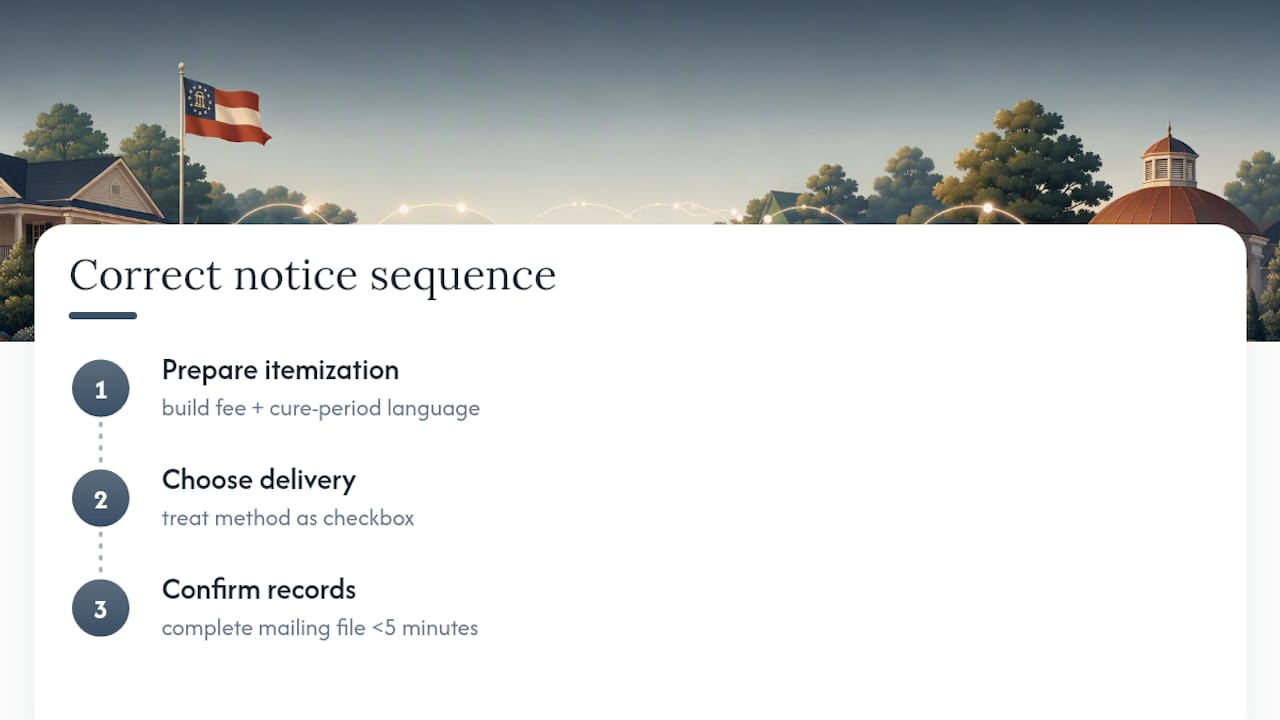
What the research here supports is a shift in sequencing. Boards should build the itemization and cure-period language into their template first, then treat the delivery method as a checkbox, not the other way around. Most guidance does this backward, obsessing over Certified Mail versus overnight carriers while treating the fee breakdown as boilerplate.
The other place conventional advice falls short is recordkeeping. A signed receipt sitting in someone’s email from eight months ago is not a system. If your board can’t produce a complete mailing file in under five minutes when a homeowner disputes a notice, the process needs rebuilding, regardless of which delivery method you chose.
— Blake
Get Your Georgia Notices SB 406 Ready Before You Mail Them
HOA Letter AI is the faster alternative to piecing together compliance language from statute PDFs and law firm blog posts. Instead of building a notice from scratch and hoping the itemized fee section holds up, you start from a Georgia-specific template that already accounts for SB 406’s requirements, then preview the finished letter on a single page before it goes anywhere near a mailbox.
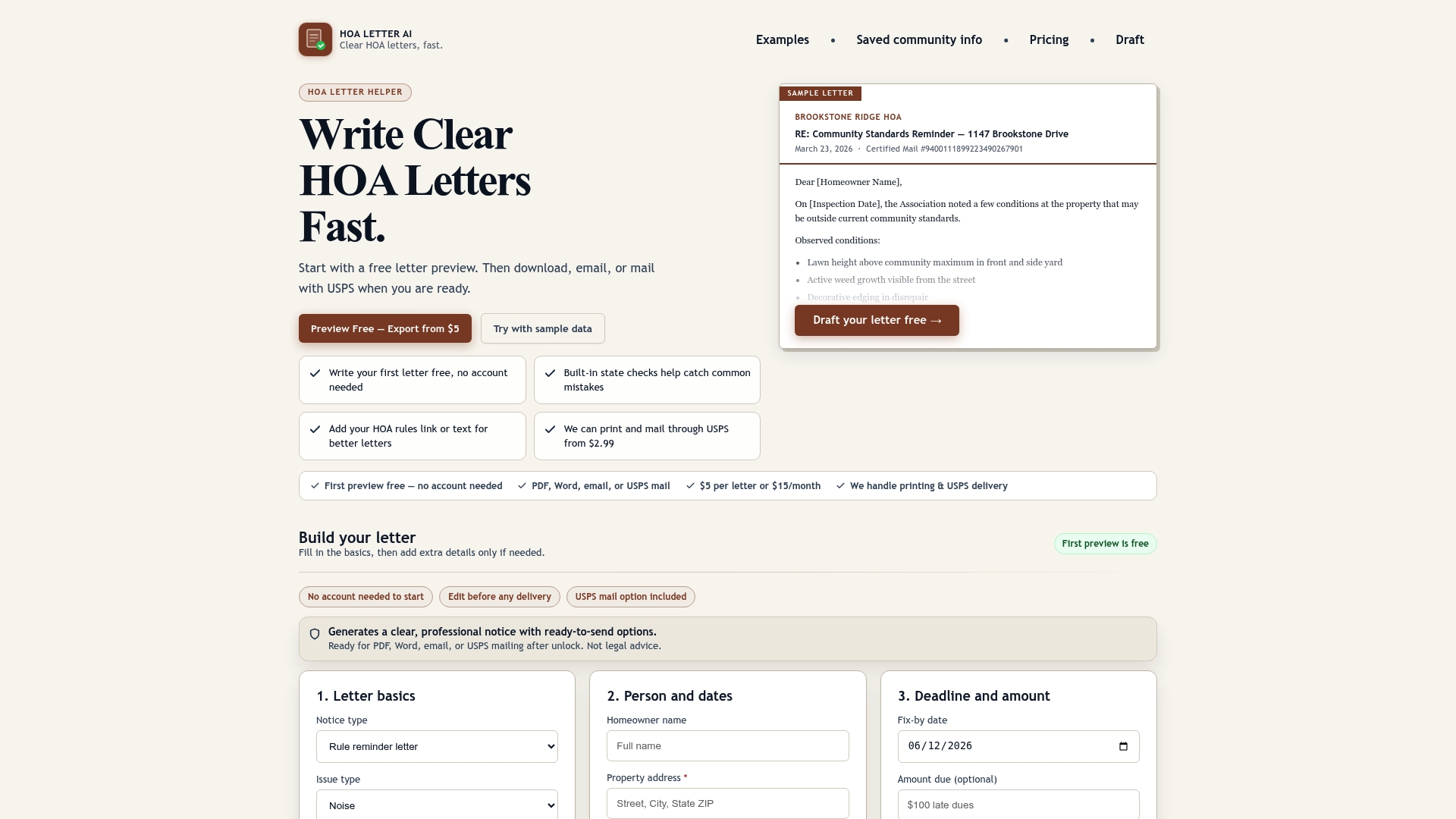
That matters most for boards juggling dozens of delinquency cases at once, where a missing itemization field or an unverified address can quietly sink a fee claim months later. The HOA warning letter template gives boards a courtesy-notice starting point with the itemized fee fields already built in, and property management teams handling higher mailing volume can check the $15/month unlimited letters plan for ongoing access. Start your next notice from a template built for exactly this statute, not a generic form letter.
Sources
- Georgia Code § 9-10-12 - Certified mail equivalent to registered mail; sufficient compliance for notice by statutory overnight delivery
- SB 406: What every community association needs to know about the Georgia Property Owners Bill of Rights Act
- USPS Domestic Mail Manual — Section 611: Delivery, Refusal, and Return