
The HOA letter appeal process is the formal procedure homeowners and board members use to contest compliance letters, violation notices, or fine decisions by submitting a structured written response backed by specific documentation and governing document references. Most homeowners receive a violation letter and assume the board's word is final. It is not. Every state with significant HOA populations, including California, Florida, and Nevada, grants residents the statutory right to contest notices, request hearings, and demand written decisions. This guide walks you through every phase of that process, from reading the original letter to attending a hearing and receiving a final determination.
What documents and prerequisites do you need before filing an HOA appeal?
Preparation determines whether your appeal succeeds or stalls at the first review. Before you write a single sentence of your response, you need to gather the right materials and understand exactly what the HOA's notice is claiming.
Start by reading the original violation or denial letter with a critical eye. Note the specific rule cited, the date of the alleged violation, the reference or case number, and the deadline for your response. These details anchor your entire appeal. Appeals work best when you reference governing provisions directly and submit written hearing requests before deadlines. Missing any of these details in your response signals to the board that you have not engaged seriously with the notice.
Next, pull your governing documents. Every HOA operates under a set of Covenants, Conditions, and Restrictions (CC&Rs), bylaws, and rules and regulations. Locate the exact section the violation letter references. Read the full provision, not just the sentence the HOA quoted, because context often reveals whether the rule was applied correctly or selectively.
Your hoa letter response checklist before filing should include:
- The original violation or denial letter with all reference numbers
- The relevant CC&R or bylaw sections cited in the notice
- Dated photographs showing the condition before, during, and after the alleged violation
- Any prior written correspondence with the HOA about this issue
- Witness statements from neighbors or contractors, if applicable
- Proof of any prior approvals the HOA granted for similar modifications
- The HOA's published fine schedule and appeal deadline policy
Pro Tip: *Request a copy of the HOA's enforcement history for your property in writing before you file. Inconsistent enforcement of the same rule against different homeowners is one of the strongest grounds for overturning a fine.*
How do you write and structure an effective HOA appeal letter?
A well-structured appeal letter mirrors the HOA's own enforcement notice. Strong appeal letters identify the exact reference number from the original notice, state the homeowner's position clearly, cite the governing section numbers, and propose a concrete remedy with a specific date. Vague letters that express frustration without citing rules rarely succeed.
Follow this sequence when drafting your letter:
- Open with identification. State your name, property address, the notice date, and the reference number from the HOA's letter. This tells the board exactly which matter you are addressing.
- State your position. Admit the violation and propose a cure date, deny the violation with factual grounds, or request a formal hearing. You can do more than one of these simultaneously.
- Cite the governing language. Quote the exact CC&R or bylaw section the HOA referenced. Then quote any adjacent language that supports your position. Referencing exact provisions rather than vague concepts like community harmony is what separates effective appeals from ignored ones.
- Present your evidence. Attach dated photographs, contractor invoices, or prior approval letters. Reference each attachment by name in the letter body so the reviewer can follow your argument.
- Propose a resolution. Offer a specific cure date or request a hearing within the deadline window. Boards respond better to homeowners who propose solutions than to those who only object.
- Close professionally. Sign with your full name, include your contact information, and send the letter via a method that creates a delivery record, such as USPS certified mail or email with read receipt.
Keep the tone factual throughout. Emotional language weakens your credibility and gives the board a reason to dismiss your argument on tone rather than engage with its substance. Appeals succeed when based on codified criteria, not on subjective or unwritten preferences, and the same standard applies to how you write your letter.
Pro Tip: *Date every attachment and reference it in the letter body. A photograph labeled "Exhibit A, taken March 3, 2026" carries far more weight than an unlabeled image attached without context.*

What are the procedural steps and timelines you must follow?
The HOA appeal process follows a defined sequence, and missing any step can forfeit your rights regardless of how strong your underlying argument is. Understanding the hoa letter response deadline guide for your state is not optional. It is the foundation of a valid appeal.
| State | Cure period before fine | Hearing notice requirement | Decision timeline |
|---|---|---|---|
| California | Written notice with opportunity to cure | At least 10 days before hearing | Written decision within 14 days after hearing |
| Florida | Written notice required | Hearing before non-board committee of at least 3 members | Fine effective only after committee approval |
| Nevada | Minimum 30-day cure period | Hearing right before fine finalization | Written determination required |
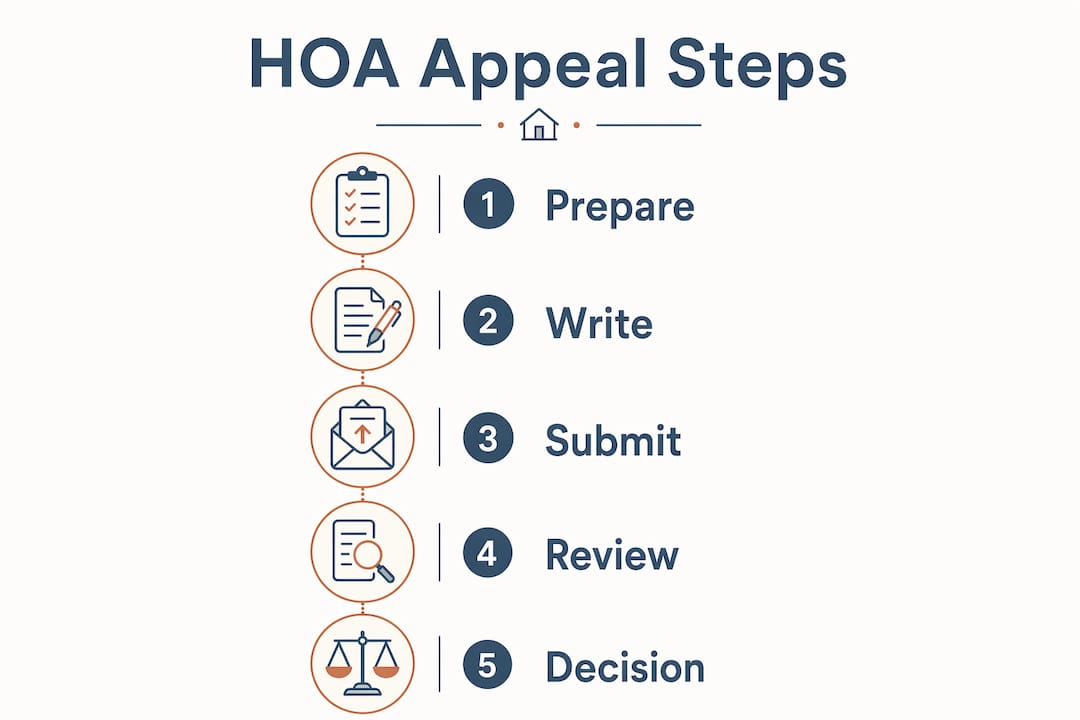
Beyond the state-level requirements, the general sequence for any HOA appeal looks like this:
- Receive the violation or denial letter and note the response deadline printed on the notice.
- Review your governing documents to confirm the HOA followed its own procedures before issuing the letter.
- Submit your written appeal or hearing request before the stated deadline, using a delivery method that creates a paper trail.
- Attend the scheduled hearing prepared with printed copies of your letter, attachments, and governing document excerpts.
- Receive the board's written determination, which most states require to be delivered within a defined period after the hearing.
- If the HOA does not follow proper procedures, consider filing a complaint with your state's ombudsman office or requesting Alternative Dispute Resolution before pursuing litigation.
Internal Dispute Resolution (IDR) is a statutory tool in California and several other states that provides homeowners a low-cost, informal meeting to resolve disputes before costly formal proceedings. IDR requires good faith participation by the HOA and often changes the tone of the entire dispute. Request it in writing if your state offers it.
What common mistakes weaken HOA appeals and how do you avoid them?
Most failed appeals share the same preventable errors. Knowing what not to do is as valuable as knowing the correct steps.
The most damaging mistake is missing the submission deadline. Procedural compliance with notices, cure periods, hearing timing, and decision delivery is a fundamental homeowner protection. A defective HOA procedure can render fines unenforceable regardless of the violation's merit. The reverse is also true: a homeowner who misses the appeal window loses the right to contest even a procedurally flawed fine.
Other frequent errors include:
- Writing in an emotional or accusatory tone, which gives the board grounds to dismiss the letter without engaging its substance
- Failing to cite specific CC&R or bylaw section numbers, leaving the appeal too vague to evaluate against written criteria
- Submitting evidence without labeling or dating it, which makes it easy for reviewers to discount
- Ignoring the cure period and assuming the appeal alone stops the fine clock
- Not confirming receipt of your appeal in writing, which creates a gap in your paper trail
Pro Tip: *If you need more time to gather evidence, request an extension proactively and in writing before the deadline passes. This demonstrates good faith and often prevents fines from accruing during the appeal period.*
> Verify the mailing date and postmark on the original HOA notice before you do anything else. Missing or incorrect notice details can make a fine vulnerable to challenge even before the appeal merits are argued. This is the first thing an HOA attorney checks, and it should be the first thing you check too.
How do state-specific laws shape the HOA appeal process?
State law sets the floor for every HOA appeal right. Your CC&Rs and bylaws can grant you more protections than state law requires, but they cannot take away the rights the legislature has already given you.
California Civil Code 4765 mandates that HOA appeal decisions on architectural applications must be issued within 60 calendar days of receiving the written appeal. This deadline is not a courtesy. An HOA that misses it has failed a statutory obligation, which strengthens any subsequent legal challenge. California also requires at least 10 days' notice before a disciplinary hearing and a written decision within 14 days after it.
Florida's Chapter 720 takes a different structural approach. Florida HOA fines require written notice and a hearing before a committee of at least three members who are not on the board. The committee must approve the fine before it becomes effective. This separation of the enforcement and review functions is a meaningful procedural protection that many Florida homeowners do not know they have.
Nevada's NRS 116.31031 requires a written notice specifying the exact violation and rule, a minimum 30-day cure period, and a hearing right before any fine becomes final. Nevada also maintains a state ombudsman office specifically for HOA disputes, which provides a low-cost escalation path when the HOA does not follow its own procedures.
Understanding which state framework applies to your community directly affects how you frame your appeal. Citing the correct statute by number in your letter signals to the board that you know your rights, and that knowledge alone often changes how seriously your appeal is reviewed.
Key takeaways
A successful HOA appeal requires preparation, precise document citation, and strict adherence to state-mandated procedural deadlines before, during, and after the hearing.
| Point | Details |
|---|---|
| Gather documents first | Collect the original notice, relevant CC&R sections, and dated evidence before drafting your appeal. |
| Cite exact rule language | Reference specific CC&R or bylaw section numbers in every appeal letter to meet written criteria. |
| Know your state deadlines | California, Florida, and Nevada each set distinct cure periods, hearing notice rules, and decision timelines. |
| Use IDR before escalating | Internal Dispute Resolution offers a low-cost, good-faith meeting that often resolves disputes without formal proceedings. |
| Confirm receipt in writing | Always use certified mail or email with read receipt and document every interaction with the HOA. |
What I have learned from watching HOA appeals succeed and fail
Most homeowners who lose their appeals do not lose on the facts. They lose on process. I have reviewed dozens of HOA dispute outcomes, and the pattern is consistent: the homeowner had a legitimate grievance but submitted an emotional letter two days after the deadline with no rule citations and unlabeled photos. The board dismissed it on procedural grounds and was technically correct to do so.
The homeowners who win are rarely the ones with the strongest underlying argument. They are the ones who treated the appeal like a legal filing. They cited section numbers. They labeled every exhibit. They sent everything certified mail and kept the receipt. They showed up to the hearing with printed copies for every board member. That level of preparation signals to the board that this homeowner will not go away quietly, and boards respond to that signal.
For board members reading this: appeals reviewed against explicit written criteria and documented in meeting minutes are far more defensible than decisions based on board preference. Rubber-stamping denials without engaging the homeowner's evidence is the fastest path to a reversal or a lawsuit. Procedural fairness is not just a legal obligation. It is the foundation of a community that functions without constant conflict.
My honest advice to any homeowner starting this process: read your CC&Rs before you write a single word of your appeal. The answer to whether you have a strong case is almost always in that document. And if the HOA did not follow its own procedures before issuing the notice, that is your strongest argument, regardless of whether the underlying violation actually occurred.
> *— Blake*
How Hoaletterai makes writing your appeal letter faster and more accurate
Writing a procedurally correct appeal letter from scratch takes time most homeowners do not have. Hoaletterai removes that friction by generating state-compliant appeal letters that already include the structural elements boards expect: notice reference numbers, governing document citations, evidence references, and formal closing language.
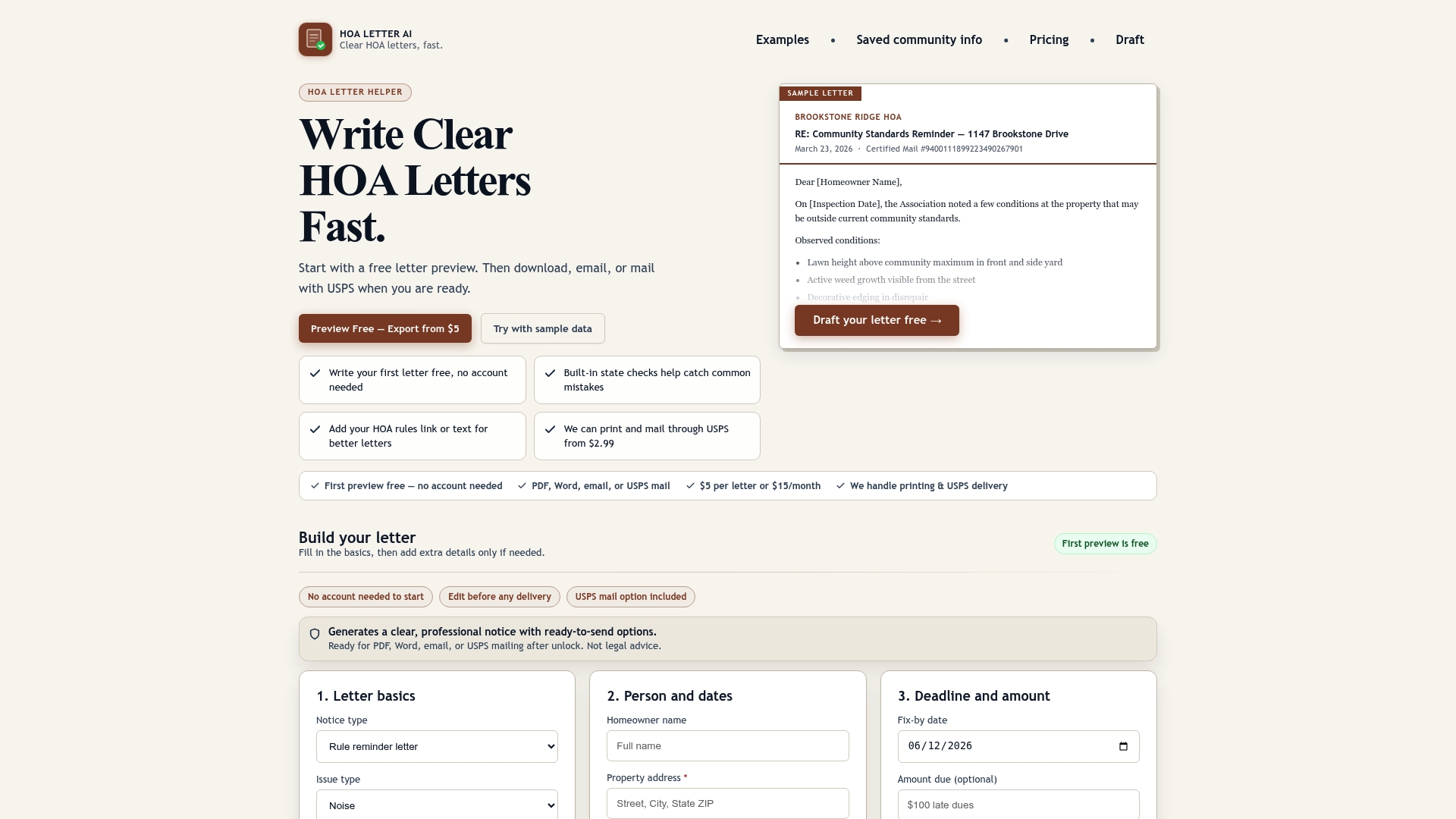
Whether you are contesting a fine appeal letter or drafting a full appeal response letter for an architectural denial, Hoaletterai's templates are built around the procedural requirements of your state. The platform includes built-in checks that flag missing elements before you send, so you do not discover a procedural gap after the deadline has passed. You can preview the letter on one page, customize it for your community's rules, and send it via USPS directly from the platform. Start with a free template at Hoaletterai and have a board-ready letter in minutes.
FAQ
What is the HOA letter appeal process?
The HOA letter appeal process is the formal procedure for contesting a violation notice, fine, or denial letter by submitting a written response that cites governing document provisions, presents supporting evidence, and requests a hearing within the deadline stated in the original notice.
How long do I have to appeal an HOA violation letter?
Deadlines vary by state and governing documents, but most HOAs require a written appeal or hearing request within 10 to 30 days of the original notice. California requires at least 10 days' notice before a disciplinary hearing, while Nevada mandates a minimum 30-day cure period before a fine becomes final.
What should I include in an HOA violation letter appeal?
Include the original notice reference number, your stated position (admit, deny, or hearing request), the exact CC&R or bylaw section that applies, dated supporting evidence labeled as exhibits, and a proposed resolution or cure date. Missing any of these elements weakens the appeal significantly.
Can procedural errors by the HOA invalidate a fine?
Yes. Missing or defective procedure, such as insufficient notice, no hearing opportunity, or a late written decision, can render HOA fines unenforceable regardless of whether the underlying violation occurred. Always verify the HOA's procedural compliance before arguing the merits of your case.
What is Internal Dispute Resolution and when should I use it?
Internal Dispute Resolution (IDR) is a statutory tool available in California and other states that allows homeowners and HOAs to meet informally before formal proceedings begin. Request IDR in writing as soon as you receive a notice you intend to contest. It requires good faith participation from the HOA and frequently resolves disputes at a fraction of the cost of formal arbitration or litigation.
Recommended
- HOA Appeal Response Letter (State-Compliant HOA Letter) | HOA Letter AI
- HOA Fine Appeal Letter: Step-by-Step Guide + Free Template | HOA Letter AI
- HOA Violation Response Letter: Template & Tips for Homeowners | HOA Letter AI
- HOA Noise Complaint Response Letter (State-Compliant HOA Letter) | HOA Letter AI
Drafting support for HOA notices
Use the HOA letter drafter to turn this guidance into a resident-ready notice, compare reusable HOA letter templates, or review the property manager workflow for higher-volume enforcement work.