
An HOA payment plan letter is a written, signed agreement that spells out exactly how past-due assessments get repaid, including the monthly amount, due dates, and what happens if a payment gets missed. Homeowners should send a specific written request with a concrete repayment number attached; boards should respond with a signed agreement delivered by certified mail. Skip the verbal handshake. Both sides need paper.
TL;DR:
- Payment plan letters must include specific details such as owner identification, exact balance, repayment schedule, interest, fees, default conditions, signatures, and delivery method.
- Requests should be precise, including a clear hardship statement, exact repayment terms, relevant supporting documents, and proper mailing or electronic follow-up to ensure prompt response.
- Boards should approve consistent, standardized plans through documented procedures, with default triggers clearly outlined and governance compliance verified beforehand.
- Signed, written agreements are enforceable, with failure to follow through resulting in acceleration, liens, or collection actions, while verbal promises hold little legal weight.
- Using state-aware templates like HOA Letter AI helps generate compliant, clear, and ready-to-sign repayment or collection letters, reducing disputes and procedural errors.
Table of Contents
- What Goes Into an HOA Payment Plan Letter
- How Should a Homeowner Request a Payment Plan?
- How Boards Should Draft and Approve Payment Plans
- Ready-to-Use Clauses for Payment Plan Letters
- Is a Payment Plan Letter Legally Binding?
- How HOA Letter AI Builds Compliant Payment Plan Letters
- What Actually Makes These Letters Work
- Draft Your Payment Plan Letter With HOA Letter AI
- Sources
What Goes Into an HOA Payment Plan Letter
A payment plan letter that actually holds up in a dispute or collections action needs specific fields, not vague promises. Missing even one of these creates room for confusion later, and confusion is exactly what turns a $400 shortfall into a lien.
Here’s what belongs in every version, whether the homeowner drafts the initial request or the board issues the final agreement:
- Identification: full owner name, unit or lot address, and account number matching the association’s ledger.
- Balance and ledger date: the exact amount owed and the date the balance was calculated, since assessments and late fees keep accruing.
- Repayment schedule: a specific dollar amount, a due date each month, a start date, an end date, and how the plan interacts with ongoing regular dues.
- Interest, fees, and default triggers: whether interest accrues on the unpaid balance, what counts as a missed payment, and whether the association can accelerate the full balance after a default.
- Signatures: the owner’s signature and the signature of an authorized association representative, dated.
- Delivery and record-keeping: how the letter was sent and where both parties keep their copies.
Pro Tip: Never let a repayment schedule run longer than about one year without a review point. Very long plans may lock the association into outdated terms and give owners a false sense of security if their circumstances change.
How Should a Homeowner Request a Payment Plan?
A vague request (“Can I get on a payment plan?”) gets ignored or slow-walked. A specific one gets answered. Requesting a hardship payment plan works best when the homeowner does the board’s math for them.
- State the hardship briefly. One or two sentences: job loss, medical bills, whatever applies. No need for a legal brief.
- Propose exact terms. Name a dollar amount and a date, not a range. “$150 on the first of each month for eight months” beats “whatever I can afford.”
- Attach supporting documents only if relevant. A layoff notice or medical bill helps; a stack of unrelated paperwork does not.
- Address it correctly. Send to the property manager if one exists, copying the board. If self-managed, send directly to the board.
- Document delivery. Certified mail with return receipt, or email with a read confirmation if the governing documents allow electronic notice.
- Follow up in writing. Once verbally approved, ask for a signed agreement before making the first payment.
Specific numbers move faster through a board meeting than open-ended requests, since a defined repayment schedule shows the board exactly what its cash flow looks like for the next several months.
How Boards Should Draft and Approve Payment Plans
Boards carry a fiduciary duty to the whole community, not just the homeowner asking for relief. That means every approved plan needs a paper trail that would survive a challenge from another owner asking, “why did they get a break and I didn’t?”
The fix is procedural consistency, applied the same way every time:
- Use a standardized, board-approved form for every request so decisions don’t hinge on who’s asking.
- Approve plans through documented action: meeting minutes, a vote, or clearly delegated authority to the manager.
- Specify who is authorized to sign on the association’s behalf, and keep that authorization on file.
- Build in default triggers (three missed payments is common) and state whether the association retains lien rights during the plan.
- Cross-check the community’s governing documents and state statute before finalizing terms, since some states set specific requirements for how associations must handle these requests.
Pro Tip: Denied a request? Document why, in writing, the same day. “Insufficient documentation” or “proposed term exceeded 12-month policy limit” protects the board if the decision is ever questioned.
Ready-to-Use Clauses for Payment Plan Letters
Copy-ready language saves both sides from reinventing the wheel. These clauses cover the parts that cause the most disputes later.
- Payment schedule: “Owner agrees to pay $[amount] on the [day] of each month beginning [date] and continuing through [date], in addition to regular monthly assessments.”
- Default and acceleration: “If Owner fails to make three consecutive payments under this agreement, the Association may declare the remaining balance immediately due and pursue all remedies available under the governing documents and applicable law.”
- Interest and fees: “Interest shall accrue on the unpaid balance at [rate]% per the Association’s fee schedule, as referenced in the governing documents.” Management companies often build equal-payment or balloon-payment options directly into this clause.
- Recordkeeping: “Payments shall be credited to Owner’s account upon receipt. Owner may request a current ledger at any time by written request to the Association or its managing agent.”
- Signatures and acceptance: “By signing below, both parties agree to the terms above.” Leave a dated signature line for the owner and one for the authorized association representative.
Is a Payment Plan Letter Legally Binding?
A verbal agreement between a homeowner and a board member is close to worthless if either side disputes it later. A written, signed agreement is the practical floor for enforceability. No signature, no leverage.
Break a signed plan, and the consequences escalate fast: acceleration of the full balance, a recorded lien, referral to collections, and in states that permit it, eventual foreclosure once the delinquency crosses a statutory threshold.
- Some states require associations to maintain a formal payment-plan policy and disclose it on request.
- Others impose specific notice periods or cure periods before further action.
- Procedural guides on demand letters consistently point back to the same governing document, so always confirm current state statute before finalizing terms.
- Certified mail with return receipt remains the standard delivery method for proof that a notice was sent and received.
The IRS’s own installment agreement structure is a useful outside reference here: explicit terms, a signed agreement, and clear records are what make any repayment plan enforceable, whether it’s a federal tax debt or an HOA balance. When a plan involves a lien already on file, most boards won’t release it until the full balance clears, plan or no plan. When the numbers or the law get complicated, loop in an attorney or ask about mediation before signing anything permanent.
How HOA Letter AI Builds Compliant Payment Plan Letters
Drafting a payment plan letter that covers every required field, matches your state’s notice rules, and still reads clearly to a stressed homeowner is harder than it looks. HOA Letter AI handles that gap with state-aware templates and built-in checks that flag missing mandatory language before a letter goes out.
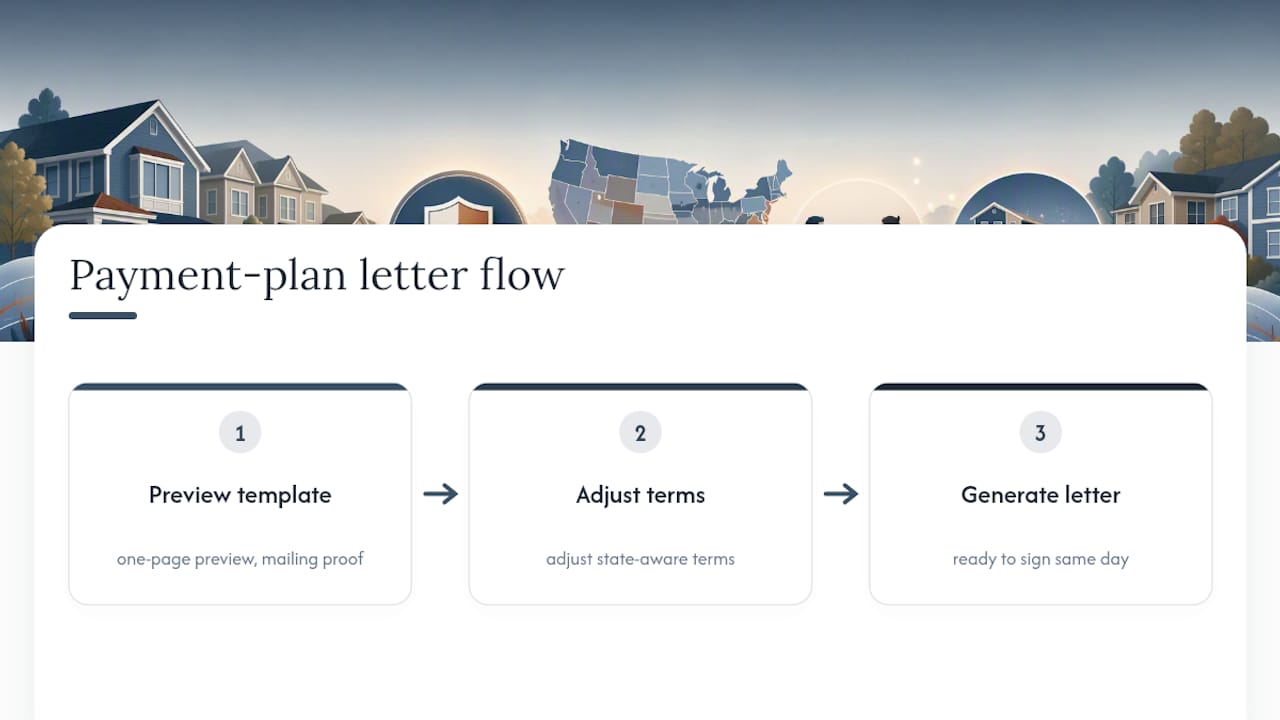
Every letter includes a one-page preview and delivery options, including mailing, so both sides have proof of what was sent and when. The template library covers payment-plan agreements, collection letters, and hardship-request responses, all built around the same governance and fiduciary-duty standards boards already answer to.
The next step is simple: preview a template, adjust the terms, and generate a letter that’s ready to sign the same day.
What Actually Makes These Letters Work
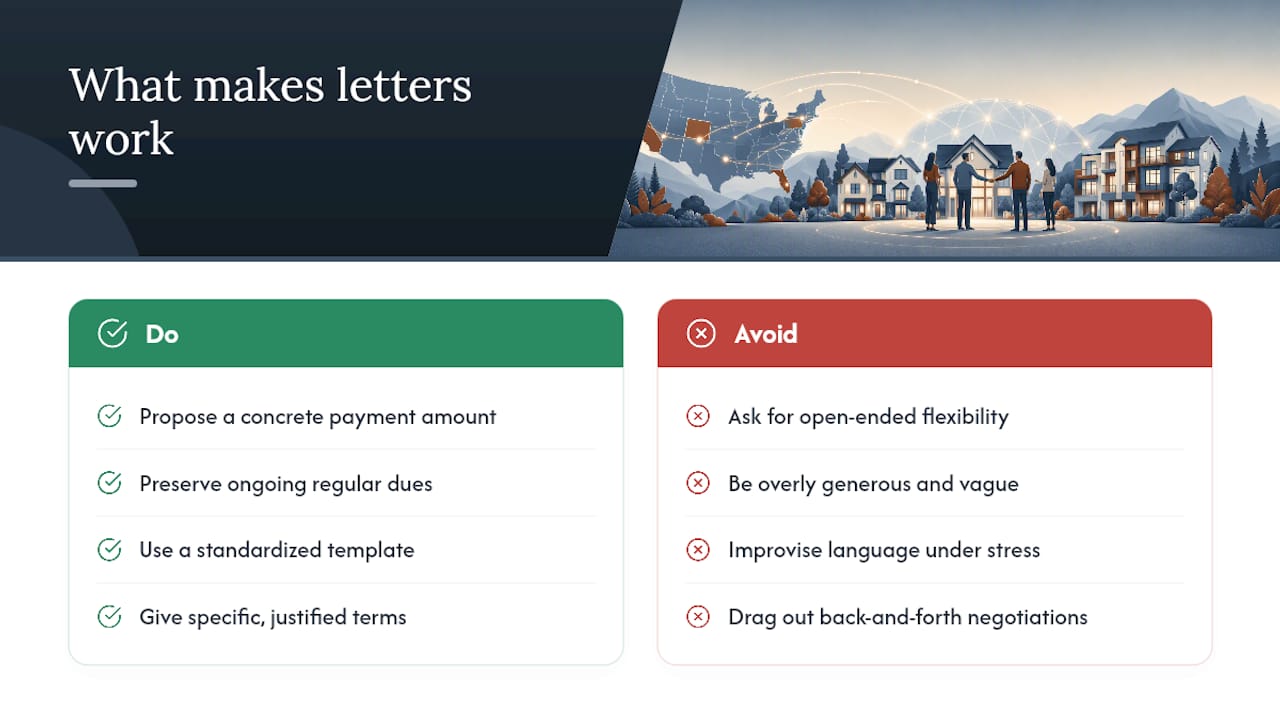
The plans that hold up aren’t the generous ones. They’re the specific ones. A board is far more likely to approve a request that preserves ongoing dues and proposes a concrete number than one that asks for open-ended flexibility, because specificity is what lets a volunteer board justify the decision to everyone else in the community.
Standardized templates aren’t just a convenience. They cut down the back-and-forth that turns a two-week request into a two-month standoff, and they give both sides language that’s already been thought through instead of improvised under stress.
— Blake
Draft Your Payment Plan Letter With HOA Letter AI
Writing this letter from scratch means guessing at what your state requires and hoping you didn’t miss a clause that matters later. HOA Letter AI removes that guesswork with state-aware templates built specifically for collection and payment-plan scenarios, so the letter you send already accounts for your jurisdiction’s notice requirements.
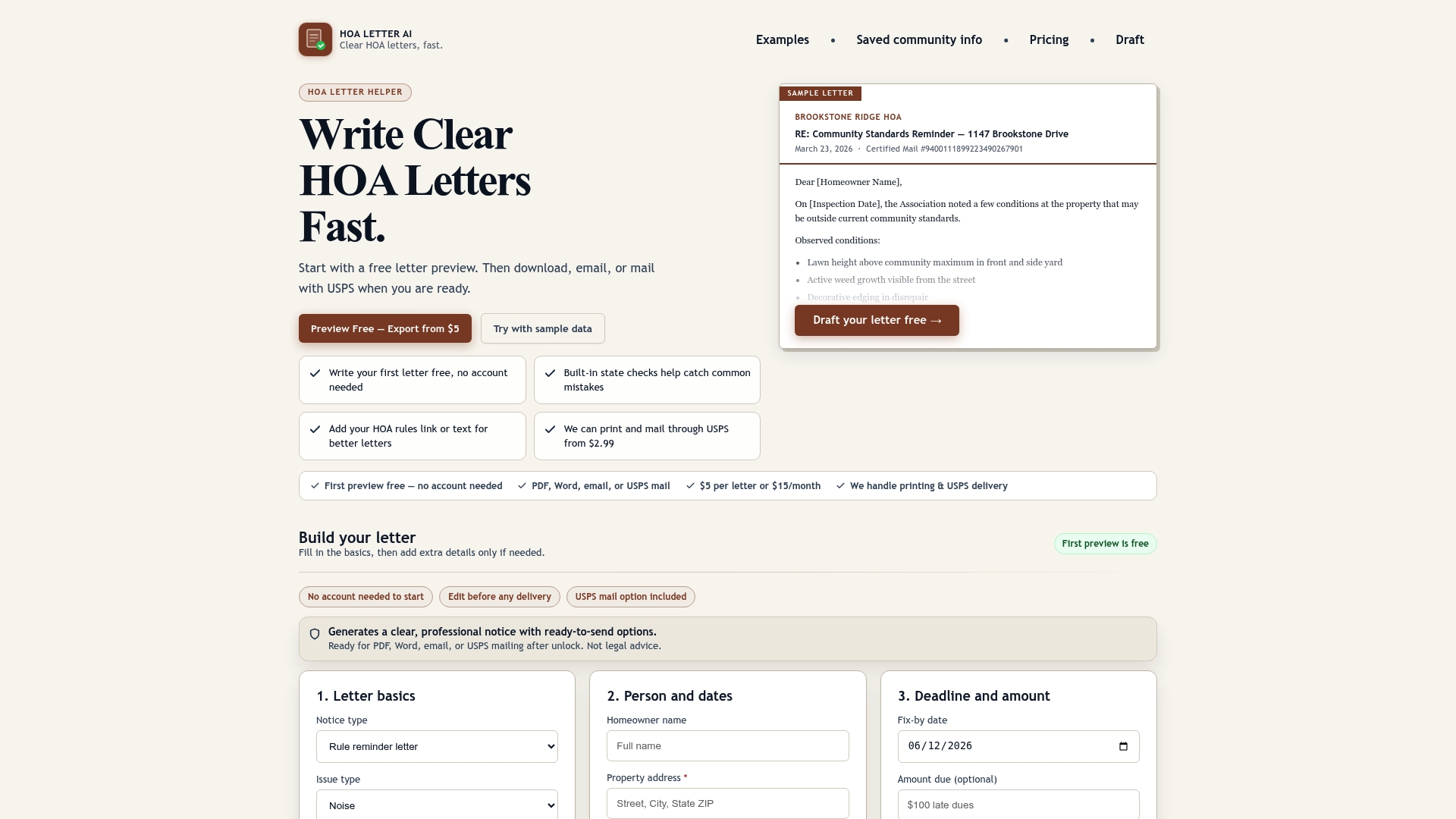
Boards get a collection letter template they can adapt into a formal repayment agreement in minutes, complete with signature blocks and default language already built in. Homeowners get the same clarity from the other side: a state-compliant response they can generate and send without hiring anyone. If you’re building a stepwise collection process, the warning letter template pairs naturally with a payment-plan offer as the first step before formal collections. For a broader look at what your state requires before you finalize anything, check HOA violation and notice laws by state. Preview a template free at HOA Letter AI and see exactly what your letter will look like before you commit to sending it. If you’re structuring a longer repayment timeline, this guide to realistic installment schedules is worth a look for framing terms both sides can actually stick to.
Sources
- Can’t Afford Your HOA Dues? How to Request a Hardship Payment Plan — FixMyHOAViolation
- Sample repayment letter and resolutions (PCMS sample PDF)
- Payment plans and installment agreements — IRS