
When an HOA inoperable vehicle letter arrives, your first move is to read the exact rule it cites, mark your cure or hearing deadline on a calendar, and then either fix the issue or submit a timely hearing request. Confirm three things immediately: which provision actually governs your car, what deadline applies, and how the HOA plans to prove it sent proper notice. A state-aware drafted response can help you cover every required element if you would rather work from a template than start from scratch.
TL;DR:
- The definition of an inoperable vehicle varies based on community rules and local codes, including issues like missing plates, disassembly, or inability to move under its own power.
- Enforcement authority depends on whether the vehicle is on your property, a common area, or a public street, with municipal laws often limiting HOA power over street parking.
- Proper notice must include a specific violation description, the provoked rule, the cure and hearing deadlines, and the right to request a hearing, with strict compliance often determining enforcement validity.
- When drafting a response, homeowners should document the vehicle’s condition, cite the exact rule, meet deadlines, and send proof of their reply via certified mail or other recorded delivery.
- Strong evidence such as timestamped photos, registration proof, repair receipts, and documentation of vehicle movement can help support your cure or contest efforts during disputes.
HOA Letter AIDraft Your HOA Response ClearlyCreate a professional compliance letter with guided drafting, state-specific context, community rules, built-in checks, and delivery options.Visit HOA Letter AI
Table of Contents
- What counts as an “inoperable vehicle”?
- Who actually has authority: your HOA or the city?
- What a valid notice must include and the deadlines that follow
- How to draft a response step by step
- Evidence that strengthens your cure or your defense
- What enforcement usually looks like and where homeowners win
- When to bring in an attorney
- Why precise wording and timing decide most vehicle disputes
- Draft a compliant letter without starting from a blank page
- FAQ
- Sources
What counts as an “inoperable vehicle”?
There is no single definition that applies everywhere. Most governing documents and municipal codes build the label from a handful of common triggers, and which ones apply to you depends entirely on the document doing the regulating.
- No valid license plates, registration, or current inspection sticker.
- Mechanical inability to move under its own power.
- Missing major parts or visible disassembly (engine, wheels, body panels).
- Sitting in the same spot for an extended period without use.
Many municipal codes borrow language from the International Property Maintenance Code, which generally describes an inoperable vehicle as one that cannot be driven on public streets, lacks current licensing, or is wrecked, dismantled, or otherwise incapable of self-powered movement. Virginia Code §15.2-904 gives localities several definition options to choose from, including vehicles that are not inoperable but lack current plates, and vehicles that are partially disassembled. Before you respond to any letter, find and quote the exact definition from the document the HOA cited. A generic understanding of “inoperable” will not help you if your community’s CC&Rs define the term differently.
Who actually has authority: your HOA or the city?
Different rules apply depending on where the vehicle sits. A car parked on your own lot is usually governed by your CC&Rs and rules. A car on a common area may fall under separate association rules. A car parked on a public street is a different matter entirely, because public streets often belong to the municipality, not the association.
- Owner-lot parking: governed by CC&Rs and community rules.
- Common-area parking: governed by association rules, sometimes with different penalties.
- Public-street parking: may fall outside HOA authority altogether.
This distinction matters because an HOA’s enforcement power comes from its governing documents and state HOA statutes, while a city’s power comes from its municipal code. A Utah advisory opinion found that associations cannot impose rules restricting use of public streets, which made certain CC&R provisions on that subject unenforceable. If your letter cites a rule about street parking, check whether the street is public or part of the association’s private property before assuming the HOA’s rule applies. When you are unsure, pull your plat map or ask your county recorder’s office who owns the roadway.
What a valid notice must include and the deadlines that follow
A letter that skips a required element is not just impolite. It can be legally defective, which matters a great deal if the HOA later tries to fine you or take further action. Use this checklist to test whether the notice you received actually complies with the rules it invokes.
- A description of the specific violation (not just “vehicle issue”).
- The exact rule, statute, or CC&R provision being enforced.
- The length of the cure period before further action.
- A statement that fines or other penalties may follow if uncured.
- Notice of your right to a hearing and the deadline to request one.
Florida Statutes §718.303 requires written notice of at least two weeks and a hearing opportunity before a condominium association can impose a fine or suspension, and limits fines per violation and in total unless the documents specify otherwise. Utah’s Department of Commerce guidance takes a different approach: a warning must describe the violation, cite the provision, state that fines may follow, give at least 48 hours to cure a continuing violation, and allow 30 days to request an informal hearing, which pauses penalties while pending. These are examples from two states, not universal rules, so always check the statute or agency guidance for your own state.
Defective notice has real consequences. An appellate court reversed a money judgment in Dwork v. Executive Estates after an HOA gave only 13 days’ notice when the statute required 14, holding that strict compliance with the notice period was required. A single missing day can undo an entire enforcement action.

How to draft a response step by step
Whether you are curing the issue, contesting the label, or asking for more time, structure your response the same methodical way.
- Log the date you received the letter and photograph the vehicle as it currently sits.
- Pull the exact clause cited and copy it verbatim into your notes.
- Calculate the cure deadline and the hearing-request deadline, and put both on a calendar.
- If curing, take the specific action the rule requires: move the vehicle, renew registration, complete repairs, or install approved screening, and photograph the result.
- If contesting, draft a letter that quotes the controlling provision, states the relevant facts, attaches your evidence, and requests either a hearing or dismissal of the notice.
- Send your response by certified mail, a documented email with read receipt, or hand delivery with a signed log, so you have proof of your own timely reply.
- If a short-term fix makes sense, such as temporary screening or a brief extension, propose it in writing and ask the board to confirm acceptance in writing too.
Pro Tip: If the HOA’s letter cites more than one provision, such as appearance, nuisance, and street parking together, respond to each allegation separately so the board cannot claim you only addressed part of the complaint.
Evidence that strengthens your cure or your defense
Good documentation turns a dispute into a quick resolution. Collect it before you send anything.
- Timestamped photos from multiple angles, showing the license plate, inspection decal, or their absence.
- A current DMV registration printout or renewal receipt.
- Repair shop invoices, parts receipts, or towing records that show active restoration.
- Dated notes on when and where the vehicle was moved, plus any witness statements from neighbors.
- Copies of every letter, email, or notice exchanged with the HOA, kept in order by date.
Courts pay attention to exactly this kind of circumstantial evidence. In Salem Twp. Bd. of Trustees v. Fazekas, judges weighed expired registration, ground indentations, and missing parts when deciding whether a vehicle qualified as junk or inoperable. The same kind of proof works in your favor if you can show current registration, a recent repair invoice, or a vehicle that has clearly been moved.
What enforcement usually looks like and where homeowners win
Most associations follow a similar sequence: an informal warning, then a formal notice, then a fine if uncured, then escalation toward a lien or collection action as explained in how to sell a house with code violations or liens. Municipal code enforcement runs on a separate track and often involves different notice and towing rules.
- Warning letter, followed by a formal notice with a cure period, followed by fines, followed by a lien if fines go unpaid.
- Defective notice (wrong cure period, missing provision citation, no hearing notice) is one of the most common grounds homeowners win on.
- Lack of statutory authority over public streets, as found in Utah’s advisory opinion, can void a street-parking rule entirely.
- Municipal towing or removal frequently requires its own separate notice under local code, distinct from HOA procedure, so check your city’s towing ordinance before assuming a tow is imminent.
Proof of cure, submitted before the deadline, typically ends an enforcement action outright.
When to bring in an attorney
Most inoperable-vehicle disputes resolve through notice and cure, but a few situations call for legal help. Watch for a lien or foreclosure threat, a tow with a claimed storage lien, fines that have piled up into a significant sum, or conflicting orders from the HOA and the municipality at the same time.

If you reach that point, bring your governing documents, every notice and certified-mail receipt, timestamped photos, repair invoices, and your DMV records to the consultation. Before paying for representation, consider an informal hearing, mediation, or a request for an advisory opinion from your state’s HOA regulator, since several of these options can resolve a dispute faster and at lower cost than litigation.
Why precise wording and timing decide most vehicle disputes
Most inoperable-vehicle disputes are not won on whether the car actually runs. They are won or lost on paperwork: whether the notice cited the right clause, gave the right number of days, and offered a real hearing opportunity. A board that skips one of those steps often loses regardless of the vehicle’s condition, and a homeowner who ignores a deadline often loses regardless of how reasonable their excuse is.
That is why state-aware, clause-specific language matters more than most homeowners expect going in. A letter that matches the exact statutory or CC&R requirement closes off the easiest defenses on both sides and tends to resolve faster, with fewer follow-up disputes and fewer letters going back and forth.
— Blake
Draft a compliant letter without starting from a blank page
We built our platform to take the guesswork out of exactly this kind of letter. It walks you through guided drafting with state-specific language, includes your community’s rules, and runs built-in checks for the notice elements covered above, then shows you a one-page preview before anything goes out.
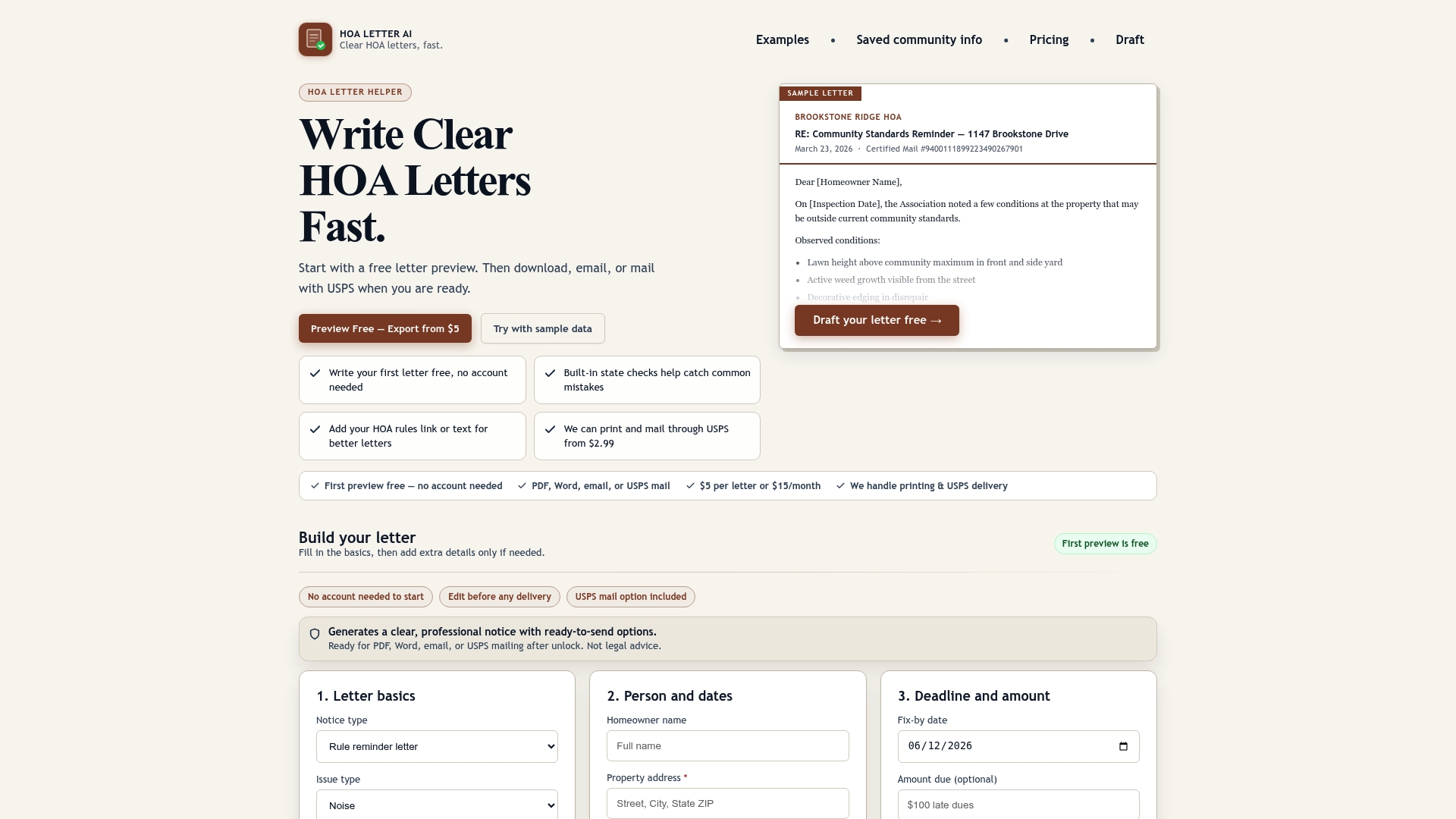
If you are a homeowner who needs to send a formal response, we offer a one-time homeowner response letter for $5. Board members and individuals can generate a single compliant notice for $5 as well, and we offer optional USPS mail fulfillment starting at $2.99 with delivery tracking, so you have proof of service on file.
- Guided drafting with state-specific rule language built in.
- A free one-page preview before you pay for anything.
- Deadline prompts that match the cure and hearing windows your state requires.
- Optional certified mail delivery with tracking for proof of service.
Start with our HOA letter templates or head straight to pricing to generate your letter now.
This article is general information, not a substitute for advice from a qualified lawyer. Consult a qualified legal professional about your own circumstances before acting on anything here.
FAQ
What is considered an inoperable vehicle?
An inoperable vehicle is generally one that cannot move under its own power, lacks current registration or inspection, or is wrecked, dismantled, or missing major parts. The exact definition depends on your CC&Rs or the local ordinance cited in your notice, so always check that specific document rather than relying on a general understanding.
What is the most common HOA violation homeowners face?
Parking and vehicle-related issues, including inoperable or unregistered vehicles parked in driveways or on streets, are among the most frequent sources of HOA complaints and notices. Exterior appearance and maintenance issues also rank high, often overlapping with vehicle complaints when a car’s condition affects curb appeal.
Can an HOA require vehicle registration?
Many HOAs can require vehicles on the property to carry current registration and plates if that requirement appears in the CC&Rs or community rules, since those documents function as a contract among owners. Whether the rule extends to public streets depends on local law, since some state guidance limits an association’s authority over public roadways.
Can you have an unregistered car in your driveway?
Rules on unregistered vehicles in a driveway vary by state and by the specific CC&Rs or municipal code that applies to your property, so there is no single nationwide answer. Check your governing documents and your local ordinance directly, since one may be stricter than the other even within the same state.
Sources
- Chapter 718 — 2026 Florida Statutes
- Community Association fines and hearings — Utah Department of Commerce
- DWORK v. EXECUTIVE ESTATES OF BOYNTON BEACH HOMEOWNERS ASSOCIATION INC (2017) | FindLaw
- § 15.2-904. Authority to restrict keeping of inoperable motor vehicles — Virginia Code
- Salem Twp. Bd. of Trustees v. Fazekas — Ohio court materials