
A defensible pet violation letter names the conduct, cites the governing rule, sets a measurable cure and deadline, preserves evidence, and pauses to check for any assistance-animal accommodation request. Skip any of these and the notice is harder to enforce and easier to challenge. The immediate next step, before drafting anything, is to document what happened and confirm whether the homeowner has raised or might raise a disability-related accommodation claim.
TL;DR:
- Pet violation notices must include specific details such as the observed conduct with dates and times, the exact rule violated, and a measurable correction deadline.
- Different enforcement stages require tailored notices, with clear separation between warning, violation, and hearing notices to ensure procedural compliance.
- When addressing assistance animal requests, associations must evaluate them promptly and avoid applying breed or size restrictions to qualified animals under fair-housing laws.
- Proper evidence collection—including objective observations, media, and delivery proof—is critical to enforce violations effectively and withstand disputes.
- Fair-housing protections require associations to provide a minimum 14-day notice and hold hearings within 90 days before imposing fines for pet violations, with specifics varying by state.
HOA Letter AIhoaletterai.comDraft Clearer Pet Violation NoticesCreate professional compliance letters with guided drafting, state-specific context, community rules, built-in checks, and delivery options.Visit HOA Letter AI
Table of Contents
- What a pet violation letter must include
- Matching the letter to the right enforcement stage
- Assistance animals and the accommodation check before escalation
- Documenting the violation and preserving evidence
- Sample language and templates for common pet violations
- How homeowners typically respond, and how to contest or comply
- Legal ramifications and rights when you receive a pet violation letter
- How enforcement and follow-up actually work
- Common mistakes boards make with pet violation letters
- How HOA Letter AI helps boards and property managers draft these letters
- FAQ
- Sources
What a pet violation letter must include
A pet violation letter is a legal document, not a complaint email, so it needs structure. Boards and managers who skip elements often end up with notices that get ignored, appealed successfully, or thrown out at a hearing because they lack the specifics a homeowner or a judge needs to evaluate the claim.
Every defensible notice contains the following:
- Identifying information: the homeowner’s name, address, parcel or unit number, and a reliable contact method.
- Factual description: the date, time, and location of each observed incident, written as objective conduct (“dog off leash in common area at 4:15 PM on March 3”) rather than characterizations (“irresponsible owner”).
- Governing-document citation: the exact CC&R section, rule number, or excerpted rule text that the conduct violates.
- Corrective action: a specific, measurable requirement (leash the dog in common areas, remove waste within 24 hours, reduce barking between designated quiet hours) tied to a firm deadline.
- Consequences: what happens if the homeowner does not cure the violation, referencing the association’s enforcement policy, whether that’s a fine schedule, a hearing, or both.
- Response instructions: how and by when the homeowner can reply, dispute the facts, or request a reasonable accommodation for an assistance animal.
The accommodation line matters more than boards often realize. A notice that never invites a response forecloses the homeowner’s chance to raise a disability-related issue before the association escalates, which can turn a routine enforcement action into a fair-housing complaint.
Vague corrective language is the most common drafting failure. “Please control your pet” gives a homeowner nothing to comply with. “Keep the dog on a leash no longer than 6 feet whenever it is in a common area, effective immediately” gives both sides a standard to measure against. The same logic applies to deadlines: “as soon as possible” is unenforceable, while “by April 15, 2026” is not.
Consequences should mirror whatever the association’s governing documents and state law actually authorize, never more. If the declaration requires a hearing before any fine, the letter should say so rather than threatening an immediate penalty. Boards that overstate their authority in a first notice often lose credibility, and sometimes the enforcement action itself, when a homeowner or their attorney points out the mismatch.
Finally, every letter should state plainly how the homeowner can respond, including a named contact, an address or portal, and the deadline for that response. A one-page HOA pet violation letter template built around these six elements covers the leash, waste, and barking scenarios that make up most pet-related notices, and adapting it to a specific community’s rules is faster than drafting from scratch each time.
Matching the letter to the right enforcement stage
Not every pet complaint warrants the same letter. Boards that send a fine notice for a first-time, minor infraction, or that skip straight to a hearing invitation without a cure period, create procedural problems that can undermine the entire enforcement effort.
Most associations work through a sequence like this:
- Courtesy or warning notice: informal, cure-oriented, no fine attached. Used for a first or minor infraction to give the homeowner a chance to correct the behavior.
- Violation notice with cure period: formal notice citing the specific rule, describing the conduct, and setting a deadline to fix it before further action.
- Fine notice (where the governing documents and state law authorize it): issued after the cure period lapses without compliance, referencing the fine schedule and amount.
- Hearing invitation: formal notice of the homeowner’s right to a hearing before the board or a committee, typically required before a fine becomes final.
These stages are not interchangeable, and combining them in one letter, such as announcing a fine and a hearing date in the same notice without separating the required content, is a frequent and avoidable error. A hearing notice template that keeps hearing-specific content separate from the underlying violation notice reduces that risk.
Florida offers a useful illustration of how specific these rules can get. Under Florida Statutes §720.305, an association must give written notice of the homeowner’s right to a hearing at least 14 days before imposing a fine or suspension, hold the hearing within 90 days, and respect fine caps that generally run $100 per violation up to an aggregate of $1,000 unless the governing documents state otherwise. This is one state’s framework, not a national standard, and boards outside Florida should confirm their own state’s notice and hearing requirements before relying on these numbers. A state-by-state reference like HOA violation letter laws by state is a faster way to confirm the applicable rule than searching statute text directly.
One in-context figure worth flagging: Florida’s 14-day minimum notice period before a hearing, set by statute, means a board cannot compress its timeline just because a violation feels urgent. That 14 days is a floor, not a suggestion.
Before escalating past a courtesy notice, pause and check whether the homeowner has raised, or is likely to raise, an assistance-animal accommodation request. Continuing to escalate while that question is open can create liability regardless of how clear the underlying rule violation is.
On delivery, certified mail with return receipt remains the most defensible proof of service, though a dated email with read confirmation or a platform delivery record showing timestamp and recipient can supplement it. Whichever method is used, the proof of delivery should be saved alongside the letter itself, not just the fact that it was sent.
Assistance animals and the accommodation check before escalation
Before any pet violation letter moves past a courtesy notice, boards need to rule out, or properly evaluate, a reasonable accommodation request. This is where fair-housing exposure is highest and where many boards make avoidable mistakes.
Housing and public-access rules are not the same thing. Assistance animals in housing fall under the Fair Housing Act, and HUD’s guidance treats them as distinct from pets: a qualifying assistance animal is not subject to pet fees, deposits, or breed or size restrictions. The ADA’s service-animal rules, by contrast, govern public accommodations like stores and restaurants and define service animals narrowly as trained dogs performing specific tasks. Applying ADA public-access rules to a housing enforcement question is a common and avoidable error.
A workable accommodation checklist includes:
- Confirm whether the homeowner has an obvious disability or has already disclosed one; if not, you may ask whether the animal is needed because of a disability and what task or support it provides.
- Avoid demanding medical records, a specific diagnosis, or special identification or certification for the animal.
- Evaluate the request promptly and individually rather than applying a blanket policy, since HUD guidance points toward handling documented requests on the order of ten business days.
- Do not apply breed, size, or weight restrictions, or charge pet fees or deposits, to a qualifying assistance animal, though conduct-based rules (leash use in shared spaces, waste cleanup, noise) still apply.
Pro Tip: Include a neutral sentence in every pet-related notice, such as “If this animal assists with a disability, please contact us to discuss a reasonable accommodation,” rather than waiting for the homeowner to raise it first.
This neutral phrasing matters because it invites disclosure without presuming the homeowner lacks an accommodation need, and it creates a documented record that the association offered the interactive process HUD guidance recommends.
Documenting the violation and preserving evidence
The letter is only as strong as the evidence behind it. A notice that says “the dog is frequently off leash” without dates, times, or corroboration gives a homeowner an easy basis to dispute the claim and gives a hearing panel little to evaluate.
Enforcement best practices call for objective records that avoid speculation about intent and instead document observed conduct, supported by media and delivery proof wherever available, according to guidance on assistance animal documentation and enforcement records. A usable evidence log tracks the following fields consistently for every incident:
| Field | What to record |
|---|---|
| Observer | Name and role of the person who witnessed the conduct |
| Date and time | Exact timestamp of the observed incident |
| Location | Precise description (common area, specific address, parking lot) |
| Conduct observed | Objective description, no speculation about intent |
| Supporting media | Photo or video file name, capture date, and device or source |
| Witness contacts | Name and contact info, where privacy rules permit |
| Delivery proof | Method used (certified mail, email, platform record) and confirmation date |
Recordings made in community common areas raise their own privacy questions, and a board considering camera evidence should understand the applicable rules around HOA security cameras before relying on footage in a notice.
Every entry should describe what happened, not why the board thinks it happened. “Dog observed off leash” is defensible; “owner clearly doesn’t care about the rules” is not, and language like that can undermine an otherwise solid case. The strength and completeness of this record should also shape the remedy proposed: a single, well-documented incident might justify a courtesy notice, while a pattern across multiple dated entries supports moving directly to a formal violation notice with a cure deadline.
Sample language and templates for common pet violations
Templates save time, but only when they’re adapted to the specific rule being enforced and the correct procedural stage. Three skeletons cover most situations.
A courtesy or warning letter stays short: “We’ve received a report that your dog was observed off leash in the common area on March 3. Per Section 4.2 of our Rules and Regulations, pets must be leashed in all common areas. Please ensure compliance going forward.” No fine, no hearing reference, just a factual note and a reminder. A ready-made HOA warning letter template covers this stage without extra drafting.
A first violation notice with a cure deadline adds specificity: name the rule, describe the conduct, state the required correction, and set a date. “You are required to keep your dog leashed in all common areas effective immediately. Failure to comply by April 15, 2026, may result in further enforcement action under our fine policy.”
A hearing or fine notice needs to track whatever your state requires, which is why the Florida 14-day and 90-day timelines discussed earlier illustrate why this stage cannot be rushed or combined with the initial warning.
In every version, add the accommodation-invitation sentence if the letter concerns a pet rather than a confirmed non-assistance animal. Run each draft through a state-specific checklist before sending, since notice content requirements vary enough between states that a template built for one jurisdiction can fail to meet another’s minimum standards.
How homeowners typically respond, and how to contest or comply
Most homeowners who receive a pet violation letter do one of three things: comply quietly, request clarification or more time, or dispute the facts. A response that disputes the violation should be taken seriously rather than dismissed, since it may surface a factual error, a documentation issue, or a disability-related accommodation need that changes how the board should proceed.
Boards should give homeowners a clear path to respond in writing, including a deadline and a named contact. Homeowners who want to contest a notice typically request the underlying evidence (what was observed, when, and by whom), point to governing-document language they believe was misapplied, or ask for additional time to cure the violation before any fine attaches.
Compliance is usually straightforward: fix the cited conduct, document that it’s been fixed, and in many associations, confirm the fix in writing so the file reflects resolution. Homeowners who believe the notice was issued in error, or who have an assistance-animal accommodation to raise, should do so in writing and in that same window.
For a response that needs to be in writing and reasonably formal, a structured response letter can help a homeowner reply clearly without unintentionally conceding more than intended.
Legal ramifications and rights when you receive a pet violation letter
A pet violation letter is not automatically enforceable just because it was sent. Homeowners retain the right to review the cited rule, request the evidence behind the allegation, and, where their governing documents or state law provide for it, a hearing before any fine becomes final.
Fair-housing protections apply regardless of what a community’s rules say. If the “pet” in question is actually an assistance animal under HUD’s Fair Housing Act guidance, breed, size, and fee restrictions generally cannot be enforced against it, and a homeowner who believes an association has ignored a legitimate accommodation request may have grounds for a fair-housing complaint independent of the underlying pet rule.
State law adds another layer. In Florida, for instance, a fine or suspension generally cannot take effect without the 14-day hearing notice and 90-day hearing window set out in Florida Statutes §720.305. A homeowner facing a fine that skipped this process has a procedural basis to challenge it, separate from whether the underlying violation actually occurred. Because these protections vary by state, a homeowner with a serious dispute, particularly one involving a potential fair-housing issue, is often better served consulting a qualified attorney than relying on general guidance.
How enforcement and follow-up actually work
Enforcement rarely ends with a single letter. Most associations follow a sequence: courtesy notice, formal violation notice with a cure deadline, and, if the violation continues, a fine notice or hearing invitation depending on what the governing documents authorize. Each stage should be documented and dated, both because state law often requires it and because a clean paper trail protects the association if the matter escalates to a hearing or court.

Follow-up matters as much as the initial notice. If a homeowner cures the violation by the deadline, the file should reflect that resolution, which protects both sides if a dispute resurfaces later. If the violation continues, the next letter should reference the prior notice by date and content rather than starting the explanation over, which reinforces that the association followed its own process consistently.
Boards and management companies handling many units benefit from standardized workflows: a reusable letter sequence tied to each community’s specific rules, a consistent delivery and proof-of-service method, and a shared record of what’s been sent to which homeowner. Without that structure, it’s easy to lose track of which notice stage a given violation is actually at.
Common mistakes boards make with pet violation letters
The same mistakes show up across most of the flawed notices I’ve reviewed: mixing a fine threat into what should be a simple warning, skipping the accommodation-invitation sentence entirely, setting a cure deadline so vague it can’t be enforced, and relying on memory instead of a dated evidence log.
Each of these is avoidable with structure rather than more legal knowledge. A template that forces a board to pick one notice type, cites the actual rule number instead of a paraphrase, and includes a standing accommodation-invitation line removes most of the guesswork. State-specific checks catch the Florida-style timing requirements and their equivalents elsewhere before a letter goes out, rather than after a homeowner’s attorney points out the gap.
Guided drafting doesn’t replace judgment, but it catches the structural errors that turn a routine notice into a liability.
— Blake
How HOA Letter AI helps boards and property managers draft these letters
Our drafting tool follows the exact structure outlined in this guide: a guided process that prompts for the rule citation, the specific conduct, a measurable cure deadline, and a dedicated accommodation-invitation line, with state-specific checks to help ensure compliance with hearing timelines and other requirements.
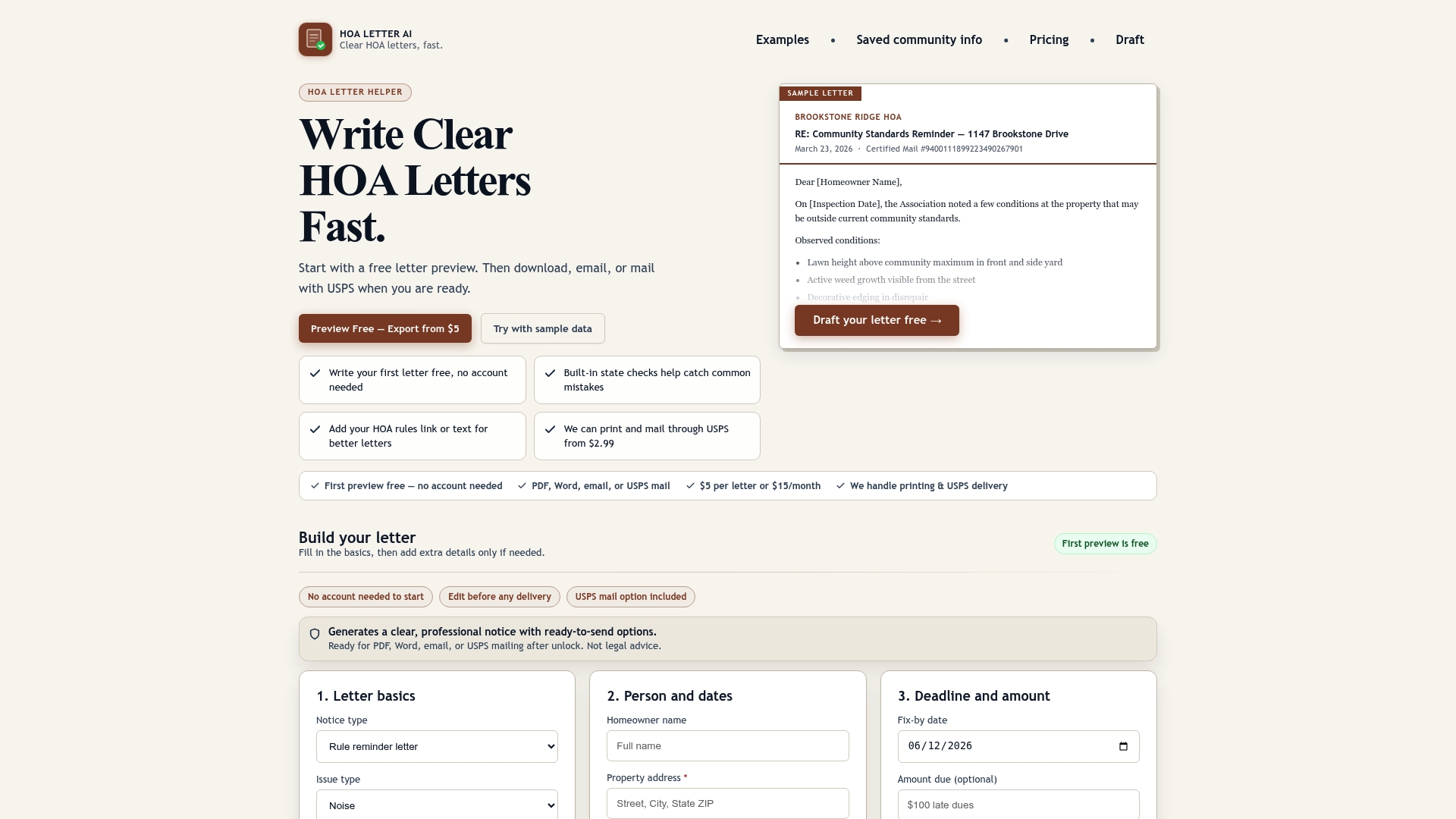
For boards and self-managed associations, a single letter unlocks for $5, and a self-serve board lane runs $15 per month for ongoing access. Property management teams handling multiple communities can use PM Starter at $199 per month or PM Pro at $399 per month, or test the workflow with a 30-day PM Pilot for $499. Every draft includes a free one-page preview before purchase, and optional USPS mailing starts at $2.99 per letter when certified delivery and proof of service are needed.
If you’re drafting your next pet violation notice, preview a letter before you send anything.
This article is general information, not a substitute for advice from a qualified lawyer. Consult a qualified legal professional about your own circumstances before acting on anything here.
FAQ
Can an HOA make you get rid of a pet?
An HOA can generally enforce pet rules like size, breed, or number limits stated in its governing documents, but it cannot require removal of a qualifying assistance animal under the Fair Housing Act, regardless of breed or size, according to HUD’s guidance. For a non-assistance pet that violates a valid rule, the association typically must follow its own notice and cure process before any removal requirement would be enforceable.
How do I write an HOA violation letter?
A defensible letter names the homeowner and property, describes the observed conduct with dates and times, cites the exact rule violated, states a specific corrective action with a deadline, and explains the consequences of non-compliance. Using a pet violation letter template built around these elements is faster than drafting from scratch and helps avoid missing required content.
Can an HOA fine you for not picking up dog poop?
Yes, if the association’s governing documents authorize fines for waste violations and the board follows its required notice process, which in many states includes a cure period and, in some cases, a hearing before the fine becomes final. In Florida, for example, a fine generally requires 14 days’ written notice of the right to a hearing under state law.
What are the pet rules and laws for homeowners associations in Florida?
Florida HOAs can enforce reasonable pet rules through their governing documents, but any fine or suspension requires written notice of the right to a hearing at least 14 days in advance, a hearing within 90 days, and generally respects fine caps under Florida Statutes §720.305. These requirements apply in addition to federal fair-housing protections for qualifying assistance animals.
How do I respond to an HOA pet violation letter?
Review the cited rule and the facts described, then reply in writing within the stated deadline to comply, dispute the facts, or request a reasonable accommodation if the pet is an assistance animal. A structured response letter can help organize that reply clearly.
Sources
The points above draw on federal housing and accessibility guidance along with a representative state statute, and boards drafting their own notices should check these directly rather than relying on summaries, since requirements and interpretations can change.
- Assessing a Person’s Request to Have an Animal as a Reasonable Accommodation Under the Fair Housing Act
- ADA requirements: Service animals
- Florida Statutes §720.305
- Illinois Attorney General guidance on assistance animals (evidence and documentation best practices)