
A short term rental violation letter tells an owner exactly which CC&R or rule their vacation-rental activity breaches, what evidence supports that finding, and by what date the violation must be cured. The single most important thing to get right is pairing an exact rule citation with a firm cure deadline; skip either one and you weaken your association’s ability to enforce later. Proof of delivery and state-specific compliance are what turn a warning letter into something a court or hearing panel will actually respect.
TL;DR:
- Accurate rule citation with a firm cure deadline is crucial for enforceability and cannot be overlooked or vague.
- The violation notice must include owner and property details, factual descriptions, supporting evidence, and a clear, non-vague deadline.
- State laws like Florida’s require specific hearing rights and procedural notices, which must be reflected in the notice, especially regarding fines and appeals.
- Delivery via certified mail provides the best proof of receipt, and all evidence should be bundled into a single, unaltered PDF file stored for the statute of limitations.
- Automated drafting tools can streamline creation, ensure compliance with state-specific rules, and reduce errors in violation notices.
HOA Letter AIDraft Clearer HOA Violation LettersCreate professional compliance letters with guided drafting, state-specific context, community rules, built-in checks, and delivery options.Create a compliance letter
Table of Contents
- Checklist: What Every STR Violation Letter Needs
- How Do State Laws Change What Your Notice Must Say?
- How Do You Draft an STR Violation Letter Step by Step?
- What Should Go in the Violation File?
- How Do You Deliver and Follow Up on the Notice?
- Where HOA Boards Lose Enforcement Cases
- How HOA Letter AI Makes This Easier
- Sources
- FAQ
Checklist: What Every STR Violation Letter Needs
Before you draft anything, pull together the pieces that make a notice defensible. Practitioner guides consistently point to six required elements: owner information, a rule citation, a factual description, photo or evidence reference, a cure deadline, and a fine schedule.
- Owner and property details. Full legal name, property address, and mailing address on file. If the owner lives elsewhere, send to both the property and their listed mailing address.
- Exact rule citation. Quote the CC&R section or rule number verbatim, then add a one-line plain-English summary so there’s no ambiguity about what was broken.
- Factual description. State who observed the activity, the date and time, and specifics like a listing URL or the presence of overnight guests. Keep it neutral and observational, not accusatory.
- Evidence reference. Note the photos, screenshots, or inspection log entries tied to this incident, each timestamped and labeled by date.
- Cure deadline. A specific date, not “promptly” or “as soon as possible.” Vague timing is the most common defect in weak notices.
- Fine schedule and consequences. Reference the association’s adopted schedule and explain what happens if the deadline passes.
- Hearing and appeal instructions. Tell the owner how to request a hearing before any fine takes effect.
- File retention note. Log the notice itself, plus proof of delivery, in the violation file the moment it goes out.
How Do State Laws Change What Your Notice Must Say?
State statutes and your own governing documents can rewrite parts of this checklist before you ever get to draft a word. Florida is the clearest example: Florida statute 720.305 requires written notice of the right to a hearing, and it sets specific timing and procedural rules before an association can impose fines or suspend use rights. A generic template that skips the hearing-notice language would be non-compliant in that state, even if it hits every item on a general checklist.
Always check your governing documents alongside state law before locking in cure periods or fine amounts. When the two conflict, apply whichever is stricter unless your association’s counsel says otherwise.
Variations worth watching for:
- Some states require a hearing committee, not just board approval, before fines take effect.
- Notice-by-email is only valid where the governing documents or statute explicitly permit it.
- Many states cap fine amounts per violation or per day.
- Lien rights often kick in only after a fine cross a set dollar threshold.
Pro Tip: Keep a one-page summary of your state’s notice and hearing rules next to your violation letter template. It takes five minutes to check and it’s the fastest way to catch a procedural gap before it becomes a legal one.
If your documents are silent or ambiguous on a point, that’s a signal to loop in association counsel before you escalate penalties, not after.
How Do You Draft an STR Violation Letter Step by Step?
A short term rental violation notice follows a predictable structure once you’ve gathered your evidence. Here’s the order that holds up under scrutiny:
- Header fields first. Association name, date of the letter, owner name and property address, and an internal file ID for tracking.
- Open with the facts. Cite the exact CC&R section, then describe what was observed: the date, the listing screenshot, or the guest activity. No editorializing.
- Demand a specific cure. State the exact date by which the violation must end, and describe what counts as proof (a screenshot showing the listing removed, or written confirmation from the owner).
- Add hearing and fine information. Reference the adopted fine schedule and explain the appeal process. Skip threatening language entirely.
Sample phrasing blocks you can adapt:
Before sending, check each sample against your state’s notice and hearing requirements and your own CC&Rs, since language that works in one state can fall short in another.
What Should Go in the Violation File?
Every notice needs a file behind it, and the file matters more than the letter itself if the case ever goes to a hearing or court. Bundle everything into a single violation packet rather than scattering pieces across email folders and desk drawers, a practice Hivepoint’s guidance recommends specifically to simplify review later.
Core contents to include:
- Inspection log entry with date, time, and inspector name.
- Timestamped photos or listing screenshots tied to that specific incident.
- Proof-of-delivery receipt, whether certified mail, a certificate of mailing, or documented hand delivery.
- Copies of all correspondence, including any response from the owner.
- Hearing notice and minutes, if the case escalates that far.
Name each packet by address and date (something like “123MainSt_2026-03-14_STR”) and save it as a single PDF per violation. Certified mail with return receipt remains the gold standard for proof of delivery; a certificate of mailing works where certified mail isn’t practical, and in-person delivery should always be logged with a witness signature. Keep the full packet for as long as your state’s statute of limitations on HOA enforcement runs, and never edit an evidence file after the fact. If you need to add information, append a new dated entry instead.
How Do You Deliver and Follow Up on the Notice?
Certified mail should be your default delivery method, with email or hand delivery as backups only where your governing documents specifically allow them.
- Send via certified mail first. This is what most templates and HOA management practitioners recommend as the primary proof-of-delivery method.
- Monitor during the cure period. Assign one inspector or manager to check the listing status and log results every few days, not just on the deadline date.
- Follow the escalation timeline. A common pattern runs: cure period (often immediate to 7 days for active listings) → hearing notice if uncured → committee hearing → fine imposition. Adjust timing to match your state and documents.
- Know when to pause. If the owner provides a delisting screenshot or files for architectural review where relevant, hold escalation until you’ve verified the cure.
Pro Tip: Log every inspection, even the ones that show no change. A gap in your monitoring record is exactly what an owner’s attorney will point to at a hearing.
Where HOA Boards Lose Enforcement Cases
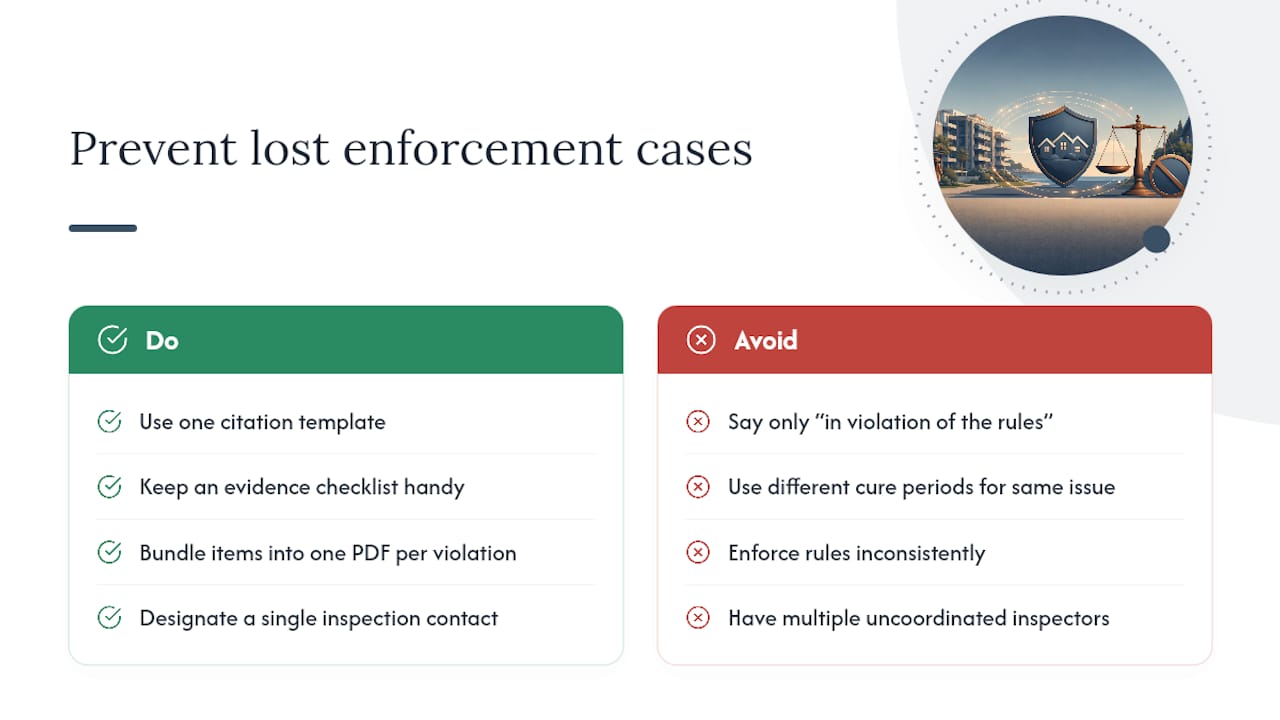
The violations I see boards lose aren’t complicated ones. They’re the ones where the citation says “in violation of the rules” instead of naming the section, or where three different letters over two years used three different cure periods for the same infraction. Inconsistent enforcement is the fastest way to hand an owner’s attorney a defense.
The fix is almost embarrassingly simple: use one template, keep an evidence checklist next to it, bundle everything into a single PDF per violation, and designate one person as the inspection contact so the same eyes are on every case. None of that requires new software or new bylaws, just discipline in how you draft.
— Blake
How HOA Letter AI Makes This Easier
Drafting a compliant STR violation letter by hand means juggling your CC&Rs, your state’s notice rules, and a blank Word document at the same time. Many boards still do exactly that, though automated drafting tools are becoming more common as an alternative to the manual template approach.
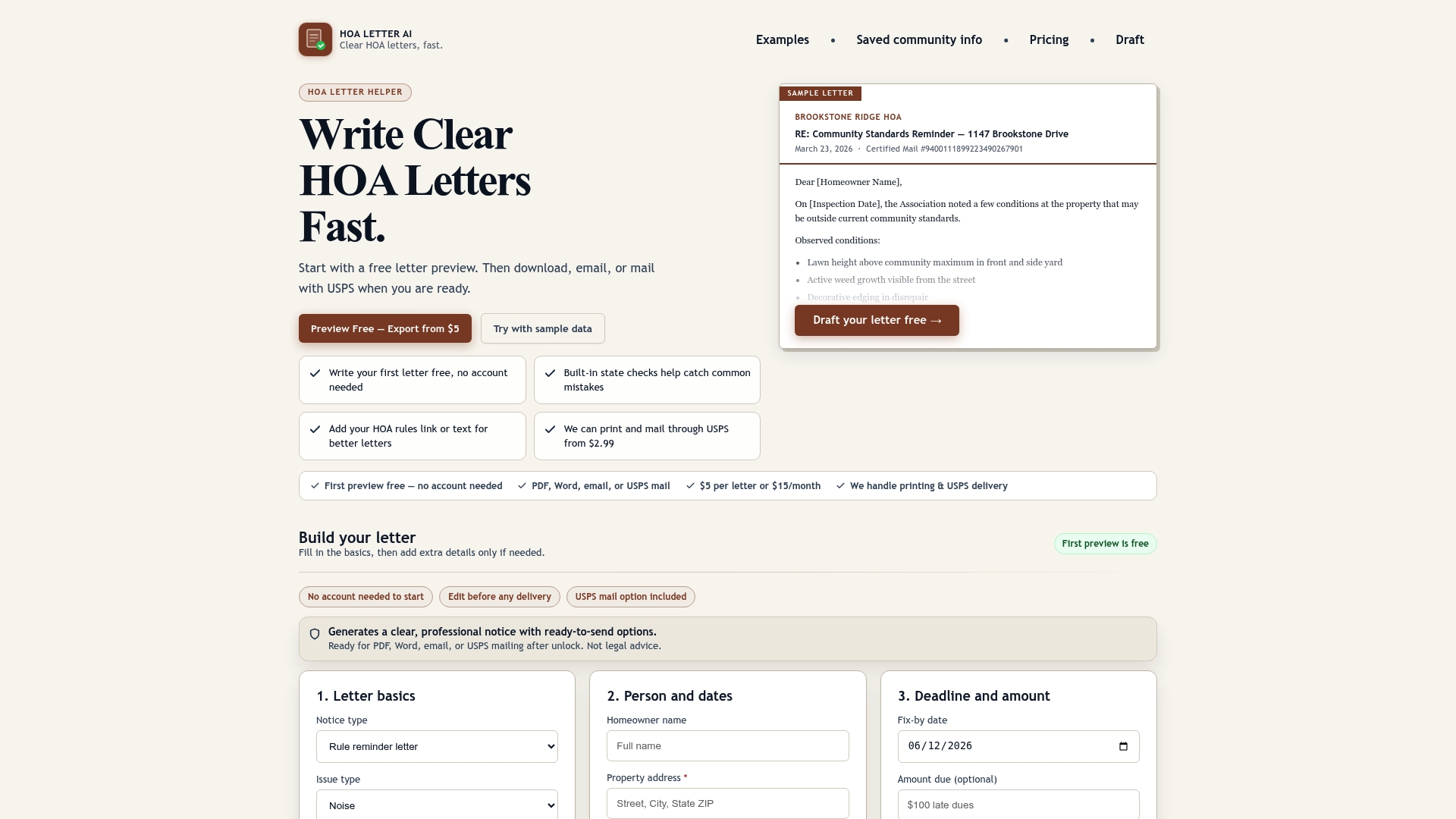
Some automated drafting tools build the state-specific rules directly into the drafting process, so the notice period, hearing language, and fine references adjust automatically based on property location. Features may include a notice-completeness checker that flags missing elements before sending, a one-page preview for review before dispatch, and mailing integration options for certified-mail proof without a post office visit. Property management teams managing multiple communities often use reusable community profiles so the correct CC&R citations populate consistently.
You can preview a sample letter for free, generate a single letter for $5, or explore the PM Starter and PM Pro plans if your team sends violation notices regularly. Start with a free preview and see exactly what a state-aware STR letter looks like before you commit to anything.
Sources
- How to Write an HOA Violation Notice (What Must Be Included) | Hivepoint Blog
- Free HOA Violation Letter Template | The HOA Guide
- Free HOA Violation Letter Template (Word Download) | Zorex
- How HOAs Can Manage Short-Term Rentals (STRs) - RealManage
- 720.305 Obligations of members; remedies at law or in equity; levy of fines and suspension of use rights — Online Sunshine
FAQ
What Must Be Included in a Short Term Rental Violation Letter?
At minimum, the letter needs owner information, an exact rule citation, a factual description of the violation, a reference to supporting evidence, a specific cure deadline, and the applicable fine schedule. Hearing and appeal instructions should also be included, especially in states like Florida that require them by statute.
How Long Should the Cure Period Be for an STR Violation?
Practitioner templates generally recommend immediate to 7 days when a guest is actively present or the listing is live, and up to 30 days for fixes that require more involved remediation. Always cross-check your governing documents and state law, since some states set minimum notice periods that override a shorter internal preference.
Does the Letter Need to Be Sent by Certified Mail?
Certified mail with return receipt is the delivery method most templates and practitioner guides recommend because it creates a dated proof-of-delivery record. Email or hand delivery can work as supplements where your governing documents allow it, but they shouldn’t replace certified mail as your primary method.
Can HOA Letter AI Generate a State-Compliant STR Violation Letter?
Yes. HOA Letter AI builds state-specific notice and hearing language into the drafting process and flags missing required elements before the letter is sent. A single letter costs $5, and management teams can access ongoing plans starting with PM Starter.
What Happens If the Owner Doesn’t Cure the Violation by the Deadline?
If the deadline passes without a cure, the typical next step is a hearing notice followed by a committee hearing, then a fine or other consequence outlined in the association’s adopted schedule. The exact sequence and timing depend on your state’s statute and your governing documents, so confirm both before scheduling the hearing.