
HOA compliance letters list specific rules because vague violation notices are legally unenforceable and routinely challenged in court. The practice of citing exact provisions from governing documents, including CC&Rs, bylaws, and rules and regulations, is not a formality. It is the foundation of every defensible enforcement action a board can take. States like Florida and California have codified this requirement into statute, and boards that skip it risk having their fines voided entirely. Understanding why HOA letters list specific rules protects both the board's authority and the homeowner's right to a fair process.
Why do HOA letters list specific rules?
HOA violation letters cite specific rules because enforcement without a named provision is legally indefensible. When a board sends a notice that says only "you violated community rules," it gives the homeowner nothing concrete to respond to and gives a court nothing concrete to uphold. Vague rule references are legally weak and routinely invalidated when homeowners challenge fines.
The governing documents that control HOA enforcement form a clear hierarchy. Federal and state law sits at the top, followed by the recorded Declaration (CC&Rs), then bylaws, and finally board-adopted rules and regulations. Every violation letter must trace its authority back through that chain. Citing the exact CC&R section or bylaw clause proves the board acted within its granted power, not beyond it.

Two states illustrate how deeply this requirement is embedded in law. Florida Statute § 720.305(2)(b) requires violation letters to include a written description of the violation, the required cure action, and the hearing date, time, and location, with at least 14 days' notice. A homeowner who cures the violation before the hearing avoids the fine entirely. California Civil Code § 5855 sets a parallel standard, requiring at least 10 days' written notice of the hearing with a precise violation description and a meaningful opportunity to respond. Failure to meet either standard weakens or eliminates fine enforceability.
These are not procedural technicalities. Statutory hearing and cure rights are homeowner protections, and specific rule citation is what makes those protections meaningful. A homeowner cannot exercise the right to cure a violation they cannot identify.
Pro Tip: *Always quote the exact text of the governing document clause in the letter, not just the section number. Quoted text removes any ambiguity about what the rule requires and makes the notice far harder to challenge.*
How does citing specific rules benefit homeowners and boards?
Specific rule citation serves both sides of the enforcement relationship, and the benefits are concrete rather than theoretical.
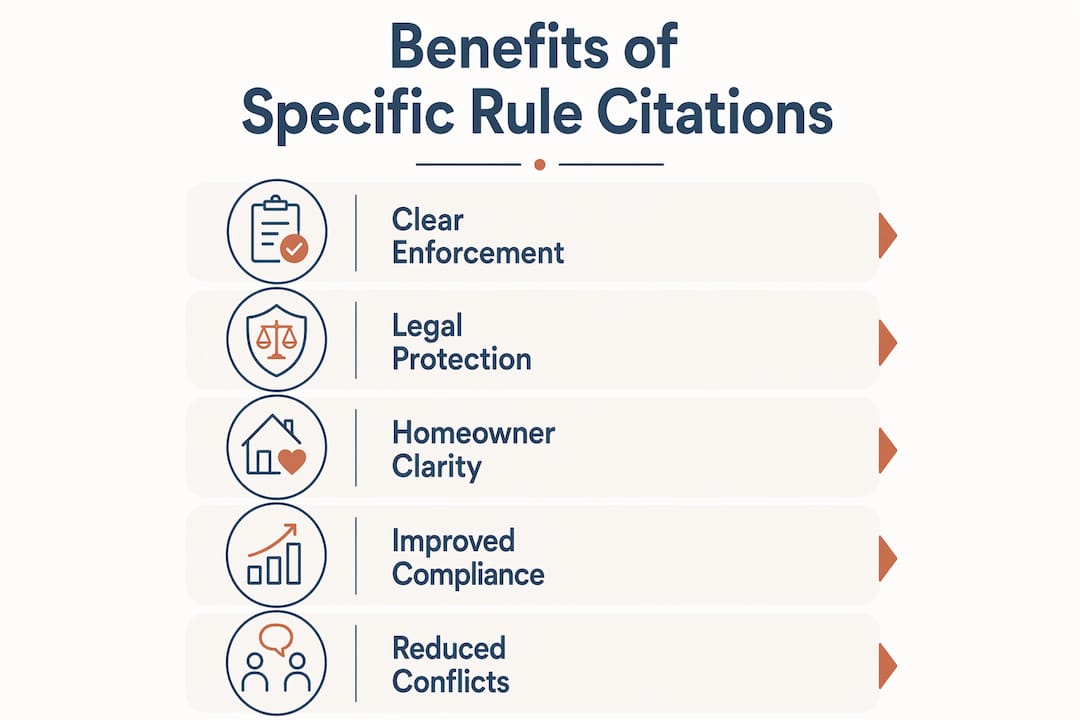
For homeowners, the most direct benefit is clarity. A letter that states "your lawn measured 8 inches on March 15, in violation of CC&Rs Section 4.3, which requires grass to be maintained at or below 4 inches" tells the homeowner exactly what is wrong, exactly what the rule says, and exactly what they need to do. That specificity turns a potentially adversarial notice into a solvable problem. Clear, measurable instructions tied to named governing provisions increase homeowner cooperation and reduce the likelihood of disputes escalating.
For boards, the benefits are legal and operational. Consider the following advantages:
- Liability protection. A letter grounded in a specific CC&R provision demonstrates the board acted within its authority. This is the primary defense against claims of overreach or selective enforcement.
- Consistent enforcement. When every notice cites the same provision for the same type of violation, the board builds a documented record of fair and uniform application of the rules.
- Reduced conflict. Notice specificity improves community relations by minimizing adversarial interactions and encouraging cooperative resolutions before fines are ever imposed.
- Stronger fine collection. If a homeowner refuses to cure and the matter goes to a hearing or court, a properly cited notice is far more likely to result in an enforceable fine than a vague one.
Pro Tip: *Keep a log of every violation notice sent, including the specific rule cited and the outcome. This record demonstrates consistent enforcement and is invaluable if a homeowner ever claims the board singled them out.*
The compliance rate improvement from specific notices is not accidental. Homeowners who understand exactly what they need to fix, and by when, are more likely to act than those who receive a general complaint with no clear path to resolution.
What common elements accompany specific rule listings in HOA letters?
A well-constructed HOA violation letter does more than name a rule. It surrounds that citation with factual context, procedural information, and clear next steps. Each element serves a specific legal or practical purpose.
The standard components of a compliant violation letter include:
- Factual description of the violation. This means objective, measurable language. Factual descriptions like "lawn measured 8 inches on March 15" are far more defensible than subjective characterizations. Dates, measurements, and photographs create a record that is difficult to dispute.
- Exact rule citation with quoted text. The letter should name the governing document, the section number, and quote the relevant language. This is the core of the notice and the element most courts and hearing committees examine first.
- Required cure action and deadline. The homeowner must know specifically what they need to do and by what date. Vague instructions like "please address this issue" are insufficient. "Mow lawn to 4 inches or below by April 1, 2026" is sufficient.
- Hearing date, time, and location. Both Florida and California statutes require this information. The hearing gives the homeowner the right to appear, present their case, and potentially avoid a fine.
- Statement of consequences. The letter should clearly state that curing the violation before the hearing prevents the fine, and that failure to cure may result in fines as specified in the board's schedule.
The table below summarizes how each element connects to its legal or practical function:
| Letter element | Purpose |
|---|---|
| Factual violation description | Creates an objective, dated record that withstands challenge |
| Exact rule citation | Establishes board authority and ties enforcement to governing documents |
| Cure action and deadline | Gives homeowner a clear, measurable path to avoid fines |
| Hearing notice | Satisfies statutory due process requirements in states like Florida and California |
| Consequence statement | Communicates stakes clearly and documents the homeowner was informed |
One detail boards frequently overlook: statutory notice timings are triggered by homeowner receipt, not the date the letter was sent. Certified mail with return receipt, or another documented delivery method, is the only way to prove the notice period started when the board intended it to.
How do specific rule citations uphold HOA authority?
Citing specific rules does more than satisfy a checklist. It is the mechanism by which a board demonstrates that its enforcement actions are grounded in legitimate authority rather than personal preference or arbitrary decision-making.
The governing document hierarchy matters here. When a board cites CC&Rs Section 6.2 rather than simply asserting a violation occurred, it is showing that the restriction was recorded with the property, agreed to by every owner at purchase, and superior to any conflicting board policy. HOA letters tie violations to the governing document hierarchy to demonstrate the board acts within its power, which directly minimizes homeowner arguments about overreach or inconsistent enforcement.
This matters most when homeowners push back. A homeowner who claims the board exceeded its authority faces a much harder argument when the notice quotes the exact CC&R provision that authorizes the enforcement action. Citing specific governing provisions reduces the likelihood a violation notice is invalidated by claims the board acted outside its power.
Conflicts between documents also arise in practice. A board rule might address something the CC&Rs cover differently, or a newer bylaw amendment might supersede an older provision. Citing the specific controlling document in the letter clarifies which rule governs the situation and prevents homeowners from pointing to a conflicting provision as a defense.
Pro Tip: *When multiple governing documents address the same issue, always cite the highest-ranking document in the hierarchy. If the CC&Rs and a board rule both cover the same violation, cite the CC&Rs. It is harder to challenge and carries greater legal weight.*
Key takeaways
HOA letters list specific rules because precise rule citation is the legal and practical foundation of enforceable, fair, and dispute-resistant community governance.
| Point | Details |
|---|---|
| Legal enforceability requires specificity | Vague notices are routinely invalidated; exact CC&R or bylaw citations are required to sustain fines. |
| State statutes mandate notice elements | Florida § 720.305 and California Civil Code § 5855 both require precise violation descriptions and cure opportunities. |
| Homeowners need clarity to comply | Specific cure actions and deadlines give homeowners a measurable path to resolve violations before fines apply. |
| Board authority depends on document hierarchy | Citing the controlling governing document proves the board acted within its granted power, not beyond it. |
| Documented delivery protects enforcement | Notice periods are triggered by receipt, not sending; certified mail or tracked delivery prevents technical failures. |
Why specificity in HOA letters is the most underrated governance tool
Most boards I have worked with treat violation letters as a necessary administrative task. They focus on getting the letter out the door rather than on what the letter actually says. That approach creates problems that show up months later, usually in a hearing room or a courtroom.
The boards that run the smoothest communities are the ones that treat every violation letter as a legal document from the first draft. They quote the CC&R text. They measure the violation and record the date. They send letters by certified mail and keep the receipts. These habits feel like extra work until the day a homeowner hires an attorney and the board's documentation holds up perfectly.
There is also a community culture dimension that gets overlooked. When homeowners receive a letter that explains exactly what rule applies, exactly what they need to fix, and exactly how to avoid a fine, most of them just fix it. The letter reads as fair rather than punitive. That perception matters enormously for long-term community cohesion. Boards that send vague, accusatory notices create resentment even when they are technically in the right.
State legislatures are also moving in one direction on this issue. Florida and California have both strengthened homeowner notice protections in recent years, and other states are following. Boards that build specificity into their enforcement process now are ahead of requirements that are likely to become more common, not less.
The most effective enforcement is the kind that rarely needs to go to a hearing because the homeowner understood the letter, believed it was fair, and resolved the issue. Specific rule citation is what makes that outcome possible.
> *— Blake*
How Hoaletterai helps boards write compliant violation letters
Drafting a violation letter that meets Florida § 720.305 or California Civil Code § 5855 requirements while citing the correct CC&R section and including every required element takes time boards often do not have.
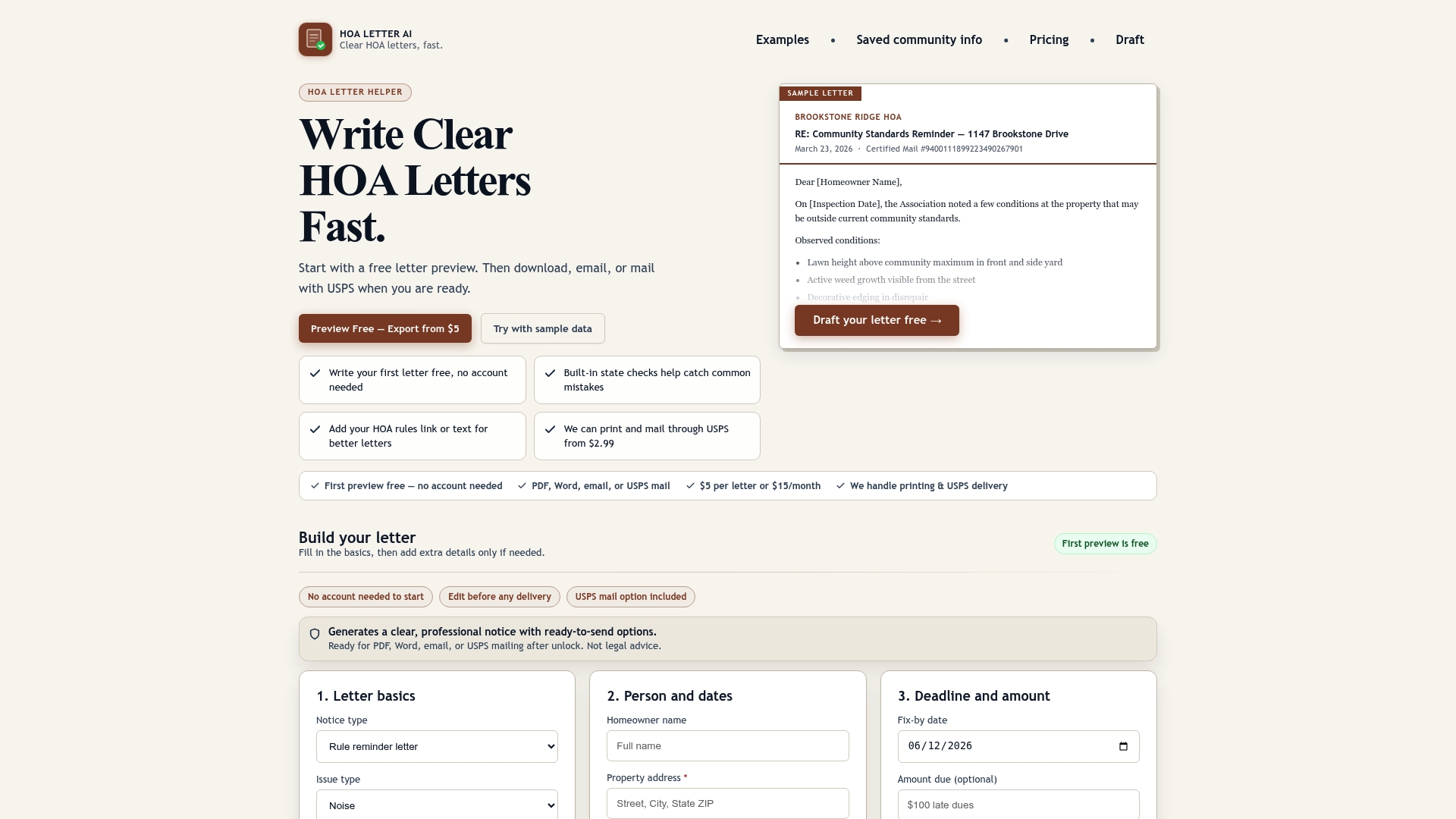
Hoaletterai generates state-compliant HOA violation letters that include exact rule citations, factual violation descriptions, cure deadlines, and hearing notices built into every template. The platform incorporates state-specific language for Florida, California, and other jurisdictions, so boards do not need to cross-reference statutes manually. Built-in checks flag missing elements before the letter is finalized. The result is a professional, legally grounded violation letter that is ready to send in minutes, with USPS mailing available directly from the platform. Boards that need a starting point can also access a free violation letter template to see exactly what a compliant notice looks like before generating their own.
FAQ
Why do HOA letters list specific rules instead of general violations?
Specific rule citations are legally required in most states and are the only way to create an enforceable notice. Vague references to "community rules" give homeowners no basis to cure the violation and give courts no provision to uphold.
What happens if an HOA sends a violation letter without citing specific rules?
A notice without a specific rule citation is procedurally defective and can be challenged successfully by the homeowner. In Florida and California, missing required elements can void the fine entirely.
Are cure periods required in HOA violation letters?
Florida Statute § 720.305 expressly requires a cure opportunity before fines can be imposed, and California Civil Code § 5855 requires a meaningful chance to respond. Most state statutes treat cure periods as a homeowner right, not a board option.
What governing documents should HOA letters cite?
Letters should cite the highest-ranking document in the governing hierarchy that addresses the violation, typically the CC&Rs or recorded Declaration. Bylaws and board rules can be cited when they apply, but CC&R provisions carry the most legal weight.
Does the method of delivering an HOA letter affect its enforceability?
Yes. Statutory notice periods are triggered by homeowner receipt, not the date the letter was sent. Certified mail with return receipt or another tracked delivery method is the standard way to document that the notice period started correctly.
Recommended
- HOA Collection Letters: A Respectful, Step-by-Step Reminder Sequence | HOA Letter AI
- How to Write an HOA Violation Letter (With a Calm, Rule-Cited Example) | HOA Letter AI
- California HOA Compliance Guide: State-Specific Rules & Violation Letter Requirements | HOA Letter AI
- HOA Letter AI — HOA Violation Letter Generator (State-Compliant)
Drafting support for HOA notices
Use the HOA letter drafter to turn this guidance into a resident-ready notice, compare reusable HOA letter templates, or review the property manager workflow for higher-volume enforcement work.