
A violation letter is a formal notice sent by property managers or HOA boards to inform tenants or homeowners of a specific breach of lease terms or community rules, requiring corrective action within a defined deadline. Understanding why property managers send violation letters matters far beyond paperwork. These notices create the legal record that protects your community, your property values, and your enforcement authority. Without them, verbal warnings evaporate, disputes escalate, and discrimination claims become harder to defend. This guide covers the core reasons, legal requirements, communication strategies, and operational impacts of violation letters for property managers and HOA board members in 2026.
Why property managers send violation letters
Property managers issue violation notices primarily to maintain community standards, enforce lease agreements, and protect public safety. The letter serves three simultaneous functions: it communicates the specific breach, specifies the corrective action required, and sets a deadline for compliance. Without this formal step, a property manager has no documented basis for escalating to fines, hearings, or eviction.

The most common triggers fall into predictable categories. Unauthorized occupants and undisclosed pets top the list, followed by property maintenance neglect such as overgrown lawns, unsecured trash, or exterior damage. Zoning breaches, noise complaints, and unauthorized structural modifications round out the most frequent reasons for sending tenant notification letters. Each of these issues, left unaddressed, compounds over time into larger legal and financial problems for the community.
Violations are typically identified through three channels: routine property inspections, neighbor complaints, and follow-up checks after prior notices. Inspections catch maintenance issues before they become code violations. Complaints from other residents document a pattern of behavior. Follow-ups confirm whether a prior notice produced the required correction. Together, these detection methods feed a consistent enforcement cycle that keeps violation letters grounded in observable facts rather than assumptions.
- Unauthorized occupants or pets not listed on the lease
- Property maintenance neglect, including lawn overgrowth, trash violations, and exterior disrepair
- Noise and nuisance complaints documented by neighbors or staff
- Unauthorized modifications to units or common areas
- Parking and vehicle violations in restricted zones
- Zoning or use violations, such as operating a business from a residential unit
Pro Tip: *Keep a violation log that records the date of detection, the source (inspection, complaint, or follow-up), and the specific rule cited. This log becomes your first line of defense if a tenant challenges the notice.*
What legal requirements govern violation letters?
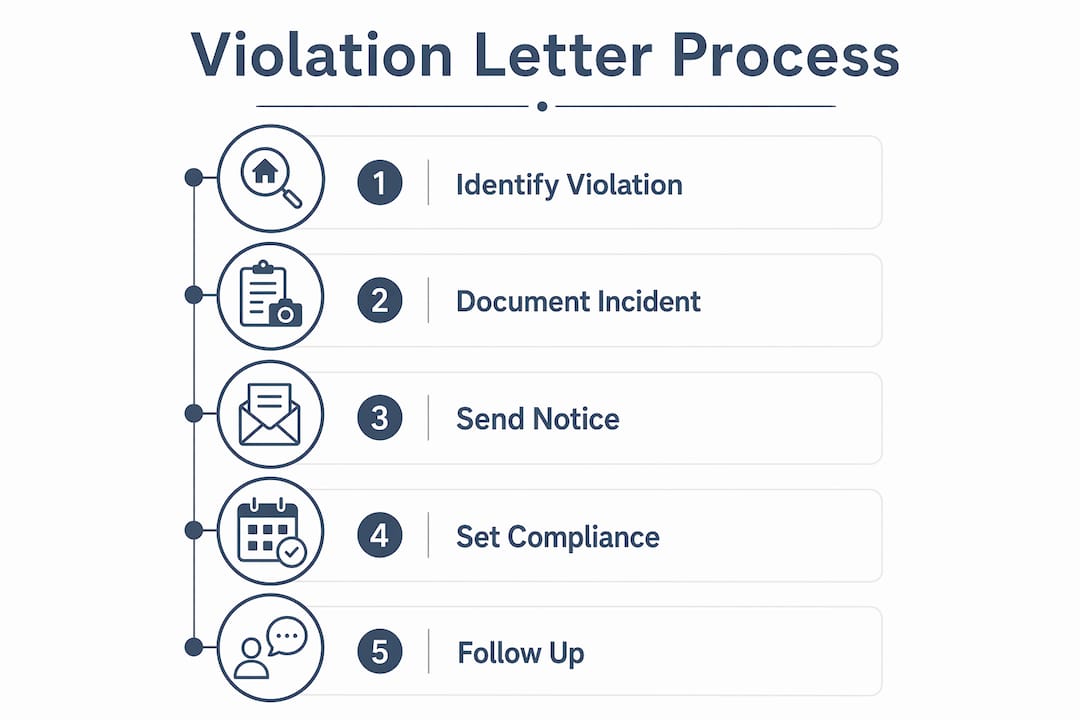
A formal violation notice must include the specific lease or ordinance section violated, a clear description of the issue, the required corrective action, and a compliance deadline ranging from 7 to 30 days. Failure to include any of these elements weakens the notice's enforceability and may require you to start the process over, delaying resolution and increasing your legal exposure.
The procedural steps for issuing a legally sound violation letter follow a clear sequence:
- Identify the specific rule or lease clause that has been violated. Cite the section number, not just a general description.
- Document the violation with evidence before sending the letter. Date-stamped photos and written inspection notes are the standard.
- Draft the notice with a factual description of the issue, the rule cited, the corrective action required, and the compliance deadline.
- Deliver via a documented method. Certified mail or timestamped delivery creates a paper trail that preempts claims of non-receipt.
- Record the delivery in your violation log, including the method, date, and recipient confirmation.
- Follow up at the deadline. Conduct a re-inspection and document the outcome, whether the violation was corrected or escalated.
> "Following repeatable, documented processes helps property managers act based on defensible evidence rather than emotion." — RentalSource
One procedural error that consistently undermines enforcement is relying on informal communication channels like text messages or email threads for violation notices. These methods produce inconsistent documentation and rarely satisfy the evidentiary standards required in a dispute or eviction proceeding. A text message saying "please clean up your yard" is not a violation notice. It is a conversation, and conversations do not hold up in court. Formal, documented delivery is the only method that preserves your legal standing.
State-specific requirements add another layer of complexity. Florida's Chapter 720 and Chapter 718, for example, impose specific notice timelines and hearing rights that differ from general landlord-tenant statutes. Property managers operating across multiple states need to verify local requirements before issuing any notice. The Florida HOA compliance guide from Hoaletterai covers these distinctions in detail for managers working in that state.
How should violation letters balance firmness with tenant relations?
Tenant communications should be calm, procedural, and objective to prevent emotional escalation and keep enforcement grounded in defensible, documented evidence. The tone of a violation letter signals to the tenant whether this is a professional process or a personal conflict. Professional tone reduces the likelihood of defensive reactions and increases the chance of voluntary compliance.
Graduated enforcement steps produce better compliance outcomes than immediate harsh penalties. Harsh penalties applied without warning increase tenant turnover and administrative stress, neither of which serves the community's long-term interests. The sequence that works looks like this:
- Step 1: Courtesy notice or friendly reminder. Informal but documented. Used for first-time, minor violations.
- Step 2: Formal violation letter. Cites the specific rule, describes the issue, and sets a compliance deadline.
- Step 3: Second notice with fine warning. Issued if the first formal letter produces no correction.
- Step 4: Fine notice. Issued after the second notice deadline passes without compliance.
- Step 5: Hearing notice. Required in many HOA jurisdictions before fines can be levied or escalation to eviction begins.
- Step 6: Eviction proceedings. The last resort, reserved for repeated or severe violations.
Property managers should also recognize that violations often feel personal to tenants. A notice about a pet or a cluttered patio can trigger defensiveness or anxiety. Responding to that reaction with additional informal pressure, such as follow-up texts or verbal warnings, muddies the documentation and weakens your position. Stick to the formal process and let the letter do the work.
Pro Tip: *When drafting a violation letter, use the HOA violation notice checklist to confirm every required element is present before sending. Missing one item can invalidate the notice entirely.*
What practical impact do violation letters have on operations?
Violation letters support property values and reduce long-term legal risks, but consistent enforcement is the variable that determines whether those benefits materialize. Inconsistent enforcement, where some residents receive notices and others do not for the same violation, creates discrimination claims and exposes the association to liability. The operational value of violation letters depends entirely on the discipline of the process behind them.
The table below compares the outcomes of structured versus unstructured enforcement approaches:
| Factor | Structured enforcement | Unstructured enforcement |
|---|---|---|
| Documentation quality | Complete, date-stamped, legally defensible | Incomplete, informal, difficult to produce in disputes |
| Discrimination risk | Low, because rules apply uniformly | High, because selective enforcement invites claims |
| Tenant compliance rate | Higher, due to clear expectations and deadlines | Lower, due to ambiguity and inconsistent follow-through |
| Property value protection | Stronger, because standards are maintained visibly | Weaker, because violations accumulate unchecked |
| Administrative burden | Predictable and manageable with templates | Unpredictable and time-consuming without systems |
Automation reduces follow-up inquiries by 40 to 50 percent, freeing property managers to focus on complex violations that require judgment rather than routine processing. That figure reflects a real operational shift. When routine notices go out on schedule with consistent formatting and documented delivery, the volume of confused or defensive tenant calls drops significantly. Managers spend less time explaining what a notice means and more time resolving the underlying issues.
The risk of overusing violation letters is real. Communities that issue notices for trivial infractions without graduated warnings create a climate of surveillance rather than cooperation. Residents who feel targeted disengage from community life and become more likely to challenge notices formally. The goal of property rules enforcement is compliance, not punishment. Letters that reflect that goal produce better outcomes than letters that feel punitive.
Key takeaways
Violation letters are the legal and operational backbone of property rules enforcement, and their effectiveness depends on consistency, documentation, and graduated communication.
| Point | Details |
|---|---|
| Core purpose of violation letters | Formally notify tenants of breaches, specify corrective actions, and set enforceable deadlines. |
| Legal requirements | Cite the specific rule violated, document with evidence, and deliver via certified or timestamped mail. |
| Graduated enforcement | Start with courtesy notices and escalate to fines and hearings only after formal notices go unaddressed. |
| Consistent application | Apply rules uniformly across all residents to protect against discrimination claims and maintain community standards. |
| Automation advantage | Automated notice systems reduce follow-up inquiries significantly and free managers for complex compliance work. |
What I've learned about violation letters after years in property management
The biggest mistake I see property managers make is treating violation letters as a last resort rather than a first formal step. By the time a manager sends a written notice, the situation has often already escalated through weeks of informal warnings, text messages, and verbal conversations. None of that history is documented. None of it is defensible. The letter arrives feeling punitive because the tenant has no record of prior warnings, and the manager has no record of prior attempts.
The managers who handle enforcement best treat the first formal notice as a routine, professional communication, not a confrontation. They send it early, they send it consistently, and they send it the same way every time. That consistency is what protects them legally and what actually changes tenant behavior over time.
I also think the industry underestimates how much the format and tone of a letter affects compliance. A letter that reads like a legal threat produces defensiveness. A letter that reads like a clear, professional notice from an organization that applies its rules fairly produces action. The difference is not just tone. It is the signal the letter sends about whether the process is personal or procedural.
The shift toward purpose-built tools for generating state-aware drafts you review is the most practical development I have seen in this space. Writing a legally sound violation letter from scratch for every incident is time-consuming and error-prone. Templates built around specific state requirements remove the guesswork and make consistency achievable at scale.
> *— Blake*
How Hoaletterai simplifies compliant violation letter generation
Drafting a legally sound violation letter from scratch for every incident is where most property managers lose time and introduce errors. Hoaletterai addresses this directly with a violation letter generator that produces state-aware, rule-cited notices in minutes, not hours.

The platform includes customizable templates for the full enforcement sequence, from the initial HOA warning letter through fine notices and hearing invitations. Built-in checks flag missing elements before you send, and USPS mailing is available directly from the platform. For HOA boards and property managers who handle multiple communities or high violation volumes, Hoaletterai removes the bottleneck between identifying a violation and getting a compliant notice out the door. Explore the full template library to find notices built for your specific enforcement needs.
FAQ
What is the main purpose of a violation letter?
A violation letter formally notifies a tenant or homeowner of a specific breach of lease or community rules, specifies the corrective action required, and sets a compliance deadline. It creates the legal record needed to support escalation if the issue goes unresolved.
How long should a compliance deadline be in a violation letter?
Compliance deadlines in violation letters generally range from 7 to 30 days, depending on the severity of the violation and applicable state or local law. More serious violations may carry shorter deadlines, while maintenance issues typically allow more time.
Can a text message serve as a violation notice?
A text message does not meet the documentation standards required for an enforceable violation notice. Informal channels weaken legal standing in disputes; certified mail or a timestamped delivery method is required.
What happens if a property manager skips the graduated enforcement steps?
Skipping graduated steps and applying immediate harsh penalties increases tenant turnover and raises the risk of legal challenges. Graduated enforcement produces higher compliance rates and fewer disputes than zero-tolerance approaches.
How do violation letters protect against discrimination claims?
Applying violation notices consistently across all residents, using the same documented process for every comparable infraction, is the primary defense against discrimination claims. Selective enforcement, where some residents receive notices and others do not for identical violations, is the most common source of fair housing complaints in HOA and rental communities.
Recommended
- How to Write an HOA Violation Letter (With a Calm, Rule-Cited Example) | HOA Letter AI
- Notice of Non-Compliance Property: What Owners Must Know | HOA Letter AI
- Florida HOA Compliance Guide: Violation Letters Under Chapter 720 & 718 | HOA Letter AI
- HOA Violation Letter Template (Free Download) — State-Aware Drafting Guide | HOA Letter AI