
Send a concise, fact-based initial notice that cites the exact CC&R section, describes what your inspector observed, and sets a clear cure deadline. Before you use the word “prohibited” for a political or flag sign, check your state’s statute first. Ready-to-adapt templates for every stage of this process are below.
TL;DR:
- Enforcement letters must cite the exact rule, include specific measurements and deadlines, and be delivered with proof of mailing to withstand disputes.
- Political signs, flags, and for-sale signs are protected by state and federal law, requiring enforcement based on size, placement, and timing, not content.
- Before sending notices, verify the rule’s existence, correct citation, and enforceability under current laws to avoid legal challenges.
- Document violations with photos, measurements, and delivery records, and retain the files until violations are fully resolved.
- Proceed with fines only after a proper progression of notices, hearings, and written notices, ensuring all actions are consistent and legally compliant.
HOA Letter AICreate Clearer HOA Violation LettersHOA Letter AI combines guided drafting, state-specific context, community rules, and built-in checks for professional compliance notices.Create a compliance letter
Table of Contents
- Ready-to-Use Yard Sign Violation Letter Templates
- What to Check Before Sending: CC&Rs and State Law
- Essential Elements Every Yard Sign Violation Letter Needs
- Documenting the Violation Before You Mail Anything
- Handling Political Signs, the Flag, and For-Sale Signs
- From Deadline to Fine: The Escalation Sequence
- Why the Letter’s Tone Matters as Much as Its Content
- How HOA Letter AI Builds State-Aware Sign Violation Letters
- Sources
Ready-to-Use Yard Sign Violation Letter Templates
You don’t need to write these from scratch, and you shouldn’t. Below are three templates covering the standard enforcement arc, plus quick variants for signs that carry extra legal weight.
1. Initial notice template
Dear [Homeowner Name], On [inspection date], a board representative observed a sign at [address] that appears to violate [CC&R Article/Section number], which states: “[quote the rule].” The sign observed was [description: size, location, content type, e.g., “a 4-foot political sign in the front setback”]. Please remove or bring the sign into compliance by [date, typically 7 to 14 days out]. If you believe this notice was issued in error, contact [board contact] before the deadline.
2. Follow-up notice template
Dear [Homeowner Name], Our records show the violation noted on [original date] regarding [CC&R section] remains uncorrected as of [reinspection date]. Failure to cure by [new deadline] may result in a hearing before the board and the possibility of fines under [governing document/state citation]. You have the right to request a hearing before any fine is imposed; contact [board contact] by [date] to schedule one.
3. Final notice template
Dear [Homeowner Name], This is the final notice regarding the unresolved violation of [CC&R section] at [address]. If the sign is not removed or corrected by [date], the board will proceed to [hearing/fine schedule/lien process per governing documents]. You have the right to appear at a hearing scheduled for [date/time] to present your position. This letter and prior notices are retained in the association’s enforcement file.
Each template needs customization notes filled in before mailing: exact measurements, the specific rule number, and a deadline that matches what your CC&Rs actually require, not just what feels fair.
A few variants deserve different wording:
- Political signs: Avoid framing this as a ban. Cite size, setback, or timing limits instead of content restrictions.
- U.S. flag: Never demand removal outright. Reference only reasonable placement or size rules.
- For-sale and security signs: These are usually exempt or protected by real estate law; confirm before citing a violation.
Check your state’s specific protections before sending any political or flag variant. If you skip that step, you risk sending a notice you can’t legally enforce.
What to Check Before Sending: CC&Rs and State Law
Before a letter goes out, confirm three things: the rule exists in writing, it’s cited correctly, and it’s still enforceable under your state’s current law.
- Locate the exact governing document provision and quote the section number verbatim rather than paraphrasing.
- Confirm when that rule was adopted or amended. A rule quietly changed two years ago and never mailed to owners is weak ground for enforcement.
- Check whether your state restricts HOA authority over political or flag signage. California Civil Code § 4710 blocks blanket bans on noncommercial signs, and many states, including Texas, protect political signs during defined windows around elections.
- Confirm federal protection for the American flag applies to what you’re citing. Federal law bars an outright flag ban, though reasonable size and placement rules survive.
Pro Tip: If the rule’s language is ambiguous, or if you suspect the board has let similar signs slide for other homeowners, get counsel involved before the letter goes out, not after the homeowner pushes back.
Selective enforcement is the single easiest way to lose a dispute. If a similar sign sat unchallenged three doors down for six months, that pattern will surface eventually.
Essential Elements Every Yard Sign Violation Letter Needs
A letter missing any of these pieces is an invitation to contest. Include them every time:
- Homeowner’s name and property address.
- Date the notice is issued.
- Specific factual description of the violation, ideally with measurements, location, and inspection notes rather than subjective language.
- The exact CC&R or rule citation, including section number.
- A cure deadline with a specific date, not “promptly” or “soon.”
- Clear consequences if the deadline passes uncured.
- Instructions for requesting a hearing or appeal.
- Signature block naming the signer’s role and authority (board president, management agent, etc.).
Vague language like “the yard appears unkempt” invites a challenge because it’s subjective and unprovable. Specific facts hold up: “a 3-foot by 5-foot political sign placed in the front setback, photographed on [date]” is a fact a homeowner can’t easily dispute. Best practice guidance from HOA management sources consistently backs quoting the governing document rather than summarizing it.
Save an enforcement-file checklist for every case:
- Copy of the letter sent
- Photos with date stamps
- Proof of delivery
- Any homeowner reply
- Hearing notes, if applicable
Roughly one in three HOA disputes that escalate to a hearing hinge on whether the original notice actually named the rule and gave a real deadline. Skipping either detail is the fastest way to lose ground later.
Documenting the Violation Before You Mail Anything
Photos and delivery proof are what turn a letter into a case file that survives a challenge. Build the habit now, before you need it.
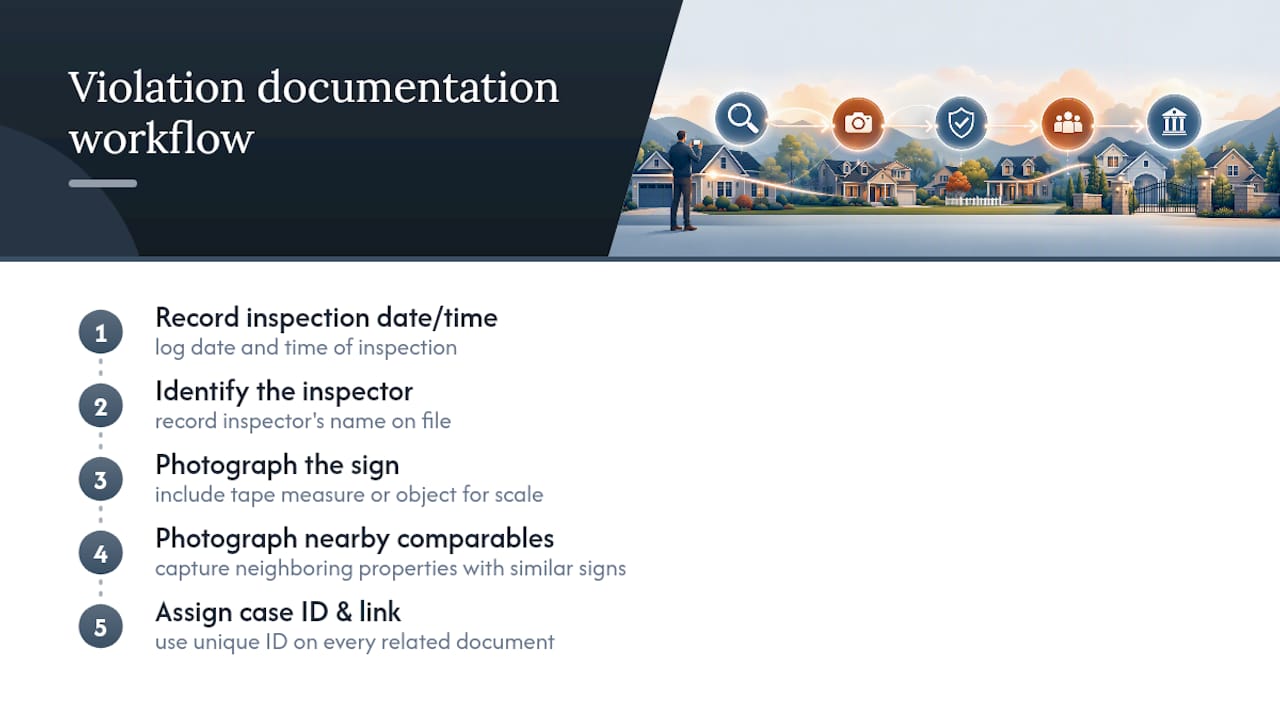
During inspection, record the date, time, and inspector’s name. Take photos that include a tape measure or comparable object for scale when sign size is the issue, and photograph nearby properties with similar signage for comparison. Assign a unique case ID to the violation and use it on every document tied to that address.
For delivery, certified mail with return receipt remains the strongest option. Pair it with an email copy when your governing documents allow electronic notice, and log every send date and delivery confirmation.

Pro Tip: Keep a simple spreadsheet with case ID, address, mail date, and return receipt number. It takes five minutes per case and saves hours if a homeowner disputes when or whether they received anything.
Retain the full file, including the landscaping violation letter if the sign issue overlaps with a yard-maintenance complaint, until the violation is cured and the file is formally closed.
Handling Political Signs, the Flag, and For-Sale Signs
These three categories cause more legal trouble than every other sign type combined, mostly because boards treat them like ordinary compliance issues.
The Freedom to Display the American Flag Act bars associations from outright prohibiting a homeowner’s flag, though reasonable size and mounting restrictions still apply. California’s Civil Code § 4710 goes further for noncommercial signs generally, preventing blanket bans while allowing limits on size, number, and placement. Texas and several other states protect political signs specifically during election windows, often starting weeks before election day and extending briefly after.
The practical fix is to rewrite your enforcement language around manner, not message. Cite square footage, setback distance, or the number of signs permitted per lot rather than the sign’s content or viewpoint.
If a homeowner challenges a notice as viewpoint discrimination or a violation of protected flag or political-sign rights, the safest move is to pause escalation immediately and offer an internal hearing before pushing toward fines.
If a dispute surfaces, document whether similar signs elsewhere in the community received the same notice. Consistency is your best defense against a selective-enforcement claim, and its absence is your biggest liability.
From Deadline to Fine: The Escalation Sequence
Once a cure deadline passes uncured, most governing documents and state laws expect a specific sequence, not a jump straight to fines.
- Reinspect the property to confirm the violation is still present.
- Send notice of a scheduled hearing, giving the homeowner a real chance to respond.
- Hold the hearing and let the board vote on the outcome.
- Issue the fine only after that vote, with written notice of the amount and basis.
- Move to collection or, in persistent cases, a lien if the fine goes unpaid.
Cure periods commonly run 7 to 30 days depending on the violation’s severity and your governing documents; a first-time sign issue usually warrants the shorter end. Notice and hearing rights are frequently required by state law before any fine takes effect, so document each step in writing to avoid a procedural challenge later.
Why the Letter’s Tone Matters as Much as Its Content
Boards that treat every notice like a legal threat generate more disputes, not fewer. A factual, respectful letter that names the rule and the deadline resolves most cases without a hearing ever happening.
The boards that struggle most are the ones that skip the state-law check because a template looked complete. It wasn’t. Consistency in enforcement and clarity in language cost you nothing and save you from the disputes that actually reach a courtroom, as detailed in SEO for Property Management: Boost Your Occupancy - Todd Stager.
— Blake
How HOA Letter AI Builds State-Aware Sign Violation Letters
The tool helps generate letters that consider relevant state rules on political signs, flags, and for-sale signage, reducing uncertainty about enforcement language. It can assist with including required elements such as rule citation, cure deadline, and hearing rights before sending.
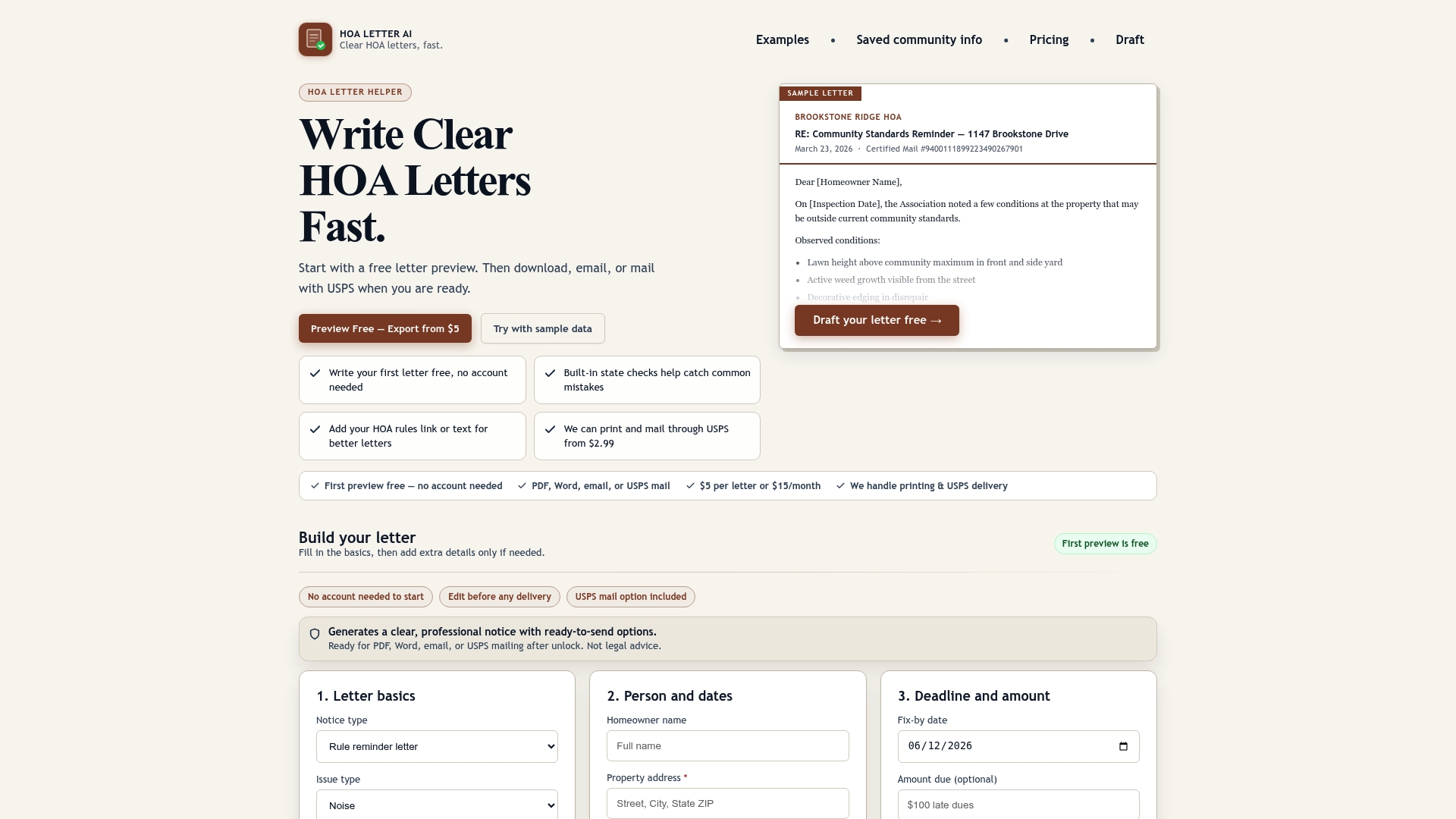
Users can preview letters, adjust specifics to match inspection notes, and select delivery options when ready to send. Letters and delivery records can be organized together for easier enforcement tracking. Start with the HOA warning letter template for your first notice, or check your state’s specific rules on the HOA laws by state page before you cite a rule you’re not sure holds up.
This article is general information, not a substitute for advice from a qualified lawyer. Consult a qualified legal professional about your own circumstances before acting on anything here.
Sources
- How to Fight HOA Signs & Flags Violations
- California guidance on political signs (Davis-Stirling analysis)
- HOA violation letter template & process guidance
- Writing violation notices: a guide for HOA boards