Yes, an HOA can suspend amenity access, but only when three conditions line up: the board has clear authority to do it, the homeowner got proper written notice with a chance to cure, and (in many states) an independent hearing happened first. Skip any of those, and the suspension is likely unenforceable. The board also can’t touch ingress, egress, parking, or essential utilities as part of the punishment, and Fair Housing rules apply the moment a disability or accommodation request enters the picture.
TL;DR:
- An HOA can suspend amenity access only if it has explicit authority, proper written notice, and an independent hearing in most states; skipping any step risks invalidating the suspension.
- Suspensions only target shared facilities like pools or clubhouses and never restrict basic utilities or ingress, egress, which are protected habitability rights.
- Florida law requires at least 14 days’ notice and a vote by an independent committee, while California and other states have similar procedural standards based on governing documents.
- Clear, detailed notices outlining violations, cure steps, and hearing info are crucial to defending against legal challenges and ensuring due process.
- Curing a violation before the hearing generally prevents suspension or fines, making documented resolution the most effective defense for homeowners.
HOA Letter AICreate Clearer Suspension NoticesHOA Letter AI helps boards and property managers draft professional compliance notices with state-specific context, community rules, and built-in checks.Create a compliance letter
Table of Contents
- What Counts as an Amenity Suspension Under HOA Rules?
- What Legal Steps Must an HOA Follow Before Suspending Amenities?
- When Should a Board Actually Use an Amenity Suspension?
- How Should a Board Handle the Notice and Hearing Process?
- What Should a Compliant Amenity Suspension Notice Say?
- What Can a Homeowner Do to Challenge or Stop a Suspension?
- How Can Boards Reduce Disputes Over Amenity Suspensions?
- Does an Amenity Suspension Affect a Home Sale or Mortgage?
- Who Actually Sends the Notice, the Board or the Management Company?
- Is an Amenity Suspension the Same as a Fine?
- Do Amenity Suspension Rules Differ From State to State?
- Why Due Process Matters More Than the Penalty Itself
- Draft a Compliant Notice Without Starting From a Blank Page
- Sources
- FAQ
What Counts as an Amenity Suspension Under HOA Rules?
An amenity suspension is a board’s decision to cut off a homeowner’s access to shared community facilities as a consequence for a rule violation. It’s a targeted penalty, not a lockout from the property itself.
The amenities usually on the table:
- Swimming pools and spas
- Clubhouses, fitness centers, and party rooms
- Tennis or pickleball courts
- Gated-access transponders or key fobs
- Marina slips, dog parks, and similar shared recreation spaces
Suspensions can hit owners, tenants, or guests, depending on who committed the violation and what the governing documents say about standing. Community handbooks typically state that a lease transfers amenity use rights to the tenant for the lease term, which means a renter’s amenity privileges usually rise and fall with the owner’s account standing, not the renter’s own conduct alone.
What a suspension can never do is block the homeowner’s actual ability to get in and out of their house, park in their driveway, or receive water, electricity, or trash service. Those aren’t amenities. They’re basic habitability, and courts treat them differently. In practice, some boards threaten creative penalties like shutting off a resident’s community cable feed, but that kind of remedy is rare, largely untested in court, and logistically difficult for most associations to pull off anyway.
What Legal Steps Must an HOA Follow Before Suspending Amenities?
Before a board can pull anyone’s pool key, it needs three things in place: documented authority, a compliant written notice, and (where required) a hearing before a body that isn’t just the board rubber stamping itself.
The standard checklist looks like this:
- Authority. The CC&Rs, bylaws, or rules must actually grant the power to suspend amenity use as a penalty. If the documents are silent, the board is on shaky ground.
- Written notice. The homeowner has to receive a notice describing the violation, the cure period, and the hearing details, delivered in a way the association can prove.
- Minimum advance period. Most statutory schemes require the notice to arrive a set number of days before any hearing.
- Independent hearing body. In states that require it, the group deciding whether to impose the suspension can’t be the same people who wrote the notice.
Florida is the clearest example. Under Fla. Stat. § 720.305(2), an owner must get at least 14 days’ written notice of the right to a hearing, and that hearing goes before a committee of at least three members who aren’t officers, directors, or employees of the association. If the committee doesn’t approve the fine or suspension by majority vote, it doesn’t happen.
Statistic Callout: Florida law requires a minimum notice period and an independent committee before a fine or suspension can take effect, and curing the violation before the hearing bars the penalty entirely.
California’s Davis-Stirling framework works on a similar principle: an association can suspend common-area privileges only if its own disciplinary policy authorizes it, and that authority still has to sit inside the boundaries of state law and the governing documents. Skip a required step in either state, and the fine or suspension can be voided outright if challenged.
When Should a Board Actually Use an Amenity Suspension?
Suspension works best as a targeted response, not a first move. It fits situations where lighter enforcement already failed or where the violation is serious enough to justify skipping straight to it.
Reasonable use cases:
- A homeowner ignored a warning letter and fine for an uncured CC&R violation, like unauthorized construction or a persistent noise complaint.
- A tenant or guest repeatedly broke posted amenity rules (glass containers at the pool, unsupervised minors in the fitness center) after prior warnings.
- An owner is significantly delinquent on assessments and the governing documents expressly tie amenity access to account standing.
Where boards get into trouble is enforcing selectively, closing an amenity indefinitely with no defined end date, or skipping the hearing because “everyone already knows what happened.” Selective enforcement, meaning punishing one owner for something the board lets others slide on, is one of the fastest ways to end up in a discrimination or breach-of-fiduciary-duty complaint. Fair Housing issues surface, too, if a suspension effectively denies a resident with a disability access to an accommodation they’re entitled to.
Pro Tip: Keep a simple enforcement log showing every similar violation and how the board handled each one. If you can’t prove you treated comparable cases consistently, a homeowner’s selective-enforcement defense gets a lot stronger.
How Should a Board Handle the Notice and Hearing Process?
A defensible suspension follows a specific order, and skipping ahead is where most procedural challenges start.
- Confirm authority. Check the CC&Rs, bylaws, rules, and any applicable state statute before drafting anything.
- Draft the notice. Include the specific violation, the exact steps to cure it, the hearing date, time, location or dial-in link, and who to contact with questions.
- Deliver it properly. Certified mail, email with delivery confirmation, or both, timed to meet your state’s minimum notice window.
- Hold the hearing. An independent committee, not the board itself in most states, hears the case and votes.
- Document and execute. Record the vote, define the suspension’s scope and end date, and notify the owner in writing once it’s official.
Committee rules matter more than boards often realize. A proper hearing committee usually excludes officers, directors, employees, and their close family, and many statutes allow the committee to meet remotely as long as the owner can still participate. Keep these on file for every case:
- Proof of notice delivery
- Hearing minutes and committee roster
- The vote outcome
- The final suspension notice with start and end conditions
A well-built notice checklist keeps this from becoming a scramble every time a violation comes up.
What Should a Compliant Amenity Suspension Notice Say?
The notice is the document that either protects the association or hands the homeowner an easy win in a dispute. Every field matters.
- Recipient and property identification. Name, address, and unit or lot number.
- Violation description. Specific rule or CC&R section violated, with dates.
- Cure steps. Exactly what the homeowner needs to do, and by when, to avoid the suspension.
- Hearing logistics. Date, time, location or remote access details, and a contact person.
- Consequences. What happens if the violation isn’t cured and the committee votes to proceed.
Proof of delivery matters as much as the content. Keep certified mail receipts, email delivery confirmations, and hearing minutes together in one file per property, since that record is what wins or loses a dispute months later.
Pro Tip: Build one enforcement file per parcel from day one: inspection notes, warning letters, delivery receipts, hearing minutes, and the final notice. Scattering these across email threads and file cabinets is how boards lose otherwise solid cases.
HOA Letter AI’s state-specific notice guidance and its warning letter template are built around this exact checklist, so boards aren’t reinventing the notice format every time a new violation comes up.
What Can a Homeowner Do to Challenge or Stop a Suspension?
Getting a suspension notice isn’t the end of the story. Homeowners have real leverage, especially in the window before the hearing.
- Cure it immediately if possible. Fix the violation, photograph or document the fix, and send written proof to the association before the hearing date.
- Check the notice for defects. Missing cure steps, an unclear hearing date, or a committee that includes a board member are all grounds to challenge.
- Request the record. Ask for the specific rule cited, prior warnings, and the committee’s composition.
- Escalate if needed. Internal dispute resolution, then mediation or arbitration, then a Fair Housing complaint with HUD if discrimination is suspected, then an attorney if none of that resolves it.
Curing before the hearing is the single strongest move available. Documented cure before the vote generally bars the fine or suspension entirely under statutes like Florida’s, which makes it worth prioritizing over an immediate legal fight.
How Can Boards Reduce Disputes Over Amenity Suspensions?
Most suspension disputes trace back to inconsistency, not malice. A board that treats every violation the same way rarely ends up in court.
- Adopt a written enforcement policy tied directly to the CC&Rs and published fine schedule, so owners can see the rules in advance.
- Keep every delivery receipt, hearing minute, committee roster, and vote record in one place per property.
- Use state-aware templates and train managers or volunteer board members on the notice requirements before they draft anything.
- Follow a graduated process, warning, then fine, then hearing, then suspension, rather than jumping straight to the harshest penalty available.
Pro Tip: Route disputes through mediation before litigation whenever the governing documents allow it. It’s cheaper, faster, and it keeps neighbors from becoming courtroom opponents. A graduated enforcement approach also gives homeowners multiple chances to self-correct before things escalate.
Does an Amenity Suspension Affect a Home Sale or Mortgage?
An open amenity suspension rarely shows up as a line item on a title report, but it still complicates a sale. Buyers and lenders typically request an estoppel letter or resale certificate from the association, and that document usually discloses outstanding violations, unpaid assessments, or active enforcement actions tied to the property.
If a suspension stems from a delinquency, the bigger issue isn’t the pool access. It’s the unpaid balance itself, since that debt often needs to be resolved at closing regardless of whether the amenity restriction is lifted first. A lender underwriting the buyer’s mortgage may flag an open dispute or lien as a condition to clear before funding, which can delay closing by weeks.
Sellers in this position have a straightforward fix: cure the underlying violation, get written confirmation the suspension is lifted, and make sure that confirmation is part of the resale package. An association that’s sloppy about documenting reinstatement creates unnecessary friction for a seller who did everything right. This is one more reason boards benefit from clean recordkeeping. A one-line email confirming “suspension lifted as of [date]” can save a closing from falling apart over a $200 fine that was paid months ago.
Who Actually Sends the Notice, the Board or the Management Company?
The board holds the legal authority to impose a suspension. The property management company, when one exists, usually handles the mechanics: drafting the notice from board-approved language, mailing or emailing it, and tracking delivery confirmations.
That division matters because a management company generally can’t decide on its own to suspend someone’s amenity access. It can flag violations, prepare paperwork, and coordinate the hearing logistics, but the vote to approve a fine or suspension has to come from the board or the independent hearing committee the statute requires. A notice that goes out on management company letterhead without board authorization behind it is vulnerable to challenge on exactly that basis.
Self-managed associations skip this layer entirely, which means volunteer board members are doing the drafting themselves, often without legal training. That’s precisely where procedural mistakes creep in: a missed notice deadline, a committee that includes a board member, or a notice missing required cure language. Whether a management company is involved or not, the underlying authority and procedure requirements stay identical. The paperwork trail just gets a little more complicated with an extra party in the loop, which is exactly the situation where a documented, repeatable template matters most.
Is an Amenity Suspension the Same as a Fine?
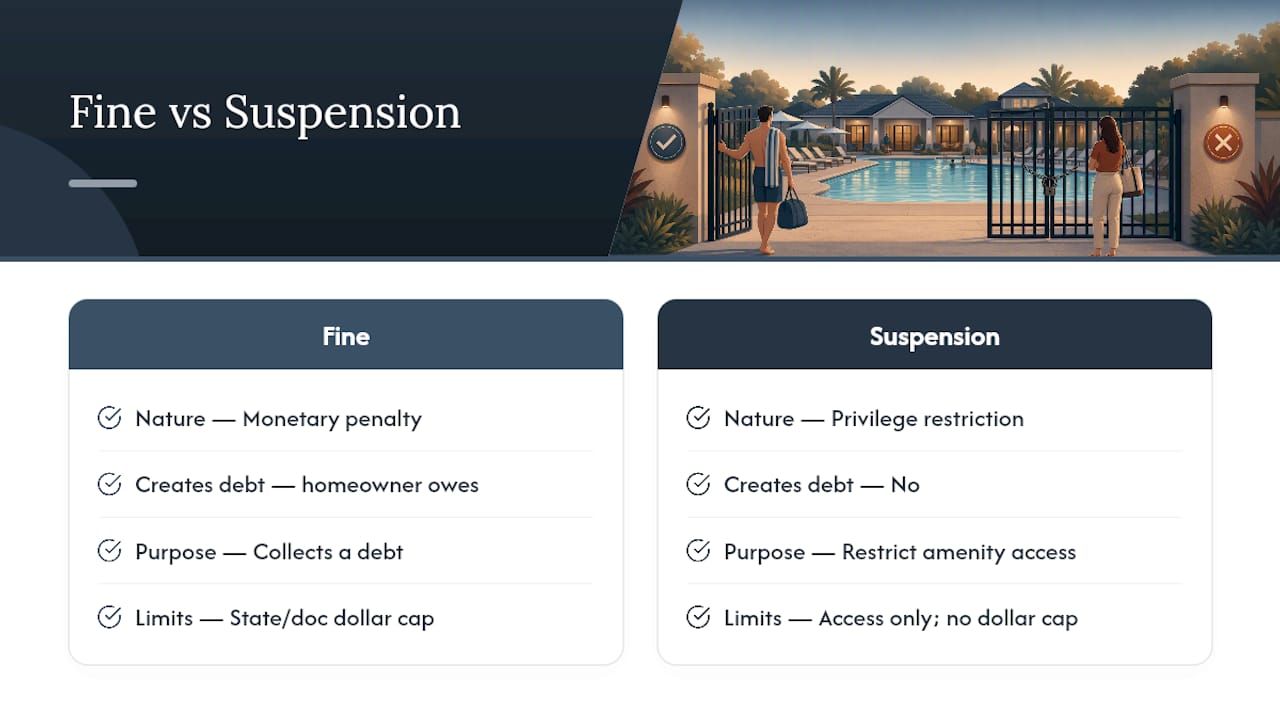
No. A fine is a monetary penalty. An amenity suspension is a restriction on privileges. Associations often use them together, but they’re legally distinct tools with different triggers and different limits.
A fine typically has a dollar cap set by state law or the governing documents, and it becomes a debt the homeowner owes the association. A suspension doesn’t create a debt at all. It simply removes access to a facility until the violation is cured or the suspension period ends. Some governing documents allow a board to impose both for the same violation, a fine plus a suspension, while others require choosing one enforcement path per infraction.
The practical difference matters for homeowners deciding how to respond. A fine can often be disputed or negotiated after the fact, and unpaid fines don’t typically justify shutting off water or electricity, no matter how tempting that leverage might look to a frustrated board. A suspension, once lifted through cure, simply ends. There’s no residual penalty unless the violation triggered a separate fine alongside it. Confusing the two categories is a common mistake among first-time board members who assume suspending amenities is just a way to “collect” an unpaid fine faster. It isn’t. The suspension addresses access; the fine addresses the debt. They resolve on separate tracks, and a board that conflates them risks applying a fine-recovery tactic (like refusing amenity access) in a way the governing documents never actually authorized for that purpose.
Do Amenity Suspension Rules Differ From State to State?
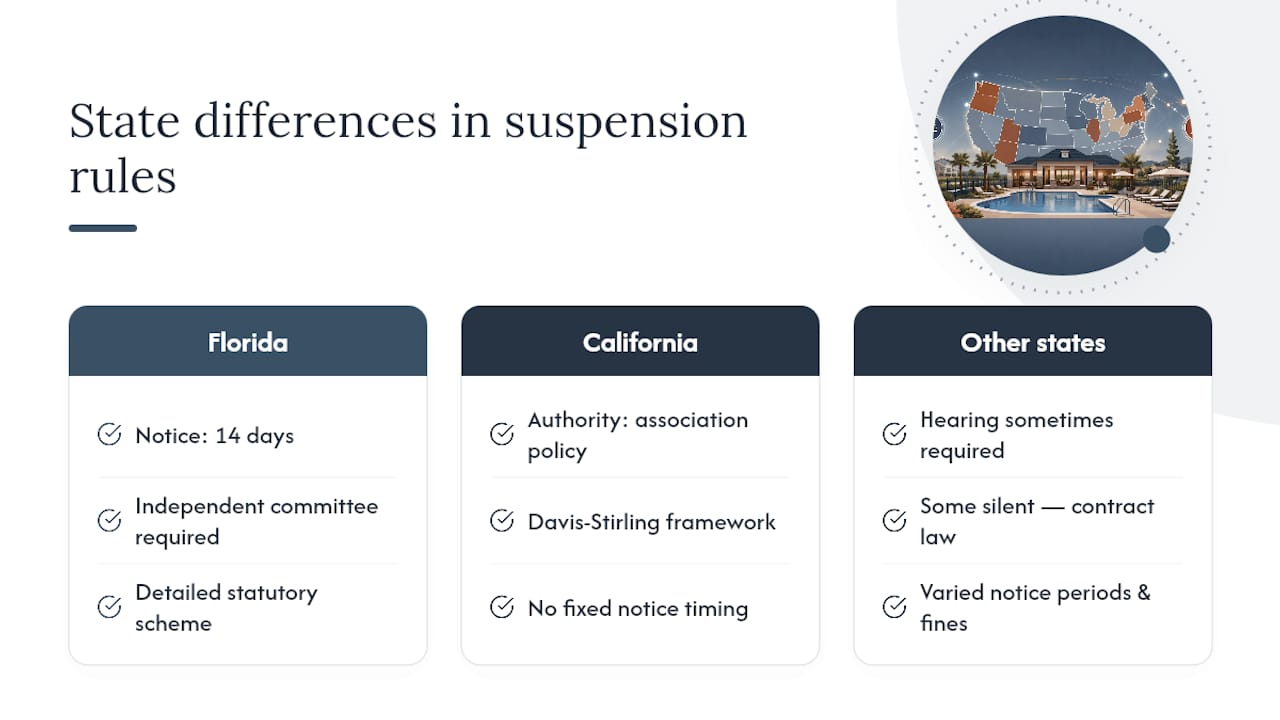
Significantly, yes. Florida’s statutory scheme, with its 14-day notice and independent committee requirement, is one of the most detailed in the country. Other states lean more heavily on whatever the CC&Rs and bylaws say, with far less statutory scaffolding layered on top.
California operates under the Davis-Stirling framework, where suspension authority hinges on the association’s own adopted disciplinary policy rather than a single detailed statute dictating notice timing and committee composition the way Florida’s does. Other states fall somewhere in between, some requiring a hearing but not an independent committee, others silent on amenity suspensions entirely and leaving the matter to contract law and whatever the governing documents spell out.
This variation is exactly why a board in Texas can’t safely copy a Florida association’s notice template word for word, and why a homeowner researching their rights needs to start with their own state’s statute, not a generic online guide. A state-by-state reference that maps out notice periods, hearing requirements, and fine caps by jurisdiction saves a lot of guesswork here, particularly for board members serving multiple properties across state lines through a management company. If a resident’s community has service providers regularly entering gated areas, coordinating access during a suspension period is another detail that varies by community, something mobile service providers working in gated communities run into constantly when a resident’s gate credentials get temporarily disabled.
Why Due Process Matters More Than the Penalty Itself
The suspensions that end up in disputes almost never fail because the board was wrong about the underlying violation. They fail because the process was sloppy: a vague notice, a committee that wasn’t independent, a hearing date that came and went without anyone confirming the homeowner actually got the letter.
That distinction changes how I’d advise any board to think about enforcement. The penalty is secondary. The paper trail is what actually protects the association, and it’s what gives homeowners a fair shot at correcting course before losing pool access over a violation they didn’t fully understand. Boards that treat notice and hearing steps as a formality to rush through are the ones that end up rescinding suspensions after a homeowner’s attorney finds the one missing element that voids the whole thing.
Clear, complete notices aren’t just a legal safeguard. They’re what keeps neighbors from becoming adversaries.
— Blake
Draft a Compliant Notice Without Starting From a Blank Page
Writing a legally sound amenity suspension notice from scratch means tracking your state’s notice period, your committee composition rules, and every required field in one document, and getting any of it wrong can void the whole action. Some letter drafting tools build that checklist directly into the drafting process: state-aware guidance, automated checks for mandatory language, and a one-page preview before anything goes out the door.
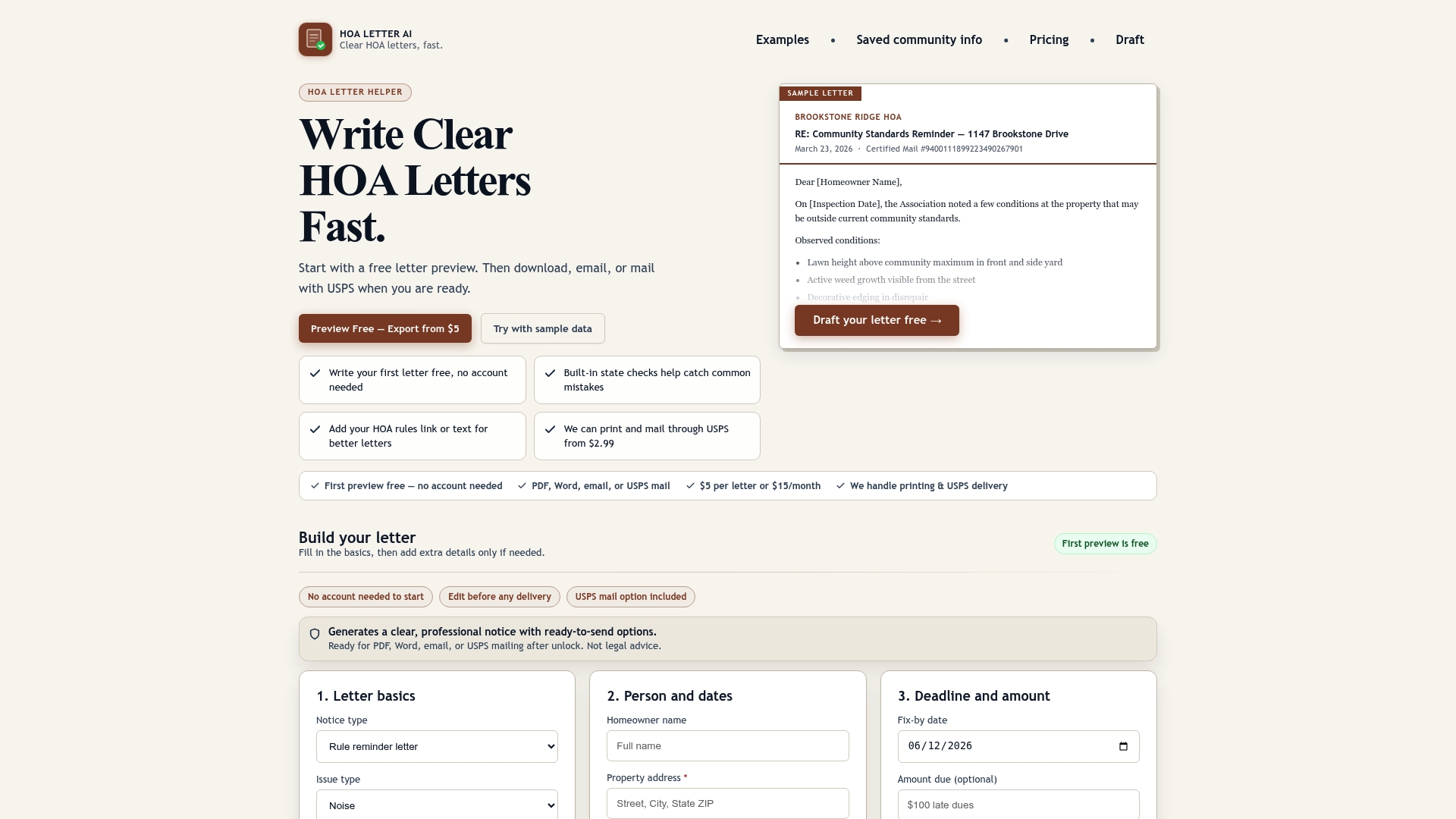
For boards handling their first suspension notice, the warning letter template is the fastest starting point, built around the same cure-and-hearing structure covered above. If you’re managing multiple communities or want ongoing access to updated templates as state rules shift, the property manager plan covers unlimited letters for a flat monthly rate. Either way, start by previewing a notice for your state and see exactly what it needs before you send anything.
Sources
- Florida HOA fines and common-area suspensions: How the process must work | Perez Mayoral, P.A.
- Suspension of Privileges | FindHOALaw
- Florida HOA rules: Can homeowners association suspend your rights? | Daily Commercial
- HOA Rules and regulations guide (2026) | ManageCasa
FAQ
What Is a 209 Notice in Texas?
A “209 notice” refers to notice and cure requirements in Texas law, which require HOAs to give homeowners written notice and a reasonable opportunity to cure certain violations before levying fines or restricting rights.
Is It Illegal to Ignore HOA Fines?
Ignoring HOA fines isn’t a crime, but unpaid fines can turn into a lien on the property, accrue interest, and in many states justify further enforcement action, including amenity suspension, if the governing documents allow it.
What Is Rule 720 in Florida?
“Rule 720” refers to Chapter 720 of the Florida Statutes, the Homeowners’ Association Act, which sets the notice, hearing, and committee requirements associations must follow before imposing fines or suspending common-area use rights.
What Are the New HOA Laws in Florida for 2026?
Florida’s HOA statutes continue to emphasize written notice, independent hearing committees, and the cure-before-hearing defense; boards and homeowners should check the current text of Chapter 720 directly, since specific amendments can shift year to year.
Can an HOA Suspend Amenities Without a Hearing?
In states with statutory hearing requirements, like Florida, no, the association must give written notice and let an independent committee vote before a suspension takes effect; skipping that step can void the suspension entirely.
Does Curing a Violation Always Stop a Suspension?
Curing the violation before the scheduled hearing generally bars the fine or suspension under statutes structured like Florida’s, making documented cure one of the strongest defenses a homeowner has.