
Read the violation notice line by line, pull out your CC&Rs and bylaws, then submit a written request for a hearing before your HOA’s deadline. That single sequence is the core of every successful HOA appeal. Most governing documents require that request within 30 days of the notice date, and missing that window can forfeit your right to appeal entirely. In some states, Internal Dispute Resolution (IDR) is a required step before any escalation, and skipping it can affect attorney fee recovery later.
Immediate actions to take right now:
- Read the violation notice and identify the exact CC&R or bylaw section cited
- Pull your governing documents (CC&Rs, bylaws, rules and regulations)
- Submit a written hearing request by certified mail or the method your documents require
- Keep proof of delivery (certified mail receipt, portal screenshot, or email confirmation)
- Note the deadline on your calendar and set a reminder three days before it
Pro Tip: If Fair Housing issues are involved, such as a disability accommodation denial, HUD provides a no-cost administrative complaint route that runs parallel to your internal HOA process.
Table of Contents
- What do the HOA appeal process steps actually require?
- How do you build an evidence packet that actually persuades?
- What should your written appeal or response include?
- How do you request and prepare for an HOA hearing?
- Which procedural defects give you the strongest appeal?
- What are your options after the board rules against you?
- When does it make sense to hire an attorney?
- What timelines and costs should you realistically expect?
- How to write an effective appeal letter fast
- Tools and templates that speed a correct written response
- How do you prevent future HOA disputes?
- Key Takeaways
- The part most homeowners get wrong
- Get a compliant appeal letter drafted in minutes
- Useful sources and next steps
What do the HOA appeal process steps actually require?
The HOA appeal process steps start with your governing documents, not the board. Before you write a single word, locate these:
- The violation notice itself (keep the original)
- Your CC&Rs (Declaration of Covenants, Conditions, and Restrictions)
- Bylaws and rules and regulations
- Any prior notices, correspondence, or meeting minutes referenced in the notice
Read the citation carefully. Identify the exact rule section, the alleged date of the violation, the corrective action required, and the fine amount. A notice that says “landscaping violation” without citing a specific CC&R provision is already on shaky ground. Vague or incomplete notices are among the most common procedural errors boards make.
Check whether your state or community requires IDR or mediation before a formal hearing. Some states mandate this step, and skipping it can weaken your legal position later. Your governing documents will also spell out delivery requirements for your response, whether that is certified mail, a specific form, or an online portal.
Pro Tip: Create one folder, digital and physical, labeled with the violation date. Preserve originals, timestamp every photo, and keep every piece of correspondence in that folder from day one.
How do you build an evidence packet that actually persuades?
Organized evidence wins hearings. Date-stamped photos, receipts, and witness statements are the simplest way to make a small-case appeal persuasive to a board. Here is what to gather:
- Dated photos and video of the alleged violation area (before and after, if applicable)
- Repair receipts or contractor invoices
- Relevant emails, texts, and prior correspondence with the HOA
- Witness statements with names and contact information
- Records of similar conditions at other properties in the community (useful for selective enforcement claims)
- Meeting minutes and the rule-adoption history for the cited rule
Once you have the materials, build a one-page timeline of events with dates and source references for each item. Then assemble your evidence packet in this order:
- Cover page with your name, address, violation notice number, and date
- One-paragraph summary of your position
- Governing document excerpts with the relevant section highlighted
- Evidence exhibits labeled A, B, C in chronological order
Print a conference-ready copy with tabbed exhibits and back up digital copies in two separate locations before the hearing.
What should your written appeal or response include?
A written response is not the place to vent frustration. It is a formal document that creates a legal record. Every appeal letter needs these elements:
- A clear statement that you are disputing the notice and requesting a hearing
- The exact rule text and section number from your governing documents
- A concise factual summary (dates, what happened, what did not happen)
- A numbered list of attached evidence exhibits
- Your requested remedy: retraction, fine reduction, or a compliance plan
- Your signature and the date
Sample one-paragraph template:
“I am writing to formally dispute Violation Notice #[NUMBER] dated [DATE], which cites an alleged violation of CC&R Section [X.X] regarding [SUBJECT]. The facts do not support this citation for the following reasons: [BRIEF FACTUAL SUMMARY]. I am requesting a hearing under Section [X.X] of the bylaws and have attached Exhibits A through [X] in support of this response. I request written confirmation of the hearing date and time.”
For the subject line of an email submission, use something specific: “Dispute of Violation Notice #2026-047 — CC&R Section 5.3 — [Your Name], [Address].” Vague subject lines get routed to the wrong person.
Delivery checklist:
- Send via certified mail or the method your governing documents specify
- Screenshot or photograph your proof of filing
- Keep a complete copy of everything you submitted
- Include a cover letter and a numbered exhibit index
How do you request and prepare for an HOA hearing?
Requesting the hearing is a procedural act. Do it in writing, send it by the required method, and attach a copy of the violation notice. Address it to the HOA board of directors or the designated contact in your governing documents.
Step-by-step hearing request:
- Write a brief letter stating your name, address, violation notice number, and a clear request for a hearing
- Cite the bylaw or CC&R section that grants you the right to a hearing
- Send it by certified mail or the required delivery method before the deadline
- Confirm receipt if the HOA uses an online portal
Once the hearing is scheduled, prepare your presentation:
- Organize your packet in the order you plan to speak
- Print extra copies for each board member
- Write a 60–90 second opening statement that maps each fact directly to the rule at issue
- Coordinate any witnesses: confirm their availability, brief them on the format, and give them a copy of the relevant exhibit
- Rehearse your opening statement at least twice
Bring to the hearing: your printed packet, extra copies, a photo ID, and a one-page chronology handout for the board.
Pro Tip: Arrive early, dress neutrally, and keep your opening statement focused on fact-to-rule mapping. The board is not a jury; they respond to precision, not passion.

Which procedural defects give you the strongest appeal?
Procedural errors by the HOA are often the strongest grounds for a successful appeal, stronger than subjective disputes about aesthetics or intent. Common defects to look for:
- Improper notice: wrong delivery method, wrong recipient, or missing required content
- Failure to follow the enforcement schedule in the governing documents
- Missing quorum at the meeting where the fine was approved
- Improper rule adoption (no proper notice to homeowners before the vote)
- Inconsistent enforcement: the same condition exists at other properties without action
To present a procedural challenge, cite the exact governing document section that was violated, then show the discrepancy with meeting minutes, notice dates, or the enforcement record. Boards frequently lose cases where homeowners can show inconsistent enforcement or missing adoption procedures.
Sample hearing script: “Under Section [X.X] of our bylaws, the board is required to provide written notice by certified mail at least [X] days before a fine is imposed. The notice I received was delivered by first-class mail on [DATE], which does not satisfy that requirement. I am requesting that the fine be voided on procedural grounds.”
Pro Tip: Request copies of meeting minutes and the rule-adoption history for the cited rule. If the rule was adopted without proper notice to homeowners, that procedural infirmity can invalidate the fine regardless of whether the underlying violation occurred.
What are your options after the board rules against you?
If the board upholds the fine or denies your appeal, you have three main paths. Check your CC&Rs before choosing any of them, because many governing documents contain mandatory arbitration clauses that limit your options.
| Path | Key Features | Best For |
|---|---|---|
| Mediation | Voluntary, nonbinding, preserves relationships, usually faster | Disputes where a negotiated fix is possible |
| Arbitration | Private, binding, faster than court, limits later remedies | When CC&Rs require it or speed matters |
| Litigation | Public, full remedies available, costly and slow | High-dollar claims, statutory violations, persistent harassment |
Action steps per path:
- Mediation: Contact the American Arbitration Association or your local bar association to find a mediator. Costs are typically split between parties. Some states require mediation before a lawsuit can be filed.
- Arbitration: Review your CC&Rs for mandatory arbitration language. File with the designated arbitration body named in your documents. Prepare as you would for a formal hearing.
- Litigation: Consult an HOA or real estate litigation attorney before filing. Read the attorney fee provision in your CC&Rs first. If you lose, you may owe the HOA’s legal fees.
If the dispute involves a Fair Housing issue, such as a disability accommodation denial, HUD provides an administrative complaint route that is free and runs separately from internal HOA processes.
Pro Tip: Check whether skipping IDR or mediation will procedurally bar attorney fee recovery in your state. In several jurisdictions, IDR is a prerequisite for any later legal claim, and bypassing it can cost you more than the original fine.
When does it make sense to hire an attorney?
Most minor violations do not need a lawyer. But some situations do, and recognizing them early saves money.
Hire an attorney when:
- The HOA has procedurally barred your rights (missed deadlines, improper notice that you did not catch in time)
- The dispute involves statutory claims under the Fair Housing Act or your state’s HOA statute
- The fine or financial exposure exceeds a few thousand dollars
- You are facing persistent selective enforcement or board harassment
- Your CC&Rs contain a mandatory arbitration clause with binding effect
Realistic cost and timeline ranges:
- Mediation: a few hundred to a few thousand dollars, often split, resolved in days to weeks
- Arbitration: roughly $1,000–$5,000 or more depending on complexity, weeks to a few months
- Litigation: several thousand to tens of thousands of dollars, months to years
To find the right attorney, look for HOA or real estate litigation specialists. Ask about fee structures: hourly, flat fee for a specific task, or contingency (rare in HOA matters but worth asking about).
Questions to ask in an initial consultation:
- Have you handled HOA disputes under [your state]'s HOA statute?
- Do you offer a flat fee for a hearing review or letter review?
- Does my CC&R’s attorney fee clause create risk if I lose?
- Is IDR or mediation required before we can file suit?
What timelines and costs should you realistically expect?
Planning ahead prevents surprises. The table below reflects common practice ranges from hearing guides and practitioner checklists.

| Stage | Typical Window | Notes |
|---|---|---|
| File hearing request | Within 30 days of the notice date | Check your governing documents; missing this forfeits rights |
| Board schedules hearing | — | Varies widely by community size |
| Written board decision | — | Some states set a statutory deadline |
| Mediation | Weeks to 2 months | Faster when both parties cooperate |
| Arbitration | 1–4 months | Depends on arbitrator availability |
| Litigation | several months to several years | Depends on court docket and complexity |
Costs for hearings themselves are typically free at the HOA level. Mediation fees run from a few hundred to a few thousand dollars, usually split. Arbitration and litigation costs scale with complexity.
Pro Tip: Ask the HOA whether the community absorbs mediator fees or offers a reduced-cost internal resolution option. Some associations do, especially when the dispute is minor and the board wants to avoid escalation.
How to write an effective appeal letter fast
When the deadline is close, use this template and checklist. Adapt the bracketed fields to your situation.
One-paragraph template:
“I am writing to formally appeal Violation Notice #[NUMBER] issued on [DATE] for an alleged violation of CC&R Section [X.X] regarding [SUBJECT]. The attached exhibits (A through [X]) demonstrate that [BRIEF FACTUAL BASIS FOR APPEAL]. I respectfully request that this notice be rescinded and that a hearing be scheduled at the board’s earliest convenience pursuant to Section [X.X] of the bylaws.”
Filing checklist:
- Print and sign the letter; keep a copy
- Attach a numbered exhibit index listing every document you are enclosing
- Send by certified mail (keep the receipt) or via the HOA’s required portal
- Screenshot or photograph your proof of submission with a visible timestamp
- Follow up in writing if you receive no acknowledgment within 14 days
For a step-by-step appeal letter guide with additional templates, HOA Letter AI’s resource library covers the full range of violation types and delivery methods.
Suggested delivery methods:
- Certified mail with return receipt: creates the strongest paper trail
- HOA online portal: screenshot the confirmation page immediately
- Email: request a read receipt and save the sent message with a timestamp
Always include a short exhibit index at the top of your packet so board members can follow your evidence without flipping through the whole document.
Tools and templates that speed a correct written response
When a deadline is tight and the violation is straightforward, a state-aware template is often the fastest path to a compliant letter. HOA Letter AI provides editable appeal and response templates that pull in state-specific context, cite CC&R sections, and include a one-page preview before you finalize. For homeowners who need certified delivery, USPS mailing fulfillment is built in.
When a template is the right call:
- Minor alleged violations with a clear factual defense
- Tight deadlines where drafting from scratch risks errors
- Rehearing requests after discovering a procedural defect
- A first response before deciding whether to escalate
When to add attorney review:
- Statutory claims (Fair Housing Act, state HOA statutes)
- Fines above a few thousand dollars
- Mandatory arbitration clauses with binding effect
- Any dispute where the CC&R attorney fee provision creates real financial risk
The practical middle ground: draft with a template and, for high-stakes matters, pay for a short attorney review rather than full litigation representation. That combination covers most homeowner situations without the cost of a full retainer.
Pro Tip: HOA Letter AI’s notice-completeness checker lets you verify whether the violation notice you received meets your state’s required elements, which is often the first place a procedural defect shows up.
How do you prevent future HOA disputes?
The best appeal is the one you never have to file. A few consistent habits cut the risk significantly.
- Attend board meetings, or read the minutes afterward, so you know about rule changes before they become violations
- Subscribe to all association notices and confirm your contact information is current with the management company
- Request written confirmation of any verbal approval you receive from the board or management
- Document every repair, modification, or improvement with dated photos and receipts
- Request reasonable accommodations or rule clarifications in writing, especially where Fair Housing or disability accommodations apply
Unresolved HOA disputes can also affect a home sale. Understanding how HOA disputes affect disclosures is worth reviewing if you are considering selling.
Pro Tip: Keep a yearly folder of CC&R updates and meeting minutes. When a rule changes, you will know exactly when it changed and whether the adoption procedure was followed, which is precisely the evidence you need if a future citation arises.
Key Takeaways
Acting within your HOA’s stated deadline is the single most critical step: missing the hearing request window forfeits your appeal rights and can eliminate attorney fee recovery in states that require IDR first.
| Point | Details |
|---|---|
| Act immediately on deadlines | Most governing documents require you to submit a hearing request within 30 days of the notice date; missing it forfeits appeal rights. |
| Build an organized evidence packet | Labeled exhibits, a one-page timeline, and tabbed copies give the board a clear record to review. |
| Procedural defects win cases | Improper notice, inconsistent enforcement, and missing adoption procedures often overturn fines outright. |
| Choose your escalation path carefully | Mediation preserves relationships; arbitration is binding; litigation is costly. Check CC&Rs for mandatory clauses before deciding. |
| HOA Letter AI speeds compliant drafting | State-aware templates, CC&R citation features, and USPS fulfillment help homeowners file a correct response fast. |
The part most homeowners get wrong
The most common mistake in HOA disputes is not missing a deadline or forgetting an exhibit. It is letting the dispute become personal before it becomes procedural.
Homeowners who walk into hearings with a list of grievances about the board’s general conduct, the management company’s attitude, or a neighbor’s behavior almost always lose ground they could have held. The board is not there to adjudicate your relationship with the community. They are there to decide whether a specific rule was violated and whether the enforcement procedure was followed. Every sentence you speak at that hearing should answer one of those two questions.
The second pattern worth noting: homeowners who skip the evidence packet because they believe the violation is obviously wrong. Obvious to you is not obvious to a board member reading a file cold. A tabbed, indexed packet with a one-page summary takes an hour to prepare and changes the entire dynamic of the hearing. Boards respond to preparation the same way any decision-maker does.
Finally, the procedural angle is almost always underused. Most homeowners argue the facts when the stronger argument is the procedure. If the board did not follow its own enforcement schedule, the fine may be invalid regardless of whether the underlying condition existed. That is not a technicality. That is the law of the governing documents.
Get a compliant appeal letter drafted in minutes
When a deadline is close and you need a letter that cites the right rule, uses the right format, and goes out the right way, HOA Letter AI is built for exactly that situation. The generator pulls in state-specific requirements, lets you reference your CC&R sections directly, and produces a one-page preview before you commit. If you need certified delivery, USPS fulfillment is available without a separate trip to the post office.
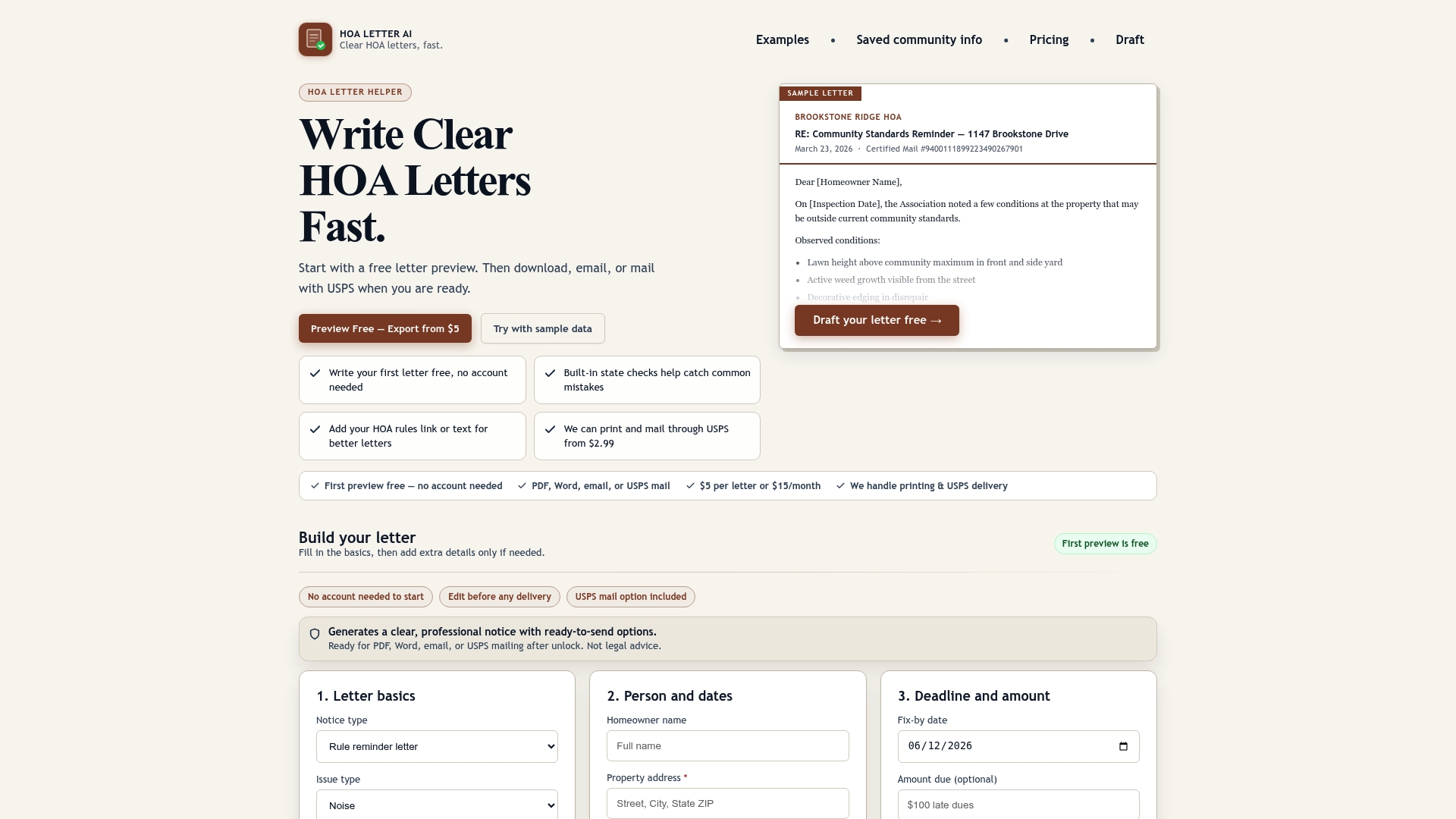
The tool works for straightforward appeal letters, rehearing requests after a procedural defect, and evidence packet cover sheets when you need a clean, professional presentation fast. For homeowners who want to check their state’s specific notice requirements before filing, the HOA violation laws by state page covers notice rules and fine procedures across the country.
Preview a sample letter or generate your appeal at HOA Letter AI.
Useful sources and next steps
Authoritative resources:
- HUD Fair Housing complaint page for discrimination or accommodation disputes
- American Arbitration Association to find a qualified mediator or arbitrator
- Your state’s HOA statute (search “[state name] HOA statute” on your state legislature’s website, such as California Civil Code Section 5905 or North Carolina G.S. 47F-3-102)
- HOA Letter AI’s appeal process guide for homeowners for document checklists and compliance checkpoints
Your immediate next steps:
- Create your evidence packet today, even if the hearing is weeks away
- File the written appeal or hearing request by certified mail before the deadline
- If your state requires IDR, initiate that process before any external escalation
- Save every delivery receipt, portal confirmation, and board response in your dated folder
This article provides general information about HOA appeal procedures in the United States. It is not legal advice. Confirm current rules with your governing documents, your state’s HOA statute, or a qualified attorney for your specific situation.
Recommended
- HOA Letter Appeal Process Guide for Homeowners | HOA Letter AI
- HOA Fine Appeal Letter: Step-by-Step Guide + Free Template | HOA Letter AI
- HOA Appeal Response Letter (State-Compliant HOA Letter) | HOA Letter AI
- HOA Violation Response Letter: Template & Tips for Homeowners | HOA Letter AI
Drafting support for HOA notices
Use the HOA letter drafter to turn this guidance into a resident-ready notice, compare reusable HOA letter templates, or review the property manager workflow for higher-volume enforcement work.