
An HOA compliance letter is a formal written notice that documents a specific rule violation, states the required corrective action, and establishes a legal deadline for resolution. HOA compliance letter formatting explained correctly means structuring that notice to meet both state law requirements and community governing documents. A poorly formatted letter can void fines, trigger disputes, and expose the board to legal liability. This guide covers every required element, formatting best practice, and common mistake that HOA board members, property managers, and homeowners need to understand in 2026.
What are the essential legal elements in an HOA compliance letter?
A legally enforceable HOA violation notice must contain four core elements: a specific violation description citing governing documents, the required corrective action, a cure deadline, and a statement of the homeowner's hearing rights. Missing even one of these elements can make the entire notice unenforceable. Courts and arbitrators look for each element when a homeowner challenges a fine.
The violation description must name the exact rule broken. Reference the specific section of the CC&Rs, bylaws, or community rules. Writing "Section 4.2 of the CC&Rs prohibits grass height exceeding 4 inches" is enforceable. Writing "your yard looks bad" is not.
The cure deadline requires careful calculation. Notice periods begin on the date the letter is mailed, not the date the homeowner receives it. A 14-day cure window starts ticking the moment the letter leaves the post office. Boards that calculate from the receipt date routinely issue invalid fines.
Delivery method is equally regulated. Legally effective notice must arrive via first-class mail, certified mail, or a method the owner has previously agreed to in writing. Text messages and standard email do not satisfy legal notice requirements in most states, including Florida and California.
- Specific violation citation: Name the exact governing document section and describe the observed condition in measurable terms.
- Required corrective action: State exactly what the homeowner must do to cure the violation.
- Cure deadline: Calculate from the mailing date, not the receipt date, and state the exact calendar date.
- Hearing rights statement: Inform the homeowner of their right to request a hearing before any fine is assessed.
- Delivery confirmation: Send via certified mail or first-class mail and retain proof of mailing.
Pro Tip: *Keep a mailing log for every compliance notice. Record the date mailed, the method used, and the name of the staff member who sent it. This log is your first line of defense if a homeowner disputes the timeline.*
How should HOA compliance letters be formatted for clarity?
Standard business letter format is the correct structure for any HOA compliance notice. That means sender information at the top, followed by the date, recipient name and address, a subject line, a salutation, body paragraphs, a closing, and a signature. This structure is not optional. It signals professionalism and makes the letter easier for homeowners, attorneys, and judges to read.
Follow these steps to build a properly formatted notice:
- Sender block: List the HOA's full legal name, mailing address, phone number, and email. This tells the homeowner exactly who is contacting them and how to respond.
- Date: Write the full date the letter is mailed. This date starts the cure clock.
- Recipient block: Use the homeowner's full legal name and property address. Avoid nicknames or abbreviations.
- Subject line: State the violation type clearly. Example: "Subject: Landscaping Violation Notice — 123 Oak Street."
- Salutation: Use "Dear [Full Name]:" rather than "To Whom It May Concern." Personalization reduces defensiveness.
- Body paragraphs: Lead with the violation, then state the required action, then give the deadline, then explain hearing rights. One topic per paragraph.
- Closing and signature: Use "Sincerely" or "Respectfully," followed by the board officer's printed name, title, and signature.
Tone is as important as structure. A factual, solution-oriented tone encourages voluntary compliance. Accusatory language increases defensiveness and disputes. Write "The property was observed to have grass measuring approximately 6 inches on march 14, 2026" rather than "You have neglected your lawn again."
Pro Tip: *Run every draft through a proofreading tool like Grammarly or the Hemingway Editor before sending. A single grammatical error can undermine the board's credibility and give a homeowner grounds to dismiss the letter's authority.*
What common mistakes weaken HOA compliance letter formatting?
Vague language is the most frequent formatting error boards make. Objective phrases like "the property was observed to have an unpermitted structure measuring approximately 8 feet by 10 feet" carry legal weight. Phrases like "your backyard is a problem" carry none. Vague language also makes it harder to prove the violation in a hearing.
- Missing legal elements: Omitting the hearing rights statement or the governing document citation is the fastest way to invalidate a fine.
- Improper delivery: Sending notice by text or standard email when state law requires certified mail voids the entire process.
- Outdated templates: Florida's HB 1203 (2024) tightened enforcement procedures. Boards using pre-2024 templates risk invalidating every fine issued under those templates.
- Wrong cure period calculation: Counting cure days from the receipt date instead of the mailing date is a procedural error that courts catch quickly.
- Emotional or accusatory language: Personal judgment phrases increase the chance a homeowner will dispute the notice rather than fix the violation.
- No documentation attached: Time-stamped photos, observer names, and exact violation citations protect enforcement actions from challenge. A letter without supporting documentation is far easier to contest.
Annual legislative changes require boards to update enforcement templates every year. What was compliant in 2023 may not satisfy 2026 requirements. Assign one board member or property manager to review templates against current state statutes each january.
How does violation type change HOA compliance letter formatting?
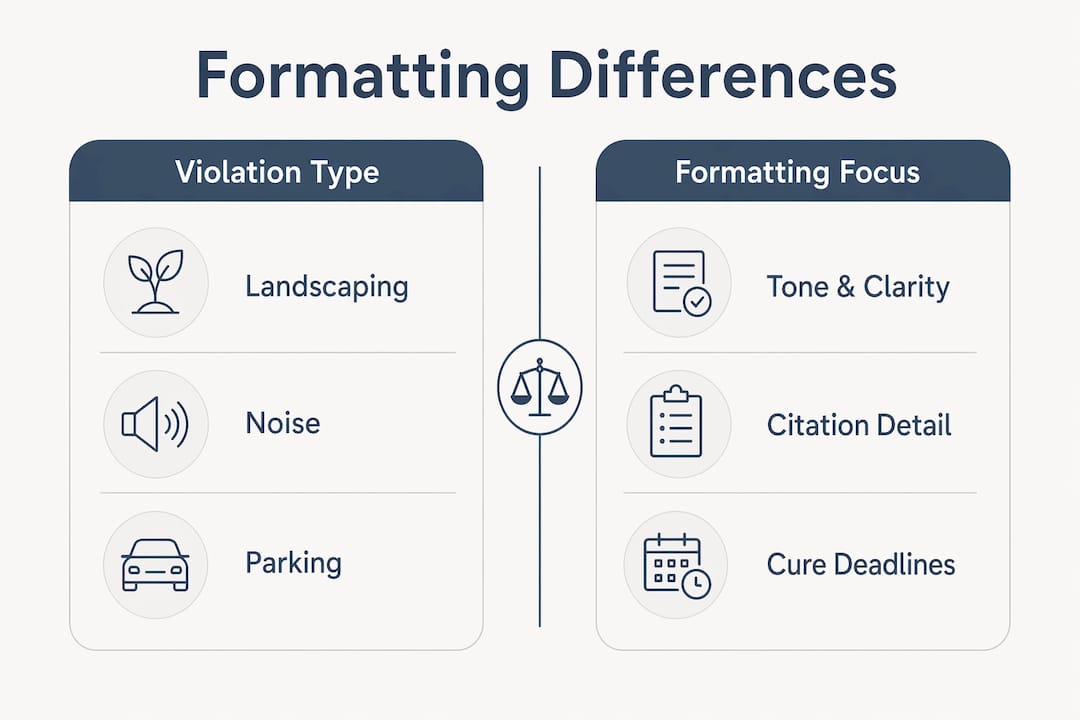
Different violation types require different emphasis in tone, citation, and formatting. A landscaping notice focuses on measurable conditions and a short cure window. An architectural violation notice requires citation of the architectural review process and may involve a longer resolution timeline. A noise complaint letter needs precise date and time documentation to be credible.
The table below summarizes the key formatting differences by violation type.
| Violation type | Tone | Key citation | Typical cure window | Supporting evidence |
|---|---|---|---|---|
| Landscaping | Neutral, factual | CC&Rs maintenance section | 14 days | Dated photos, measurements |
| Noise complaint | Firm, documented | Nuisance or quiet hours rule | Immediate to 7 days | Incident log, dates, times |
| Architectural | Formal, process-focused | Architectural review guidelines | 30–60 days | Photos, permit records |
| Unauthorized modification | Formal, legal reference | Modification approval section | 30 days | Photos, original approval docs |
Severity and recurrence also shape formatting. A first-time landscaping notice uses a cooperative tone and offers a clear path to resolution. A third notice for the same violation shifts to a firmer tone, references prior notices by date, and states that fines will be assessed if the violation continues.
State law adds another layer of customization. California HOA boards must follow the Davis-Stirling Common Interest Development Act, which sets specific notice and hearing requirements. Florida boards must comply with the updated procedures under HB 1203. A state-specific compliance letter for California looks different from one drafted for Florida, even for the same violation type.
Pro Tip: *Build a separate template for each violation category and each state where your community operates. Generic templates create legal gaps. Specific templates close them.*
Including specific, measurable descriptions backed by dated photos strengthens every letter regardless of violation type. "Grass exceeding 4 inches as photographed on march 10, 2026" is a defensible claim. "Unkempt lawn" is not.
Key Takeaways
Proper HOA compliance letter formatting requires legally required elements, precise language, and correct delivery to be enforceable in 2026.
| Point | Details |
|---|---|
| Four required legal elements | Every letter must include violation citation, corrective action, cure deadline, and hearing rights. |
| Cure period starts at mailing | Calculate the deadline from the date mailed, not the date the homeowner receives the letter. |
| Delivery method matters | Use certified mail or first-class mail; text and standard email do not satisfy legal notice requirements. |
| Update templates annually | Legislative changes like Florida HB 1203 require boards to revise templates every year to stay compliant. |
| Match format to violation type | Landscaping, noise, architectural, and unauthorized modification notices each require different tone and citation emphasis. |
Why I think most HOA boards underestimate formatting
Most boards treat compliance letters as a formality. They copy a template from five years ago, fill in the homeowner's name, and send it. That approach works until it doesn't, and when it fails, it fails expensively.
The boards I have seen handle enforcement well share one habit: they treat every letter as a legal document from the first draft. They cite the exact governing document section. They photograph the violation with a timestamp. They mail via certified mail and keep the receipt. They review their templates every january against current state law. That discipline is not excessive. It is the minimum required to make enforcement stick.
The tone issue is where I see the most avoidable damage. A letter that reads like a personal attack on a neighbor turns a fixable violation into a six-month dispute. A letter that reads like a factual record of an observed condition gives the homeowner a clear path forward. Most people will take that path if you make it obvious and non-threatening.
One more thing boards consistently miss: the hearing rights statement is not just a legal checkbox. It is a communication tool. When homeowners know they can request a hearing, they feel less cornered. That feeling reduces the chance they will hire an attorney and fight the notice on procedural grounds. Write the hearing rights statement clearly, and mean it.
> *— Blake*
Get your HOA compliance letters right the first time
Formatting a compliant HOA violation notice takes more than a blank template. It requires state-specific language, correct legal elements, and a tone that holds up in a hearing.

Hoaletterai builds every letter with the legal elements your state requires, including the violation citation, cure deadline, hearing rights statement, and correct delivery instructions. You get a one-page preview before anything is sent, and USPS mailing is available directly through the platform. No juggling multiple tools. No outdated templates. Check the full state-by-state requirements or go straight to the violation letter generator to draft your first letter in minutes.
FAQ
What must an HOA compliance letter include to be legally valid?
A legally valid HOA compliance letter must include a specific violation description citing governing documents, the required corrective action, a cure deadline calculated from the mailing date, and a statement of the homeowner's hearing rights. Missing any of these elements can invalidate the notice and any fines that follow.
How do I calculate the cure deadline in an HOA violation notice?
The cure period begins on the date the letter is mailed, not the date the homeowner receives it. Count calendar days from the mailing date and state the exact deadline date in the letter to avoid procedural disputes.
What delivery method is required for HOA compliance letters?
Most states require HOA compliance letters to be sent via first-class mail, certified mail, or a delivery method the homeowner has previously agreed to in writing. Text messages and standard email are not legally sufficient notice in most jurisdictions.
How often should HOA boards update their compliance letter templates?
Boards should review and update compliance letter templates at least once a year. Legislative changes such as Florida HB 1203 (2024) can alter required elements and procedures, and using an outdated template risks invalidating every fine issued under it.
Does the violation type change how I format the letter?
Yes. Landscaping violations call for measurable descriptions and short cure windows, while architectural and unauthorized modification notices require formal process citations and longer resolution timelines. Noise complaint letters need precise date and time documentation to be credible in a hearing.
Recommended
- California HOA Compliance Guide: State-Specific Rules & Violation Letter Requirements | HOA Letter AI
- HOA Letter AI — HOA Violation Letter Generator (State-Compliant)
- HOA Collection Letters: A Respectful, Step-by-Step Reminder Sequence | HOA Letter AI
- HOA Parking Violation Letter Explained for Boards | HOA Letter AI