
An HOA governing document is a legally binding set of records that establishes the rules, structure, and procedures of a homeowners association and its community management. These documents define what you can and cannot do with your property, how the board operates, and what happens when rules are broken. According to Nolo, the standard set includes articles of incorporation, bylaws, CC&Rs, and rules and regulations. Understanding these documents is not optional for homeowners. They attach to your property deed and bind you whether or not you ever received a copy.
What is an HOA governing document and what types exist?
HOA governing documents are the legal records that control how an association operates and governs its community. Each document type serves a distinct purpose, and they work together as a layered system. Confusing one for another is one of the most common mistakes homeowners make during disputes.
Here are the four core document types every homeowner should know:
- Declaration of Covenants, Conditions, and Restrictions (CC&Rs): This is the most powerful document in the set. CC&Rs govern property use, appearance standards, and restrictions that run with the land. They cover everything from fence heights to rental restrictions. CC&Rs hold the highest authority among HOA documents and override conflicting provisions in any other document.
- Bylaws: Bylaws govern the internal operations of the HOA itself. They define board structure, how elections work, quorum requirements, and meeting procedures. Bylaws do not regulate what you do with your property. They regulate how the association is run.
- Rules and Regulations: These are the day-to-day policies the board adopts to manage common areas and resident conduct. Bylaws and rules cover operational procedures and daily policies like parking, pet restrictions, and pool hours. Rules are easier to amend than CC&Rs, which is why boards use them for evolving community needs.
- Articles of Incorporation: This document establishes the HOA as a legal entity under state law. It is typically filed with the state and gives the association the legal standing to enter contracts, sue, and be sued.
Pro Tip: *When you move into an HOA community, request all four document types at once. Receiving only the rules and regulations without the CC&Rs leaves you with an incomplete picture of your actual obligations.*
How does the document hierarchy affect HOA enforcement?

The hierarchy of HOA documents determines which rule wins when two documents conflict. The legal hierarchy runs in this order: federal and state law, the recorded plat, the Declaration or CC&Rs, articles of incorporation, bylaws, and then board-adopted rules and regulations. A rule in the regulations that contradicts the CC&Rs is unenforceable. The CC&Rs win every time.
| Document Level | Authority | Scope |
|---|---|---|
| Federal and State Law | Highest | Overrides all HOA documents |
| CC&Rs / Declaration | Second | Property use, restrictions, land covenants |
| Articles of Incorporation | Third | HOA's legal entity status |
| Bylaws | Fourth | Internal governance and board operations |
| Rules and Regulations | Lowest | Day-to-day conduct and policies |
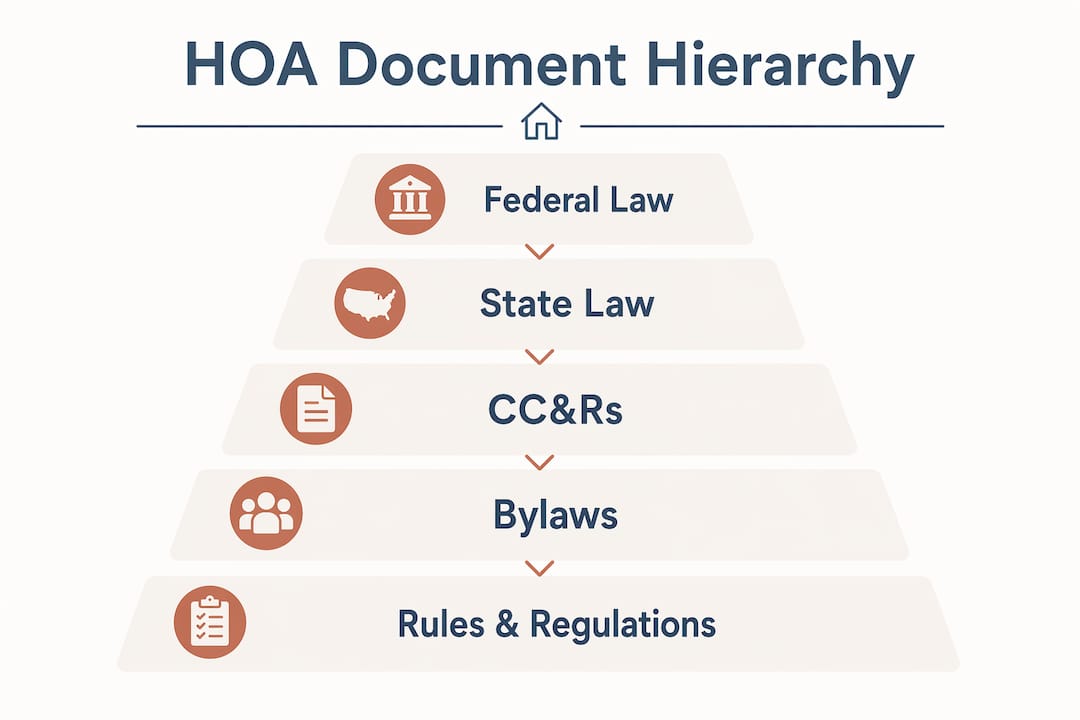
This hierarchy has real consequences. Boards sometimes enforce rules that contradict their own CC&Rs, either because they do not know the hierarchy or because they are working from outdated documents. Effective dispute resolution depends on identifying the exact document clause that authorizes a particular enforcement action. If the board cannot point to a specific clause, the enforcement may not hold up.
Federal law adds another layer that many homeowners overlook. The Fair Housing Act limits what HOAs can enforce through governing documents. Even a rule that appears neutral on its face can violate federal law if it produces a discriminatory effect on a protected class. This means the hierarchy does not stop at the CC&Rs. Federal and state statutes always sit above every HOA document in the stack.
One practical example: an HOA board adopts a rule banning satellite dishes on any exterior surface. That rule may conflict with FCC regulations protecting residents' rights to install antennas. The board's rule loses, regardless of what the CC&Rs say, because federal law sits at the top of the hierarchy.
Where can homeowners access HOA governing documents?
Locating your HOA's governing documents is straightforward once you know where to look. The Declaration and CC&Rs are recorded public land records. Recorded Declarations are accessible through your county clerk or recorder's office, and HOAs are required to share these documents upon homeowner request.
Follow these steps to get the complete document set:
- Request directly from the HOA. Contact your board or management company and ask for the full governing document package. This should include the Declaration, bylaws, rules and regulations, and all recorded amendments.
- Search the county recorder's office. The Declaration and any recorded amendments are public records. Most county recorders now offer online search tools where you can find documents by subdivision name or parcel number.
- Check the HOA's website. Many associations post their governing documents in a member portal or public section of their website. This is convenient but may not always reflect the most current amendments.
- Review before you buy. If you are purchasing a home in an HOA community, request the full governing document set before closing. Obtaining complete, up-to-date documents protects you from inheriting enforcement of superseded or outdated rules.
One critical detail most buyers miss: CC&Rs bind you even if you never personally received them. CC&Rs recorded against the property deed create what is called constructive notice. The law assumes you knew about them because they were publicly recorded. Ignorance of the documents is not a defense in an HOA dispute.
What practical implications do HOA documents have for daily life?
Governing documents create frameworks for consistency in decision-making, dispute resolution, and community management policies. Their practical reach extends into nearly every aspect of property ownership in an HOA community.
Here is where homeowners feel the impact most directly:
- Property appearance and maintenance: CC&Rs typically specify paint color restrictions, landscaping standards, and rules about exterior modifications. Painting your front door an unapproved color or adding a shed without board approval can trigger a violation notice and fines.
- Parking and vehicle rules: Rules and regulations commonly restrict where residents and guests can park, what types of vehicles are permitted, and how long vehicles can remain in certain areas.
- Pets: Many HOAs limit the number of pets, restrict breeds, or require leashes in common areas. These restrictions typically appear in the rules and regulations, not the CC&Rs, which means the board can update them more easily.
- Amenities and common areas: Pool hours, guest policies, and reservation systems for clubhouses are governed by the rules and regulations. Violations here are common and often result in temporary loss of amenity access.
- Enforcement and fines: When you violate a governing document provision, the board follows a process defined in the bylaws and rules. That process typically includes written notice, an opportunity to cure, a hearing, and then fines. The HOA rule enforcement checklist boards follow must align with the procedures spelled out in the governing documents.
Pro Tip: *If you receive a violation notice, ask the board to cite the specific document and clause authorizing the enforcement. If they cannot, the notice may not be valid. Knowing how to read hoa rules at the clause level gives you real leverage.*
Understanding the amendment history of your documents matters just as much as reading the current version. Boards sometimes enforce outdated rules because they are working from an old document version. Always confirm you have the most recently amended copy.
Key takeaways
HOA governing documents form a legal hierarchy where CC&Rs hold the highest authority over property use, and every enforcement action must trace back to a specific document clause.
| Point | Details |
|---|---|
| Four core document types | CC&Rs, bylaws, rules and regulations, and articles of incorporation each serve a distinct role. |
| CC&Rs hold top authority | CC&Rs override conflicting provisions in bylaws or rules on all property-related matters. |
| Federal law sits above all HOA documents | The Fair Housing Act and other federal statutes limit what any HOA document can enforce. |
| CC&Rs bind you automatically | Recorded CC&Rs create constructive notice, meaning you are bound even without receiving a copy. |
| Always get the full amended set | Outdated documents lead to invalid enforcement; request all amendments when reviewing your documents. |
Why most HOA disputes come down to one overlooked document
Most homeowners I have worked with walk into an HOA dispute knowing only the rules and regulations. They have never read the CC&Rs. That gap is where almost every conflict gets complicated.
The hierarchy issue is not theoretical. I have seen boards issue fines based on a rule that directly contradicted the CC&Rs. The homeowner had no idea the CC&Rs even existed, let alone that they outranked the rule being enforced. Once the homeowner pulled the CC&Rs from the county recorder's office and compared the two documents, the fine was dropped.
My honest advice: treat your CC&Rs like a second deed. They define what you actually own and what you can do with it. Reading them once, carefully, before you ever receive a violation notice puts you in a completely different position than most of your neighbors.
For newcomers to HOA communities, I recommend a simple three-step review. First, read the CC&Rs in full, even if it takes two hours. Second, read the bylaws to understand how the board makes decisions and how you can participate. Third, read the current rules and regulations to know the day-to-day policies. That sequence follows the hierarchy and gives you the clearest picture of where authority actually sits.
One more thing most articles skip: governing documents are not static. Amendments happen. A rule that was in place when your neighbor bought their home five years ago may have been changed since. Checking the amendment history is not paranoia. It is basic due diligence that protects you in any dispute.
> *— Blake*
How Hoaletterai helps boards enforce documents correctly
Understanding your governing documents is the foundation. Acting on them correctly is the next step.

Hoaletterai is built for exactly that gap. When a board needs to issue a violation notice, the letter must cite the specific governing document clause, follow the state-required notice process, and use clear language that holds up if challenged. Hoaletterai generates state-compliant violation letters that reference your community's actual rules, reducing errors and saving boards hours of drafting time. You can review HOA violation notice requirements by state to confirm your letters meet local standards before they go out. Whether you manage a small community or a large association, Hoaletterai keeps your enforcement process grounded in the documents that actually govern your community.
FAQ
What is an HOA governing document?
An HOA governing document is a legally binding record that defines the rules, structure, and procedures of a homeowners association. The standard set includes CC&Rs, bylaws, articles of incorporation, and rules and regulations.
What is the difference between cc&rs and bylaws?
CC&Rs regulate property use and restrictions that run with the land, while bylaws govern the internal operations of the HOA board, including elections and meeting procedures. CC&Rs hold higher authority than bylaws in any conflict.
Are HOA governing documents public records?
The Declaration and CC&Rs are recorded public land records accessible through your county clerk or recorder's office. Bylaws and rules are not always recorded publicly but must be provided to homeowners upon request.
Can an HOA enforce a rule that contradicts the cc&rs?
No. CC&Rs override conflicting provisions in any lower-level document, including board-adopted rules and regulations. A rule that contradicts the CC&Rs is unenforceable, and homeowners can challenge it by citing the document hierarchy.
How do i get the most current version of my hoa's governing documents?
Request the full document set directly from your HOA board or management company, and ask specifically for all recorded amendments. You can also search your county recorder's office for the recorded Declaration and any amendments filed against your property.