
An HOA meeting notice is the official document that informs homeowners of an upcoming meeting, specifying when, where, and what will be discussed to guarantee transparency and legal compliance. Most board members treat these notices as a formality. They are actually a legal shield. A well-constructed notice prevents “I didn’t see it” defenses and upholds the board’s fiduciary responsibilities. The right hoa meeting notice examples give your community a clear record, reduce disputes, and keep every vote on solid legal ground.
What key elements must an HOA meeting notice include?
A valid HOA meeting notice must explicitly include the date, time, place, purpose, and detailed agenda to uphold transparency and legal protection. Missing even one of these elements can invalidate decisions made at the meeting.
Every compliant notice should contain:
- Meeting type: State whether it is a regular board meeting, special meeting, or annual meeting.
- Date, time, and location: Include the full address and, for virtual meetings, the video conference link, dial-in number, and access code.
- Agenda items: List every topic to be discussed or voted on. Many states prohibit boards from voting on items not published in the notice.
- Notice period: Most bylaws require delivery within a specific window before the meeting date.
- Proxy and quorum instructions: Tell homeowners how to submit a proxy vote and what quorum percentage is required for the meeting to proceed.
- Contact information: Provide a name, phone number, or email for questions.
The agenda is the most legally sensitive part of the notice. Many states prohibit discussing or voting on items not listed on the published agenda. That rule protects homeowners from surprise decisions and protects the board from legal challenges.
Pro Tip: Include a “consent calendar” note in the agenda for routine items like approval of prior minutes and standard financial reports. Bundling these into one vote saves meeting time and signals to homeowners that the board respects their schedule.

Sample HOA meeting notice examples for different meeting types
Practical examples make the abstract concrete. The three most common notice formats cover regular board meetings, special meetings, and annual meetings. Each has a different legal threshold and content requirement.
Regular monthly board meeting notice
Maplewood Homeowners Association Board of Directors Meeting Notice
Date: Tuesday, february 18, 2026 Time: 7:00 PM Location: Maplewood Community Center, 400 Oak Lane, Room B
Agenda:
- Call to order
- Approval of january 2026 meeting minutes
- Treasurer’s report and budget review
- Landscaping contract renewal vote
- Homeowner open forum (15 minutes)
- Adjournment
Questions? Contact the HOA Manager at manager@maplewoodhoa.org or (555) 210-4400.
This format covers every required element in under one page. The open forum allocation follows the standard recommendation of 15–20 minutes for homeowner input, which keeps the meeting on track without silencing residents.
Special meeting notice
Special meetings carry a higher bar. Many bylaws require a petition signed by 25% of members before the board can call one. The notice must state the specific purpose, because the board cannot address any other business at a special meeting.
Key elements unique to a special meeting notice:
- A clear statement that the meeting is a “special meeting” and not a regular session
- The single purpose or limited agenda (no other business may be conducted)
- Reference to the petition or board resolution that triggered the meeting
- A shorter, clearly stated notice period as required by your governing documents
Annual meeting notice
The annual meeting notice is the most detailed of the three. Most states mandate 10–60 days’ advance notice for annual HOA meetings, and the notice must include the full agenda, candidate information, proxy forms, and financial disclosures. Skipping any of these elements creates grounds for homeowners to challenge election results.
Including proxy details and candidate bios in the annual meeting notice improves voter confidence and reduces election disputes. A well-prepared annual notice packet typically runs two to four pages and travels with a cover letter summarizing the key dates and deadlines.
How to write an HOA meeting notice using notification templates
Templates exist to protect boards from inconsistency. A board that drafts each notice from scratch risks omitting required language, using different formats across meetings, and creating a paper trail that looks disorganized in a legal dispute. HOA meeting notification templates solve all three problems at once.
Follow these steps to write a compliant notice using a template:
- Start with your governing documents. Pull your CC&Rs and bylaws before touching any template. Note the required notice period, required delivery methods, and any mandatory language your state or association requires.
- Select the right template type. Use a simple notice for regular meetings, a purpose-specific template for special meetings, and a full packet template for annual meetings.
- Fill in the fixed fields first. Date, time, location, and meeting type never change in structure. Complete these before writing any agenda language.
- Write the agenda in plain language. Avoid legal jargon. “Vote on proposed amendment to Rule 4.2 regarding parking” is clearer than “Consider modifications to governing instrument provisions.”
- Add proxy and quorum language. Copy this directly from your bylaws to avoid paraphrasing errors.
- Review against your state’s HOA statute. States like California, Florida, and Texas each have specific notice requirements. Cross-check your draft against the applicable statute before sending.
- Get a second set of eyes. Have one other board member review the notice before distribution. Errors caught before sending cost nothing. Errors discovered after a meeting can cost the board its decisions.
Clear distribution deadlines and redundant communication methods combat member claims of inadequate notice. That means sending the notice by email, posting it in common areas, and mailing a physical copy when your bylaws require it.
Pro Tip: Layer your delivery methods. Send the email notice first, post the physical notice in common areas the same day, and follow up with a brief text or app notification three days before the meeting. This approach makes “I never received it” nearly impossible to argue.
Comparing HOA meeting notice template types
Not every template fits every meeting. The table below compares the three standard template categories by their key features.
| Feature | Simple notice | Detailed agenda notice | Annual meeting packet |
|---|---|---|---|
| Meeting type | Regular board | Special or regular | Annual meeting |
| Agenda detail level | Basic item list | Full descriptions per item | Full agenda plus attachments |
| Proxy instructions included | No | Optional | Yes, required |
| Financial disclosures | No | No | Yes, required |
| Candidate information | No | No | Yes, required |
| Recommended notice period | Per bylaws | Per bylaws | 10–60 days per state law |
| Delivery methods | Email, posting | Email, posting, mail | Email, mail, posting |
| Typical length | Half page | One page | Two to four pages |
The simple notice works for routine monthly meetings where no votes on major issues are expected. The detailed agenda notice is the right choice when the board plans to vote on rule changes, contracts, or budget amendments. The annual meeting packet is a legal document as much as a communication tool. Treat it accordingly.
When and how to send HOA meeting notices for maximum legal compliance
Timing is the most commonly violated element of HOA meeting notice guidelines. Sending a notice one day late can expose the board to legal challenges, even if the meeting itself was run perfectly.
Key timing and delivery rules to follow:
- Regular board meetings: Most bylaws require 4–10 days’ advance notice. Check your specific documents.
- Special meetings: Notice periods are often shorter, sometimes 48–72 hours, but the purpose must be stated precisely.
- Annual meetings: State law typically mandates 10–60 days’ advance notice. California, for example, requires at least 10 days and no more than 90 days for most HOA annual meetings.
- Virtual and hybrid meetings: Include the full platform name, meeting link, dial-in number, and access code in the notice. State whether homeowners can vote remotely and how.
- Proof of delivery: Keep records of email delivery receipts, posting dates with photos, and certified mail tracking numbers. These records protect the board if a homeowner later claims they received no notice.
A practical timeline for a regular meeting works like this: draft the notice 14 days out, send and post it 7–10 days before the meeting, and send a reminder 48 hours in advance. For annual meetings, start the drafting process 60–75 days before the meeting date to leave room for legal review and corrections. You can review formal notice formatting standards to make sure your layout meets governance requirements before you send anything.
Key takeaways
A compliant HOA meeting notice must include the date, time, location, meeting type, full agenda, and delivery proof to protect the board legally and keep homeowners informed.
| Point | Details |
|---|---|
| Include all required elements | Every notice needs date, time, location, meeting type, agenda, and contact information. |
| Match the template to the meeting | Use a simple notice for regular meetings and a full packet for annual meetings. |
| Respect notice timing rules | Most states require 10–60 days for annual meetings; check bylaws for regular meetings. |
| Layer your delivery methods | Send by email, post in common areas, and mail physical copies when bylaws require it. |
| Keep proof of delivery | Save email receipts, posting photos, and mail tracking numbers to defend against disputes. |
Why most HOA meeting notice problems are self-inflicted
I have reviewed a lot of HOA meeting notices over the years, and the pattern is consistent. Boards that run into legal trouble almost never had a bad meeting. They had a bad notice. The meeting itself was fine. The vote was legitimate. But the notice went out six days before a meeting that required seven, or the agenda said “general business” instead of naming the specific vote, and suddenly the whole decision is in question.
The fix is not complicated. It is just not exciting, which is why boards skip it. A good notice template, reviewed against your state’s HOA statute once a year, eliminates most of the risk. The HOA hearing notice template is a good example of how structured formatting removes ambiguity from a document that could otherwise create serious liability.
My honest advice: treat the notice as the most important document you produce for any given meeting. Not the minutes. Not the agenda packet. The notice. Get that right, and everything downstream becomes easier.
— Blake
How Hoaletterai makes compliant meeting notices faster
Writing a meeting notice from scratch every month is time that most board members do not have. Hoaletterai builds state-specific language and compliance checks directly into its letter and notice templates, so you are not guessing whether your wording meets California’s Davis-Stirling Act or Texas Property Code requirements.
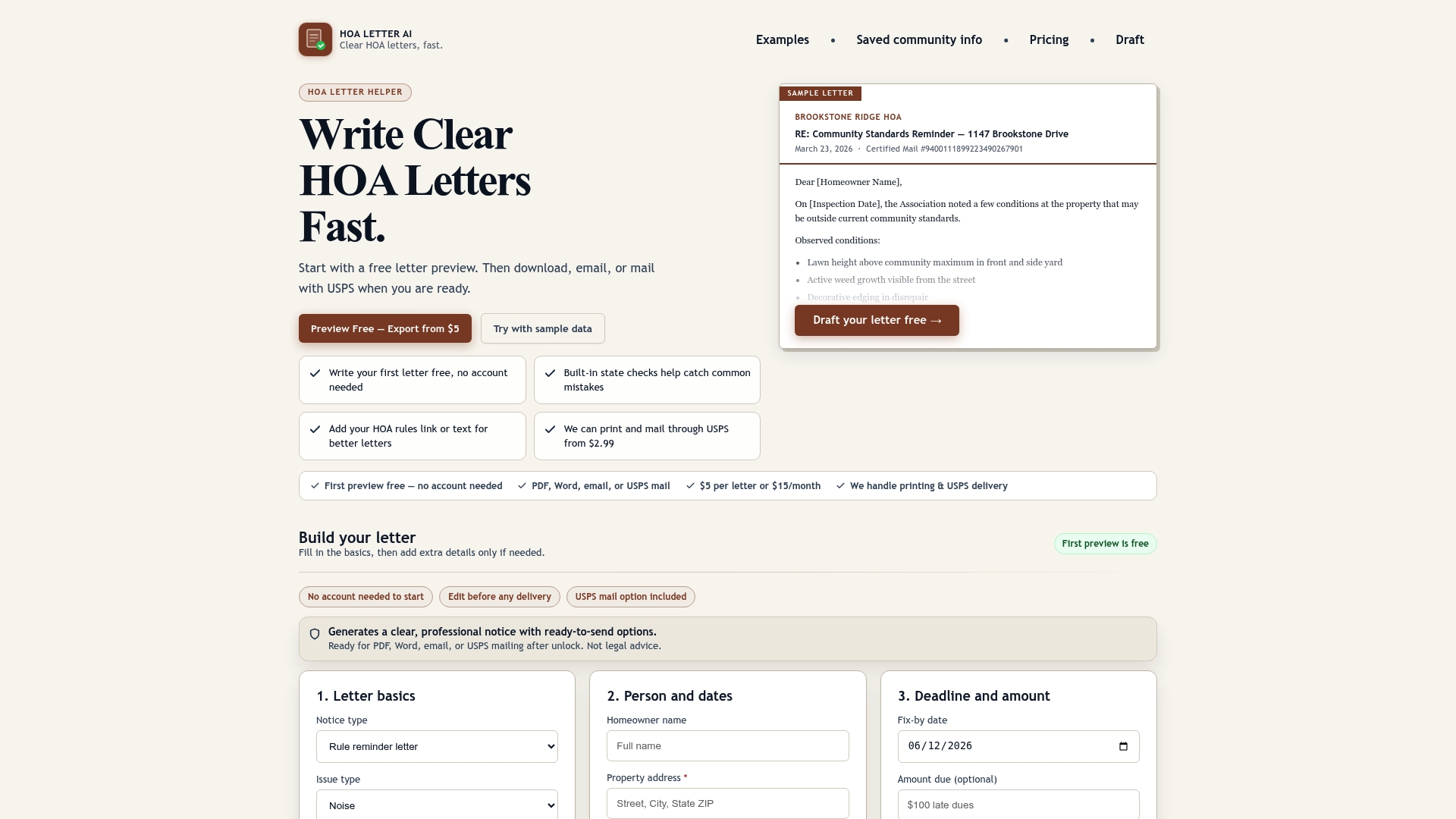
The platform generates a one-page preview before you send, so you can catch formatting errors without printing a draft. Delivery options include USPS mailing, which satisfies bylaws that require physical notice. Boards that need to handle related communications, like HOA violation notices by state, can manage multiple document types in one place without juggling separate tools. For boards that want a faster path to compliant, professional notices, Hoaletterai is the direct route.
FAQ
What must an HOA meeting notice legally include?
A valid HOA meeting notice must include the date, time, location, meeting type, and a detailed agenda. Many states also require proxy instructions and, for annual meetings, financial disclosures and candidate information.
How far in advance must an HOA send a meeting notice?
Most states require 10–60 days’ advance notice for annual meetings. Regular board meeting notices typically follow bylaws, which commonly require 4–10 days.
Can an HOA board vote on items not listed in the meeting notice?
No. Many state laws prohibit HOA boards from discussing or voting on agenda items not published in the official meeting notice. Adding items at the meeting can invalidate those votes.
What delivery methods satisfy HOA notice requirements?
Most bylaws accept email, physical posting in common areas, and first-class or certified mail. Using all three methods at once is the most defensible approach and reduces the risk of homeowner claims of inadequate notice.
Do virtual meetings require a different notice format?
Yes. A virtual or hybrid meeting notice must include the full platform name, meeting link, dial-in number, and access code. It should also state whether homeowners can vote remotely and explain the process for doing so.
Recommended
- HOA Hearing Notice Template — Enforcement Hearing Invitation Letter | HOA Letter AI
- HOA Fine Notice Template — State-Compliant Fine Letter for HOA Boards | HOA Letter AI
- HOA Warning Letter Template — Courtesy Notice Before Fines | HOA Letter AI
- Free HOA Letter Templates — Violation, Fine, Welcome & More | HOA Letter AI