
Ready-to-use HOA notice language examples for common situations
The most effective HOA notices share one quality: they describe what was observed, cite the rule that applies, and tell the homeowner exactly what to do next. No editorializing, no assumptions about intent. Here are ready-to-use language examples organized by notice type.
Courtesy warning (first contact, no fine):
- “During a routine inspection on [Date], it was observed that the lawn at [Address] has grass exceeding the maximum height permitted under Section 4.2 of the Rules and Regulations. Please mow to four inches or below by [Calendar Date]. No fine has been assessed at this time.”
- “This is a friendly reminder that trash receptacles at [Address] were visible from the street on [Date], which is not permitted under Article VI, Section 6.1 of the CC&Rs. Please return containers to an enclosed area within 24 hours of collection.”
Official violation notice (first formal notice):
- “This notice is to inform you of a violation of the governing documents of [Association Name] observed at [Address]. Specifically, [Section X.X of the CC&Rs] prohibits [description of prohibited condition]. On [Date], an Association representative observed [specific factual description]. Please correct this matter by [Calendar Date].”
- “Failure to resolve this violation by [Calendar Date] may result in a hearing before the Board of Directors and fines per the Association’s published fine schedule, as outlined in [Document Reference].”
Hearing notice:
- “You are hereby notified that a hearing has been scheduled for [Date, Time, Location] to discuss the unresolved violation at [Address] referenced in our notice dated [Prior Notice Date]. You have the right to attend, present information, and address the Board.”
Closing statements that encourage cooperation:
- “We appreciate your attention to this matter and your commitment to maintaining the standards that benefit every resident.”
- “If you believe this notice was issued in error, or if you have questions, please contact [Name] at [Phone/Email].”
Notices should always include clear cure deadlines with exact calendar dates, not vague phrases like “within a reasonable time.” Homeowners also have the right to contest a notice, and stating that right explicitly reduces escalation and encourages good-faith responses.
Pro Tip: Reference the exact document section and quote or paraphrase the specific provision. “Section 8.1 of the Declaration requires each owner to maintain exterior landscaping in a clean, neat, and attractive condition” is enforceable. “You need to take care of your yard” is not.

Table of Contents
- Common mistakes that make HOA notices backfire
- Formatting standards that protect your HOA in a dispute
- How professional tools simplify drafting and mailing HOA notices
- Key Takeaways
- Why most HOA boards underestimate the cost of inconsistent notices
- Hoaletterai puts compliant, conflict-reducing notices in your hands faster
Common mistakes that make HOA notices backfire
Accusatory language in HOA notices consistently produces the opposite of the intended result. When a homeowner reads “you always ignore the rules” or “you clearly have no intention of complying,” the conversation shifts from fixing a violation to defending against a personal attack. Boards lose the cooperation they need.
Writing mistakes to avoid:
- Using second-person accusations (“you never,” “you always,” “you refuse to”)
- Stating assumptions about intent rather than observed facts
- Threatening legal action in a first or second notice before the escalation process warrants it
- Using inconsistent terminology across notices (calling the same document “CC&Rs” in one letter and “community rules” in another)
- Overreaching or defamatory language that goes beyond the documented violation
- Skipping the courtesy notice and jumping straight to fines, which undermines enforceability
- Omitting the homeowner’s right to a hearing
Best practices:
- Describe only what was observed: “On [Date], grass at the property measured approximately ten inches in height” rather than “Your lawn is a mess.”
- Cite the specific rule violated, not a general community expectation.
- Keep the tone consistent across all notices, from courtesy warnings through hearing letters.
- Document every notice sent, including the delivery method and date.
Pro Tip: Read your draft notice aloud and ask: does this describe a condition, or does it judge a person? If it judges, rewrite it. The goal is a homeowner who fixes the issue, not one who calls an attorney.
Formatting standards that protect your HOA in a dispute
Consistent formatting does more than look professional. According to HOA Start, standardized letterhead, fonts, and templates strengthen association authority and protect against claims of selective enforcement. A notice that looks different from the last one invites the argument that the board is treating homeowners unequally.
Every compliance notice should include these components:
- Date of the notice (not the date of the violation)
- Owner name and property address as they appear in association records
- Inspection or observation date with approximate time when relevant
- Specific rule citation (document name, article, section number)
- Factual description of the violation with enough detail to be unambiguous
- Required corrective action stated in plain terms
- Cure deadline as a specific calendar date
- Consequences of non-compliance referencing the governing documents
- Homeowner’s right to a hearing or appeal
- Contact information for questions
Use the same letterhead, font, and layout for every notice type. A courtesy warning and a formal violation notice should look like they came from the same organization, because they did. Boards that maintain a standardized letter format are far better positioned when a dispute reaches a hearing or court.
Delivery tracking matters just as much as the letter itself. Send formal notices via USPS Certified Mail or a method that generates a delivery record. Skipping escalation steps or applying rules inconsistently jeopardizes enforceability regardless of how well the notice is written.
How professional tools simplify drafting and mailing HOA notices
Writing every notice from scratch is where errors creep in. A board member working from memory may omit a required element, use language that varies from the last notice, or miss a state-specific requirement. Professional HOA letter software addresses all three problems at once.
Hoaletterai offers multiple HOA letter templates with built-in error checking, state-specific language options, and a one-page preview before sending. Boards can generate a compliant notice in minutes, review it on screen, and send it directly via USPS with tracking, without managing separate tools for drafting, printing, and mailing.
Manual drafting vs. platform-assisted drafting:
- Manual: starts from a blank document or an old letter, risks inconsistent language, no built-in rule citation prompts, no delivery tracking
- Platform-assisted: guided template with required fields, state-aware language, error flagging, integrated USPS mailing with proof of delivery
For property managers handling multiple HOA communities, the volume of notices makes consistency especially difficult to maintain manually. A platform that enforces the same structure across every letter removes that risk.
| Feature | Manual Process | Platform-Assisted |
|---|---|---|
| Template consistency | Varies by author | Enforced by template |
| State-specific language | Requires manual research | Built into the platform |
| Error checking | Relies on proofreading | Automated flagging |
| Delivery tracking | Separate trip to post office | Integrated USPS mailing |
| Time per letter | — | Minutes |
USPS mailing integration is worth calling out specifically. Proof of delivery is often the deciding factor when a homeowner claims they never received a notice. A platform that handles mailing and generates a delivery record closes that gap cleanly.
Key Takeaways
Clear, rule-cited HOA notice language is the single most reliable way to reduce homeowner conflict and keep violations enforceable from the first letter through a hearing.
| Point | Details |
|---|---|
| Cite the exact rule | Reference the specific document, article, and section in every notice to make it enforceable. |
| Use factual, observational language | Describe what was seen on a specific date; never assume intent or use accusatory phrasing. |
| Include a calendar cure deadline | Exact dates outperform vague phrases and give homeowners a clear, fair target. |
| Maintain formatting consistency | Standardized letterhead and templates protect against selective-enforcement claims in disputes. |
| Hoaletterai simplifies the process | The platform generates state-aware drafts you review with built-in error checking and integrated USPS mailing. |
Why most HOA boards underestimate the cost of inconsistent notices
The conventional wisdom is that HOA enforcement problems stem from homeowners who simply refuse to comply. In practice, a significant share of disputes trace back to the notice itself: vague language, a missing rule citation, an inconsistent tone, or a letter that looks nothing like the one sent six months ago.
Boards that invest in clear, consistent notice language are not just being polite. They are building a paper trail that holds up when a homeowner contests a fine or a dispute reaches an attorney. A notice that cites Section 4.2 of the CC&Rs, describes a specific observation on a specific date, and gives a calendar deadline is nearly impossible to challenge on procedural grounds. A notice that says “your property looks bad and needs attention” is not.
The research from KindHOA and HOA Start points in the same direction: factual, rule-grounded language reduces conflict because it removes the personal element entirely. The board is not criticizing the homeowner. The board is reporting that a condition at a property does not meet a standard the homeowner agreed to when they purchased. That framing changes the dynamic.
Technology makes consistency achievable even for small, self-managed boards. Hoaletterai’s state-specific templates and error-checking remove the most common drafting mistakes before a letter goes out. Check the HOA violation notice requirements for your state before drafting your next notice.
Hoaletterai puts compliant, conflict-reducing notices in your hands faster
Drafting HOA notices that are factually grounded, properly formatted, and state-compliant takes real effort when you are starting from scratch every time. Hoaletterai cuts that effort significantly. The platform generates professional violation notices and compliance letters in minutes, with built-in prompts for rule citations, cure deadlines, and homeowner rights language that boards commonly miss.
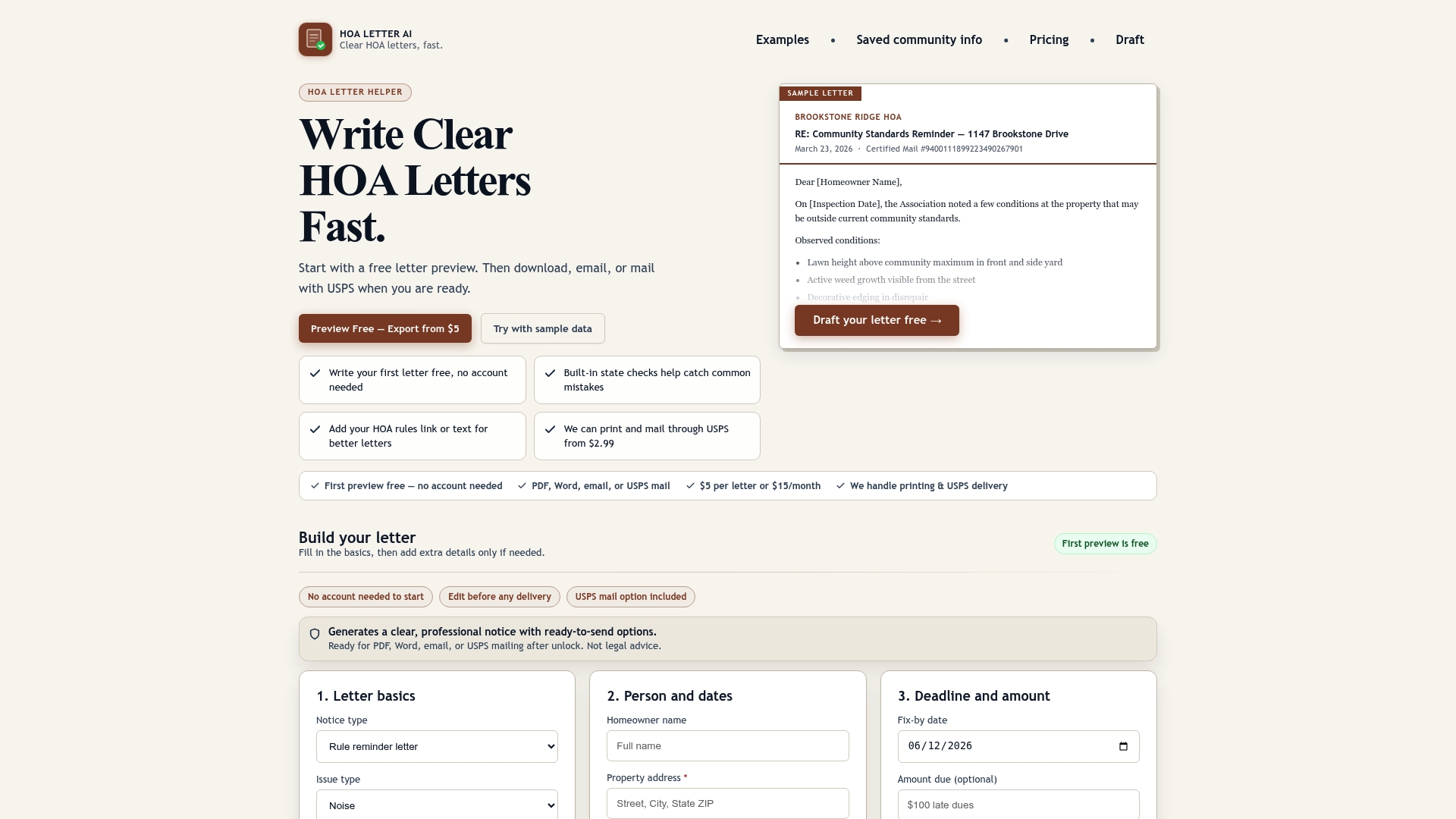
Every letter includes a one-page preview so you can review before sending, and USPS mailing with tracking means you have proof of delivery without a separate trip to the post office. For boards managing exterior maintenance standards or any recurring compliance issue, that combination of speed and documentation adds up fast.
Start with the free HOA letter templates to see the format, or go straight to the platform to generate your first state-aware draft you review today.
Recommended
- HOA Warning Letter Template — Courtesy Notice Before Fines | HOA Letter AI
- How to Write an HOA Violation Letter (With a Calm, Rule-Cited Example) | HOA Letter AI
- HOA Meeting Notice Examples: Templates That Work | HOA Letter AI
- HOA Fine Notice Template — State-Compliant Fine Letter for HOA Boards | HOA Letter AI