
Institutional letter formatting guidelines are the standardized structure and style rules that govern how formal letters are written, organized, and presented in professional and organizational contexts. Every element matters: sender address, date, recipient details, salutation, body paragraphs, closing, and signature each occupy a specific position and serve a specific function. Tools like Microsoft Word, style guides like APA, and legal formatting standards from sources like LegalClarity all reinforce the same core principle. A letter that ignores these conventions signals carelessness before the recipient reads a single word of content.
What are the essential components of an institutional letter?
The standard institutional letter includes eight core components arranged in a fixed sequence: sender address, date, recipient address, subject line, salutation, body paragraphs, closing, and signature. Each component has a defined role, and placing them out of order undermines both readability and professional credibility.
Sender address and date
The sender's address appears at the top left in block format, or top right in modified block. The date follows directly below the sender address, written in full: "March 15, 2026." Never abbreviate the month in formal correspondence. The date establishes a legal and procedural timestamp that matters in compliance and dispute contexts.
Recipient address and subject line
The recipient's full name, title, organization, and mailing address appear below the date, flush left. A subject or reference line follows, labeled "Re:" or "Subject:" in bold or underline. This line tells the reader exactly what the letter addresses before they reach the body, which reduces the time a busy executive or board member spends orienting themselves.
Salutation, body, and closing
Salutation varies by recipient knowledge: use "Dear Mr./Ms. [Last Name]:" with a colon for known recipients, or "Dear Sir/Madam," if the recipient is unknown. Legal style prefers the colon; standard professional letters often use a comma. Getting this detail right signals that you understand the context and audience of your letter.
The body divides into three clear parts:
- Introduction paragraph: State the letter's purpose in the first two sentences. No preamble.
- Supporting paragraphs: Provide facts, context, evidence, or policy references that justify your position or request.
- Closing paragraph: State the specific action you need the recipient to take, and include a deadline when appropriate.
After the body, the closing phrase ("Sincerely," "Respectfully," or "Regards,") appears followed by three to four blank lines for a handwritten signature, then the typed name and title. Optional elements include:
- CC: (carbon copy) for additional recipients
- Encl.: to note attached documents
- Attn: when directing the letter to a specific person within an organization
Pro Tip: *Always include an enclosure notation when attaching documents. Courts and compliance boards treat missing enclosure references as evidence of incomplete correspondence.*
How do block and modified block formats differ?
Block format aligns every element to the left margin with no paragraph indentation. Modified block shifts the date and closing to the center or right, and indents the first line of each paragraph. Block is the dominant style in U.S. business correspondence. Modified block carries a more traditional feel, favored in formal British and South Asian institutional contexts.
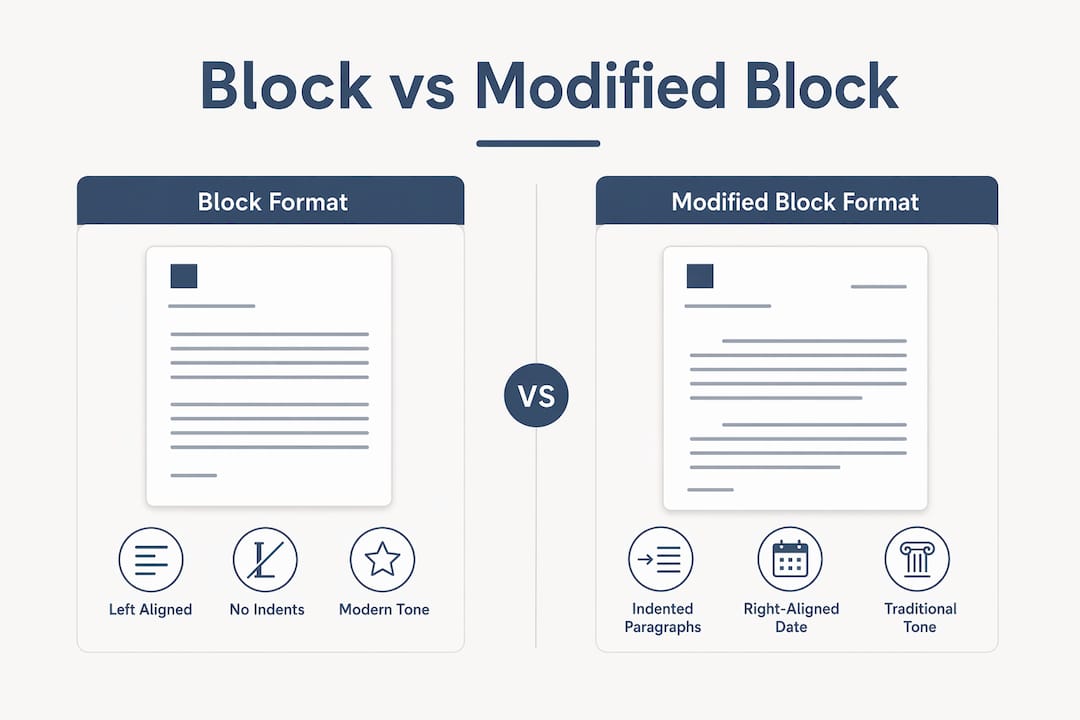
The choice between them is not just aesthetic. Format choice signals organizational tone: block style conveys modern straightforwardness, while modified block suggests tradition and formality. An HOA board sending a compliance notice to a homeowner benefits from block format's clean authority. A law firm writing to a government ministry might prefer modified block to signal deference to institutional hierarchy.
| Feature | Block format | Modified block format |
|---|---|---|
| Paragraph indentation | None | First line indented |
| Date and closing alignment | Left | Center or right |
| Common usage | U.S. business, HOA, corporate | Legal, government, traditional institutions |
| Tone signal | Modern, direct | Traditional, formal |
| Spacing between sections | Double space | Double space |
Pro Tip: *When sending letters across international organizations, confirm which format the recipient institution expects. Sending a block-format letter to a UK government body can read as informal, even if the content is perfectly professional.*
The semi-block format exists as a third option, combining indented paragraphs with left-aligned headers, but it appears rarely in modern institutional practice. For most organizational leaders in 2026, the choice is binary: block for speed and clarity, modified block for tradition and formality.
What typography and layout practices maximize readability?
Typography is not decoration. Font choice, size, margin width, and line spacing directly affect whether a letter reads as authoritative or amateurish. Standard margins for institutional letters are 1 inch on all sides, which corresponds to Microsoft Word's default "Normal" margin setting. Deviating from this standard risks text clipping during printing or PDF export.
Recommended fonts and sizes for institutional letters include:
- Times New Roman, 12 pt: Traditional, widely accepted in legal and academic contexts
- Arial, 11 pt: Clean and modern, preferred in corporate environments
- Calibri, 11 pt: Microsoft Word's default; professional and readable on screen
Single spacing applies within paragraphs. Double spacing separates each major section: sender address from date, date from recipient address, and so on. Business letters should fit on one page with single spacing inside paragraphs and double spacing between sections. If your letter runs longer, reconsider whether every paragraph earns its place.
Page size matters more than most writers realize. U.S. Letter (8.5 x 11 inches) is standard in North America. A4 (210 x 297 mm) is standard in Europe, Asia, and most international institutions. Verifying page size before exporting or printing prevents unintended layout clipping, particularly when letters are shared across borders or printed on foreign office equipment.
For digital letters, scanned or electronic signatures inserted in the three-to-four-line space between the closing phrase and typed name are fully acceptable. Platforms like DocuSign and Adobe Acrobat Sign produce legally recognized digital signatures that satisfy most institutional requirements.
Pro Tip: *Before sending any institutional letter as a PDF, open the exported file and verify that margins, fonts, and page breaks appear exactly as intended. Format drift between Word and PDF is more common than most professionals expect.*
How to write an effective body and closing that drives action
The body of an institutional letter does one job: move the recipient from reading to acting. A well-constructed letter with a clear format reduces ambiguity and improves follow-through, especially in compliance and legal contexts. Vague language is the most common reason institutional letters fail to produce results.
Follow this sequence for every institutional letter body:
- State the purpose in sentence one. "This letter notifies you of a violation of Section 4.3 of the community's governing documents." No warm-up sentences.
- Cite the relevant rule, policy, or fact. Reference the specific document, date, or regulation that supports your position. Specificity removes room for dispute.
- Describe the current situation. State what occurred, when it occurred, and how it conflicts with the cited rule or expectation.
- Make a specific request. Tell the recipient exactly what action is required. "Please remove the unauthorized structure by April 15, 2026" is effective. "We hope this matter can be resolved" is not.
- Set a deadline. Effective letter closings include a specific action and deadline, typically 14 to 30 days for demand letters. This creates a clear record for any follow-up enforcement.
- State consequences. If the request is not met, note what steps follow. This is not a threat. It is information the recipient needs to make an informed decision.
Choosing the correct salutation and personalizing the opening improves professionalism and helps the recipient quickly grasp the letter's relevance. The same principle applies to the closing. "Sincerely" works for most formal letters. "Respectfully" is appropriate when writing to a superior or government body. "Regards" suits professional but less formal correspondence.
Proofreading is not optional. Proofreading is essential to maintain professionalism and avoid credibility loss. A single spelling error in a compliance letter can undermine the authority of the entire document. Read the letter aloud, use Grammarly or ProWritingAid for a second pass, and have a colleague review any letter with legal implications before it goes out.
Key takeaways
Institutional letter formatting works because consistent structure, precise typography, and specific closing language together produce correspondence that is credible, actionable, and legally defensible.
| Point | Details |
|---|---|
| Fixed component order | Sender address, date, recipient, subject, salutation, body, closing, and signature must appear in sequence. |
| Format choice signals tone | Block format reads as modern and direct; modified block signals tradition and formality. |
| Typography standards matter | Use Times New Roman or Arial at 11 to 12 pt, 1-inch margins, and single spacing within paragraphs. |
| Closings must be specific | State the exact action required and a deadline of 14 to 30 days for compliance or demand letters. |
| Verify before sending | Confirm page size and margin settings in the exported PDF to prevent format drift and clipping. |
Why most institutional letters fail before the closing line
I have reviewed hundreds of institutional letters over the years, and the failure point is almost never the closing. It is the body. Most writers spend their effort on the opening salutation and the polite sign-off, then rush through the middle three paragraphs where the actual argument lives.
The most common mistake I see is burying the request. A letter that spends two paragraphs explaining background before stating what it actually needs gives the recipient an easy exit. They skim, miss the request, and file the letter without acting. State the purpose in sentence one of the body. Every sentence after that should support or advance that single purpose.
The second mistake is format inconsistency. I have seen letters where the sender used Times New Roman for the header and Calibri for the body, with margins that shifted between sections because the writer assembled the letter from multiple copied templates. That kind of inconsistency signals that the organization does not take its own correspondence seriously. Readers notice, even if they cannot articulate why.
My practical recommendation: build one master template in Microsoft Word with locked styles for each component. Use that template every time. When you need state-specific language or compliance-specific phrasing, add it to the template rather than drafting from scratch. Consistency at the template level eliminates 80% of formatting errors before you write a single word.
The letters that produce results are the ones that respect the reader's time. Clear format, specific request, firm deadline. Everything else is noise.
> *— Blake*
How Hoaletterai makes institutional letter formatting faster
For HOA boards and property managers, formatting compliance letters correctly every time is a real operational challenge. Hoaletterai solves it directly.

The Hoaletterai violation letter generator produces state-compliant, professionally formatted letters in minutes. Every letter follows the block format standard, includes the correct component order, and incorporates state-specific language automatically. Board members do not need to manage templates or verify margin settings manually. The platform handles formatting, compliance checks, and delivery options including USPS mailing, so the letter that leaves your office is the letter that arrives correctly formatted and legally sound. For boards managing noise complaints or trash violations, purpose-built templates remove the guesswork entirely.
FAQ
What are the standard components of an institutional letter?
An institutional letter includes sender address, date, recipient address, subject line, salutation, body paragraphs, closing phrase, and signature in that order. Optional additions include CC notations, enclosure references, and attention lines.
What is the difference between block and modified block format?
Block format aligns all elements to the left with no paragraph indentation. Modified block indents paragraphs and right-aligns the date and closing. Block is standard in U.S. business correspondence; modified block is preferred in more traditional or international institutional contexts.
What font and margin settings should institutional letters use?
Use Times New Roman, Arial, or Calibri at 11 to 12 pt with 1-inch margins on all sides. Single-space within paragraphs and double-space between sections to meet standard institutional letter formatting guidelines.
How specific should the closing request be in a formal letter?
The closing request must name the exact action required and include a deadline, typically 14 to 30 days for compliance or demand letters. Vague language like "we hope to resolve this" reduces follow-through and weakens the letter's legal standing.
How do I prevent formatting errors when exporting to PDF?
Open the exported PDF before sending and verify that margins, fonts, and page breaks match the original document. Confirm the page size matches the recipient's regional standard, either U.S. Letter or A4, to prevent clipping.
Recommended
- HOA Letter AI — HOA Violation Letter Generator (State-Compliant)
- Why HOA Letters List Specific Rules: A Board Guide | HOA Letter AI
- HOA Collection Letters: A Respectful, Step-by-Step Reminder Sequence | HOA Letter AI
- How to Write an HOA Violation Letter (With a Calm, Rule-Cited Example) | HOA Letter AI
Drafting support for HOA notices
Use the HOA letter drafter to turn this guidance into a resident-ready notice, compare reusable HOA letter templates, or review the property manager workflow for higher-volume enforcement work.