
North Carolina law says an HOA cannot fine you or suspend your privileges without first sending written notice and giving you a chance for a hearing. That is the entire ballgame: no hearing offer, no valid fine, regardless of what your community guidelines claim. The moment you receive a north carolina hoa violation notice, the clock starts on your right to respond, so check the deadline printed on the letter, pull your governing documents, and send a written hearing request before that window closes.
TL;DR:
- Violations notices must cite specific rules, describe the violation clearly, and be delivered through proper methods like certified mail to be valid.
- Homeowners should request a hearing in writing before the deadline, provide evidence like photos and delivery proof, and use proper channels to challenge fines.
- Fines are limited to $100 per violation, with potential stacking of daily fines, but assessments supporting liens or foreclosure must follow strict procedural rules.
- Procedural errors such as vague notices or improper delivery are the main reasons fines get dismissed, making attention to notice quality crucial for homeowners.
- Legal and mediation resources are available if the board threatens liens or ignores proper procedures, and tools like HOA Letter AI help ensure notices are compliant.
HOA Letter AICreate Clearer HOA NoticesDraft professional compliance letters with state-specific context, community rules, built-in checks, and delivery options in one workflow.Explore HOA Letter AI
Table of Contents
- What North Carolina Law Requires for HOA Violation Notices
- The Notice and Hearing Process: A Step-by-Step Checklist
- How to Respond: Steps, Evidence, and a Hearing Request
- Fines, Liens, and the Limits on Enforcement
- Timelines, Appeals, and Deadlines to Track
- When to Bring in an Attorney or Mediation
- How HOA Letter AI Helps Reduce Procedural Errors
- Why Due Process Matters for Healthy HOA Governance
- Draft a Compliant Notice or Response in Minutes
- Official Statutes and North Carolina Resources
- Sources
- FAQ
What North Carolina Law Requires for HOA Violation Notices
N.C. Gen. Stat. § 47F-3-107.1 is the statute that governs almost everything about how North Carolina HOAs can punish you. It requires written notice and a genuine opportunity to be heard before an association imposes a fine or suspends privileges like pool access or parking. Fines are capped at $100 per violation, though the statute allows daily amounts to stack up once a violation is confirmed as continuing after a hearing.
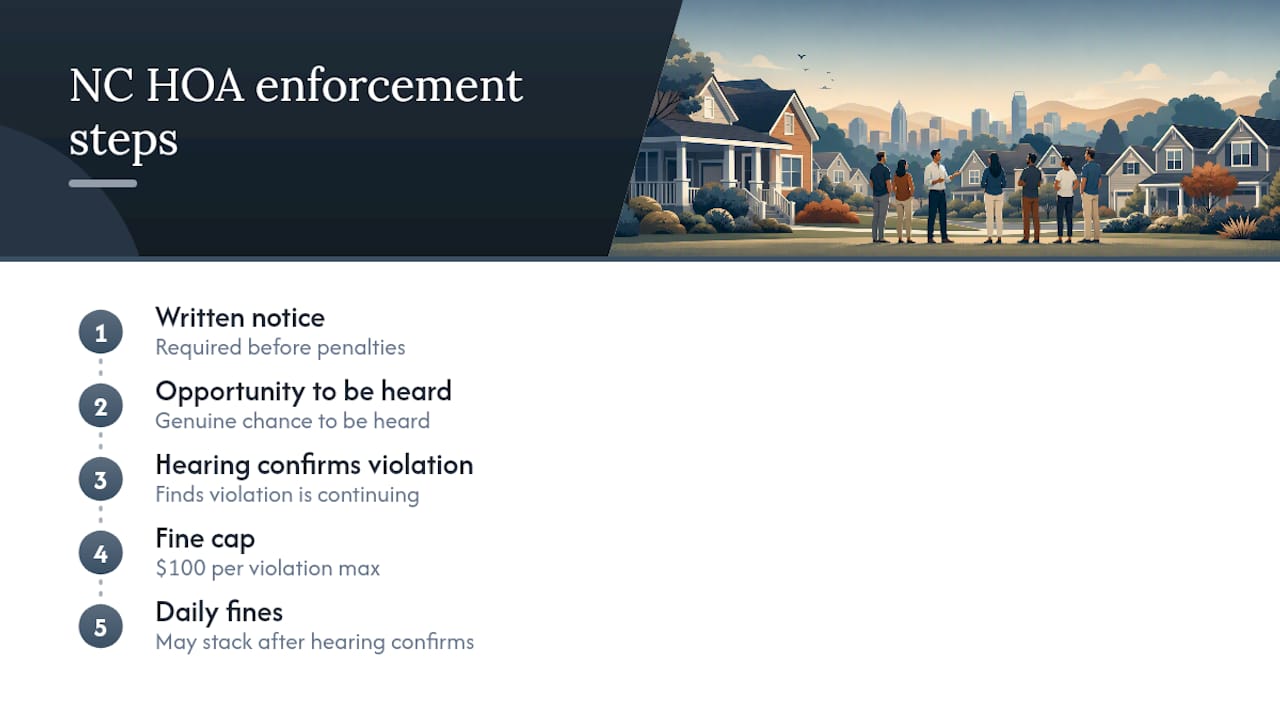
That $100 figure surprises a lot of homeowners who assumed their board could invent whatever penalty schedule it wanted. It cannot. GS 47F-3-102 grants the association its core powers, including collecting assessments, adopting rules, and suspending privileges, but every one of those enforcement powers is conditioned on notice and a hearing. Your declaration and bylaws still matter. They set the specific rules you agreed to follow and often spell out procedural details the statute leaves open, like who sits on a hearing panel.
When a hearing panel exists separately from the full board, panel members typically must be association members who are not officers or directors. That distinction can decide a case on its own, since a panel stacked with board insiders undercuts the neutrality the process is supposed to guarantee.
The Notice and Hearing Process: A Step-by-Step Checklist
Before you argue about whether you actually violated a rule, check whether the notice itself is even valid. Procedural defects are the most common reason fines get thrown out, according to attorneys who handle these disputes regularly.
- Confirm the notice cites a specific rule. A valid notice references the exact CC&R or rule section allegedly violated, not a vague reference to “community standards.”
- Check for a clear description of the violation. The notice should describe what happened, when it was observed, and how the board identified it.
- Look for the fine schedule and hearing instructions. A compliant notice states the proposed penalty and explains how to request a hearing, including the deadline.
- Verify the delivery method. Most governing documents require certified mail, hand delivery, or another method that creates proof; a note taped to your door usually will not hold up.
- Confirm a cure period was offered if your documents require one. Many declarations give owners a window to fix the issue before penalties apply.
- Match the sequence against the statute. Identification of the violation, notice, any cure period, a hearing opportunity, and a written decision all have to happen in that order.
Boards trip themselves up most often on delivery and vagueness. A notice mailed to the wrong address, missing a rule citation, or silent on hearing rights hands you an immediate procedural argument. This is where the fight usually gets won or lost, and it rarely has anything to do with whether your fence was actually two inches too tall.
How to Respond: Steps, Evidence, and a Hearing Request
Start with a calendar entry, not an argument. Mark the exact deadline for requesting a hearing, confirm how the notice was delivered, and pull your CC&Rs and bylaws so you know what your board is actually required to do.
- Photograph the alleged violation with a timestamp, especially if it is something like landscaping or a parked vehicle that changes daily.
- Gather any prior board approvals, emails, or texts related to the issue.
- Collect the notice envelope or delivery confirmation as proof of when and how it arrived.
- Pull the specific CC&R section cited and compare it word for word against what you actually did.
Your hearing request does not need to be long, but it needs specific elements: your name and address, the notice date, the violation cited, a clear statement that you are requesting a hearing under the association’s procedures, and the date you are sending the request. Send it by a method that creates a paper trail, ideally certified mail or email with a read receipt, and keep a copy for yourself.
Once the request is in, ask the board for its evidence in advance of the hearing. You have a right to know what they are relying on before you have to respond to it. Request a written decision after the hearing, not a verbal explanation, and ask whether the association offers internal dispute resolution or mediation before things escalate further.
Pro Tip: Never respond informally by phone or in a casual conversation with a board member. An oral complaint does not preserve your hearing rights, and it gives the board room to claim you never formally objected.
Fines, Liens, and the Limits on Enforcement
Fines are capped at a specific maximum amount per violation, but daily continuing fines can accumulate once a hearing confirms the violation persists, so a slow response can get expensive fast. Fines and assessments are treated differently under the law: unpaid assessments can support a lien and eventually foreclosure, while fines generally cannot carry that same weight on their own.
That distinction matters when a board threatens to put a lien on your property over a violation fine. If the amount in question is purely a fine, question the legal basis. Your best defense against collection is almost always procedural: no proper notice, no hearing offered, or a panel that did not meet composition requirements. Point that out early, in writing, before the matter moves toward a lien or litigation.

Timelines, Appeals, and Deadlines to Track
North Carolina generally requires at least 10 days’ notice before a hearing can take place, though many associations build in longer windows through their own governing documents.
- Track the initial notice date and count the minimum 10-day window before any hearing.
- Watch for a common appeal period of around 15 days if you want to challenge a hearing decision to the full board.
- Expect the entire process, from first notice through final decision, to run roughly 4 to 8 weeks depending on how responsive the board is.
The biggest trap is silence. Missing the hearing-request window, or responding informally instead of in writing, can waive your right to challenge the fine entirely.
When to Bring in an Attorney or Mediation
Call a lawyer once a lien, foreclosure threat, or stacking daily fine shows up, or if you suspect the board is skipping its own procedures. Mediation through the Dispute Resolution Commission can resolve smaller disagreements without the cost of litigation. If you need counsel, the North Carolina State Bar’s public directory helps you find licensed attorneys who handle community association disputes.
How HOA Letter AI Helps Reduce Procedural Errors
Most invalid fines trace back to the same handful of mistakes: no rule citation, no hearing instructions, or an unclear delivery method. HOA Letter AI builds state-specific templates that check for exactly those elements before a board sends a notice, and it does the same for homeowners drafting a response or hearing request.
The templates prompt for the CC&R citation, the violation description, the proposed fine, and delivery proof, so boards are less likely to hand a homeowner an easy procedural win. Homeowners get tailored response guidance built around what North Carolina actually requires, not generic boilerplate. None of this replaces legal advice, but a clean, complete notice or response is the first line of defense either side has.
Why Due Process Matters for Healthy HOA Governance
Enforcement keeps communities functional, but only when boards follow the process the legislature actually wrote. Homeowners fare best when they use their hearing rights immediately instead of letting a dispute fester into litigation. Boards that share their evidence early and offer mediation resolve most conflicts before anyone needs a courtroom.
— Blake
Draft a Compliant Notice or Response in Minutes
HOA Letter AI is the alternative to hiring outside counsel for routine notice drafting: instead of paying attorney rates to check whether a letter includes the right citation and delivery language, you get a state-aware template with a free preview built in.
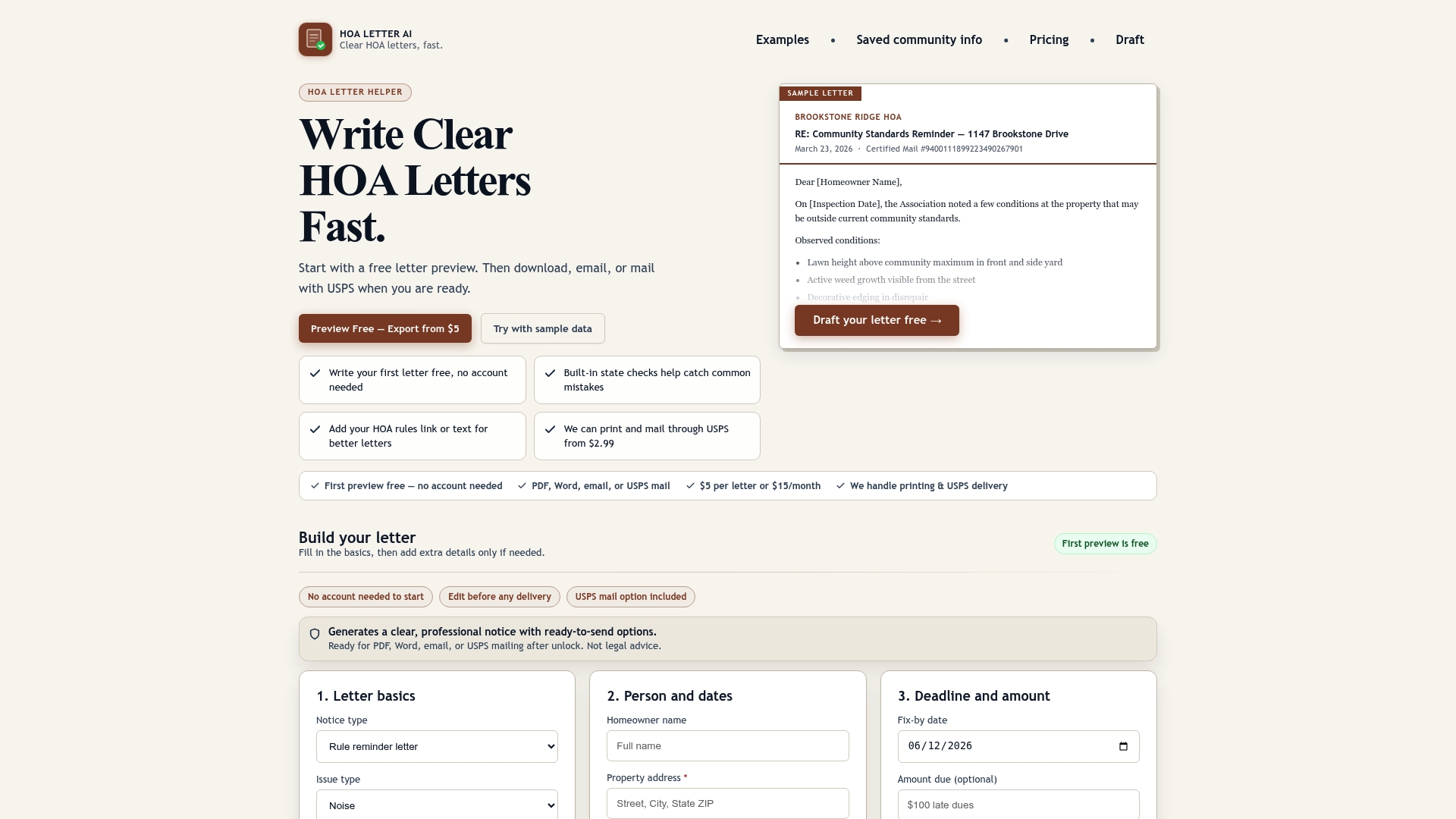
Boards and property managers avoiding the procedural mistakes that void fines can start with the $5 one-time letter or move to the PM Starter plan at $199 per month for ongoing template access across a whole portfolio. Homeowners who received a notice and want a formal, well-structured hearing request can generate a homeowner response letter for a one-time $5 fee. Need proof of delivery for a hearing request or a board notice? USPS mailing starts at $2.99 directly from the platform. Preview your letter free, then decide if it is worth unlocking.
Official Statutes and North Carolina Resources
- GS 47F-3-107.1: fine and hearing procedures.
- North Carolina Department of Justice HOA guidance.
- Dispute Resolution Commission: mediation resources.
This article is general information, not a substitute for advice from a qualified lawyer. Consult a qualified legal professional about your own circumstances before acting on anything here.
Sources
- GS 47F-3-107.1 — Procedures for fines and suspension of planned community privileges or services
- Homeowners’ Associations — North Carolina Department of Justice
- What to do if you’re fined or threatened by your HOA — Delton Barnes Law
FAQ
What Are the New HOA Laws in North Carolina?
Recent legislative activity, including House Bill 444 introduced in 2025, has proposed additional HOA reform measures around transparency and enforcement. Homeowners and boards should check the current bill text before assuming any specific change is already in effect, since proposed legislation and enacted law are not the same thing.
What Is the Most Common HOA Violation Complaint?
Landscaping, exterior modifications, and parking violations generate the bulk of HOA complaints nationally, and North Carolina communities follow that same pattern. Most disputes over these violations get resolved or dismissed based on notice defects rather than the underlying facts, since procedural mistakes are the most common basis for a successful appeal.
How Do You Get Out of an HOA in North Carolina?
Leaving an HOA is difficult once your property is subject to a recorded declaration, since the covenant typically runs with the land regardless of who owns it. Selling the property is usually the only realistic exit; a small number of older or informally organized associations may allow a formal withdrawal process, but that depends entirely on the specific governing documents.
How Do You Get Out of HOA Fines?
Your strongest option is challenging the notice on procedural grounds: missing rule citations, improper delivery, or no hearing offer. If the board followed every step correctly under GS 47F-3-107.1, your remaining options are arguing the facts at the hearing or negotiating a reduced penalty directly with the board.