
Every HOA violation follows a five-stage path: courtesy notice, formal letter, fines, hearing, and if ignored long enough, a lien or lawsuit. Homeowners have a right to written notice, a reasonable cure period, and typically a hearing before any fine becomes final. Ignore all of it, and unpaid fines can attach to your property as a lien.
TL;DR:
- Homeowners have the right to written notices, cure periods, and hearings before fines become final, emphasizing the importance of timely response and documentation.
- Unpaid fines can lead to liens or legal action only if a violation remains unresolved after all procedural steps, including a hearing if applicable, are completed.
- Gathering photographic evidence, checking rule citations, and documenting repairs are essential for homeowners contesting violations or disputing fines effectively.
- The enforcement process varies by state and community rules, making it critical to verify specific procedures, including notices and hearing rights, to avoid procedural invalidation.
- HOA management typically handles inspections and notices, but legal enforcement decisions, fines, and liens are decided by the board based on documented violations.
Table of Contents
- Understanding the HOA Violation Process Step by Step
- What to Do the Moment You Get a Violation Notice
- How Do HOA Hearings and Appeals Actually Work?
- Fines, Liens, and What Financial Escalation Really Costs You
- Can You Legally Challenge an HOA Violation?
- HOA Violation Timelines and Fine Ranges to Expect
- Why State-Specific Notices Prevent Costly Enforcement Mistakes
- Who Actually Enforces HOA Rules: The Board vs. the Management Company
- Where Your CC&Rs Define What Counts as a Violation
- Does an HOA Violation Follow You When You Sell Your Home?
- Alternatives to Fines: Mediation and Correction Plans
- What Evidence Can Homeowners Request From the HOA?
- How Unresolved Violations Affect Escrow and Title
- A Fair Enforcement System Protects Everyone, Not Just the Board
- Draft Compliant Violation Letters in Minutes, Not Hours
- Where to Verify Your Legal Rights and Local Rules
- Sources
Understanding the HOA Violation Process Step by Step
Most violations start the same way: a board member, property manager, or landscaping crew notices something during a routine walk-through, or a neighbor files a complaint. That observation gets logged, often with a photo and a date, before anyone drafts a letter. This documentation matters more than most homeowners realize. If a case ever reaches a hearing, the association’s records of what was observed and when become the backbone of its argument.
The courtesy notice. This is the first formal step, and according to ManageCasa’s research on violation enforcement, most cases never go further than this stage. A courtesy notice typically describes the violation, cites the specific rule or CC&R section, and gives a cure window, usually a short period appropriate for minor issues like an overflowing trash can or an unapproved yard ornament. No fine attaches at this point. It’s a heads-up, not a penalty.
The formal violation letter. If the courtesy notice gets ignored or the problem isn’t fixed in time, the association sends a formal letter. This document carries more legal weight and usually includes:
- The specific CC&R, bylaw, or rule provision violated
- Photographic or written evidence of the violation
- A revised cure deadline, often 15 to 30 days for larger issues like unapproved construction or major landscaping changes
- A clear statement that fines will begin accruing if the issue isn’t resolved
- Instructions for requesting a hearing
Fines begin. Once the formal letter’s deadline passes without resolution, the board can start assessing fines under the schedule spelled out in the governing documents. Many associations use an escalating structure: a flat fine for the first offense, then a per-day or per-week charge if the violation continues. Fines get recorded against the homeowner’s account, and in most states they can eventually be added to a lien if they go unpaid.
The hearing. Before a fine becomes final and enforceable in many jurisdictions, homeowners are entitled to a hearing. The HOA Handbook’s guide to due process confirms this right applies broadly: written notice, a chance to cure, and a hearing before the association can lock in penalties. The hearing panel reviews evidence, hears the homeowner’s side, and either upholds, reduces, or dismisses the fine.
Lien or legal action. If fines pile up and go unpaid after a hearing decision, the association can record a lien against the property. In more serious or prolonged cases, that can escalate to a lawsuit or, in extreme circumstances, foreclosure. This is the outcome every earlier stage is designed to help homeowners avoid, which is exactly why courtesy notices exist in the first place.
Escalation almost never happens because a board is looking for a fight. It happens because a notice sat unopened, a deadline slipped by, or a homeowner assumed the problem would go away on its own. It won’t.
What to Do the Moment You Get a Violation Notice
Getting a violation notice in your mailbox triggers a small window where your actions decide whether this becomes a minor paperwork exercise or a drawn-out dispute. Work through these steps in order.
- Photograph and timestamp the condition immediately. Before you touch anything, take dated photos of whatever the notice references, whether it’s your fence, your parked car, or your lawn. This protects you if the timeline or details get disputed later.
- Pull your CC&Rs and bylaws and check the cited provision. Confirm the rule actually exists, applies to your situation, and was cited correctly. Boards make mistakes, and a wrong citation can be grounds to challenge the notice outright.
- Send a written response, by certified mail or documented email. State whether you’re curing the issue, contesting it, or requesting a hearing. Verbal conversations with a board member don’t create a paper trail, and a paper trail is what protects you.
- Fix the issue if it’s a legitimate violation, and document the fix. New photos, receipts, or contractor invoices showing the repair date all matter if you need to prove compliance later.
- Request written confirmation that the case is closed. Don’t assume silence means resolution. Get it in writing.
Pro Tip: Keep every piece of correspondence, notice, and photo in a single folder, digital or physical, organized by date. If your case reaches a hearing, the homeowner who shows up with an organized timeline almost always fares better than the one relying on memory.
If you plan to contest the violation, our guide to disputing an HOA notice walks through how to structure that written response so it holds up.
How Do HOA Hearings and Appeals Actually Work?
Hearing procedures vary more by state and by governing document than most homeowners expect. Some associations use the board itself as the hearing panel. Others, particularly in states like Florida, require an independent committee separate from the board to confirm fines before they take effect, according to Fix My HOA Violation’s breakdown of the hearing process. Checking your state’s specific statute is worth the ten minutes it takes, because a missed procedural requirement can void the entire enforcement action.
To request a hearing, homeowners typically respond in writing within the window stated on the formal notice. RunHOA’s guidance on notice-to-hearing timelines puts common hearing lead times at roughly 10 to 15 days after a request is submitted, though this shifts depending on state law and the association’s own rules.
Evidence that actually moves the needle at a hearing includes:
- Dated, timestamped photos showing the condition before and after
- Written approvals from architectural committees for anything you were told was fine at the time
- Prior inspection records or maintenance logs
- Copies of correspondence with the board or management company
Decisions typically come in writing within a few weeks of the hearing depending on the association’s bylaws. If the outcome doesn’t go your way, options include an internal appeal (if the governing documents allow one), mediation, or, for larger disputes, small claims or civil court. Our breakdown of the appeal process covers how to structure that next step if the hearing decision feels wrong.
Fines, Liens, and What Financial Escalation Really Costs You
Fine structures usually follow a pattern spelled out in the CC&Rs: a set amount for the first offense, then either a flat repeat fine or a per-day charge that climbs the longer the violation continues. Many governing documents cap the total fine amount, though state law sometimes overrides those caps entirely, which is why reading your specific CC&Rs matters more than trusting a generic number you saw online.
- Unpaid fines typically get recorded against the homeowner’s account first
- If they remain unpaid, many states allow the association to record a lien against the property
- A lien can block or complicate refinancing and will almost always surface during a title search at resale
- Associations generally escalate to litigation or foreclosure only after liens go unpaid for an extended period, and usually only for larger balances
Whether to pay a fine or fight it comes down to simple math: a small first-time fine often costs less to pay than the time and legal fees required to contest it. But if a fine is procedurally flawed, cites the wrong rule, or reflects selective enforcement, disputing it early, before it compounds into a lien, is almost always worth the effort. Our explainer on HOA fine schedules breaks down how to read your association’s specific structure.
Can You Legally Challenge an HOA Violation?
Homeowners have more leverage here than most assume, provided they can document their case. Three defenses come up again and again.
- Selective enforcement. If the board enforced a rule against you but ignored the identical violation by a neighbor, that’s a recognized defense, and ManageCasa notes it frequently succeeds when the homeowner has photos or records proving the double standard.
- Prior approval or estoppel. A written architectural approval, or years of the board looking the other way on a specific condition, can undercut a new violation claim.
- Procedural defects. Missing deadlines, wrong addressee, no hearing offered, or a notice that skips a required CC&R citation can void a fine entirely.
Pro Tip: Screenshot your neighborhood on a mapping app or keep dated photos of comparable violations nearby. Selective enforcement claims live or die on comparison evidence, not just your own situation.
Boards reduce their legal exposure by applying rules consistently and documenting every notice the same way, every time.
HOA Violation Timelines and Fine Ranges to Expect
| Stage | Typical timeframe |
|---|---|
| Courtesy notice cure window | 10 to 15 days |
| Formal letter cure window | 15 to 30 days |
| Larger repairs or construction issues | Often more than 30 days |
| Hearing request lead time | Roughly 10 to 15 days |
| Written decision after hearing | 5 to 30 days |
A pattern worth knowing: boards that treat fines as a compliance tool rather than a revenue source see lower repeat-offense rates over time. Tracking simple metrics like first-notice compliance helps associations catch problems before they escalate into disputes nobody wanted.
Exact fine amounts vary by community, but many associations start with a modest initial fine and escalate for repeat offenses, always within whatever cap their CC&Rs set.
Why State-Specific Notices Prevent Costly Enforcement Mistakes
A violation notice that skips the wrong CC&R section, uses the wrong homeowner name, or ignores a state-mandated hearing requirement can get thrown out entirely, wasting months of enforcement effort. Citing the exact statute and CC&R provision in every notice isn’t a formality. It’s what makes the notice enforceable if a homeowner challenges it later.
A notice-completeness checklist, covering the cited rule, cure deadline, hearing rights, and delivery method, catches these gaps before a letter goes out. HOA Letter AI builds this into its drafting process with state-specific guidance, built-in checks for mandatory language, and a one-page preview so boards can catch a missing element before it becomes a voided fine. For a deeper look at what a compliant notice needs, see our violation notice checklist for board members.
Who Actually Enforces HOA Rules: The Board vs. the Management Company
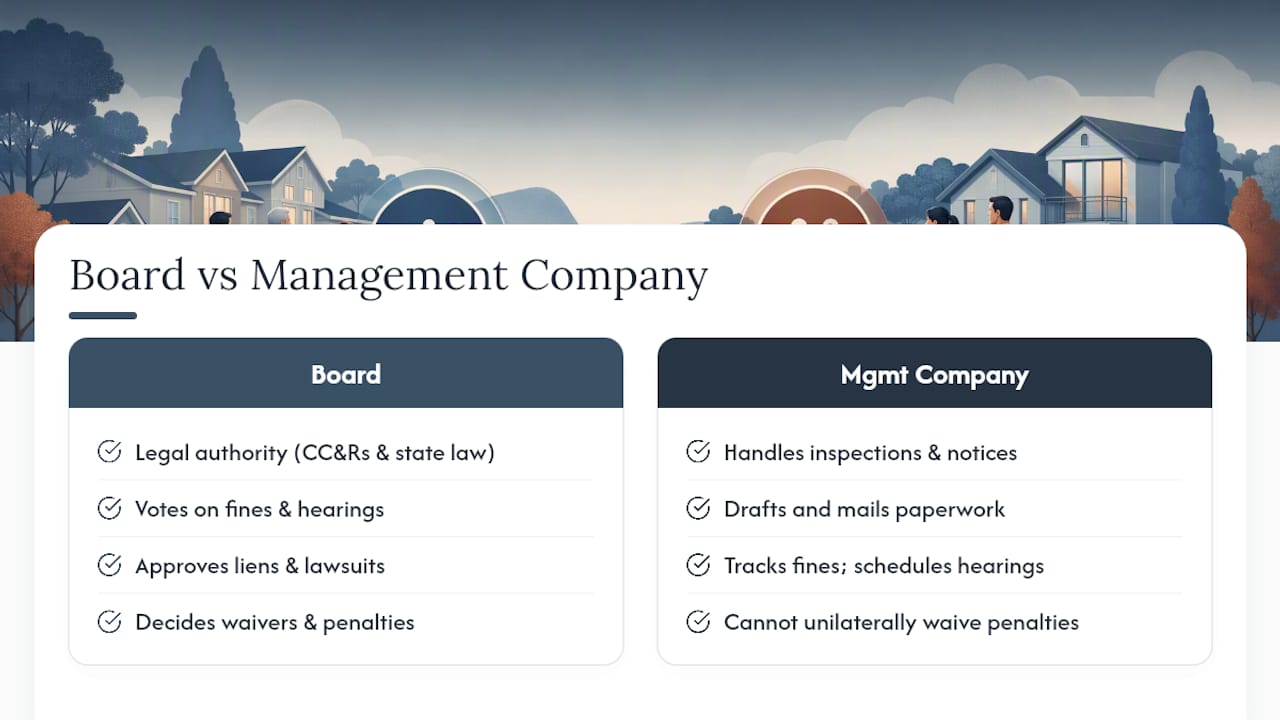
The HOA board holds the legal authority to enforce the community’s governing documents. Board members vote on fine schedules, approve hearing outcomes, and ultimately decide whether to escalate to a lien or lawsuit. That authority comes directly from the CC&Rs and state nonprofit corporation law, not from the management company.
The property management company, when one is hired, usually handles the operational side: conducting inspections, drafting and mailing notices, tracking fines, and scheduling hearings. Management staff typically can’t unilaterally decide penalties or waive fines. That decision-making stays with the board, even when a management company drafts the paperwork.
This division matters for homeowners trying to figure out who to contact. A dispute over notice wording or a scheduling question usually goes to the management company first. A request to waive a fine or challenge a hearing decision needs to go to the board directly, since that’s where the actual authority sits. Associations that outsource day-to-day enforcement to a management company still need board sign-off on anything that touches fines or legal escalation. For associations weighing how much enforcement work to hand off, a broader guide to management responsibilities covers where those lines typically fall.
Where Your CC&Rs Define What Counts as a Violation
Every enforceable rule traces back to three documents: the CC&Rs (covenants, conditions, and restrictions), the bylaws, and any separately adopted rules and regulations. The CC&Rs are the foundational contract every homeowner agrees to at closing, covering things like architectural standards, landscaping requirements, and use restrictions. Bylaws govern how the association itself operates, including how the board is elected and how meetings run. Rules and regulations are typically narrower, more frequently updated policies, like pet leash requirements or parking restrictions, adopted under authority the CC&Rs grant the board.
Penalties trace the same hierarchy. A CC&R violation, say, an unapproved structural addition, usually carries steeper fines and a longer cure window than a rules violation like a trash can left out too long. Most CC&Rs also specify a maximum fine amount or an escalation formula for repeat offenses, and boards that deviate from that formula open themselves up to a procedural challenge.
Homeowners should read the actual provision cited in any notice, not just trust the board’s summary of it. Rules occasionally get amended, and a fine based on an outdated version of the CC&Rs is one of the more common procedural defects that gets a case thrown out at a hearing.
Does an HOA Violation Follow You When You Sell Your Home?
An unresolved HOA violation can complicate a sale in ways that catch sellers off guard. Most title companies and buyers request an estoppel letter or resale certificate from the association before closing, and that document typically discloses any open violations, unpaid fines, or liens attached to the property. A buyer’s lender may also flag an open lien during underwriting, which can delay or derail financing entirely.
Beyond the paperwork, reputation within the community matters more than homeowners often expect. Boards and neighbors talk, and a homeowner known for repeat violations sometimes faces closer scrutiny on future issues, even unrelated ones. That’s not a legal consequence, but it’s a real one.
The practical fix is straightforward: resolve violations, pay or successfully dispute fines, and get written confirmation that a case is closed well before listing the property. A seller who waits until escrow to discover an open lien loses negotiating leverage and often ends up paying it off just to close on time, sometimes at a worse rate than if they’d disputed it months earlier.
Alternatives to Fines: Mediation and Correction Plans
Fines aren’t the only enforcement tool available, and boards that reach for them first often generate more disputes than they resolve. A correction plan, a documented agreement laying out specific repairs, a timeline, and check-in points, gives homeowners a structured path to compliance without an immediate financial penalty. This works particularly well for larger issues like landscaping overhauls or exterior repairs that can’t reasonably happen inside a 15 day window.

Mediation offers another route, especially for disputes involving selective enforcement claims or disagreements over what a rule actually requires. A neutral third party can often resolve in one session what might otherwise take months of letters and a formal hearing. Some state statutes actually require mediation attempts before litigation can proceed.
Boards that offer these alternatives, rather than jumping straight to fines, generally see faster resolution and fewer appeals. For homeowners facing a violation, asking directly whether a correction plan is available is a reasonable first move; it costs nothing to ask, and many boards would rather see compliance than collect a fine.
What Evidence Can Homeowners Request From the HOA?
Homeowners generally have the right to inspect the documentation behind a violation notice, including the specific complaint or inspection report, photos taken by the association, and the board meeting minutes where the violation or fine was discussed. This isn’t a courtesy; it’s typically written into state open-records statutes governing community associations, and it’s foundational to the due-process rights The HOA Handbook describes.
Requesting this evidence in writing, before a hearing, gives homeowners time to prepare a real response instead of hearing the details for the first time at the hearing table. If a board can’t produce the underlying documentation, that gap itself can become part of a procedural challenge. Associations that stall or refuse reasonable inspection requests create their own exposure, since a fine built on evidence the homeowner never got to see is far easier to overturn on appeal.
How Unresolved Violations Affect Escrow and Title
When a home goes into escrow, the title company or escrow agent typically requests a resale certificate or estoppel letter directly from the HOA. That document lists any outstanding violations, unpaid fines, and recorded liens tied to the property, and it becomes part of the closing package the buyer’s lender reviews.
An unresolved violation doesn’t automatically kill a sale, but it does slow it down. Escrow agents commonly hold a portion of the sale proceeds, or require the seller to resolve the issue before releasing funds, when a lien shows up on the title report. Buyers’ lenders are often reluctant to fund a loan against a property with an active lien, since it complicates their own claim to the collateral.
Sellers who request their own estoppel letter early, well before listing, avoid the scramble that happens when a title company flags a violation mid-escrow. It’s a five-minute request to the management company that can save weeks at closing.
A Fair Enforcement System Protects Everyone, Not Just the Board
Enforcement works best when it’s aimed at getting homeowners into compliance, not at collecting fines. Boards that apply rules consistently, document every step, and run hearings that actually listen to homeowners end up with fewer disputes and less legal exposure over time. The boards that get sued are almost always the ones that skipped a notice requirement, ignored a comparable violation next door, or treated the hearing as a formality.
Homeowners protect themselves the same way: documentation, prompt responses, and knowing exactly what the governing documents say before assuming a fine is final. Using state-aware templates instead of generic boilerplate closes most of the procedural gaps that turn a routine notice into a legal fight.
— Blake
Draft Compliant Violation Letters in Minutes, Not Hours
For boards and homeowners tired of second-guessing whether a notice covers every legal requirement, HOA Letter AI builds state-specific guidance directly into the drafting process, so the letter reflects your community’s actual CC&Rs and your state’s notice rules instead of a generic template.
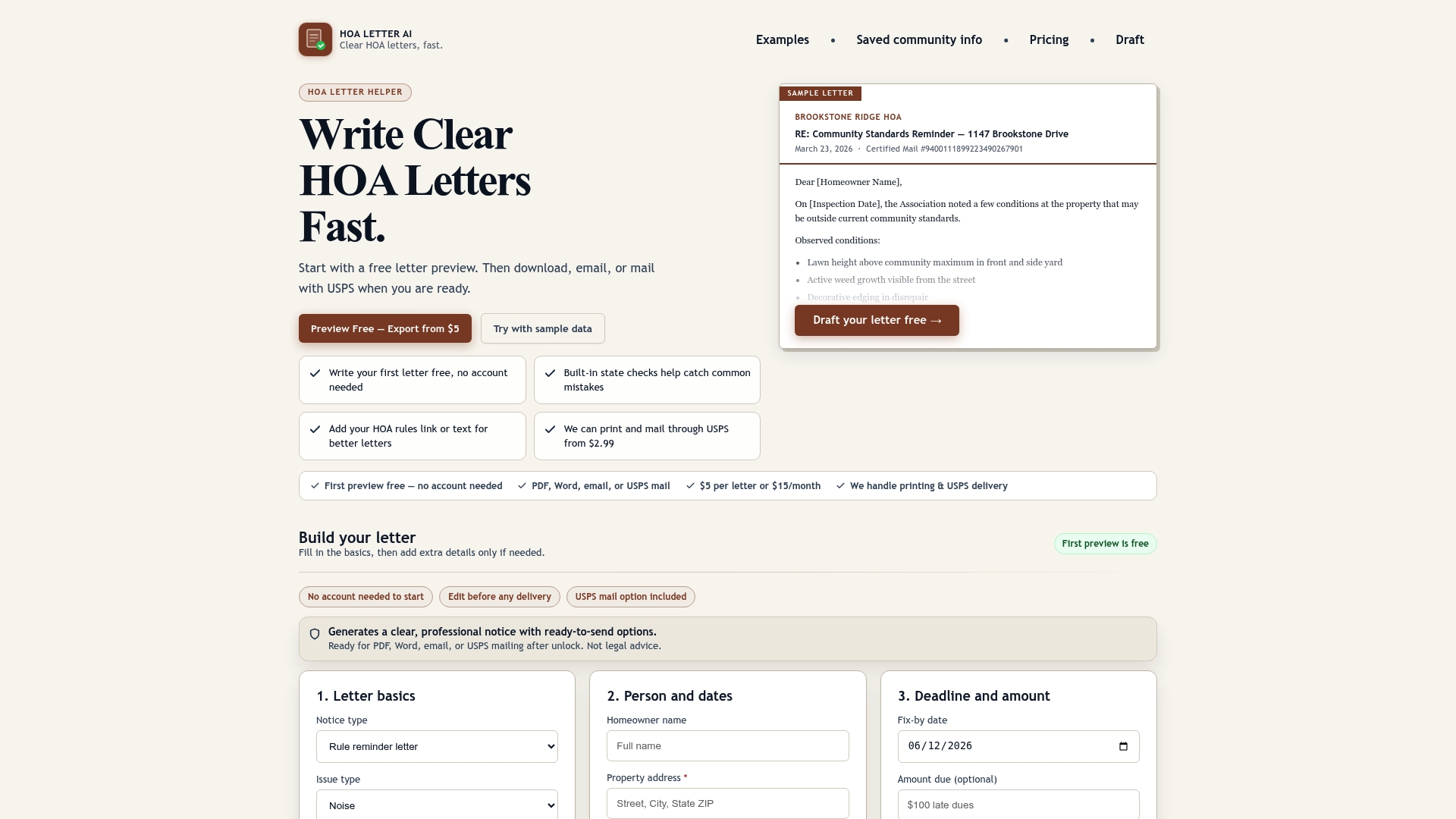
The tool walks you through generating a courtesy notice, a formal violation letter, or a homeowner response letter, with a built-in completeness check that flags missing cure deadlines, hearing language, or citation errors before anything gets mailed. Boards managing multiple violations can reuse community profiles across letters instead of rebuilding them each time, and USPS mailing fulfillment handles delivery without a separate trip to the post office. Homeowners responding to a notice can generate a formal response letter for a one-time fee rather than starting from a blank page.
Start with the HOA warning letter template to see a compliant courtesy notice in action, check your state’s specific notice requirements, or review pricing for property management teams managing violations across an entire portfolio.
Where to Verify Your Legal Rights and Local Rules
- HUD’s Fair Housing office for violations that touch fair-housing-protected categories
- Community Associations Institute for best-practice guidance on board operations
- Foundation for Community Association Research for statistical benchmarks on enforcement patterns
Sources
- HOA Violations: Notices, Letters, Enforcement and How to Respond — ManageCasa
- Understanding HOA Due Process: Your Rights During Violation Proceedings — The HOA Handbook
- FHEO — U.S. Department of Housing and Urban Development (HUD)