
When an HOA notice lands in your mailbox, your first move matters more than your eventual argument. Read the notice the same day, calendar the response deadline, photograph the alleged condition with a timestamped device, and submit a written hearing request via certified mail before that window closes. Many states give homeowners a limited time to act before fines become final and appeal rights evaporate.
The stakes are real. An unanswered notice can trigger daily fines, a lien on your property, or the loss of your right to challenge the violation in court. But the HOA notice dispute process is procedural, not personal. Treat it as an administrative task, build a document file, and you preserve every legal option available to you.
Your immediate TL;DR:
- Calendar the deadline today (typically 10–30 days from the notice date)
- Photograph the alleged condition with timestamps
- Pull your CC&Rs and locate the specific provision cited
- Submit a written hearing or appeal request before the deadline
Table of Contents
- What types of HOA notices should you know about?
- Step-by-step: what to do in the first 10 days after a notice
- How to write a response letter that actually works
- What are your formal dispute options beyond the initial letter?
- Realistic timelines, costs, and outcomes
- When should you bring in an attorney?
- How do state laws change what you need to do?
- Key Takeaways
- What actually wins HOA disputes
- Hoaletterai makes your written response faster and state-aware
- Useful sources and where to look next
What types of HOA notices should you know about?
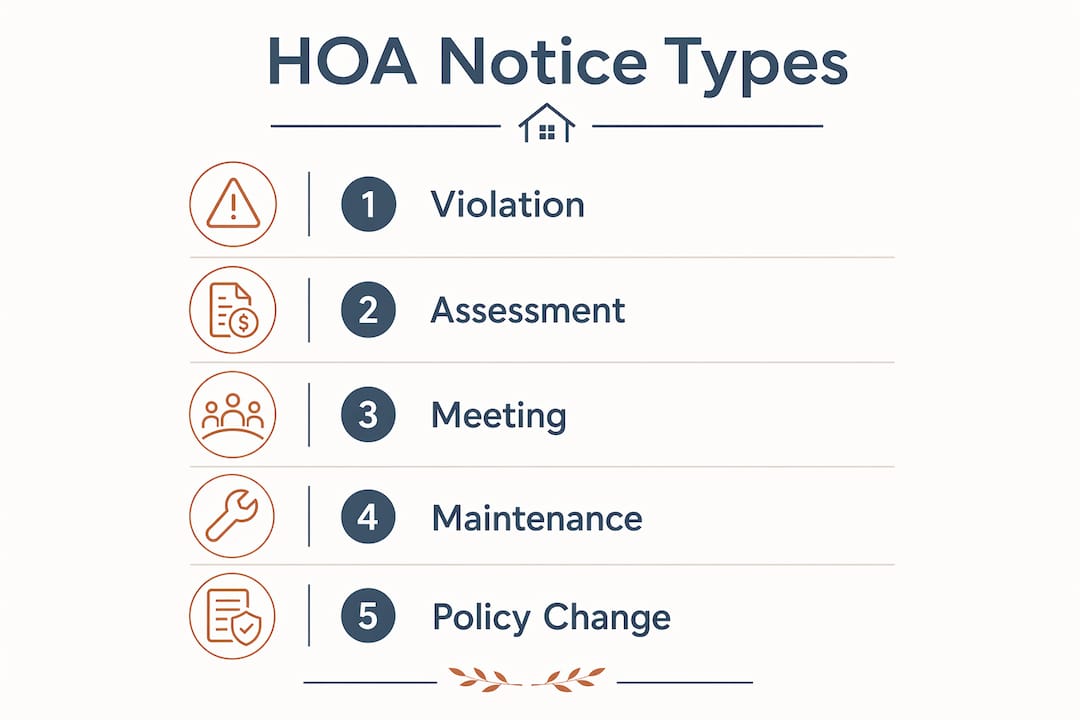
An HOA notice is any formal written communication from your association asserting a rule violation, assessing a fine, or initiating an enforcement action. The type of notice you receive determines your deadline and your next move.
- Violation notice: Identifies a specific rule breach, names the provision, and sets a cure deadline. This is the starting point for most disputes.
- Fine or assessment notice: Follows an uncured violation; states the dollar amount and the fine schedule it draws from.
- Hearing notice: Informs you of a scheduled board hearing before a fine is finalized. Many states require this step.
- Demand to cure: A formal written demand with a hard deadline, often a precursor to lien filing.
- Notice of lien or collection: The most serious type; signals the HOA intends to record a lien or pursue collection.
Every valid notice should cite the specific CC&R or bylaw provision, the date the condition was observed, the cure deadline, and your hearing rights. If any of those elements are missing, that gap is a legitimate procedural defense.
Step-by-step: what to do in the first 10 days after a notice
Acting fast and methodically is the difference between a resolved dispute and an escalating fine balance.
- Read the notice in full. Identify the exact provision cited, the alleged violation date, the cure deadline, and whether a hearing is offered.
- Calendar every deadline immediately. Write the response window end date somewhere you will not miss it.
- Photograph the condition. Use a phone with location and timestamp enabled. Shoot wide, then close. If neighbors have comparable conditions, photograph those too.
- Pull your governing documents. Locate the CC&Rs and bylaws and read the cited provision in full. Check whether the rule is actually in effect and whether the fine schedule matches what the notice states.
- Check the enforcement policy. The association’s published fine schedule must match the amount assessed. In Texas, for example, Chapter 209 requires HOAs with fining authority to adopt and publish a written enforcement policy; a mismatch between the notice amount and that schedule is a valid defense.
- Preserve all communications. Save every email, letter, and voicemail. Start a simple log: date, time, who you spoke to, what was said.
- Submit a written hearing or appeal request. Send it via certified mail to the management company or board address on the notice. Keep the return receipt.
Pro Tip: Create a one-page timeline document listing every event in chronological order — notice date, photos taken, documents reviewed, letters sent, responses received. Attach it as Exhibit A to every submission. It anchors your evidence file and signals to the board that you are organized.

How to write a response letter that actually works
Most dispute victories are document-driven, not emotion-driven. Your letter should read like a business memo, not a complaint. Legal experts consistently advise that homeowners who use emotional language weaken their own position, sometimes creating accidental admissions.
Opening sentence example: “I am writing to formally dispute the violation notice dated [date], reference number [X], and to request a hearing before the board pursuant to [CC&R Section X.X].”
Template outline for your response letter:
- Header: Your name, property address, notice reference number, and date
- Reference the notice: Cite the notice date and the specific provision the HOA invoked
- State your grounds: One to three concise factual reasons the notice is incorrect or procedurally deficient
- List your evidence: Photos (with dates), prior written approvals, neighbor comparables, inspection reports
- Request the HOA’s evidence: Ask for the photos, inspection notes, and the enforcement policy in effect on the alleged violation date
- State your requested remedy: Dismissal, fine reduction, or a cure extension
- Request a written decision: Ask the board to respond in writing within a specific timeframe
Send the letter via certified mail and follow up with an email copy the same day. Keep the certified mail tracking number and the email confirmation. For a full walkthrough of what to include, the homeowner response letter guide covers each element in detail.
What are your formal dispute options beyond the initial letter?
Once you have submitted a written response, you have several escalation paths. Choosing the right one depends on the size of the dispute and what your state requires.
Internal Dispute Resolution (IDR) / Board Hearing
IDR is a structured meeting between you and a board-designated director. Under California’s Davis-Stirling Act, IDR is a legal prerequisite before either party can file a civil action. The request must be in writing, the parties must meet promptly and in good faith, and any resolution must be signed by both parties to be enforceable. Skipping IDR where it is required can result in immediate dismissal of a later lawsuit.
Mediation
Mediation brings in a neutral third party to facilitate a voluntary agreement. A written, signed mediation agreement is legally enforceable and can substitute for expensive litigation. Arizona’s Department of Real Estate, for example, offers a formal HOA dispute petition process that includes a mediation option before an Administrative Law Judge hearing.
Arbitration
More formal than mediation. The arbitrator issues a decision that may be binding or nonbinding depending on what both parties agreed to upfront. Useful when the dispute involves a specific dollar amount or a clear factual question.
Small Claims Court
Appropriate for disputes under your state’s small claims dollar threshold, typically when the HOA has overcharged or improperly assessed a fine.
Civil Litigation
The last resort. Reserve it for serious governance violations, discriminatory enforcement, or cases where the HOA has refused every other process.
Realistic timelines, costs, and outcomes
| Stage | Typical Duration | Approximate Cost | Common Outcome |
|---|---|---|---|
| IDR / Board Hearing | 2–6 weeks | No fee (required by law in many states) | Dismissal, cure agreement, or fine reduction |
| Mediation | Several months | Several thousand dollars per party | Signed enforceable agreement |
| Arbitration | 10–30 days | — | Binding or nonbinding award |
| Litigation | — | Tens of thousands of dollars | Court judgment, possible lien or dismissal |
Most HOA disputes resolve before litigation, and mediation alone can significantly reduce legal costs compared to going to court. Hidden costs to watch for: reinspection fees, daily fine accrual during the dispute period, and late charges on unpaid assessments.
When should you bring in an attorney?
- Small fine, clear cure path: Handle it yourself with a well-drafted letter and your governing documents.
- Repeated notices or pattern of selective enforcement: Consult an attorney before responding further.
- Lien threat or collection notice: Get legal advice before the lien is recorded.
- Improper notice patterns or accounting errors: An attorney can identify procedural defects that invalidate the enforcement action.
- Governance violations affecting property value: These warrant counsel from the start.
For most disputes, mediation is the efficient middle path. Retaining counsel specifically for an ADR session costs far less than full litigation and signals to the board that you are serious. Save full litigation for cases where the HOA has violated its own procedures, discriminated against you, or refused to participate in any resolution process.
How do state laws change what you need to do?
State HOA statutes can create mandatory prerequisites that, if skipped, can be fatal to your case. California’s Davis-Stirling Act requires IDR before filing suit. Texas Chapter 209 mandates a published enforcement policy. Florida, Nevada, and other states have their own HOA acts with specific notice and hearing requirements.
Where to check what applies to you:
- Your state’s HOA statute (search “[state name] homeowners association act” on your state legislature’s website)
- Your recorded CC&Rs and bylaws (request a current copy from management if you do not have one)
- The association’s published enforcement policy and fine schedule
- Meeting minutes from the period when the alleged violation occurred
Always confirm the enforcement policy that was in effect on the date of the alleged violation, not the current version. Associations sometimes update their rules, and the version that applied on the violation date is the one that governs your dispute. Check HOA violation letter laws by state for a state-by-state summary of notice requirements and fine rules.
Key Takeaways
Disputing an HOA notice successfully comes down to acting within the deadline, building a fact-based evidence file, and choosing the right escalation path before fines compound or a lien is filed.
| Point | Details |
|---|---|
| Act promptly | Most states give homeowners a limited window to request a hearing or file an appeal before fines are finalized. |
| Build a document file | Timestamped photos, CC&R citations, prior approvals, and a chronological timeline form the core of a winning dispute. |
| IDR before court | Skipping required Internal Dispute Resolution can result in immediate dismissal of a later lawsuit in states like California. |
| Mediation saves money | Mediation can significantly reduce legal costs compared to litigation and usually resolves faster. |
| Hoaletterai speeds the response | Hoaletterai generates state-compliant response letters with CC&R citation support and a notice-completeness check for a one-time fee. |
What actually wins HOA disputes
The homeowners who come out ahead treat the process as paperwork, not a fight. Every experienced HOA attorney and mediator says the same thing: focus your objections on procedural failures and evidence gaps, not on whether the rule feels fair. “The board is wrong” rarely wins. “The board failed to produce the inspection photos it relied on, and the fine amount does not match the published schedule” wins.
Mediation deserves more credit than most homeowners give it. A written, signed mediation agreement is enforceable in court, and the process moves in weeks, not years. IDR is often a state-mandated prerequisite, not an optional courtesy — treat it as your first real legal safeguard, not a formality to rush through.
The single most common mistake? Sending an angry email the day the notice arrives. That email becomes Exhibit A for the HOA. Write nothing until you have read the governing documents, assembled your evidence, and drafted a calm, factual letter that cites specific provisions. Avoid the common letter-writing mistakes that give the board an easy reason to dismiss your appeal.
Hoaletterai makes your written response faster and state-aware
Writing a formal HOA response from scratch is where most homeowners lose time and make mistakes. Hoaletterai generates state-specific response letters that cite the correct CC&R provisions, include mandatory language required by your state’s HOA act, and flag completeness issues before you send anything.
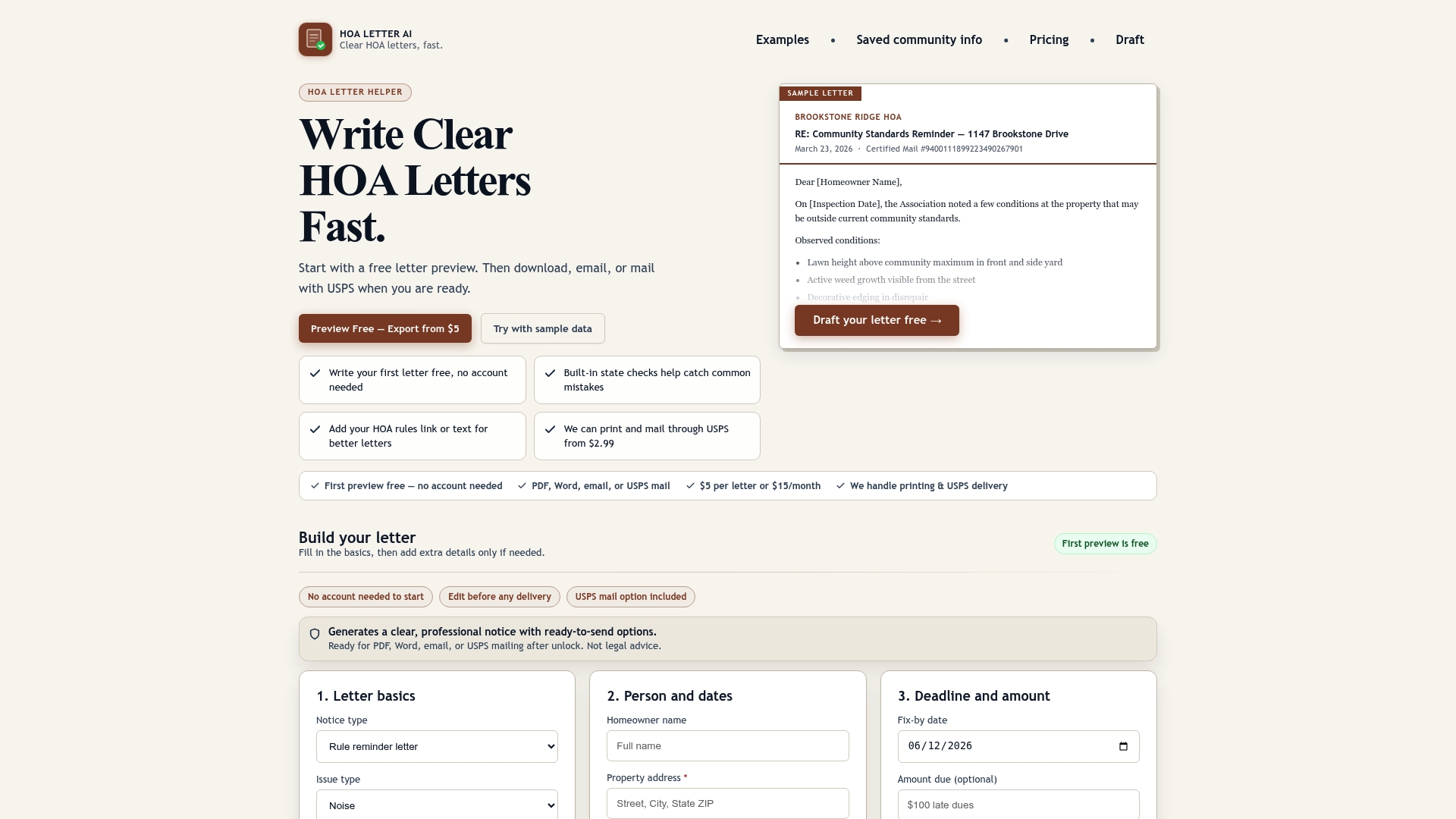
For a one-time fee, you get a professionally formatted letter with a one-page preview, built-in checks for required elements, and the option to send via USPS certified mail directly from the platform. No subscription needed for a single response. Check the HOA violation letter laws for your state and generate a compliant response letter in minutes.
Useful sources and where to look next
- Davis-Stirling IDR page: The authoritative reference for California IDR requirements, including what must be in writing and when a resolution becomes enforceable.
- Arizona Department of Real Estate HOA Dispute Process: Explains the state’s formal petition and mediation process for Arizona homeowners.
- Your state legislature’s website: Search “[state] homeowners association act” to find the controlling statute. Look for sections on notice requirements, hearing rights, and IDR prerequisites.
- Your recorded CC&Rs: Request the current recorded version from your county recorder’s office or directly from management. The recorded version controls, not an informal rules sheet.
- HOA Start dispute resolution guide: Practical overview of the full dispute ladder from informal communication through litigation, with cost context.
- Your association’s enforcement policy and fine schedule: Request this in writing from management. Confirm the version in effect on the alleged violation date.
This article is general information, not legal advice. Confirm the rules that apply to your specific situation with your state’s HOA statute, your association’s governing documents, or a qualified HOA attorney.
Recommended
- HOA Fence Violation Notice Explained for Homeowners | HOA Letter AI
- HOA Notice Language Examples That Reduce Conflict | HOA Letter AI
- HOA First Notice Response Letter (State-Compliant HOA Letter) | HOA Letter AI
- HOA Landscaping Violation Notice Explained for Homeowners | HOA Letter AI
Drafting support for HOA notices
Use the HOA letter drafter to turn this guidance into a resident-ready notice, compare reusable HOA letter templates, or review the property manager workflow for higher-volume enforcement work.