
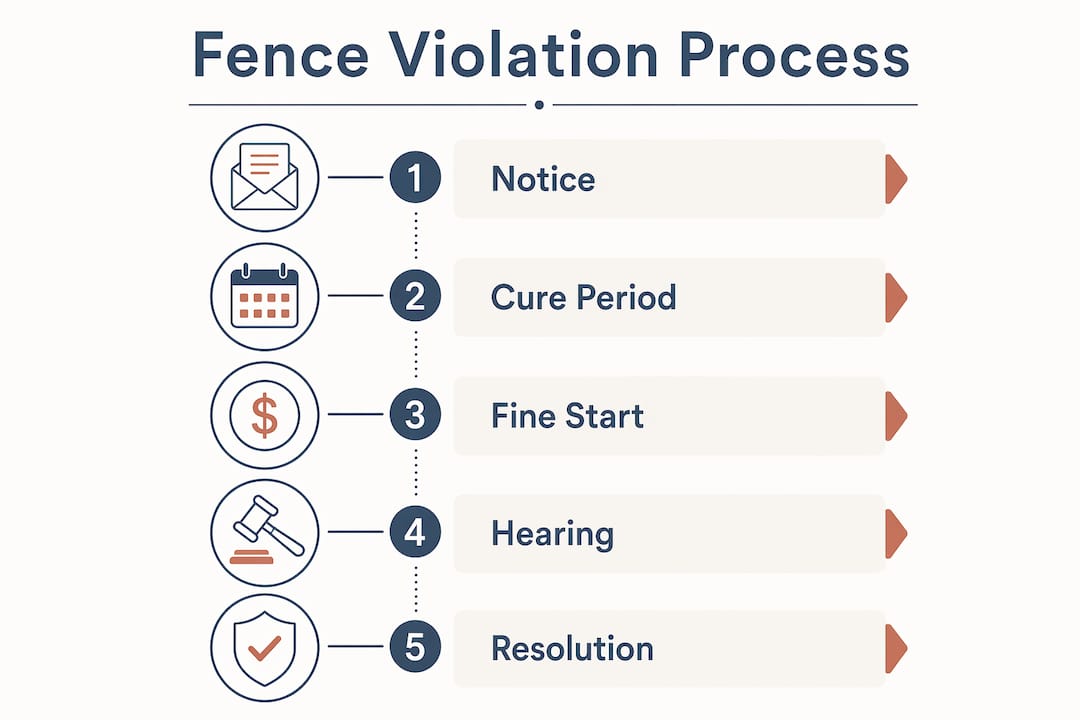
An HOA fence violation notice is a formal written document that identifies a specific breach of your community's fence rules, states what you must do to fix it, and outlines your rights regarding hearings and penalties. Most homeowners receive one and assume the board holds all the cards. That assumption is wrong. Understanding the fence violation process gives you real leverage, whether you are a homeowner defending your property or a board member issuing a notice that will hold up in court.
The notice draws its authority from your association's governing documents, primarily the CC&Rs (Covenants, Conditions, and Restrictions), along with applicable state HOA statutes. Both sources define what counts as a violation, what the notice must contain, and what procedural steps the board must follow. Skip any of those steps, and the enforcement action can be invalidated entirely.
What does an HOA fence violation notice include?
A valid fence violation notice must contain specific, verifiable information. A vague notice is not just unhelpful. A notice lacking specific references to governing document provisions or details of the violation may invalidate the enforcement action entirely. That single fact gives homeowners more power than most realize.
Every enforceable notice must include:
- The exact rule breached. The notice must cite the specific CC&R section or community rule that the fence violates, not a general reference to "community standards."
- A factual description of the violation. What the fence looks like, where it is located, and when the violation was observed. Dates and addresses matter.
- A cure deadline. The notice must state how many days you have to fix the problem and what "fixed" means in measurable terms.
- Fine and hearing information. If you do not cure the violation by the deadline, the notice must explain what fines will apply and how to request a hearing.
- Delivery confirmation. Proper delivery methods such as certified mail or in-person delivery with receipt proof are required for a valid notice. A notice slipped under your door with no proof of receipt may not satisfy your governing documents.
Pro Tip: *If your notice says something like "landscaping issue" or "fence problem" without citing a specific rule, request written clarification immediately. Vague allegations are one of the strongest grounds for contesting a notice.*
Board members drafting notices should review effective violation notice practices before sending anything. One missing element can undo months of enforcement effort.
How do cure periods and fine structures work?
The cure period is the window of time you have to fix the fence violation before fines begin. Standard cure periods for HOA fence violations typically range from 10 to 30 days, depending on severity, governing documents, and state statutes. Some states allow extensions when a homeowner submits a written commitment to repair. That extension option is worth knowing about if you need a contractor and cannot meet the original deadline.

Fine structures vary widely. The table below shows how different approaches work in practice.
| Fine structure | How it works | Key consideration |
|---|---|---|
| Daily fines | A set dollar amount charged per day after the cure deadline | Accumulates quickly if ignored |
| Per-occurrence fines | A flat fee charged each time the violation is observed | Less predictable for homeowners |
| State-capped daily fines | Some states limit daily fines to $50–$100 per day | Check your state statute first |
| Governing document fines | Amount set by CC&Rs with no state cap | Board must apply consistently |
Fines must be applied consistently across all homeowners. A board that fines one neighbor $100 per day but ignores the same violation next door opens itself to a selective enforcement challenge. Before fines take effect, due process requires a hearing opportunity, which the next section covers in detail.
Pro Tip: *Request a copy of your association's fine schedule in writing before your cure deadline expires. Knowing the exact dollar amounts helps you weigh the cost of repair against the cost of delay.*
What rights do homeowners have when receiving a fence violation notice?
Homeowners have more procedural protections than most realize. Homeowners have a right to a hearing or opportunity to dispute violations before fines are imposed, as required by most state HOA laws and governing documents. That right is not optional for the board to offer. It is a legal requirement in most jurisdictions.
Your core procedural rights include:
- Written notice with adequate response time. The board cannot impose fines without first giving you a written notice and a reasonable window to respond.
- The right to attend a hearing. You can appear before the board, present your case, and challenge the alleged violation directly.
- The right to request documentation. Ask for meeting minutes, hearing outcomes, and any vote records related to your violation. Boards are generally required to provide these.
- Protection against procedural shortcuts. Courts may invalidate HOA fines or enforcement actions if the board fails to follow mandated notice and hearing procedures. The violation itself becomes irrelevant if the process was flawed.
- The right to raise a selective enforcement defense. If your neighbor has the same fence and received no notice, that pattern matters. Selective enforcement claims require documented evidence that identical violations by other neighbors were ignored by the HOA without a legitimate reason.
Understanding your HOA governing documents is the foundation of every defense. You cannot challenge a notice you have not read carefully against the rules it claims to enforce.
How should you respond to an HOA fence violation notice?
Responding promptly and professionally is the single most effective thing you can do. Ignoring violation notices often leads to escalating penalties and legal complications, including liens on your property. A measured, documented response protects your rights and often resolves the issue without a hearing.
Follow these steps in order:
- Read the notice carefully. Check whether it cites a specific CC&R section, includes a date and location, and states a clear cure deadline. A notice missing any of these elements may be legally deficient.
- Gather evidence. Take dated photographs of your fence from multiple angles. Measure the fence height or setback if those are the disputed elements. Collect any contractor timelines or permits that support your position.
- Draft a written response. Reference the specific CC&R section cited in the notice. State your position clearly and attach your evidence. Keep the tone professional. Emotional responses rarely help and sometimes hurt.
- Request a hearing if the notice is vague or disputed. Strong homeowner defenses include challenging vague violation notices and demanding evidence-based claims tied clearly to governing documents. A hearing forces the board to present its evidence, not just its conclusion.
- Confirm your response in writing. Send your response by certified mail or email with a read receipt. Keep copies of everything.
- Consult a community manager or attorney if fines are significant. When the dollar amounts are large or the board is unresponsive, professional guidance pays for itself.
A well-structured violation response letter does more than defend your position. It signals to the board that you understand the process, which often accelerates resolution.
Pro Tip: *Never admit to a violation in your first response letter. Acknowledge receipt of the notice, state that you are reviewing it, and request any additional documentation the board relied on. That buys time and preserves your options.*
Key Takeaways
A valid HOA fence violation notice must cite specific rules, follow proper delivery procedures, and allow due process before any fine takes effect.
| Point | Details |
|---|---|
| Notice specificity is required | A notice missing exact CC&R references or violation details can be legally challenged and invalidated. |
| Cure periods run 10–30 days | Most associations give homeowners 10 to 30 days to fix the issue before fines begin. |
| Fines vary by state and document | Daily fine caps range from $50–$100 in some states; others defer entirely to the CC&Rs. |
| Due process is a legal right | Homeowners must receive a hearing opportunity before any fine takes effect. |
| Prompt response prevents escalation | Responding in writing with evidence stops fines from compounding and protects against liens. |
Why boards get this wrong more often than homeowners expect
Boards often lack formal training on due process requirements, and failure to follow notice, hearing, and delivery protocols frequently causes enforcement actions to be overturned. I have seen this play out repeatedly: a homeowner with a clearly noncompliant fence walks away without paying a cent because the board sent the notice by regular mail, skipped the hearing step, or failed to cite the right CC&R section.
The uncomfortable truth is that HOA enforcement is procedurally fragile. The rules exist to protect homeowners from arbitrary action, and they apply equally whether the fence is clearly in violation or not. A board that skips steps does not just lose that case. It signals to every homeowner in the community that its enforcement process cannot be trusted.
For homeowners, the takeaway is this: do not assume the board is right simply because it sent a formal letter. Read the notice against your governing documents line by line. If the notice is vague, say so in writing. If the board skipped the hearing requirement, raise it before the fine is imposed, not after.
The most effective homeowners I have seen handle these situations are not the ones who hire attorneys immediately. They are the ones who respond quickly, document everything, and communicate in writing. That combination resolves the vast majority of fence disputes without escalation.
Resolving these issues amicably benefits everyone in the community. A well-run enforcement process, with clear notices and fair hearings, builds trust. A poorly run one breeds resentment and litigation.
> *— Blake*
How Hoaletterai helps you draft a compliant response
Drafting a response to a fence violation notice takes time, and getting the tone or citations wrong can hurt your case. Hoaletterai generates professional, state-specific violation response letters in minutes, with built-in references to governing document sections and state HOA statutes.

Whether you are a homeowner responding to a first notice or a board member issuing one, Hoaletterai formats the letter correctly, includes the right legal language for your state, and offers USPS mailing so you have proof of delivery. You can review a full one-page preview before anything is sent. For state-specific requirements, the HOA violation laws by state page covers notice rules, fine caps, and cure period requirements across the country. If you are in California, the California HOA violation letter guide includes templates built to meet California's specific statutory requirements.
FAQ
What is an HOA fence violation notice?
An HOA fence violation notice is a formal written document informing a homeowner that their fence breaches a specific rule in the association's governing documents, such as the CC&Rs, and stating what action is required to fix it.
How long do I have to fix a fence violation?
Cure periods typically range from 10 to 30 days, depending on your governing documents and state law. Some states allow extensions if you submit a written commitment to repair.
Can I dispute an HOA fence violation notice?
Yes. Homeowners have the right to request a hearing and dispute the violation before any fine takes effect. A notice that lacks specific rule citations or was improperly delivered can also be challenged on procedural grounds.
What happens if I ignore a fence violation notice?
Ignoring a notice leads to escalating fines and can result in a lien on your property. Responding promptly in writing, even to dispute the notice, is always the better option.
Can an HOA fine me without a hearing?
No. Most state HOA laws and governing documents require the board to offer a hearing before imposing fines. Skipping that step can invalidate the fine entirely, regardless of whether the fence actually violates the rules.
Recommended
- HOA Landscaping Violation Notice Explained for Homeowners | HOA Letter AI
- HOA Warning Letter Template — Courtesy Notice Before Fines | HOA Letter AI
- HOA Violation Letter Laws by State — Notice Requirements & Fine Rules | HOA Letter AI
- HOA Lawn Maintenance Violation Letter Template — Landscaping Notice | HOA Letter AI