
You have a right to inspect most HOA records, and the fastest way to use it is a written letter that names the exact documents you want and demands a response within your state’s statutory window. Send it by certified mail, keep proof of delivery, and set a firm date for inspection or copies. If the board misses that deadline, you have grounds to escalate.
TL;DR:
- Most HOA laws give members roughly 10 business days to respond to records requests, with extensions sometimes available under state statutes.
- Requests should specify exact document types and date ranges rather than vague terms like “all records” to avoid delays.
- Sending the request by certified mail with proof of delivery is essential for holding the HOA accountable if they fail to respond or comply.
- Fees are usually limited to reasonable copying costs, which must be communicated upfront, and some records are exempt from disclosure.
- Escalating non-responsiveness involves follow-up letters and, if necessary, legal action, with a strong paper trail improving chances of compliance.
HOA Letter AICreate Your Records Request LetterDraft a clear, professional HOA records request with state-specific context, community rules, built-in checks, and delivery options.Create your letter
Table of Contents
- Which HOA records can you actually request?
- What the law typically requires: timelines, fees, and exceptions
- How to draft a records request letter that gets answered
- How to send the letter and keep proof it arrived
- A short template and phrase bank you can copy
- What to expect on fees, deadlines, and what to do if you’re ignored
- What most homeowners get wrong about records requests
- Get a state-aware records request letter in minutes
- FAQ
Which HOA records can you actually request?
Most associations keep the same core categories of records, and a good request names the ones you need instead of asking for “everything.” For guidance on managing operational records and association documentation, see Condo Loading Dock Rules for Residents & Managers. Being specific also satisfies the “reasonable particularity” standard that many state statutes require before a board has to act.
- Governing documents: CC&Rs, bylaws, rules and regulations, and amendments.
- Financial records: budgets, financial statements, reserve studies, and delinquency reports.
- Enforcement records: violation notices, hearing minutes, and fine schedules tied to your address.
- Operational records: vendor contracts, insurance policies, board meeting notices, agendas, and ballots.
Pick a time window that matches your reason for asking, such as the last 12 or 24 months, rather than an open-ended date range. A request for “all violation notices and board correspondence about 123 Main St. between January 1, 2024, and December 31, 2025” is far easier for a manager to fulfill, and harder to reject, than a vague demand for “my file.”
What the law typically requires: timelines, fees, and exceptions
Records request rights come from state statute, and the details vary, but a few patterns repeat. Being a member in good standing is usually enough to trigger the right, and you typically do not need to explain why you want the records, though you do need to describe them with reasonable particularity.
Many associations must respond within a typical statutory timeframe, such as around 10 business days, a common production window under statutes like Texas Property Code § 82.1141, which also allows a short extension in some circumstances. Arizona ARS 33-1805 sets the same 10-business-day period for associations to make records available for examination or copies. Colorado CRS § 38-33.3-317 requires associations to make records available for examination and copying, allows written requests describing records with reasonable particularity, and permits reasonable copying fees.
- Timelines: expect roughly 10 business days to produce records or propose inspection dates, sometimes extendable with notice.
- Fees: associations can typically charge reasonable per-page copying costs and may ask for payment before producing copies.
- Exemptions: attorney-client communications, active litigation files, and personnel or medical information are commonly excluded.
How to draft a records request letter that gets answered
A records request letter works best when it reads like a checklist, not a narrative. Walk through these steps in order.
- Add a header with the date, the board or property manager’s name and mailing address, and your name and property address.
- State your legal basis briefly, including a bracketed space for your state’s statute number so you can fill it in after checking your local code.
- List the records by type and date range, using the categories from the checklist above rather than a general request.
- Specify inspection or copies, and say whether you plan to review documents in person or want copies mailed or emailed.
- Offer to pay reasonable copying costs up front so the association has no excuse to stall on payment terms.
- Ask for written confirmation of receipt and a specific date for inspection or delivery that falls within your state’s statutory timeframe.
- Request an estimate of copying charges, if any, before the association proceeds.
Keep the tone factual and unemotional. A letter that reads like a demand for accountability, not a complaint, tends to move faster through a manager’s inbox.
How to send the letter and keep proof it arrived
Certified mail with return receipt requested is the standard method, because it gives you a signed delivery record if the association later claims it never received your letter. Keep the green card and the tracking number together with your copy of the letter.
- Use certified mail with return receipt or USPS signature confirmation for anything you may need to prove later.
- Email can work when your governing documents or state law explicitly allow electronic notice, but save the headers or request a read receipt.
- Keep copies of the letter itself, your postage receipt, any payment for copying costs, and every reply from the association.
Pro Tip: Photograph or scan the green card the day it arrives back, since faded ink on thermal receipts can become unreadable within a year.
A short template and phrase bank you can copy
A records request does not need to be long. A compact letter that hits every required element is more likely to get a fast, complete response than one padded with explanation.
- Opening line: “Pursuant to [state statute citation], I am requesting to inspect and/or copy the following association records.”
- Record list line: “Please provide the following records for [date range]: [list of specific records].”
- Method line: “I would like to [inspect in person / receive copies by mail or email]. I am prepared to pay reasonable copying costs.”
- Confirmation line: “Please confirm receipt of this request in writing and provide a proposed date within the statutory timeframe.”
Fill in the bracketed statute citation only after checking your state’s code, since an incorrect citation can give the board an easy reason to question your request.
What to expect on fees, deadlines, and what to do if you’re ignored
When you ask for copies rather than inspection, expect to pay reasonable copying costs, and ask for an itemized estimate before the association starts printing. If the board misses its statutory deadline, some states allow for penalties or damages, so it is worth verifying the exact remedy under your local code before you threaten legal action you cannot back up.
- Step one: send a polite certified follow-up letter referencing the original request date.
- Step two: send a formal demand letter citing the missed statutory deadline.
- Step three: consult an attorney or consider small claims court if the association still refuses to comply.
Escalation works best when each letter builds a paper trail, since a judge or arbitrator will want to see exactly when you asked and exactly when the association failed to respond.
What most homeowners get wrong about records requests

The most common mistake is vague wording: asking for “all HOA records” instead of naming specific document types and dates. That invites a board to claim the request lacks reasonable particularity and stall for weeks. The second mistake is skipping proof of delivery entirely, which leaves a homeowner with no leverage if the association later denies receiving anything.
A tightly worded, state-aware letter fixes both problems at once, and that is the gap HOA Letter AI was built to close.
— Blake
Get a state-aware records request letter in minutes
Writing a compliant letter from scratch means tracking down your state’s statute, formatting the request correctly, and hoping you did not miss a required line. HOA Letter AI builds that structure in for you, with state-specific context, a one-page preview before you pay, and an option to send the finished letter by certified mail.
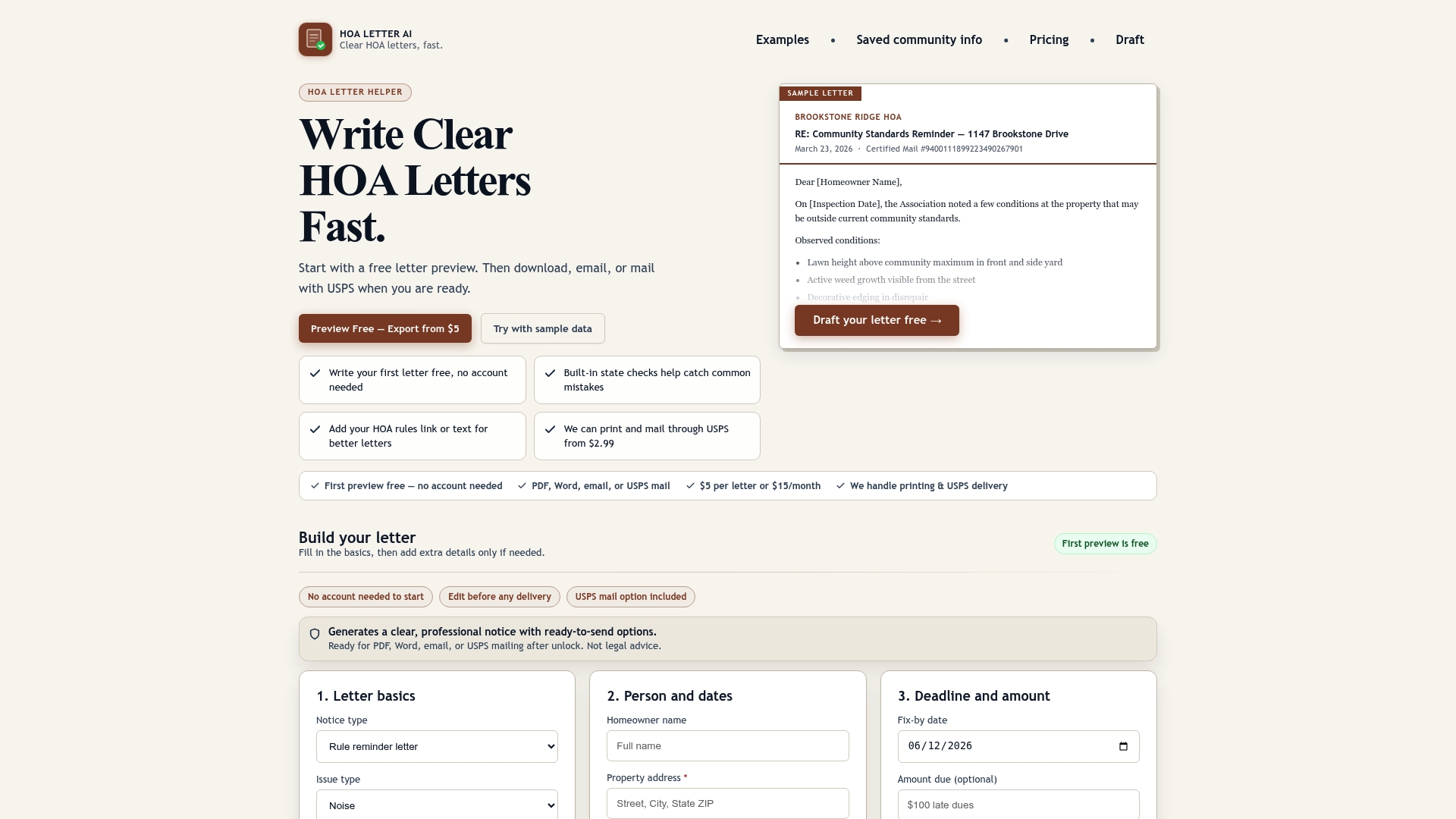
A single letter costs $5, and if the situation turns into a dispute, the same platform can generate a homeowner response letter for $19 or add certified mail delivery starting at $2.99. Preview your letter free, then decide if it is worth the price of getting it right the first time.
FAQ
How do you write a records request letter to your HOA?
State your name and property address, list the specific records you want by type and date range, and specify whether you want to inspect them or receive copies. Ask for written confirmation of receipt and a response date within your state’s statutory timeline, and offer to pay reasonable copying costs.
How do you request HOA records in a state with a specific statute?
Check your state’s property or common-interest ownership statute first, since timelines and fee rules differ; for example, Texas Property Code § 82.1141 gives associations 10 business days to respond. Send your written request by certified mail with return receipt so you have proof of the date it arrived.
What is an HOA records request letter?
It is a written letter a homeowner sends to their association’s board or property manager asking to inspect or receive copies of specific records, such as financial statements, meeting minutes, or violation files. Most state laws require the association to respond within a set number of business days once the request is received.
Do you need a reason to request HOA records?
In many states you do not need to state a purpose, only describe the records you want with enough detail that the association can identify and locate them. This standard is often called “reasonable particularity.”
What happens if the HOA ignores your records request?
If the association misses its statutory deadline, you can send a follow-up letter referencing the missed date, then a formal demand letter, and ultimately consult an attorney or consider small claims court depending on your state’s remedies. Keeping certified mail receipts and copies of every letter strengthens your position at each step.