An HOA record retention letter is a state-aware compliance, violation, or response notice that documents a rule issue, states what’s required to fix it, and creates a paper trail an association can defend later. Done right, the outcome is simple: a letter that cites the correct governing document, gives a real deadline, and comes with proof it reached the homeowner. Before you send or answer one, confirm which template fits the situation, pull the exact CC&R or bylaw provision, and verify the address of record.
Key Takeaways
A defensible HOA letter combines the correct governing document citation, a firm deadline, and USPS-documented proof of delivery, all matched to your state’s specific notice requirements.
| Point | Details |
|---|---|
| Include every mandatory field | Cite the exact provision, state the facts, attach evidence, and set a calendar deadline, not a relative one. |
| Follow the graduated sequence | Move from courtesy notice to formal notice to hearing before any fine, skipping steps risks a void penalty. |
| Match delivery to the stakes | Use Certified Mail with return receipt for hearings, fines, or collection-related notices. |
| Keep one case file per unit | Store the notice, evidence, delivery proof, and outcome together, with restricted access. |
| Use state-aware templates | HOA Letter AI checks wording against state requirements and generates a one-page preview before mailing. |
Table of Contents
- What Every HOA Compliance Letter Must Include
- How Should Boards Draft, Approve, and Send a Notice?
- Why State Law Changes What Your Letter Must Say
- What’s the Best Way to Prove a Letter Was Delivered?
- How Should a Homeowner Respond to an HOA Notice?
- How Long Should Associations Keep Letter Records?
- What Should a State-Compliant Letter Template Include?
- What Actually Separates a Good Enforcement Letter From a Bad One?
- Get State-Compliant Letters Ready to Send Today
- Frequently Asked Questions
- Sources
What Every HOA Compliance Letter Must Include
A letter that skips a mandatory element is a letter a homeowner can successfully challenge. At minimum, a defensible notice needs:
- The date, association name, and homeowner’s name and address of record
- The specific governing document citation, down to the article or section number
- A factual description of the violation, not a characterization (“grass was overgrown on a specific date in early spring” beats “yard is a mess”)
- Evidence references, such as dated photos or inspection report numbers
- The exact corrective action required, not a vague instruction
- A firm calendar deadline (“by April 15, 2026,” not “within 10 days of this letter”)
- Consequences for non-compliance and instructions for requesting a hearing
- Sender’s signature and title
Templating helps here. Standard field labels like Re:, Ref#, Observed:, Provision:, and Required action: force consistency across every letter your board sends, which matters when a homeowner turnover means five different volunteers have drafted notices over three years. BuildingLink’s guide outlines six of these elements and offers courtesy, formal, and hearing-notice templates built around them.
Two mistakes sink otherwise solid letters: a “cure” so vague nobody can prove compliance, and a deadline tied to receipt rather than a calendar date. Both give a homeowner grounds to argue the notice was defective.
Pro Tip: Quote the CC&R or bylaw language directly in the letter instead of paraphrasing it. A homeowner or judge should be able to read your sentence and the governing document side by side and see they match.
How Should Boards Draft, Approve, and Send a Notice?
A repeatable workflow keeps enforcement consistent and protects the association if a letter gets challenged. Most boards and managers follow something close to this sequence:
- Log the incident — record the observation date, location, and any witness or inspector name.
- Select the correct template — courtesy notice, formal violation, or hearing notice, based on where this owner sits in the enforcement sequence.
- Attach evidence — dated photos, an inspection report, or a prior notice number.
- Route for review — a manager or board liaison checks accuracy; legal counsel reviews anything involving fines, liens, or repeat violations.
- Get board approval — especially for formal notices and anything that could lead to a fine or hearing.
- Choose a delivery method and send.
- Log the outcome — mailing receipt, delivery confirmation, and any response received.
Save each artifact where it belongs: the inspection report and photos in the unit’s case file, the template version used, and the mailing receipt once it comes back. Someone should sign off at each handoff, even if it’s just an initial on a shared log.
Call counsel before sending anything tied to a statutory deadline, a lien or foreclosure step, or a situation where enforcement looks selective, such as one owner cited for something dozens of others have done unpunished. Mulcahy Law Firm’s overview of enforcement steps is worth reading before your association finalizes its policy. Your enforcement policy itself should include a workflow diagram showing this exact sequence, so new board members don’t have to reconstruct it from memory.
Pro Tip: Draft your templates before a dispute exists, not during one. A board scrambling to write a formal notice while an angry homeowner is on the phone makes mistakes a calm draft avoids.
Why State Law Changes What Your Letter Must Say
State law and your governing documents often dictate the notice method, minimum cure period, and required wording, so a generic template can produce a letter that a court or hearing panel later throws out. This is the core reason state-aware templates matter more than a Google-searched form letter.
The variation is real and specific:
- Texas requires written notice before an association can impose a fine or suspend privileges, under Property Code Section 209.006.
- California’s Davis-Stirling framework governs delivery methods and pre-fine hearing procedures, including when electronic notice is acceptable.
- Florida caps certain fines and requires a committee hearing before some penalties take effect.
- Colorado has its own delinquency notice and multi-method contact requirements before collection steps proceed.
Gavelhouse’s enforcement guide summarizes these differences and stresses that associations need a published fine schedule alongside strict adherence to statutory cure and hearing periods. Miss the hearing requirement in a state that mandates one, and the fine can be void even if the underlying violation was real.
Statute-triggered consequences escalate fast once a matter moves toward collections. Pre-foreclosure notice periods, lien filing rules, and required disclosures vary enough by state that a letter template built for one jurisdiction can actively hurt an association using it in another.
This article offers general guidance, not legal advice. Talk to counsel before any letter tied to fines, liens, or foreclosure, since those areas carry the highest litigation risk.
Pro Tip: Check your state’s HOA statute every year, not just when you adopt a new policy. Legislatures amend these rules more often than boards expect.
What’s the Best Way to Prove a Letter Was Delivered?
Certified Mail with return receipt requested is the strongest USPS-based proof of delivery, and it’s required or strongly recommended in many states for hearing notices, fines, liens, or anything moving toward foreclosure. Here’s how the common methods stack up:
- Certified Mail with return receipt — strongest paper trail; tracking number and signed receipt both go in the file.
- First-Class Mail — cheap and fast, but offers no proof the homeowner received it, only that it was sent.
- Registered Mail — highly secure, mostly overkill for routine violations, useful for high-value or contested matters.
- Hand-delivery with affidavit — works when a manager or board member can deliver in person and sign a sworn statement confirming it.
- Verified email — only valid if your governing documents explicitly permit electronic notice and the homeowner has agreed to it.
- Commercial mailing services — convenient for volume, and many now integrate tracking and receipt scanning automatically.
LetterStream’s guide breaks down these state differences in more detail and walks through the documentation steps that hold up if a notice gets challenged later.
Keep a copy of the letter itself, the mailing receipt or tracking number, the signed return receipt or delivery affidavit, and any delivery attempt notices in the case file.
Pro Tip: Scan every signed return receipt into the homeowner’s digital file the same week it arrives. Paper receipts get lost in a filing cabinet; a scanned PDF attached to the case log doesn’t.
How Should a Homeowner Respond to an HOA Notice?
A timely written response should state the factual dispute or a remediation plan, reference the original notice’s date and reference number, attach any supporting evidence, and request a hearing if the homeowner wants one.
A solid response letter includes:
- Respondent’s name and address
- Date of the response and reference to the association’s original notice
- The specific facts being disputed, or a plan and timeline for fixing the issue
- Evidence supporting the homeowner’s position, such as photos or receipts
- The remedy requested, including a hearing request if applicable
- Signature
Send the response by Certified Mail, or by email only if the association’s governing documents explicitly allow it. Don’t ignore the stated deadline, and don’t let frustration turn a factual dispute into an escalating tone. If a homeowner requests a hearing, the board should acknowledge receipt promptly and, where governing documents require it, pause enforcement until that hearing happens. A full guide to drafting a homeowner response letter walks through each field in more depth.
How Long Should Associations Keep Letter Records?
Keep one centralized case file per unit containing the original notice, evidence, delivery proof, any hearing record, and the final outcome. Scattered files across a manager’s inbox and a board member’s desk drawer are how associations lose the exact document they need during a dispute two years later.
Name folders consistently, something like “Unit-142_Landscaping_2026,” store scanned PDFs on a shared drive with a backup, and restrict access to people who actually need it, since these files contain private homeowner information. There’s no universal retention window written into most state statutes, but many associations keep enforcement records for several years past the resolution date, and longer for anything involving a lien or dispute. Ask counsel what your state and insurer expect.
Pro Tip: Standardizing your folder structure across every unit makes it possible for a new manager to find a five-year-old case file in under a minute, which matters more than people expect during board turnover.
What Should a State-Compliant Letter Template Include?
A good template merges owner, unit, and provision fields automatically, checks the wording against your state’s requirements, generates a clean one-page preview, and lets you attach evidence before sending, with mailing built in rather than bolted on afterward.
That’s the core of what HOA Letter AI provides across its template library:
- Courtesy notices for first-time or minor issues, like a landscaping violation or a trash violation
- Formal violation letters once a courtesy notice has been ignored
- Hearing notices that meet state-specific procedural requirements
- Homeowner response templates, including noise complaint responses and appeal responses
- Batch mailing tools for property managers handling dozens of units at once
Previewing the finalized letter before sending helps catch missing deadlines or citation errors before the letter is mailed and recorded.
What Actually Separates a Good Enforcement Letter From a Bad One?
Most boards think the hard part is writing the letter. It isn’t. The hard part is having a template ready before the dispute exists, because the letters drafted in a hurry, mid-argument, are the ones with vague cure language or missing deadlines that get thrown out later.
Consistency across turnover matters more than most volunteers realize. A board that changes every two years but keeps the same wording, the same evidence standards, and the same case-file structure looks organized to a court even if the individual members never testify. That continuity is worth more than any single well-written letter.
If I had one habit to recommend, it’s an annual review of your templates against current state law. Statutes change, and a template that was compliant three years ago can quietly become a liability.
Get State-Compliant Letters Ready to Send Today
HOA Letter AI cuts the two biggest risks out of enforcement letters: the wrong wording for your state and no proof the letter ever arrived. Instead of building a template from scratch and hoping it matches Texas notice requirements or California’s Davis-Stirling delivery rules, you start from a state-checked template, preview the finished letter on one page, and send it with USPS mailing built into the same workflow.
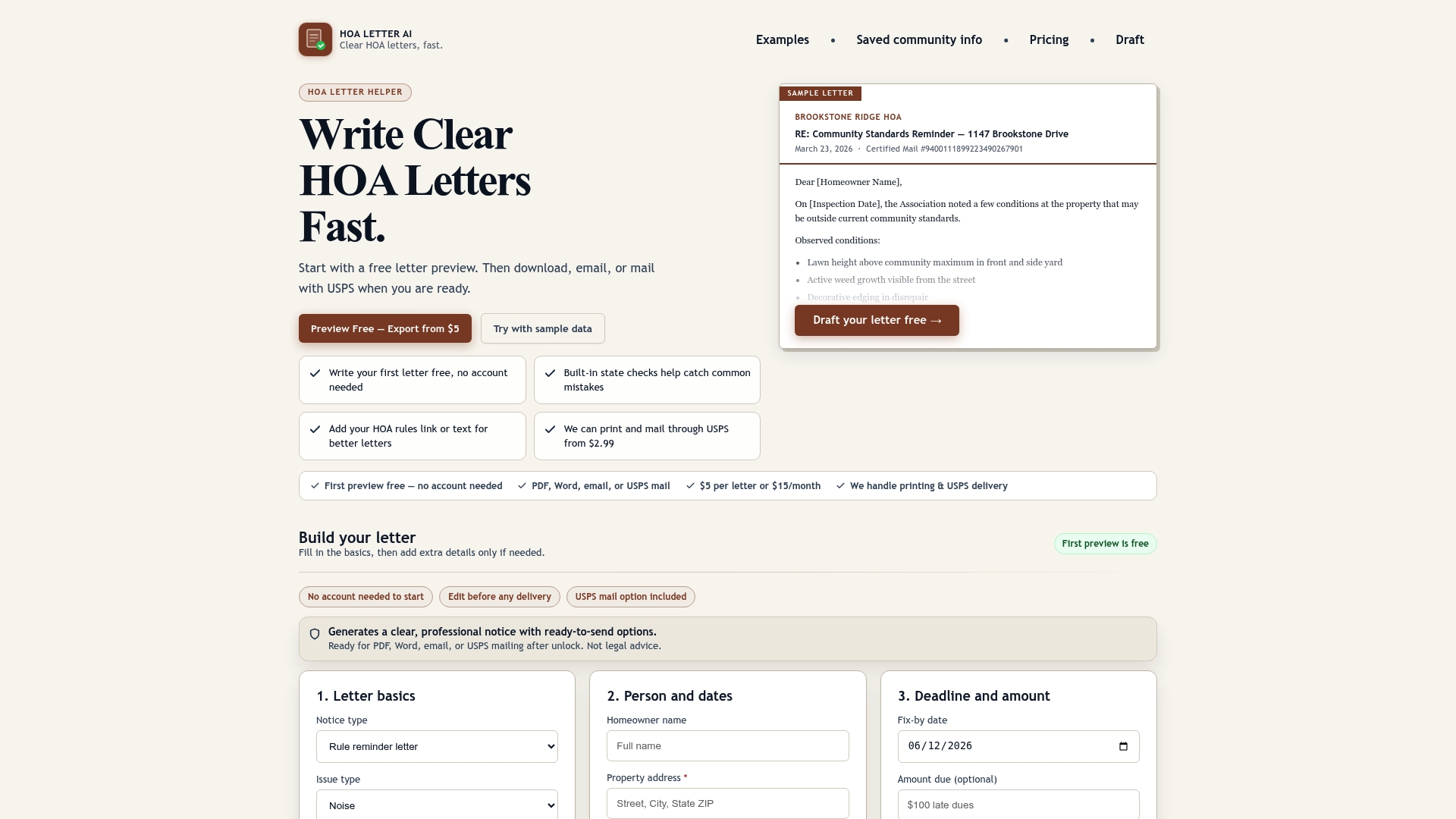
Boards and property managers can start with the HOA Warning Letter Template for courtesy notices, or check state-specific notice requirements before drafting a formal violation letter. Property management teams handling multiple communities can review unlimited-letter pricing starting at $15 a month. Homeowners who need a formal response only pay when they generate one, a one-time $19 fee for a complete, ready-to-send letter.
Frequently Asked Questions
What is an HOA record retention letter?
In practical terms, it’s a state-aware compliance, violation, or response letter that an association or homeowner generates and sends, built to meet state notice requirements and hold up if challenged later.
How long should an association keep enforcement letters on file?
Most associations keep enforcement case files, including the notice, evidence, and delivery proof, for several years after resolution, longer if a lien or dispute was involved. Check with counsel for your state’s specific expectations.
What’s the strongest proof that a homeowner received a notice?
Certified Mail with return receipt requested, according to LetterStream’s mailing guide, gives you a signed receipt and a tracking number, the two pieces of evidence that matter most if a delivery gets disputed.
Can a homeowner get a fine voided over a paperwork issue?
Yes. Missing a required notice, giving too short a cure period, or denying a requested hearing are common due-process failures that can void a fine entirely, according to FixMyHOA’s breakdown of these tactics.
Does every state require the same notice content?
No. Requirements vary significantly, Texas mandates written notice before fines under Property Code Section 209.006, while California’s Davis-Stirling Act governs delivery methods and pre-fine hearings differently. State-aware templates account for these differences.
This article is general information, not a substitute for advice from a qualified lawyer. Consult a qualified legal professional about your own circumstances before acting on anything here.
Sources
- HOA Violation Letter Mailing: Rules, Certified Mail & Documentation
- Enforcement of Association Governing Documents | Mulcahy Law Firm