
HOA notices require documentation because state statutes and governing documents make proof of notice a legal prerequisite for enforcement. Without a documented record, fines can be voided, liens can be challenged, and boards face selective-enforcement claims they cannot defend. The short version: no paper trail, no enforceable action.
At a glance, the legal and procedural reasons to document every notice:
- Legal defensibility. Courts and arbitrators give greater weight to contemporaneous records than to a board member’s recollection.
- Due-process compliance. Most state HOA statutes require a documented notice-and-cure sequence before fines or liens are valid.
- Member inspection rights. Homeowners have a statutory right to review association records in most states; boards that cannot produce them face penalties.
- Selective-enforcement defense. A consistent, timestamped record proves the rule was applied the same way to every unit.
- Insurance and lender requirements. Insurers and mortgage lenders increasingly request enforcement records during claims and resale transactions.
The two headline authorities governing these obligations are California’s Davis-Stirling Act and the patchwork of state HOA statutes (Florida Statute 720, Texas Property Code Chapter 209, Colorado’s CCIOA, and others). Every board’s specific obligations flow from whichever source, statute or governing document, imposes the stricter rule.
Table of Contents
- Why do HOA notices legally require documentation?
- Which delivery methods produce verifiable proof of service?
- What must every notice say, and how do you document the timeline?
- What happens when notice documentation is inadequate?
- How long should you keep HOA records, and where?
- A step-by-step workflow for issuing and documenting a notice
- How do state rules differ, and how do you check yours?
- How a compliant drafting tool reduces your documentation risk
- Key Takeaways
- The documentation gap boards keep falling into
- HOA Letter AI makes compliant notice drafting straightforward
- Authoritative sources and further reading
Why do HOA notices legally require documentation?
Statutes and governing documents make documented notice a precondition for fines, liens, and hearings. That is not a best practice; it is the legal structure enforcement depends on.
State HOA acts set the floor. California’s Davis-Stirling Act, for example, requires a pre-fine hearing opportunity and mandates that the notice be delivered at least 10 days before that hearing. Florida Statute 720.305 sets minimum cure periods before fines can be assessed. Texas Property Code Section 209.006 requires written notice that names the specific provision violated, describes the required cure, states the deadline, and specifies the fine amount. Failure to comply with the notice requirements is an explicit statutory defense to the fine in Texas.
The core principle: State statutes set the minimum notice obligations, but CC&Rs and bylaws can impose stricter requirements. Boards must follow whichever rule is more demanding. Ignoring either source creates an enforcement gap a homeowner’s attorney will find.
CC&Rs and bylaws add another layer. Colorado’s Division of Real Estate describes the HOA relationship as a contractual one, with governing documents setting the terms of that contract. Bylaws typically define notice procedures, meeting requirements, and the roles of board officers. When a bylaw requires certified mail for violation notices and the state statute only requires first-class mail, the bylaw controls.
Most state laws and governing documents mandate a specific notice and cure period before an association can levy fines. Skipping or poorly documenting that sequence does not just create a procedural gap; it can invalidate the entire enforcement action and open the board to selective-enforcement claims.
Which delivery methods produce verifiable proof of service?
Many states require formal notices involving fines, hearings, or liens to be sent via certified mail or another method that provides verifiable proof of delivery. The delivery method determines what evidence you hold afterward.

| Delivery Method | Proof Produced | Typical Statutory Acceptability |
|---|---|---|
| Certified mail, return receipt | USPS tracking number + signed green card | Accepted in virtually all states |
| First-class mail | Certificate of mailing | Accepted in most states; mailbox rule applies |
| Personal delivery | Signed affidavit from the server | Accepted universally with proper affidavit |
| Posting (common area/door) | Photo with timestamp + affidavit | Accepted in some states as supplemental |
| Email (with written consent) | Transmission headers + consent record | Accepted where member gave written consent |
| Owner portal delivery | System-generated delivery log | Accepted where governing docs permit |
Under the Davis-Stirling Act, a notice is deemed delivered upon deposit into the U.S. mail (Civil Code § 4050(b)), which means the mailbox rule creates a presumption of receipt. If a homeowner denies receipt, that presumption shifts the burden to them. Email and portal delivery are valid under Davis-Stirling only when the member has consented in writing under Civil Code § 4041. California associations must also monitor for email bounce-backs and resend to a physical address when delivery fails.
Electronic consent is a separate record you must retain. Log the date the member provided consent, the method (email, signed form, portal acknowledgment), and the exact address or portal account consented to. That consent record is what makes an email notice legally equivalent to a mailed one.
Pro Tip: Save delivery receipts, USPS tracking confirmations, and portal delivery logs in the same file as the notice itself. A notice without its proof-of-service record is incomplete evidence. Screenshots of email headers showing the recipient address, timestamp, and “sent” status are often the deciding detail in a dispute.
What must every notice say, and how do you document the timeline?
Every enforceable notice contains the same core elements: the date the violation was observed, the specific rule citation (CC&R or bylaw section number and title), a factual description of the condition, the required corrective action, an exact cure deadline stated as a calendar date, the consequences of non-compliance, the homeowner’s right to request a hearing, contact information, and the name and title of the board officer or authorized sender.
Vague notices get challenged. “Your lawn needs attention” is not defensible. “Your lawn grass has exceeded the 6-inch limit per Section 4.2 of the Rules and Regulations, as documented on March 15, 2026” is. Standardizing notice language with a rule citation, cure deadline, and factual description, and attaching photo evidence, materially improves enforcement defensibility.
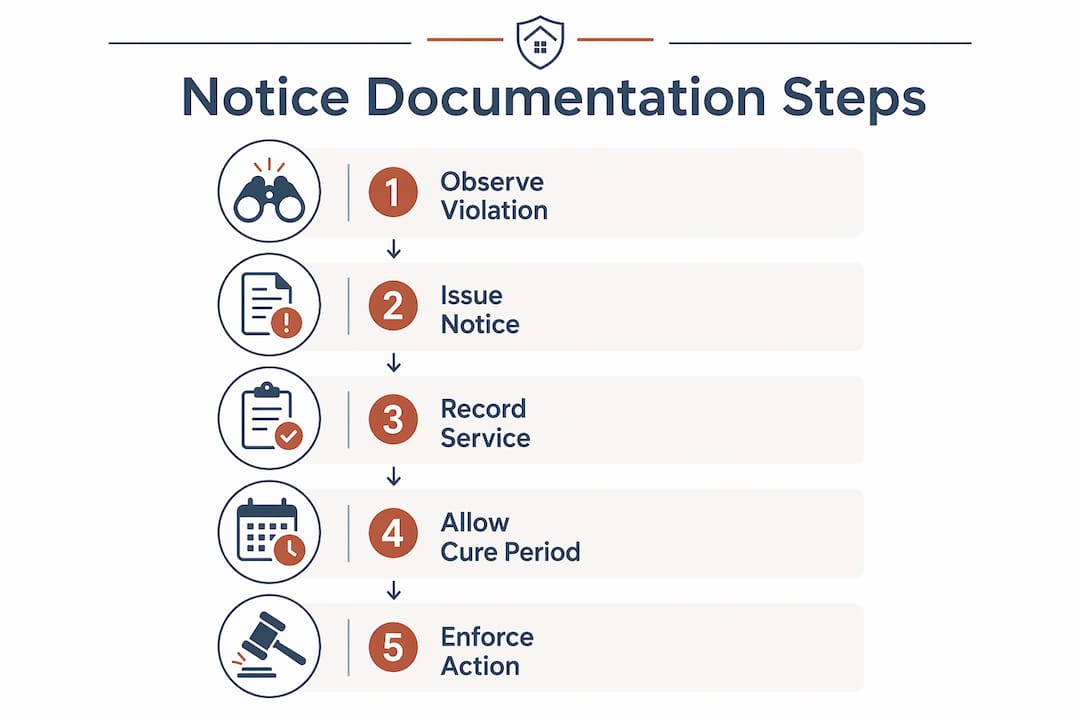
A typical enforcement sequence runs like this:
- Courtesy notice (Day 0). Violation identified, rule cited, cure period stated (typically 14–21 days). No fine. A well-drafted HOA warning letter at this stage resolves roughly 80% of first-time violations before escalation.
- First formal notice (Day 21–30). Violation still present. Initial fine assessed, new cure deadline set.
- Pre-fine hearing notice. If uncured, written notice of the hearing must be delivered before any fine is imposed. In California, this must arrive at least 10 days before the hearing date.
- Fine imposition / escalation. After the hearing, the board votes and issues a fine imposition notice.
Document every date in this sequence as the service date, not the date the homeowner reads the letter. Statutory cure periods typically run from service, and the mailbox rule means service occurs on deposit into the mail. Note the calculation method in your log so there is no ambiguity later about when the cure window closed.
What happens when notice documentation is inadequate?
Poor documentation does not just create administrative headaches. It can erase the enforcement action entirely.
The most direct consequence is a voided fine. When a board cannot prove it followed the required notice-and-cure sequence, the fine has no legal foundation. Courts and state HOA oversight bodies treat a missing pre-fine hearing notice as a complete procedural defect, not a technicality. In states like California and Texas, the statute explicitly makes notice compliance a defense to the fine.
Beyond voided fines, inadequate records create these concrete risks:
- Selective-enforcement claims. If Unit 12 receives a violation letter for an unapproved fence and Unit 7 does not, despite the same condition, Unit 12 has a legitimate grievance. Without a documented record showing consistent enforcement across all units, the board cannot rebut that claim. In states with fair housing protections, a pattern of selective enforcement can escalate to a discrimination complaint.
- Attorney-fee exposure. Many state HOA statutes allow a prevailing homeowner to recover attorney fees when the board violated procedural requirements. A single improperly documented enforcement action can cost the association far more than the fine it was trying to collect.
- Lien collection failures. A lien based on an unenforceable fine is itself vulnerable. Title companies and lenders scrutinize HOA liens during resale; a lien without a documented notice trail can delay or kill a transaction.
- Insurance and resale disclosures. Condo insurance underwriters and mortgage lenders increasingly request enforcement records during claims and resale transactions. Gaps in documentation can affect coverage determinations and disclosure obligations.
The reputational cost is real too. Homeowners who feel the board enforced rules arbitrarily are far more likely to escalate to mediation, arbitration, or litigation, even when the underlying violation is clear.
How long should you keep HOA records, and where?
The guiding principle for HOA record retention is simple: keep more rather than less, and centralize everything. Many states require minimum retention periods, commonly 5–7 years for financials and permanent retention for governing documents.
| Record Type | Retention Period | Notes |
|---|---|---|
| Governing documents (CC&Rs, bylaws, articles) | Permanent | Keep all versions, including superseded ones |
| Meeting minutes (board and annual) | Permanent or 7+ years | Check state statute; many require permanent |
| Financial records, contracts, audits | 7 years minimum | Matches IRS and most state HOA requirements |
| Violation notices and delivery proof | 7 years | Keep through any litigation hold |
| Homeowner correspondence | 3–7 years | Err toward 7 if enforcement-related |
| Newsletters, routine communications | 1–3 years | Lower risk, but retain during active disputes |
When litigation is pending or reasonably anticipated, a litigation hold overrides all standard retention schedules. Destroy nothing until counsel clears it.
Storage matters as much as retention. Centralized, role-based storage with audit trails is the standard for defensible HOA document management. Spreadsheets and email threads fail in two specific ways: they lack immutable timestamping, and they cannot track whether a notice was actually sent. Purpose-built systems attach photos, log status changes automatically, and generate a complete history tied to each violation record.
Practical storage rules:
- Centralize records in one system with role-based access; no board member’s personal device should be the only copy.
- Require audit trails that show when a document was created, modified, or accessed.
- Maintain offsite or cloud backups with regular verification.
- Use a formal transition checklist when board members rotate off; access credentials and record custody must transfer, not disappear.
A step-by-step workflow for issuing and documenting a notice
A repeatable workflow prevents most documentation failures before they happen. Here is the sequence, from complaint to resolution:
- Receive and log the complaint. Record the complaint date, the submitter’s name, and the alleged violation. A complaint is not a violation; it is the trigger for an inspection.
- Verify the violation. A board member, property manager, or designated compliance officer inspects the property. Take a timestamped photo. Log the inspector’s name and the inspection date.
- Draft the notice. Use a standardized notice template that includes all required elements: rule citation, factual description, cure deadline as a calendar date, consequences, and hearing rights. For a first offense, start with a courtesy notice.
- Choose the delivery method. Match the method to your governing documents and state statute. Default to certified mail for formal notices and fines.
- Send and capture proof. Retain the USPS tracking number, the signed return receipt, the portal delivery log, or the email transmission headers. Attach proof to the notice record immediately.
- Re-inspect on or after the cure deadline. Document the re-inspection with a new timestamped photo. Note whether the violation was corrected.
- Close or escalate. If cured, close the record with a resolution note. If uncured, issue the formal notice or pre-fine hearing notice and repeat steps 4–5.
Violation log fields to capture for every record:
- Complaint date and source
- Inspector name and inspection date
- Photo filenames with timestamps
- Notice type, date sent, delivery method, and tracking number
- Homeowner response (date and summary)
- Re-inspection date and outcome
- Hearing date and minutes reference
- Final resolution and date
On delegation: the board secretary typically owns the record log, the property manager handles drafting and delivery, and a compliance officer or board member conducts inspections. Assign these roles in writing so there is no ambiguity during turnover.
How do state rules differ, and how do you check yours?
State law differences are not minor variations. California, Florida, and Texas each impose distinct notice requirements, and what is sufficient in one state may void an enforcement action in another.
California (Davis-Stirling Act). Requires a pre-fine hearing opportunity before any fine is imposed. The hearing notice must be delivered at least 10 days in advance. Beginning January 1, 2023, notices must be delivered by the member’s preferred delivery method as specified under Civil Code § 4041. Associations must solicit preferred delivery methods annually.
Florida (Statute 720.305). Sets minimum cure periods before fines can be assessed. Fines require approval by a committee of at least three members who are not officers, directors, or employees of the association. The committee must approve the fine before it is imposed.
Texas (Property Code §§ 209.006 and 209.0062). Requires written notice that specifies the provision violated, the required cure, the cure deadline, and the fine amount. Failure to comply with these notice requirements is an explicit statutory defense to the fine.
Colorado (CCIOA). Unit owner meeting notices must be delivered 10–50 days in advance, hand-delivered or sent prepaid by U.S. mail. Notices must also be physically posted in a conspicuous place where feasible.
To verify your state’s current requirements:
- Search your state legislature’s official website for the HOA or common-interest community act by name.
- Review the HOA violation letter laws by state resource for a jurisdiction-by-jurisdiction summary of notice and fine rules.
- Cross-reference your CC&Rs and bylaws against the statute; the stricter rule applies.
- Consult an HOA attorney for ambiguous CC&R language, complex lien work, or any enforcement action that has reached litigation.
How a compliant drafting tool reduces your documentation risk
Tools that combine state-aware templates, required-language checks, delivery integration, and proof capture close the gaps that most documentation failures come from. The gap is rarely intentional; it is usually a missing cure date, an unsigned letter, or a delivery receipt that never got filed.
The features that matter for documentation compliance:
- Guided drafting with mandatory fields. Rule citation, cure deadline, factual description, and hearing rights language are required before the notice can be sent.
- State-specific context. Templates and checks reflect the notice requirements for your jurisdiction, not a generic national standard.
- Delivery integration. USPS mailing fulfillment with tracking built in, so proof of service is captured automatically.
- Audit trail. Every notice, delivery confirmation, and status change is logged with a timestamp tied to the violation record.
- Photo attachments. Timestamped photos attach directly to the notice record, not to a separate folder that may not survive board turnover.
- Community profiles. Reusable CC&R citations and rule sets for property management teams handling multiple communities.
Consider what happens when a board uses structured templates with delivery proof built in: a homeowner who disputes a fine at a hearing cannot simply claim the notice was never received. The board produces the USPS tracking confirmation and the notice with the correct rule citation and cure date. The dispute resolves at the hearing instead of escalating to arbitration. That outcome is not unusual; it is what consistent documentation produces.
Pro Tip: Run a notice-completeness check before every send. Verify that the rule citation matches the current version of your CC&Rs, the cure deadline is a specific calendar date, and the delivery method matches the member’s stated preference or your governing document’s default.
HOA Letter AI’s fine notice template and state-law resource are designed specifically to close these gaps for boards and property managers.
Key Takeaways
Documented notices are legally enforceable notices. Boards that skip proof of service or incomplete notice sequences risk voided fines, attorney-fee awards, and selective-enforcement claims they cannot defend.
| Point | Details |
|---|---|
| Documentation is a legal prerequisite | State statutes and CC&Rs make proof of notice a condition for valid fines, liens, and hearings. |
| Delivery method determines your evidence | Certified mail with return receipt and portal delivery logs are the strongest proof of service. |
| Every notice needs nine core elements | Include rule citation, factual description, cure deadline as a calendar date, consequences, and hearing rights. |
| Retention: 7 years minimum for enforcement records | Keep violation notices, delivery proof, and hearing minutes for at least 7 years; governing documents permanently. |
| HOA Letter AI closes common drafting gaps | Guided templates, mandatory fields, USPS delivery integration, and audit trails reduce unenforceable notices. |
The documentation gap boards keep falling into
Most enforcement failures are not caused by boards that ignored the rules. They are caused by boards that followed the rules but could not prove it.
Lost emails, personal-device storage, and informal handoffs between board members create the same outcome as skipping the process entirely: when a dispute reaches a hearing or a court, the record does not exist. A homeowner’s attorney does not need to prove the board acted in bad faith. They only need to show the board cannot produce the notice, the delivery proof, or the hearing minutes.
The fix is not complicated. A centralized log, a consistent notice template with mandatory fields, and a delivery method that generates automatic proof will handle the vast majority of enforcement situations. The boards that get into trouble are the ones that treat documentation as an afterthought rather than the first step. Consistent documentation is not just a compliance exercise; it is what makes every subsequent enforcement step defensible.
HOA Letter AI makes compliant notice drafting straightforward
Drafting a legally defensible notice from scratch, checking it against your state’s requirements, and capturing delivery proof in one place is exactly what HOA Letter AI is built for. Boards and property managers get guided templates that require rule citations, cure deadlines, and hearing rights language before a letter can be sent. USPS mailing with tracking is built in, so proof of service is automatic, not an afterthought.
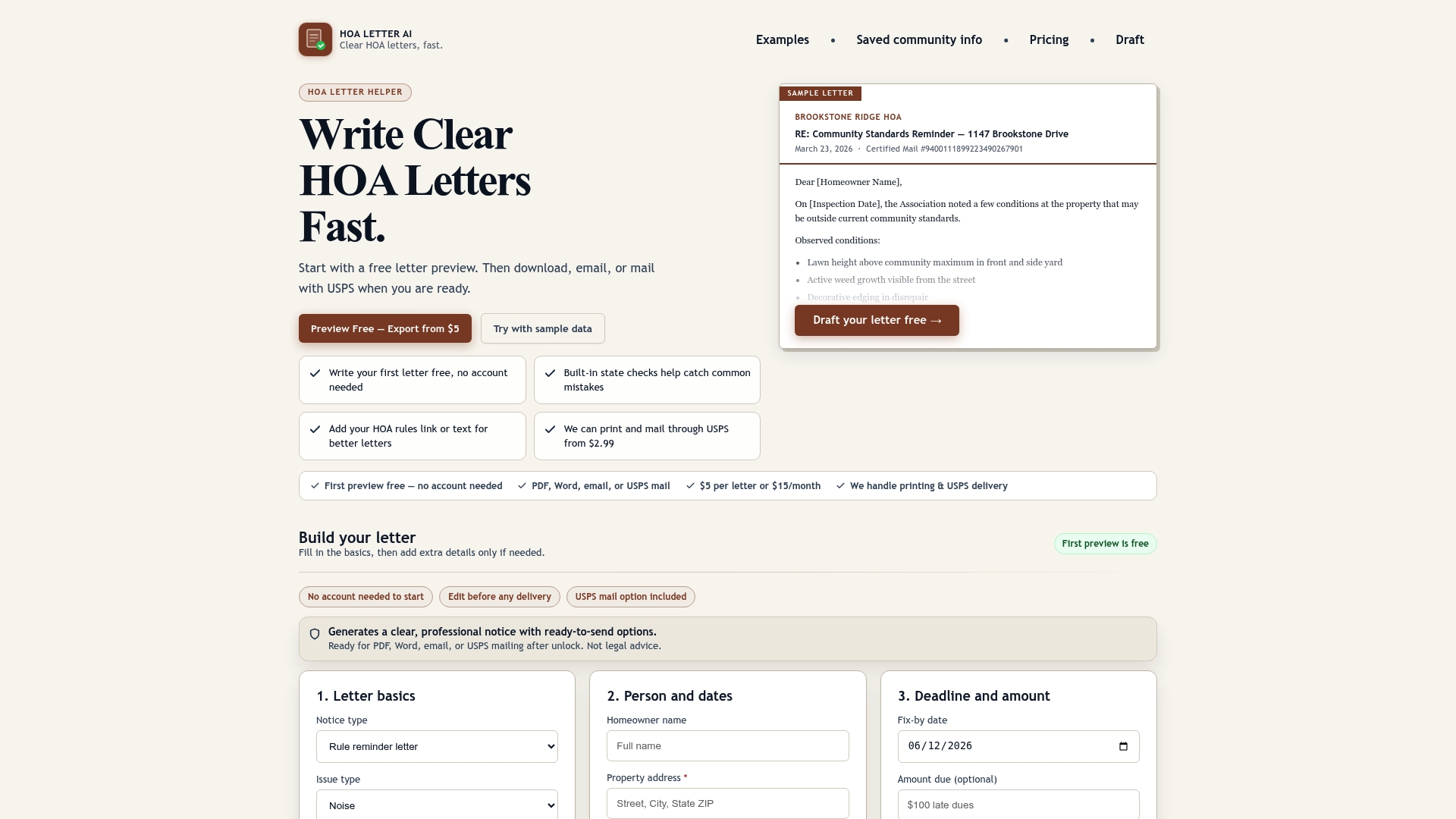
The HOA warning letter template gives you a ready-to-use courtesy notice that captures every required element, with a free preview before you commit. Property management teams can store community profiles and CC&R citations for reuse across every community they manage. For boards that want to confirm their state’s specific notice and fine rules first, the state-by-state compliance resource covers notice requirements and fine rules across jurisdictions. Preview your first letter free at HOA Letter AI.
Authoritative sources and further reading
When you need to verify your state’s current notice requirements or escalate a complex enforcement matter, start with primary sources.
Primary statute references:
- California Davis-Stirling Act (Civil Code §§ 4000–6150), including §§ 4040–4050 on notice and delivery and § 5855 on pre-fine hearings
- Florida Statute § 720.305 (fines and suspensions for residential HOAs)
- Texas Property Code §§ 209.006 and 209.0062 (notice before fine and hearing requirement)
- Colorado Common Interest Ownership Act (CCIOA), C.R.S. § 38-33.3 et seq.
Where to look up your state’s code:
- Your state legislature’s official website (search “[state] HOA act” or “[state] common interest community act”)
- HOA Letter AI’s violation letter laws by state resource for a practical summary of notice and fine rules by jurisdiction
When to consult an HOA attorney:
- Any enforcement action that has reached or is likely to reach litigation or arbitration
- Ambiguous CC&R language that conflicts with the state statute
- Complex lien work, collections, or foreclosure proceedings
- Fair housing or selective-enforcement complaints
Adopt a record-retention policy and run an annual document inventory. A written policy tells every board member and property manager exactly what to keep, for how long, and where. An annual inventory confirms the records are actually there before you need them in a dispute.
This article provides general information about HOA notice and documentation practices in the United States. It is not legal advice. Confirm current rules with your state’s official statutes, your governing documents, and a qualified HOA attorney for your specific situation.