
Photo evidence in HOA violation letters is defined as date-stamped visual documentation that converts a subjective allegation into a verifiable fact. Understanding why hoa letters include photo evidence matters for both board members and homeowners because it determines whether enforcement holds up or falls apart. Without photos, a violation notice is just one person’s word against another’s. With them, the record speaks for itself.
Why photo evidence is the foundation of HOA enforcement
Photos transform subjective allegations into objective facts that boards, arbitrators, and courts can evaluate without relying on memory or testimony. That shift is the entire point of photographic documentation in HOA enforcement.
A violation letter without photo support is vulnerable. A homeowner can simply deny the violation occurred, and without visual proof, the board has no anchor for its claim. Boards lacking photo documentation risk having disciplinary actions voided in legal disputes. That is not a theoretical risk. It happens regularly when enforcement records are thin.

Photo documentation also protects homeowners. When a board attaches a clear, timestamped image to a notice, the homeowner can see exactly what triggered the letter. That transparency reduces confusion, shortens disputes, and often leads to faster compliance. Both sides benefit from a record that is concrete rather than contested.
The standard industry term for this practice is “photographic documentation,” and it sits alongside certified mail logs and written inspection reports as a core component of an airtight enforcement file.
How photo evidence enhances fairness and clarity in HOA enforcement
Date-stamped photos establish the factual basis of a violation at a specific point in time. That timestamp is what separates admissible evidence from a vague complaint.
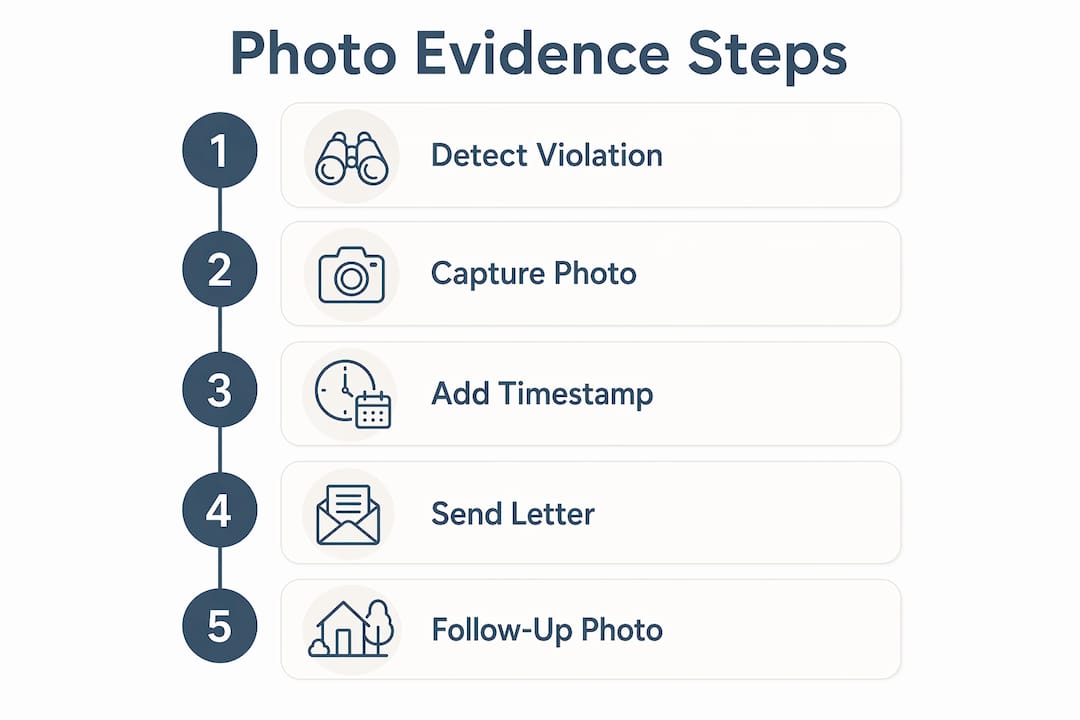
Organized photographic evidence is prioritized over verbal reports by arbitrators and boards during dispute hearings. The reason is simple: a photo with a date and time is harder to dispute than a neighbor’s recollection. Arbitrators and hearing panels consistently give more weight to visual records than to oral testimony when the two conflict.
Best-practice enforcement uses two photo sets per violation:
- Discovery photos taken when the violation is first observed, showing the condition and its location
- Follow-up photos taken after the cure deadline, confirming whether the issue was resolved or persists
This two-set approach does two things. First, it proves the violation existed. Second, it proves whether the homeowner complied. Without the follow-up set, a board cannot demonstrate that a repeat fine is warranted.
Visual evidence also removes the bias problem. When a board member and a homeowner have a prior conflict, verbal enforcement claims look personal. A photo taken from a public area, with a visible timestamp, removes that perception entirely.
Pro Tip: Set a calendar reminder to photograph the same location after every cure deadline. That follow-up image is often the one that matters most in a hearing.
What are the best practices for capturing photo evidence?
Capturing useful photos requires more than pointing a phone at a problem. The image must establish location, show the specific violation clearly, and carry a verifiable timestamp.
Wide-angle shots and close-ups serve different purposes and both are required for a complete record. Follow this sequence for every violation:
- Wide-angle establishing shot. Frame the photo to include a visible street address, house number, or landmark. This proves the image shows the correct property.
- Close-up of the violation. Move in to show the specific issue clearly. A photo of an overgrown lawn means little if the grass height is not visible.
- Multiple angles. Photograph the violation from at least two directions. This prevents claims that the image was misleading or taken from a flattering angle.
- Timestamp verification. Confirm your device’s date and time settings are accurate before shooting. A timestamp that contradicts other records can undermine the entire file.
- Public area positioning. Photos taken from public spaces avoid trespassing issues and improve admissibility. Stand on the sidewalk or common area, not on the homeowner’s property.
- Organized photo log. Store images in a folder labeled by property address, violation type, and date. A disorganized photo archive is nearly as bad as no archive at all.
Boards should capture photos at discovery and again after the cure deadline. That two-point record creates a timeline that is difficult to dispute in any forum.
Pro Tip: Use a dedicated device or app that embeds GPS coordinates in the image metadata. GPS data adds a second layer of location proof that strengthens admissibility.
How photo evidence helps address selective enforcement disputes
Selective enforcement is one of the most common legal challenges homeowners raise against HOAs. The claim is that the board enforces rules against some residents while ignoring identical violations by others.
Selective enforcement disputes hinge on organized photo proof showing inconsistencies in how the HOA applies its own rules. A homeowner who receives a fine for an unapproved fence color can challenge that fine effectively if they have photos of three other unapproved fence colors in the same community that went unaddressed.
Homeowners can build what attorneys call a “counter-file.” This is an organized collection of photos showing similar violations elsewhere in the community that the board has not cited. Showing the same violation exists but is ignored elsewhere is the core of a selective enforcement defense. Timestamps on those photos matter because they prove the violations were ongoing, not corrected before the homeowner noticed them.
The table below shows how photo documentation affects each party in a selective enforcement dispute:
| Scenario | Board’s position | Homeowner’s position |
|---|---|---|
| Board has timestamped photos, homeowner does not | Strong enforcement record | Limited grounds to dispute |
| Homeowner has counter-file photos, board does not | Enforcement looks inconsistent | Strong selective enforcement claim |
| Both parties have organized photo logs | Dispute resolved on the merits | Fair hearing based on evidence |
| Neither party has photos | Outcome depends on testimony | He-said-she-said result |
Quality photo documentation shifts the burden of proof in selective enforcement cases. The party with the better photo record almost always controls the narrative in a hearing. That is true whether you are a board member defending a fine or a homeowner challenging one.
What legal and procedural standards govern photo evidence in HOA cases?
Photos are treated as full proof in HOA proceedings when their authenticity is unchallenged. That means the image must be contemporaneous, meaning taken at or near the time of the violation, and verifiable through metadata or a consistent paper trail.
Certified mail receipts and communication logs complement photo evidence by proving that notices were sent and received. A photo proves the violation existed. A certified mail receipt proves the homeowner was notified. Together, they create an enforcement record that is hard to attack on procedural grounds.
Failure to produce valid photo evidence can result in fines being reversed and enforcement actions voided. Courts and arbitrators expect photos to meet a basic standard of authenticity. An image with an obviously incorrect timestamp, or one that cannot be tied to a specific property, fails that standard.
Boards should follow these procedural standards for every enforcement file:
- Confirm the device clock is set correctly before taking any photos
- Store original image files, not screenshots or copies, to preserve metadata
- Log each photo with the inspector’s name, date, time, and location in a written record
- Attach photos directly to the violation letter rather than storing them separately
- Retain the full photo file for the duration of any applicable statute of limitations
The role of images in HOA violations extends beyond the letter itself. Photos become part of the enforcement record that may be reviewed in mediation, arbitration, or civil court. Treating them as formal evidence from the moment they are taken is the standard that protects the board’s position.
Key Takeaways
Photo documentation is the single most effective tool for converting HOA violation claims into enforceable, dispute-resistant records.
| Point | Details |
|---|---|
| Two-set photo rule | Capture photos at discovery and after the cure deadline to prove both violation and outcome. |
| Timestamp accuracy | Verify device date and time before shooting; incorrect timestamps can void enforcement actions. |
| Public area positioning | Photograph from sidewalks or common areas to avoid trespassing claims and improve admissibility. |
| Counter-file strategy | Homeowners can challenge selective enforcement by building organized photo logs of similar unaddressed violations. |
| Certified mail pairing | Combine photo evidence with certified mail receipts to create an enforcement record that holds up procedurally. |
Photos are the great equalizer in HOA disputes
I have reviewed a lot of HOA enforcement files over the years, and the pattern is consistent. The disputes that drag on the longest are almost always the ones where neither side took photos at the right time. The disputes that resolve quickly are the ones where the record is clear from day one.
What surprises most board members is how often a single well-timed photo ends a dispute before it starts. A homeowner who receives a letter with a clear, timestamped image of the violation rarely argues that the violation did not occur. They argue about the fine amount or the cure period, which are conversations that can actually be resolved. Without the photo, the argument shifts to whether the violation happened at all, and that argument goes nowhere productive.
Homeowners often do not realize they have the same tool available to them. If you believe your HOA is enforcing rules selectively, start photographing. Document what you see in your community, note the dates, and organize the images by address and violation type. That file gives you something concrete to bring to a board meeting or a hearing. It changes the conversation from accusation to evidence.
The boards I find most effective are the ones that treat photo documentation as a standard operating procedure, not an afterthought. They photograph every inspection, file every image, and pair every letter with a visual record. That discipline protects them legally and builds credibility with the community over time. Homeowners are more likely to comply with enforcement they perceive as fair and consistent. A photo record is the clearest signal that the board is applying rules the same way to everyone.
— Blake
How Hoaletterai makes photo-based violation letters easier
Writing a violation letter that properly incorporates photo evidence, state-specific notice language, and correct fine procedures takes time. Hoaletterai cuts that process down significantly.
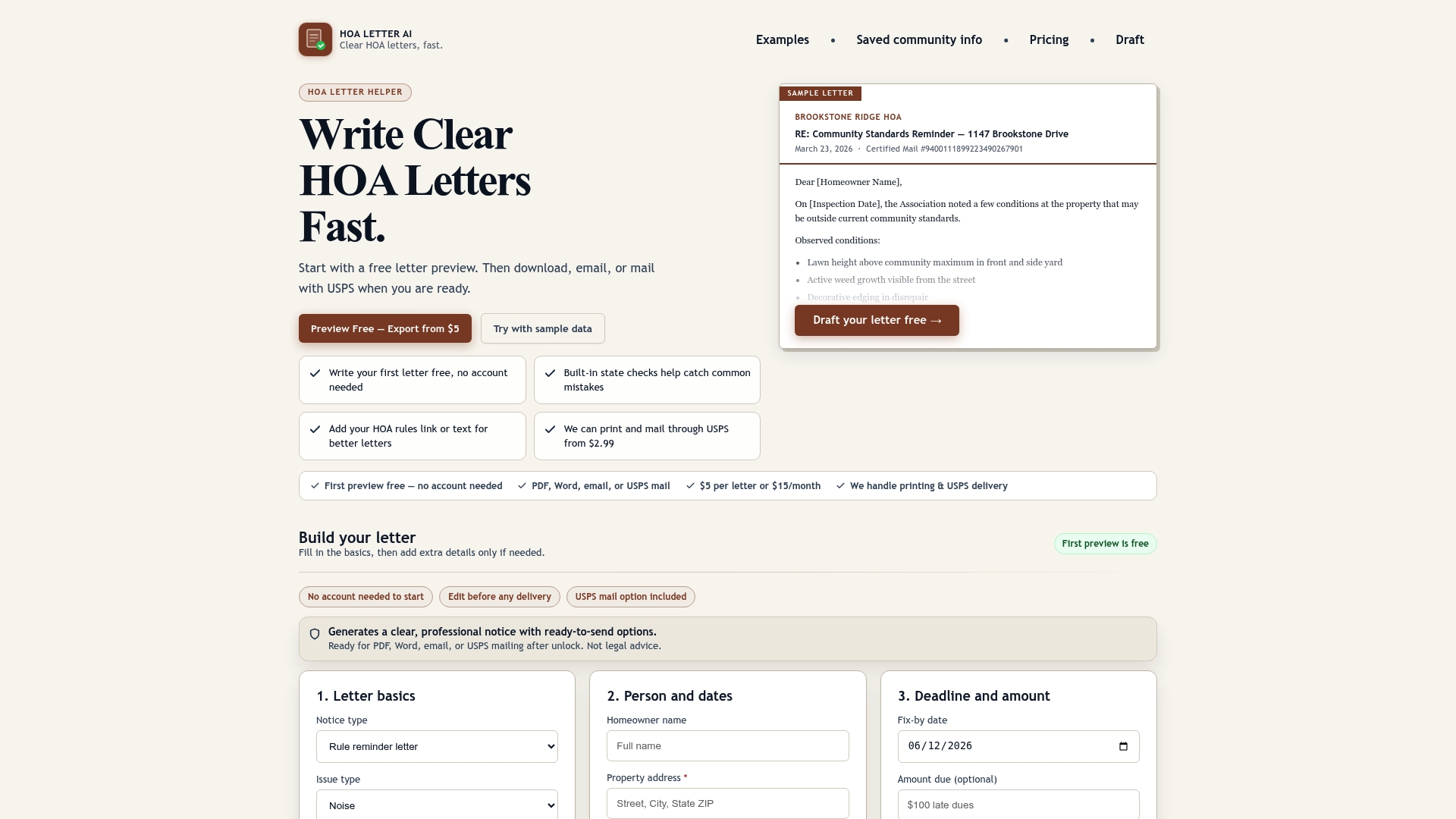
The platform generates professional HOA violation letters with clear formatting that makes it easy to reference attached photo documentation. Boards can review a one-page preview before sending and choose USPS mailing directly through the tool. Built-in checks flag common errors in notice language and fine rules. For boards that need to stay current with state requirements, the HOA violation notice rules resource covers notice requirements and fine guidelines by state. Boards that want to generate a letter right now can use the violation letter generator to preview a draft for free.
FAQ
Why do HOA letters include photo evidence?
HOA letters include photo evidence to convert subjective violation claims into verifiable facts. Date-stamped photos prevent disputes from becoming unresolvable arguments and give boards a defensible enforcement record.
What makes a photo admissible in an HOA hearing?
A photo must be contemporaneous, meaning taken at or near the time of the violation, and carry an accurate timestamp. Original image files with intact metadata are stronger than screenshots or copies.
Can homeowners use photos to fight HOA fines?
Yes. Homeowners can build a counter-file of photos showing similar violations elsewhere in the community that the board has not cited. Organized photographic evidence of inconsistent enforcement is the foundation of a selective enforcement defense.
How many photos should an HOA include in a violation letter?
Boards should include at least two photos per violation: one wide-angle establishing shot showing the property location and one close-up showing the specific issue. Two photo sets per violation, taken at discovery and after the cure deadline, create the strongest enforcement record.
What happens if an HOA sends a violation letter without photo evidence?
Without valid photo documentation, enforcement actions are vulnerable to legal challenges and fines can be reversed. Boards that rely on verbal reports alone give homeowners a straightforward path to dispute the notice successfully.
Recommended
- Responding to an HOA Compliance Notice: 2026 Guide | HOA Letter AI
- HOA Enforcement Letter Step by Step: 2026 Board Guide | HOA Letter AI
- HOA Collection Letters: A Respectful, Step-by-Step Reminder Sequence | HOA Letter AI
- How to Write an HOA Violation Letter (With a Calm, Rule-Cited Example) | HOA Letter AI