
HOA compliance communication runs on two categories of standardized notice templates: regulatory-mandated formats issued by government bodies to meet specific legal requirements, and operational best-practice templates that HOA boards develop for consistent, day-to-day administration. Both serve a distinct purpose, and confusing them is where boards get into trouble.
The most common notice formats HOA boards work with include:
- Violation notices citing the specific rule breached, the date observed, and the required remedy
- Meeting notices announcing annual, special, or board meetings with required advance notice periods
- Payment reminder and assessment notices for dues, fines, or special assessments
- Hearing notices informing homeowners of their right to appear before the board
- Fine notices documenting escalating penalties after an unresolved violation
- Courtesy notices serving as informal first warnings before formal enforcement begins
- Lien and collection notices required by state law before an HOA can pursue legal action
Agencies like the U.S. Department of Labor and state-level departments supply regulatory templates to standardize communication and protect both parties legally. For HOA boards, using the right format for each situation reduces legal exposure and keeps communication clear and defensible.
What every well-structured HOA notice needs to include
A notice that lacks key structural elements can be challenged or ignored. The essential components of a formal notice include sender and recipient details, the date, a clear subject line, a professional introduction identifying the relationship between parties, and a chronological account of the facts that prompted the notice.
Beyond the opening, the notice must identify the specific rule or governing document being violated, state the remedy demanded, set a firm deadline, and spell out the consequences of non-compliance. Vague demands like “please address this issue” give homeowners no clear target and give boards no enforcement footing.
- Sender and recipient information: full legal names and addresses of both parties
- Date of notice: establishes the timeline for response deadlines
- Subject line: identifies the nature of the notice at a glance
- Professional introduction: states the HOA’s authority and the homeowner’s relationship to it
- Chronological facts: documents when the violation was observed and any prior communications
- Rule citation: references the specific CC&R, bylaw, or rule being enforced
- Remedy and deadline: states exactly what action is required and by when
- Consequences: describes fines, hearings, or legal action that follow non-compliance
Pro Tip: Date every fact in your chronology. A notice that says “the vehicle was observed parked in violation on March 4, 2026, and again on March 11, 2026” is far harder to dispute than one that says “on multiple occasions.”
Legal and formatting requirements that protect your notices

Formatting rules are not cosmetic. CFPB safe harbor standards require a minimum 10-point font size, black ink on white or light-colored paper, and physical separation from other documents. Failure to meet these requirements can void the legal protections the notice was meant to provide.
For regulatory-mandated templates, customization is tightly restricted. The CFPB model privacy form, for example, permits modification only in prescribed bracketed fields. Changing the layout, font, or shading outside those fields strips the safe harbor protection entirely. HOA boards using state-supplied templates face similar constraints.
Key formatting and legal constraints to follow:
- Minimum 10-point font for body text throughout the notice
- Black ink on white or light paper to meet contrast and readability standards
- Document separation so the notice is not buried inside other paperwork
- No unauthorized layout changes on regulatory templates with safe harbor status
- State-specific language where required by your state’s HOA statutes
- Bracketed fields only for customization on federally standardized forms
Operational HOA templates carry more flexibility, but boards still need to check their state’s HOA act for mandatory content requirements. California, Florida, and Texas each impose specific notice periods and content rules that override any generic template.
Best practices and common pitfalls when customizing notice templates
Templates are frameworks, not finished documents. A violation notice template only works when you fill it with accurate, specific facts about the actual situation. Boards that copy-paste a template without updating the dates, rule citations, and factual details send notices that are easy to challenge.
Legal advocates consistently find that clarity of facts, not complexity of legal language, determines whether a notice holds up. Plain language with a precise chronology outperforms dense legalese every time.
Do:
- Use plain, direct language a homeowner can understand without a lawyer
- Cite the exact CC&R section or rule number being enforced
- Document every fact with a specific date
- Review state law requirements before sending any notice
- Keep a copy of every notice sent, including delivery confirmation
Don’t:
- Use emotional or accusatory language
- Make vague demands without a specific deadline
- Add unauthorized content to regulatory templates
- Send a notice without verifying the facts it contains
- Rely on a template without checking it against your current community rules
Pro Tip: Before sending any notice, have a second board member read it as if they were the homeowner receiving it. If the required action is not immediately obvious, revise it.
Regulatory bodies prioritize readability and plain language in official templates, and HOA boards should apply the same standard to their operational notices. A homeowner who understands the notice is far more likely to comply than one who is confused or defensive.
How Hoaletterai helps boards generate compliant notices faster
Hoaletterai gives HOA boards a practical path from blank page to ready-to-send notice without the usual back-and-forth. The platform provides a library of notice types covering violations, fines, meetings, and more, each built with state-specific language and community rule customization built in.
Key features boards rely on:
- Template variety: violation notices, fine notices, meeting notices, hearing notices, and courtesy warnings
- State-specific language: automatically incorporates the notice requirements for your state’s HOA statutes
- Built-in error checks: flags missing fields, formatting gaps, and common drafting mistakes before you send
- One-page preview: lets you review the complete notice before printing or mailing
- USPS mailing option: sends physical notices directly, with delivery tracking built in
- Electronic delivery tracking: documents when notices were sent and received
Pro Tip: Use Hoaletterai’s preview feature to check that every bracketed field has been filled in before delivery. An unfilled placeholder like “[homeowner name]” in a sent notice is the kind of error that undermines board credibility immediately.
Tailoring notice templates to specific HOA compliance scenarios
Not every compliance situation calls for the same notice format. A first-time parking violation warrants a courtesy notice. A repeated landscaping violation that has already received two written warnings calls for a formal fine notice with a hearing option. Matching the notice type to the situation keeps enforcement proportionate and legally defensible.
For HOA fine notices, the template must reference the prior notices sent, the dates of each, and the escalating fine schedule outlined in your governing documents. For meeting notices, the key variables are the required advance notice period (often 10–30 days depending on state law) and the agenda items that must be disclosed. Lien and collection notices require the most precision because they trigger legal rights and timelines that vary significantly by state. Checking HOA violation letter laws by state before sending any enforcement notice is a practical step that prevents procedural errors.
Affordable housing compliance contexts add another layer. Boards managing mixed-use or subsidized communities may need to cross-reference housing compliance software to confirm that their notice formats align with program-specific requirements beyond standard HOA statutes.
How to make sure your notices actually reach homeowners
Sending a notice is not the same as delivering one. Many state HOA statutes specify acceptable delivery methods, and using the wrong one can invalidate the notice regardless of its content. First-class mail with a certificate of mailing is the baseline standard in most states. Certified mail with return receipt adds a layer of proof that the homeowner received the document.
For formal enforcement notices, especially those preceding fines or legal action, maintain a delivery log that records the method used, the date sent, and any confirmation received. Electronic delivery is increasingly accepted, but only when the homeowner has consented to it in writing. Posting a notice on the homeowner’s door is permitted in some states for certain notice types, but it should always be paired with a mailed copy.
Tracking delivery matters as much as drafting the notice correctly. A well-written violation notice that cannot be proven delivered is legally the same as one never sent.
Hoaletterai makes compliant HOA notices faster and simpler
Writing compliant HOA notices from scratch takes time most boards do not have. Hoaletterai cuts that time significantly by generating state-specific, properly formatted notices in minutes, with USPS mailing and delivery tracking handled in the same platform.
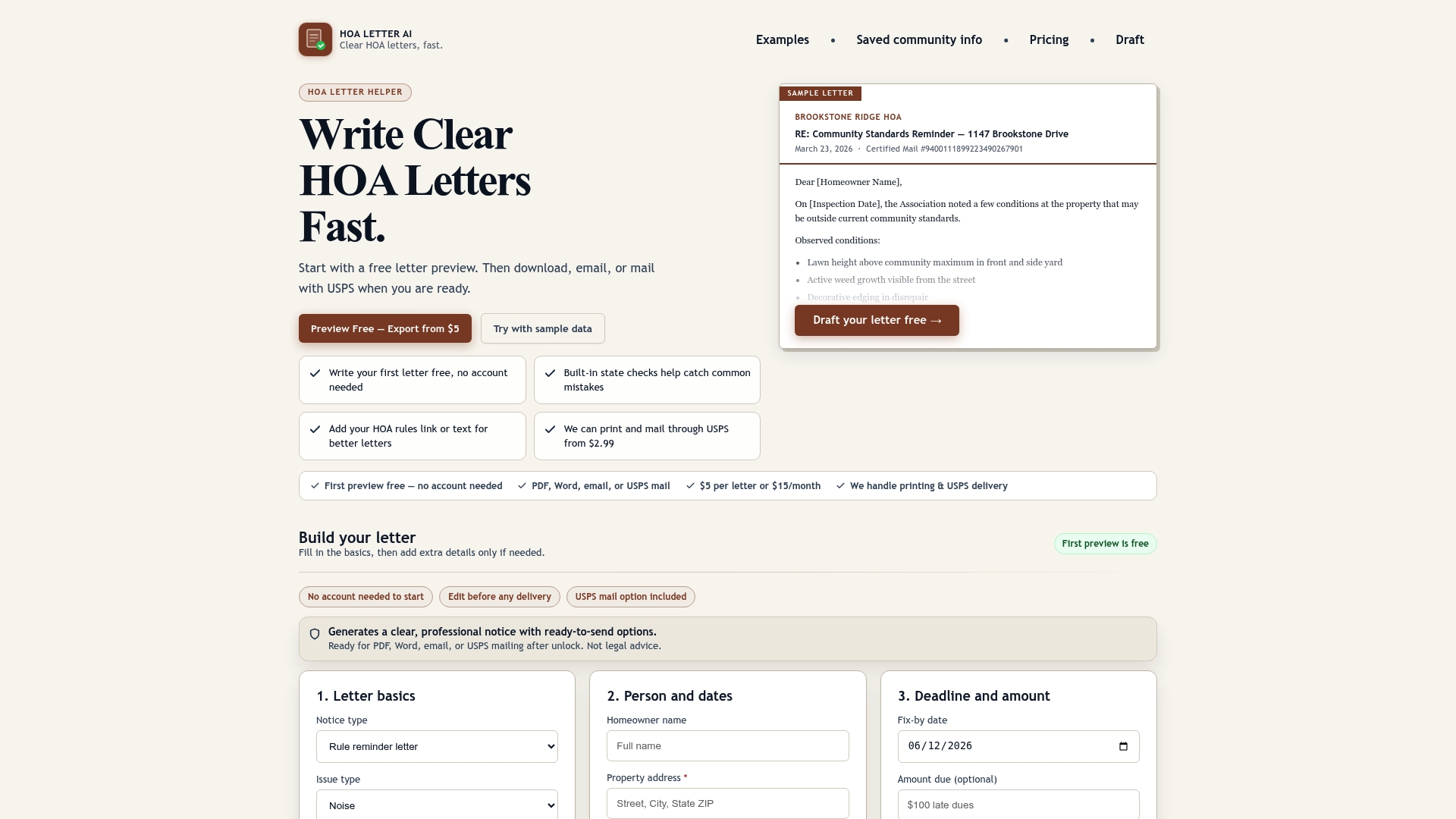
Whether you need a warning letter before fines begin or a formal violation notice with a hearing deadline, Hoaletterai covers the full range of HOA compliance communications. Every template includes built-in checks for formatting compliance and state-specific language, so boards spend less time worrying about procedural errors and more time on actual governance. Visit hoaletterai.com/hoa-laws to check the notice requirements for your state and generate your first compliant letter today.
Key Takeaways
HOA compliance notices fall into two categories: regulatory-mandated templates with strict formatting rules and operational templates boards customize for day-to-day enforcement.
| Point | Details |
|---|---|
| Two template categories | Regulatory-mandated and operational best-practice templates serve different legal and administrative purposes. |
| Formatting rules are binding | A minimum 10-point font, black ink on light paper, and document separation are required to preserve legal protections. |
| Facts over legal jargon | Plain language with a precise, dated chronology makes notices more defensible than complex legal wording. |
| Match notice type to scenario | Courtesy notices, fine notices, and lien notices each require different content and follow different state-law timelines. |
| Hoaletterai for faster compliance | Hoaletterai generates state-specific, formatted HOA notices with USPS mailing and delivery tracking in one platform. |