HOA board templates are standardized documents that govern meetings, communications, and compliance enforcement across community associations. Every board that skips them pays for it in wasted hours, inconsistent records, and legal exposure. Understanding why HOA boards need templates starts with recognizing that governance is a repeating process. The same meetings, notices, and reports happen month after month. Templates give boards a reliable framework for each one, cutting administrative drag and protecting the association from procedural mistakes that invite disputes or lawsuits.
State laws reinforce this point. California's Davis-Stirling Act, Florida's HOA Act, and Texas statutes all require written meeting minutes and make them available to members. That legal obligation alone makes standardized document templates a governance necessity, not a convenience.
Why HOA boards need templates: the core case
Templates for HOA governance cover five main document categories, and each one carries distinct operational weight.
- Meeting minutes templates capture motions with exact language, voter names, and vote counts. Approved minutes must record this level of detail to survive legal challenges. A template pre-structures every required field so the secretary never omits a critical item.
- Meeting agenda templates confirm quorum, sequence discussion items, and prevent boards from taking votes on matters not properly noticed. Skipping this structure is how boards end up with invalid decisions that residents can contest.
- Violation and fine notice templates standardize enforcement language. A consistent, neutral tone in violation letters reduces the chance that a homeowner reads the notice as a personal attack rather than a rule reminder.
- Budget and financial report templates give residents a predictable format for reviewing association finances. Transparency in fiscal reporting reduces conflict at annual meetings and supports fiduciary accountability.
- Welcome packets and resident communication templates set expectations for new homeowners from day one. A well-structured welcome packet covers CC&Rs, parking rules, amenity hours, and contact information in one place.
Each template type removes a recurring decision from the board's plate. That reduction in decision fatigue compounds over a full governance year.
How templates save time and reduce errors

A standardized meeting minutes template cuts drafting time from 2–3 hours down to minutes. That is a reduction of over 90% in administrative time spent on formatting alone. The time recovered goes directly toward reviewing content quality rather than building structure from scratch.
The time savings extend beyond minutes. 58% of HOA board directors want to spend less time on routine presentations and more on strategic planning. Templates make that shift possible by removing the setup work from every meeting cycle. When the agenda is already structured, the board walks in ready to decide rather than ready to organize.
Errors drop sharply when boards use templates consistently. Consistent formatting makes minutes easier to audit, search, and hand off to a new secretary. Without a template, each secretary applies their own structure. That inconsistency creates gaps that surface during disputes or audits at the worst possible moment.
Pro Tip: *Keep a read-only master copy of every template stored in a secure, centralized location. Always work from a duplicate. Boards that edit the master file directly risk corrupting the format and losing the original structure.*
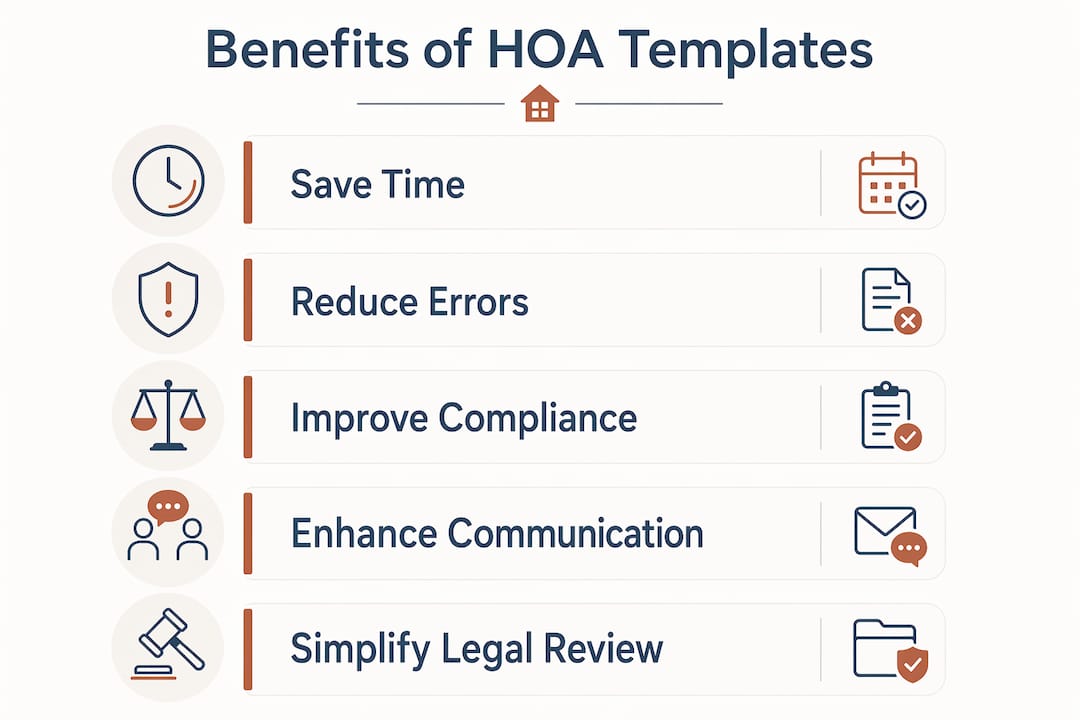
High-performing boards use templates to focus meeting time on decision-making rather than administrative reporting. That is the real payoff. Templates do not just save time. They redirect it toward the governance work that actually moves the community forward.
Why customization and legal review matter
Templates are frameworks, not finished products. The most common mistake boards make is treating a generic template as ready to use. Generic free templates often lack critical jurisdictional clauses required by law to be legally binding. Using one without review is a liability, not a shortcut.
This problem has a name in governance circles: template blindness. It happens when a board fills in the blanks without checking whether the template's structure matches their state's due process requirements. A violation notice that omits a required cure period, for example, may be unenforceable regardless of how professional it looks.
Customization requires attention to several specific areas:
- State notice periods. California requires specific written notice timelines before a hearing. Florida mandates its own procedures under the Florida HOA Act. A template built for one state can fail in another.
- Community-specific rules. CC&Rs and bylaws vary by association. A template that references generic "community rules" without citing the actual governing document gives a homeowner grounds to challenge enforcement.
- Voting procedures. Some states require secret ballots for certain decisions. A minutes template that does not account for this creates a record that contradicts the legal requirement.
- Retention requirements. Many states require boards to retain approved minutes for specified periods. A template that does not include an approval date field makes compliance harder to track.
Association attorneys should review every template before it enters regular use. That review is a one-time investment that protects the board across hundreds of future documents. Boards that skip it often discover the gap only after a dispute has already escalated.
You can review your state's specific notice and fine requirements through the HOA violation laws by state resource to understand what your templates must include.
How templates improve homeowner communication and compliance
Standardized communication templates do more than save time. They change how homeowners experience the board. A violation letter built from a professional HOA letter format reads as institutional rather than personal. That distinction matters enormously when a homeowner receives a notice about their property.
Consistent violation notices maintain impartiality across all residents. When every homeowner receives the same structure and tone regardless of their relationship with board members, enforcement feels fair. That perception of fairness reduces the likelihood of formal disputes and appeals.
Welcome packets built from templates set the right tone before any enforcement is ever needed. A new resident who receives a clear, organized packet covering the HOA governing documents understands the rules before they accidentally break one. Prevention through clear communication costs far less than enforcement after the fact.
Template traceability also supports dispute resolution. When every notice follows the same format and includes the same required fields, the board can demonstrate a consistent enforcement record. That record is the board's best defense if a homeowner claims they were treated differently from their neighbors.
The HOA rule enforcement checklist pairs well with communication templates because it confirms that every procedural step was followed before a notice was sent. Together, they create a documented, defensible enforcement process.
Key Takeaways
HOA board templates are the single most effective tool for reducing administrative time, maintaining legal compliance, and building consistent communication across a community association.
| Point | Details |
|---|---|
| Templates cut administrative time | Standardized minutes templates reduce drafting time from hours to minutes, freeing boards for strategic work. |
| Legal compliance requires templates | State laws in California, Florida, and Texas mandate written minutes and proper documentation that templates reliably produce. |
| Customization is non-negotiable | Generic templates often lack jurisdictional clauses; attorney review before use protects enforceability. |
| Consistent notices reduce conflict | Standardized violation letters maintain neutral tone and impartiality, lowering the risk of homeowner disputes. |
| Master file protection prevents errors | Keeping a read-only master copy and working from duplicates prevents format corruption and inconsistency. |
What I've learned from watching boards get this wrong
Boards that treat templates as a one-time setup task almost always run into trouble within two years. The template gets edited in place, the master file disappears, and suddenly every meeting's minutes look slightly different. By the time a dispute surfaces, the inconsistency in the record is the first thing an attorney notices.
The boards that get the most value from templates are the ones that treat them as living governance documents. They schedule an annual review, involve their association attorney, and update templates whenever state law changes or the CC&Rs are amended. That discipline is rare, but it is what separates boards that operate confidently from boards that are always reacting.
I have also seen boards underestimate the communication side. They invest in meeting templates but send violation notices that read like personal grievances. A well-built violation template does not just protect the board legally. It protects the relationship with the homeowner. That is worth more than most boards realize until they are sitting across from an angry resident at a hearing.
The practical advice I give every board is this: start with your three highest-volume documents. For most associations, that is meeting minutes, violation notices, and the annual budget report. Get those three right, have them reviewed, and lock the master files. Then expand from there. Trying to template everything at once leads to half-finished documents that nobody trusts.
Templates are governance levers. Used well, they give boards more time, better records, and stronger relationships with the people they serve.
> *— Blake*
Hoaletterai makes compliant templates faster to use
Board members who spend hours drafting violation letters from scratch are solving a problem that should already be solved. Hoaletterai provides customizable, state-compliant letter templates built specifically for HOA boards and property managers.

The platform generates professional violation notices quickly, with built-in state-specific language that reflects actual notice requirements and fine rules. Boards can preview letters before sending and choose USPS mailing directly through the platform. Use the HOA violation letter generator to produce a compliant notice in minutes, or browse the full fine notice template library to find the right starting point for your community.
FAQ
What are HOA board templates used for?
HOA board templates are standardized documents used for meeting minutes, agendas, violation notices, financial reports, and resident communications. They give boards a consistent, repeatable structure for every governance task.
Do state laws require HOA boards to use templates?
State laws do not mandate templates specifically, but they do require accurate written minutes that record motions, voter names, and vote counts. Templates are the most reliable way to meet those requirements consistently.
Can a board use free templates found online?
Free templates are a useful starting point, but generic templates often lack the jurisdictional clauses required by state law. Every template should be reviewed and customized by an association attorney before regular use.
How do templates reduce homeowner conflicts?
Standardized violation letters maintain a neutral, consistent tone that prevents enforcement communications from sounding personal or selective. That consistency makes enforcement feel fair, which reduces formal disputes.
How often should HOA boards update their templates?
Boards should review templates at least once a year and whenever state law changes or the community's CC&Rs are amended. Outdated templates can create compliance gaps that expose the association to legal challenges.