
Professional HOA letter formatting is the process of structuring community communications with precise headers, concise paragraphs, and relevant legal citations to produce letters that are clear, credible, and enforceable. Whether you are a board member issuing a violation notice, a property manager sending a fine notice, or a homeowner submitting a request, the format of your letter shapes how seriously it gets treated. This professional HOA letter formatting guide covers every structural element you need, walks through common letter types, and flags the mistakes that derail even well-intentioned correspondence.
What are the essential components of a professional HOA letter?
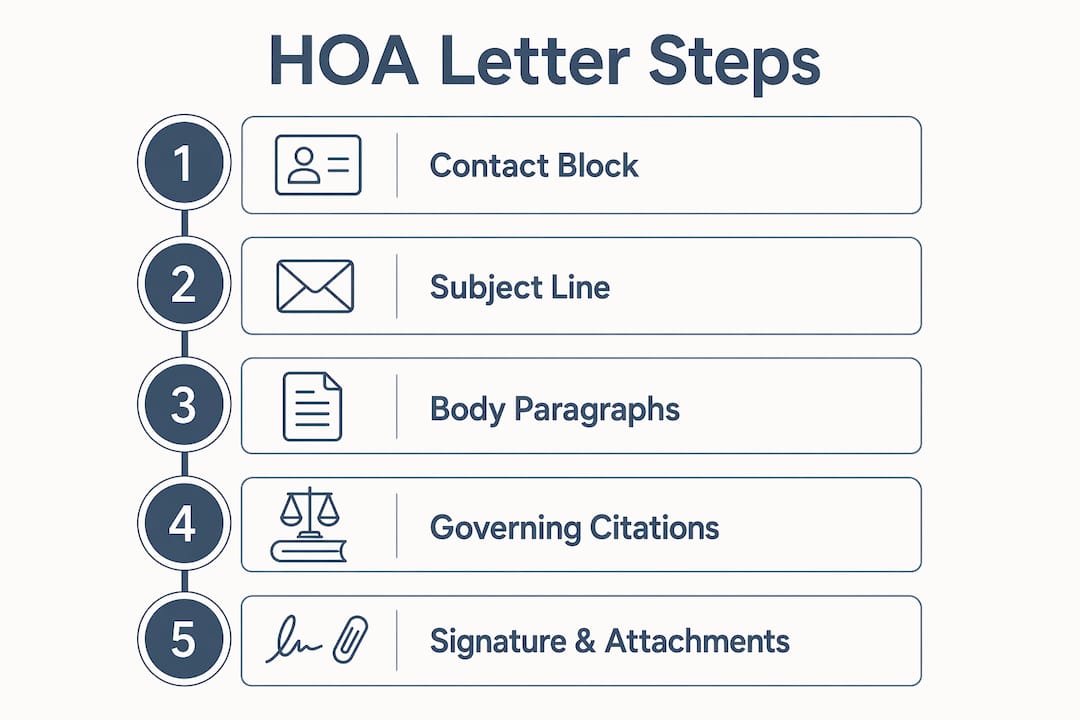
Every professional HOA letter shares the same structural skeleton, regardless of its purpose. Letters should include a date, full contact block, subject line, purpose statement, supporting facts, statute citations, deadline, and a signature with parcel ID. That list is not optional. Each element serves a specific function in making the letter legally sound and easy to act on.
Contact block and date
The contact block sits at the top of every letter. It includes the sender's full name, mailing address, phone number, and email. The recipient's name and address follow directly below. The date must be exact, not approximate. Vague dates like "recently" or "last month" weaken any legal argument you may need to make later.

Subject line and opening statement
The subject line identifies the exact purpose of the letter in one line. "Re: Fence Installation Request, 4821 Maple Drive, Parcel ID 0023-44-11" tells the reader everything before they read a single paragraph. The first sentence of the body then states your identity and purpose directly. One sentence is enough. Anything longer delays the point.
Body paragraphs and governing document citations
Concise paragraphs of 2–5 sentences that cite specific CC&R sections or bylaw provisions carry far more weight than paragraphs built on personal opinion. Cite the exact section number. Include measurements, dates, and material specifications where relevant. Boards handle dozens of letters. A letter that does the board's research for them gets processed faster.
Signature block and attachments
Close with a full signature block: your printed name, title if applicable, and parcel ID. List every attachment at the bottom of the letter. Common attachments include photos, contractor quotes, prior correspondence, and copies of the relevant CC&R pages. A complete attachments list prevents the board from claiming they lacked information to act.
Pro Tip: *Number your attachments and reference them by number in the body text. "See Attachment 2: Contractor Quote" is cleaner and harder to overlook than a vague mention of "enclosed documents."*
***
How to format different types of HOA letters
Different letter types follow the same structural rules but shift in tone and content focus. The table below maps each common letter type to its key formatting priorities.
| Letter type | Tone | Core content focus | Key formatting element |
|---|---|---|---|
| Violation notice | Firm, neutral | Specific rule cited, compliance deadline | CC&R section number, deadline date |
| Request letter | Professional, positive | Project description, desired approval | Attachments, material specs |
| Fine notice | Formal, factual | Fine amount, governing document basis | Payment instructions, due date |
| Welcome letter | Warm, informative | Community overview, contact info | Board contact block, key rules summary |
| Appeal letter | Measured, documented | Grounds for appeal, supporting evidence | Prior correspondence references |
Violation notices
A violation notice must name the specific rule broken, not just describe the behavior. Citing the exact governing document section and giving a clear compliance deadline removes any ambiguity about what the homeowner must do. State the violation in one sentence. Follow with the rule citation. Then state the deadline and the consequence of non-compliance. Keep the tone neutral. The goal is correction, not confrontation.
Request letters
Framing a request as a formal business proposal rather than a personal appeal increases the likelihood of approval. Boards have fiduciary duties. A request that demonstrates awareness of community standards and includes supporting documentation shows you have done the work. Include the project description, the specific approval you are seeking, and all relevant attachments. One page is the target length.
Fine notices and welcome letters
A fine notice must state the exact dollar amount, the governing document basis for the fine, and clear payment instructions with a due date. Vague fine notices invite disputes. Welcome letters take the opposite approach in tone. Keep them warm and brief. Cover the board's contact information, the community's key rules, and where to find the full CC&Rs. A welcome letter sets the tone for the entire homeowner relationship.
Pro Tip: *For fine notices, include a brief timeline of prior communications, such as the original violation notice date and any follow-up letters. This paper trail protects the board if the homeowner disputes the fine.*
***
What tools and formatting standards improve HOA letter professionalism?
The visual presentation of a letter signals credibility before anyone reads a word. Professional HOA letterhead should feature the association's full legal name, a consistent logo, and complete contact details, with a header height of 1.5 to 2 inches using clean fonts like Arial or Calibri. That standard exists because cluttered or inconsistent letterhead makes letters look unofficial, which undermines their authority.
Key formatting standards for HOA correspondence include:
- Fonts: Arial, Calibri, or Times New Roman at 11–12 point for body text. Avoid decorative fonts entirely.
- Header height: 1.5 to 2 inches, containing the HOA's legal name, logo, address, phone, and email.
- Legal identifiers: Include incorporation status and tax ID on formal correspondence. This detail matters during audits and disputes.
- Email addresses: Official HOA email addresses separate board business from personal accounts, preserve organized records, and reduce personal liability exposure.
- Print standards: Black and white with limited accent colors keeps printing costs low and ensures readability on photocopies.
Consistent letterhead does more than reinforce branding. It functions as a risk management tool by making official communications easy to identify and categorize during disputes or audits. A board that uses inconsistent or informal letterhead creates document management problems that can surface at the worst possible time.
***
What common pitfalls should be avoided in HOA letter writing?
The most damaging mistakes in HOA correspondence are not typos. They are structural and tonal errors that undermine the letter's purpose before the reader reaches the second paragraph.
- Emotional or combative language: Letters perceived as combative are routinely deprioritized or escalated adversarially. Words like "demand," "threatening," or "rights violation" trigger defensive reactions. Replace them with factual statements and specific requests.
- Vague complaints: "The noise has been ongoing" is not a complaint. "Loud music was audible from the street at 11:30 p.m. on march 14, 2026" is. Dates, times, and documented evidence make complaints actionable.
- Missing citations: A letter that references "the rules" without citing a specific CC&R section or bylaw gives the board nothing concrete to act on. Always name the document and section number.
- Wrong delivery method: Certified mail with return receipt is the gold standard for statutory compliance. For records requests, appeals, or any correspondence that triggers a legal deadline, email alone is often insufficient. Certified mail creates legally recognized proof of delivery.
- Tone that is too casual: A letter written like a text message signals that the sender does not take the matter seriously. Boards respond in kind.
> *"Using precise legal terminology, referencing specific governing documents, and including exact dates signals competence and promotes more careful board handling than vague or emotional complaints."*
Approaching HOA correspondence with the same discipline you would apply to a business letter changes the outcome. Boards take well-documented, professionally formatted correspondence more seriously. That is not a soft observation. It is a pattern that shows up consistently in how boards prioritize their responses.
***
Key takeaways
Professional HOA letter formatting requires a complete contact block, specific governing document citations, and a neutral tone to produce correspondence that boards act on quickly and courts recognize as credible.
| Point | Details |
|---|---|
| Use a full contact block | Include sender name, address, parcel ID, and exact date on every letter. |
| Cite governing documents specifically | Reference the exact CC&R section or bylaw number, not just general "community rules." |
| Match tone to purpose | Violation and fine notices require neutral firmness; welcome and request letters benefit from a positive, professional tone. |
| Choose the right delivery method | Use certified mail with return receipt for any letter that triggers a statutory deadline or legal obligation. |
| Maintain consistent letterhead | Official letterhead with the HOA's legal name and contact details supports record-keeping and reduces liability exposure. |
***
Why formatting is the first thing I check in any HOA dispute
When a homeowner or board member brings me a letter that went nowhere, the problem is almost never the facts. The facts are usually there. The problem is that the facts are buried under emotional language, missing citations, or a layout that looks like it was typed in a hurry. Boards are busy. A letter that requires effort to decode gets set aside.
The insight that changed how I think about HOA correspondence is this: a well-formatted letter is a credibility signal before it is a communication tool. When a board member opens an envelope and sees clean letterhead, a precise subject line, and a CC&R section cited in the first paragraph, they immediately treat the letter differently. They assume the sender knows what they are talking about. That assumption does most of the work.
I have seen homeowners win approval for projects that seemed like long shots, simply because their request letter read like a professional proposal. I have also seen boards lose disputes they should have won because their violation notices were vague and their letterhead was inconsistent. The content was right. The format undermined it.
The practical advice I give every board member and homeowner is the same: before you send anything, ask whether a stranger could read your letter and know exactly what happened, what rule applies, what you want, and by when. If the answer is no, the letter is not ready. Format is not cosmetic. It is the structure that makes your argument legible.
> *— Blake*
***
How Hoaletterai makes professional letter drafting faster
Drafting a properly formatted HOA letter from scratch takes time, especially when state-specific language and governing document citations need to be accurate. Hoaletterai is built specifically for boards, property managers, and homeowners who need professional correspondence without the back-and-forth of manual drafting.

Hoaletterai generates state-compliant letters for violation notices, noise complaints, fine notices, and more, with built-in formatting checks that catch common errors before the letter goes out. Every letter includes a one-page preview so you can review the full document before sending. The platform also offers direct USPS mailing, which means certified mail delivery is handled without a separate trip to the post office. For boards and managers handling high letter volumes, that combination of speed, accuracy, and delivery in one place makes a measurable difference. You can also explore the HOA violation letter generator to preview a compliant letter before committing.
***
FAQ
What must every professional HOA letter include?
Every HOA letter needs a date, full contact block with parcel ID, a specific subject line, a one-sentence purpose statement, governing document citations, a compliance deadline where applicable, and a signed signature block.
How long should an HOA letter be?
One page is the standard target for most HOA letters. Longer letters are appropriate only when supporting documentation or a detailed timeline of prior communications is necessary to establish the record.
When is certified mail required for HOA correspondence?
Certified mail with return receipt is required whenever a letter triggers a statutory deadline, such as records requests or formal appeals. Email alone does not provide legally recognized proof of delivery in most states.
What tone works best in HOA letters?
Firm and neutral is the most effective tone. Avoiding emotional or combative language keeps the focus on facts and actionable requests, which boards respond to more favorably than letters that feel like personal attacks.
What fonts and formatting standards should HOA letterhead use?
Arial, Calibri, or Times New Roman at 11–12 point are the recommended body fonts. The letterhead header should be 1.5 to 2 inches tall and include the HOA's full legal name, logo, address, and contact information.