
Standardized letter formats, governed by a written correspondence manual, materially reduce legal liability for HOA boards and property managers. The single most effective first step is adopting one master template per letter type and enforcing a proof-of-delivery process for every notice that leaves the office.
That one change delivers two immediate benefits:
- Letters generated from an approved, repeated format hold up better as evidence under business-record rules, since routine practice is what courts look for.
- Fewer ambiguous claims slip through, because a fixed structure forces every writer to include the same facts, dates, and deadlines every time.
Key Takeaways
Standardized letter formats, backed by a written correspondence manual and a documented delivery process, are the most reliable way to reduce an HOA’s exposure to disputes and legal challenges.
| Point | Details |
|---|---|
| Adopt one master template per letter type | Consistency in structure supports admissibility under business-record rules. |
| Enforce a 14 to 30 day deadline | Every demand letter needs a specific, stated deadline and consequence. |
| Build a correspondence manual | Define approved language, mandatory fields, and signature authority in one document. |
| Use certified mail for high-stakes notices | Return receipt delivery creates the proof-of-transmission record disputes require. |
| Use a governed tool to enforce the process | HOA Letter AI applies state-aware templates and delivery tracking automatically. |
Table of Contents
- Why Consistency in Letter Formats Reduces Legal Liability
- What Belongs in Every Legally Effective HOA Letter
- Building a Correspondence Manual That Actually Gets Used
- How to Roll Out Standardized Templates in 60 to 90 Days
- Sending Letters So They Hold Up as Evidence
- A One-Page Template Skeleton You Can Copy Today
- Common Liability Risks a Standard Format Actually Prevents
- Why Every Letter Needs a Disclaimer or Limitation Clause
- Adjusting Standard Formats for Different States and Situations
- Do Digital Signatures Change Your Liability Exposure?
- Keeping Formats Consistent Over Time
- Put the Playbook to Work With HOA Letter AI
- Sources
Why Consistency in Letter Formats Reduces Legal Liability
Courts and opposing counsel treat routine, repeated documents differently than one-off letters written in a hurry. Under the Federal Rules of Evidence, records created as part of a regularly conducted business activity carry a hearsay exception that ad-hoc correspondence does not enjoy. A letter generated from the same template your HOA has used for three years, with the same required fields filled in the same order, looks like routine practice. A letter typed fresh each time, with different phrasing and missing details, looks improvised, and improvised looks challengeable.
The pattern holds up in the data: organizations with a formal correspondence manual see measurably fewer ad-hoc drafts and lower exposure when disputes escalate.
Inconsistency creates exploitable gaps. If one violation letter cites a deadline and the next omits one, or if terminology for the same rule shifts between “assessment” and “fine” and “penalty,” a homeowner’s attorney will use that drift to argue the board applied rules unevenly. Standardization closes that door before it opens.
What Belongs in Every Legally Effective HOA Letter
A legally sound letter is not a creative writing exercise. It is a checklist, and skipping any item on it is where liability creeps in.
- Header block with the association name, property address, date, and both recipient and sender contact details.
- Formal subject line (“Re: Notice of CC&R Violation, Unit 14B”) so the letter’s purpose is unmistakable on first glance.
- Opening statement naming the relationship (homeowner, tenant, board) and the reason for writing, in one or two sentences.
- Chronological facts with specific dates, amounts, and any governing document section numbers, not vague references to “recent issues.”
- A single, specific request paired with a deadline within a standard range of about two to four weeks (https://legalclarity.org/how-to-write-a-legal-letter-key-steps-and-format/), plus a plainly stated consequence for missing it.
- Closing and signature from an authorized board member or manager, never left blank or informally signed.
Formatting matters as much as content. Use a standard font at 11 or 12 point, one-inch margins, and single or 1.15 spacing. Keep the letter concise, typically limited to a couple of pages (https://legalclarity.org/how-to-write-a-legal-letter-key-steps-and-format/); extra pages usually mean extra opinions, and extra opinions are what get quoted back at you in a hearing.
Pro Tip: Keep every mandatory element in a fixed order across all your letter types. When a homeowner’s attorney reviews five letters and sees the deadline in the same spot each time, it reads as policy. When it moves around, it reads as improvisation.
Building a Correspondence Manual That Actually Gets Used
A correspondence manual is the document that makes consistency last beyond whichever board member happens to be writing letters this quarter. Without one, every new manager or volunteer reinvents the wording, and drift creeps back in within a year.
Your manual should define:
- Approved tone and style rules, including which words to avoid (nothing accusatory, nothing that implies legal conclusions the board hasn’t reached).
- Merge-field conventions, so “[Owner Name]” always means the same thing across every template.
- Which fields are mandatory (deadline, citation, signature) versus optional (photo attachments, prior notice history).
- A signature authority map naming exactly who can approve and send each letter type.
- Version control with a changelog, so anyone can see when a template last changed and why.
Assign one person to own audits and one to own training. Split those roles and the manual rots within a year.
| Point | Details |
|---|---|
| One master template per letter type | Prevents each writer from drafting from memory or an old email chain. |
| Mandatory fields beat optional ones | Deadlines, citations, and signatures should never be skippable. |
| Version control creates a paper trail | A changelog shows counsel exactly when language changed and why. |
How to Roll Out Standardized Templates in 60 to 90 Days
You don’t need a full year to fix this. A focused rollout looks like this:
- Weeks 1 to 2: Audit your last 20 to 30 letters and identify the three highest-volume types (usually late payment, architectural violation, and general compliance notices).
- Weeks 3 to 5: Draft master templates for those three types with required merge fields and conditional clauses for edge cases (repeat offenders, tenant versus owner).
- Weeks 6 to 7: Pilot the templates with one manager or board member, collect feedback on where the fields felt awkward or incomplete.
- Week 8: Get sign-off from legal counsel on the finalized language, especially any deadline or penalty clauses.
- Weeks 9 to 10: Train the full team, then roll the templates out association-wide.
- Ongoing: Track compliance rate (percentage of letters sent using the approved template), average time-to-send, and error rate, reviewing all three quarterly.
Note that automated systems handle the majority of routine demand letters well; the remaining complex or contested cases still need a human review step before they go out.
Sending Letters So They Hold Up as Evidence
How you send a letter matters almost as much as what it says. Certified mail with return receipt requested remains the standard for notices where proof of delivery could matter later, since it creates a paper record that a homeowner actually received the notice, not just that you sent it. Tracked electronic delivery works for lower-stakes routine communications, but skip it for anything tied to fines, liens, or legal deadlines.
Every letter you send should generate a metadata trail:
- Who drafted it and who approved it.
- Which template ID and version was used.
- The exact send timestamp and delivery method.
- Any attachments included, logged by filename.
Worth remembering: without routine generation and a retained audit trail, opposing counsel has an easier argument that your letter was a one-off, drafted under pressure, and therefore unreliable. A dated, versioned file with a delivery receipt attached raises the bar for anyone trying to make that case.
Set a retention timeline, typically matching your state’s statute of limitations for contract or property disputes, and name your files consistently: date, letter type, unit number. Six months from now, when someone asks “did we actually send that,” you want the answer in ten seconds, not an afternoon of searching email threads.
A One-Page Template Skeleton You Can Copy Today
Strip a legally sound letter down to its skeleton and it looks like this: header block, “Re:” line, one-sentence opening statement, a short paragraph of chronological facts, a specific request with a deadline, a closing line stating next steps, then signature and any attachments listed by name.
Before anything goes out, run it against a short mandatory check:
- Are the names, dates, and dollar amounts correct? (This single error causes more disputes than bad tone ever does.)
- Does the letter include any legal argument or citation to a specific statute? If so, flag it for counsel review before sending.
- Is the deadline stated once, clearly, with a real date rather than “within 30 days of this letter”?
- Are jurisdiction-specific citations noted where your state requires them, particularly for lien or fine notices?
Keep this checklist taped inside your letter-writing folder. A ready-made warning letter template already builds most of this structure in, which saves you from rebuilding the skeleton from scratch every time a new violation type comes up.
Common Liability Risks a Standard Format Actually Prevents
Most HOA liability doesn’t come from a board acting in bad faith. It comes from inconsistency that looks like bad faith in hindsight. A few patterns show up again and again.
Selective enforcement claims. If one homeowner gets a friendly reminder call and another gets a formal notice for the identical violation, a standardized process with a documented trigger point (say, “formal letter issued on second occurrence”) closes that gap.
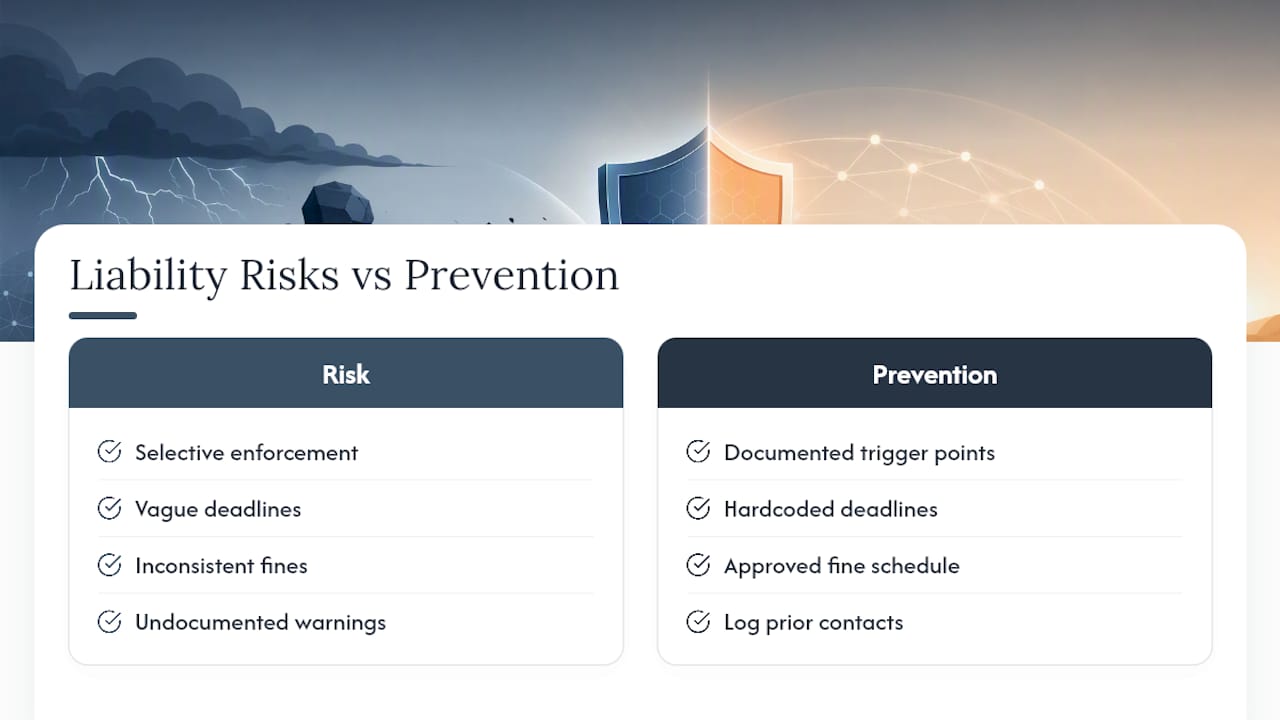
Missing or vague deadlines. A letter that says “please address this soon” gives a homeowner room to argue they were never properly notified. A template with a hardcoded deadline field removes the ambiguity.
Inconsistent fine calculations. When fine amounts vary letter to letter because someone did quick math instead of pulling from the approved schedule, that variance becomes evidence of arbitrary enforcement in a hearing.
Undocumented verbal warnings. Boards that rely on phone calls or hallway conversations before escalating have no record at all. A template that requires logging prior contact attempts fixes this at the source.
Improper delivery. Notices sent to the wrong address, or with no delivery confirmation, are among the easiest things for a homeowner’s attorney to challenge. Standardizing your delivery method, discussed above, removes this risk almost entirely.
Each of these risks traces back to the same root cause: no fixed process forcing consistency. Fix the process and most of these disputes never reach a hearing.
Why Every Letter Needs a Disclaimer or Limitation Clause
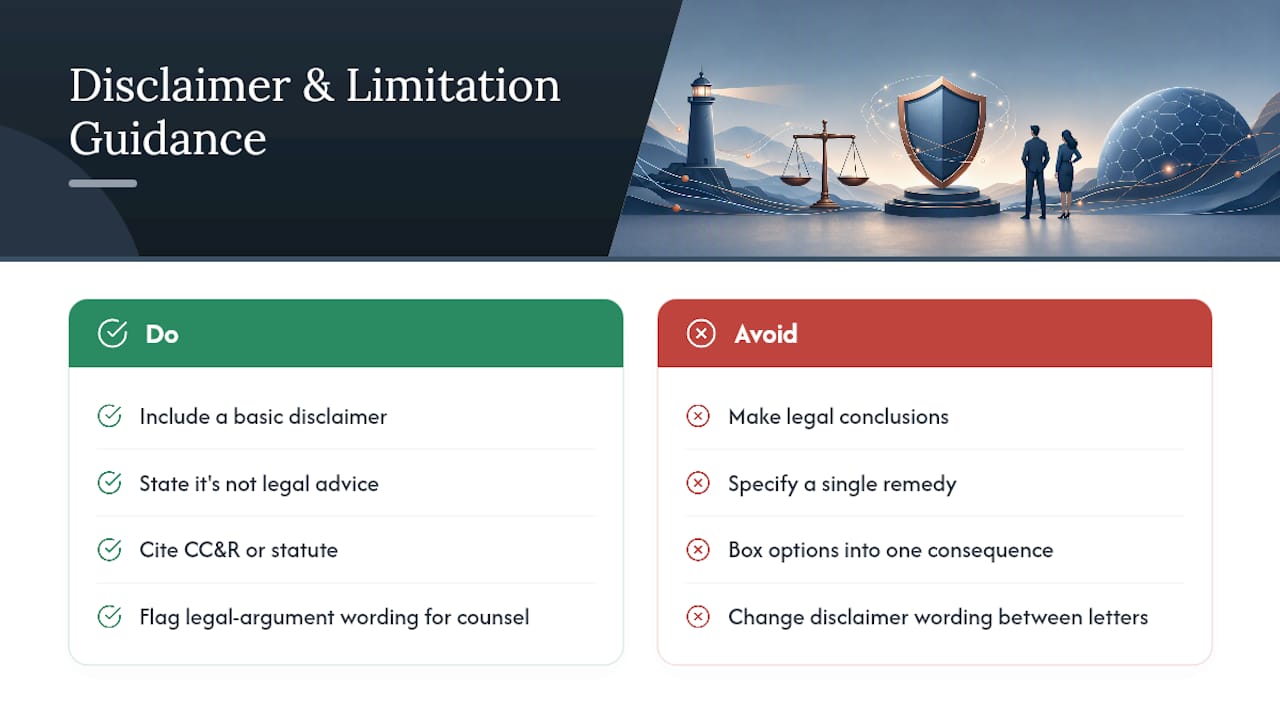
A well-drafted letter includes language that limits how it can be interpreted later. This isn’t about hedging your position. It’s about preventing a homeowner from reading more into the letter than the board intended.
A basic disclaimer clarifies that the letter reflects the board’s understanding based on available information at the time, and that it does not constitute legal advice or a waiver of any rights the association holds. Limitation language should also state that failure to respond by the stated deadline may result in further action, without specifying every possible remedy, which keeps the board’s options open rather than boxing it into one stated consequence.
Where a letter references a specific CC&R section or state statute, include the citation but avoid characterizing what a court would decide. That’s a legal conclusion, and legal conclusions belong to counsel, not to a board letter. If a template includes any language that edges toward legal argument, flag it for attorney review before it goes into general rotation, not just the one time it’s used.
Keep disclaimer language identical across every letter type in your manual. A disclaimer that changes wording letter to letter is itself a form of inconsistency, and it invites the same scrutiny you’re trying to avoid.
Adjusting Standard Formats for Different States and Situations
A single master template rarely works unmodified across every jurisdiction. State laws vary on notice periods, required disclosures, and even the specific language a lien or fine notice must include, so your correspondence manual needs a jurisdiction layer, not just a style layer.
Build your templates with a base structure that stays fixed (header, facts, request, signature) and a conditional clause section that changes based on state requirements. Some states mandate specific pre-lien notice language; others require a right-to-cure period before fines can escalate. State-specific notice and fine rules differ enough that a template built for one state can create real exposure if reused unmodified in another.
Beyond state law, tailor templates for context: a first notice reads differently than a second or third notice for the same violation, and a pet-related complaint needs different fact fields than a parking or architectural violation. A dedicated pet violation template captures details, like breed restrictions or leash-law citations, that a generic violation letter skips entirely. Build separate templates for distinct fact patterns rather than forcing every scenario into one generic shell.
Do Digital Signatures Change Your Liability Exposure?
Electronic correspondence and digital signatures are now standard for most HOA communication, and they don’t inherently increase liability when handled correctly. What matters is whether the signature and delivery method can be verified after the fact.
A digital signature tied to an authenticated sender, with a timestamp and audit log, generally holds up as well as a wet signature for board correspondence. The risk isn’t the digital format itself. It’s using email for something that legally requires certified delivery, or letting anyone with template access sign on behalf of the board without an approval step. Keep your signature authority map current, and make sure your delivery method matches the stakes of the letter, not just the convenience of hitting send.
Keeping Formats Consistent Over Time
Templates decay without maintenance. New board members bring their own writing habits, property managers switch software, and within eighteen months a “standardized” process often looks nothing like the manual on file.
Two practices keep this from happening. First, train every new board member and staff member on the correspondence manual before they draft a single letter, not after the first complaint. Second, run a quarterly audit comparing sent letters against the approved templates, flagging any deviation in tone, missing fields, or altered deadline language.
Assign audit responsibility to someone outside the letter-writing rotation, ideally the person who also owns version control. That separation catches drift that the letter writers themselves are too close to notice.
A Practitioner’s Note on Where Boards Actually Go Wrong
Most liability problems trace back to the same habit: a board member writes a letter from memory instead of from the template, and one small omission, a missing deadline or an inconsistent fine amount, becomes the thread an attorney pulls on. The fix is almost always structural, not a smarter letter writer. Standardized compliance letter formatting closes that gap fast, often within one audit cycle.
— Blake
Put the Playbook to Work With HOA Letter AI
Building a correspondence manual from scratch takes weeks. HOA Letter AI compresses that work into a guided drafting tool that already encodes the playbook above: master templates for every common letter type, state-aware compliance checks, mandatory merge fields, and a free one-page preview before anything gets sent.
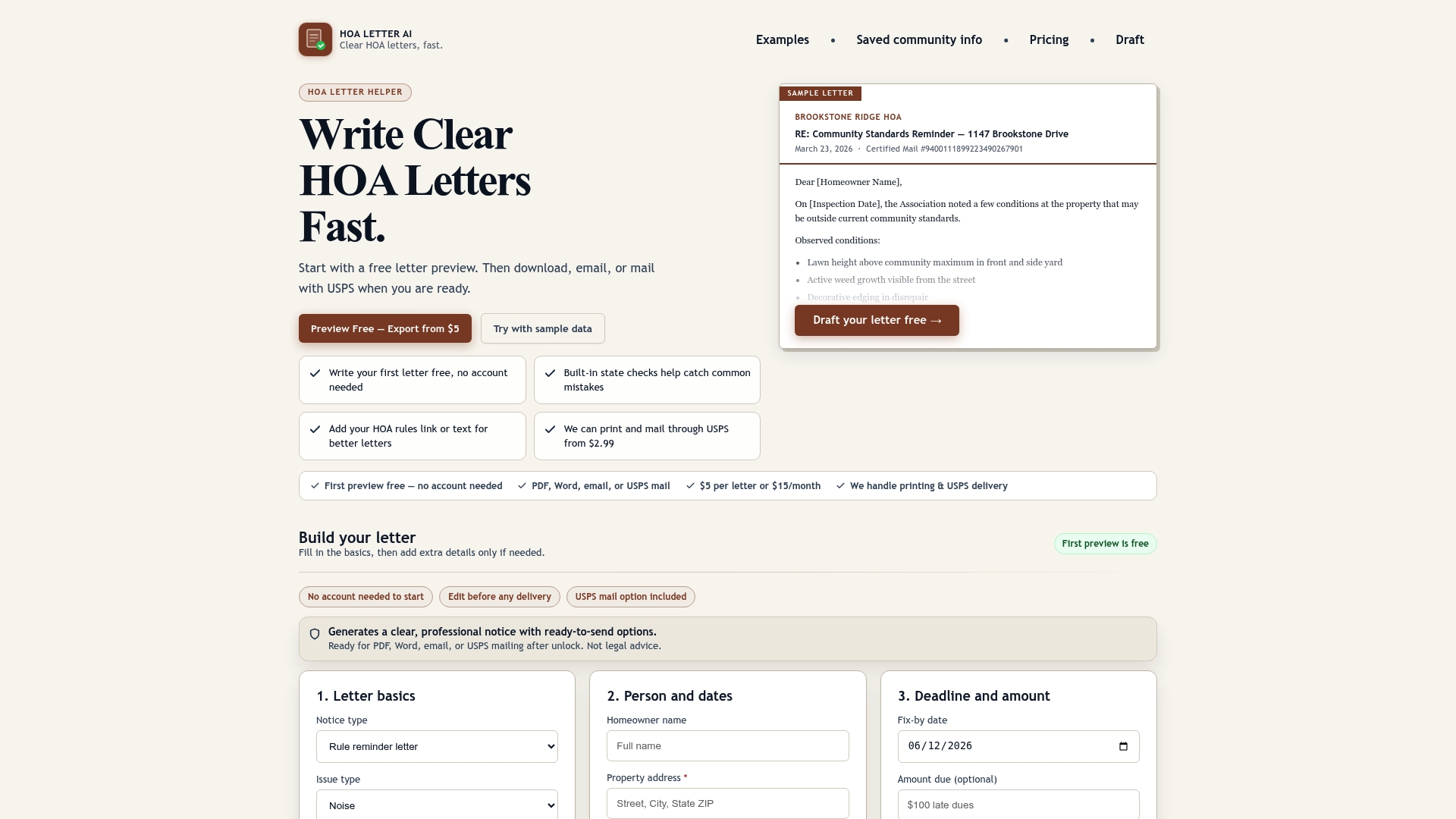
Boards and property management teams can subscribe for ongoing access across their full letter volume, while individual homeowners or small boards can unlock a single letter for a one-time fee, including editable response letters for homeowners who received a notice and need to reply formally. USPS mailing integration handles delivery and creates the transmission record your manual should already require. Property management teams managing multiple communities can set up reusable community profiles built for larger portfolios, so state-specific rules and CC&R citations carry over automatically instead of being re-entered letter by letter. Start by previewing a template for your next notice and see how the state-aware checks flag missing fields before you send.
Sources
- Business correspondence examples: letters, memos and emails - LegalClarity
- Demand Letter Automation for Law Firms Checklist | US Tech Automations
This article is general information, not a substitute for advice from a qualified lawyer. Consult a qualified legal professional about your own circumstances before acting on anything here.