
Letter format compliance legal requirements are the structural, timing, and delivery rules that determine whether a formal legal letter is valid and enforceable. A letter that looks professional but skips a required delivery method or misses a notice deadline can lose all legal effect. Courts interpret notice clauses strictly, and a single formatting or timing error can forfeit rights entirely. This guide covers the essential legal letter components, delivery rules, and common mistakes that determine whether your letter holds up legally.
What are the essential elements of letter format compliance legal requirements?
A legally compliant letter follows a defined structure that courts and regulators recognize. Standard legal letter formatting includes a sender block, recipient block, a subject line beginning with "Re:", body paragraphs, and a formal closing with a handwritten signature, typed name, and title. Skipping any of these components weakens the letter's authority and can make it unenforceable in a dispute.
Structural components every legal letter needs
The sender block appears at the top left and includes the full name, organization, address, phone number, and email. The recipient block follows immediately below, with the same level of detail for the receiving party. The subject line uses "Re:" to state the letter's purpose in one concise phrase, such as "Re: Notice of Lease Default."

The body divides into three clear parts: a purpose statement in the first paragraph, supporting facts with specific dates and references in the middle paragraphs, and a specific demand or request in the final paragraph. Each paragraph covers one idea. The closing uses "Sincerely" or "Respectfully," followed by a handwritten signature above the typed name and title.
Formatting standards vs. common mistakes
| Standard | Correct practice | Common mistake |
|---|---|---|
| Font | Times New Roman or Arial, 12 pt | Decorative fonts, inconsistent sizes |
| Margins | 1 inch on all sides | Narrow margins that crowd the text |
| Spacing | Single within paragraphs, double between | All double or all single throughout |
| Alignment | Block style, left aligned | Centered or indented paragraphs |
| Subject line | Starts with "Re:" | Missing or vague subject line |
| Signature | Handwritten plus typed name and title | Typed name only, no title |
Pro Tip: *Print a draft and check that every block aligns to the left margin. Block style is the recognized standard for legal correspondence, and misaligned text signals a lack of care to the reader.*
How do timing and delivery method requirements affect legal letter compliance?
Timing rules are where most compliance letter guidelines break down. The mailing date is not the same as the legal effectiveness date. A letter mailed on monday may not be "deemed received" until three to five business days later under a contract's notice clause. That gap can push a deadline past the point where rights can still be exercised.
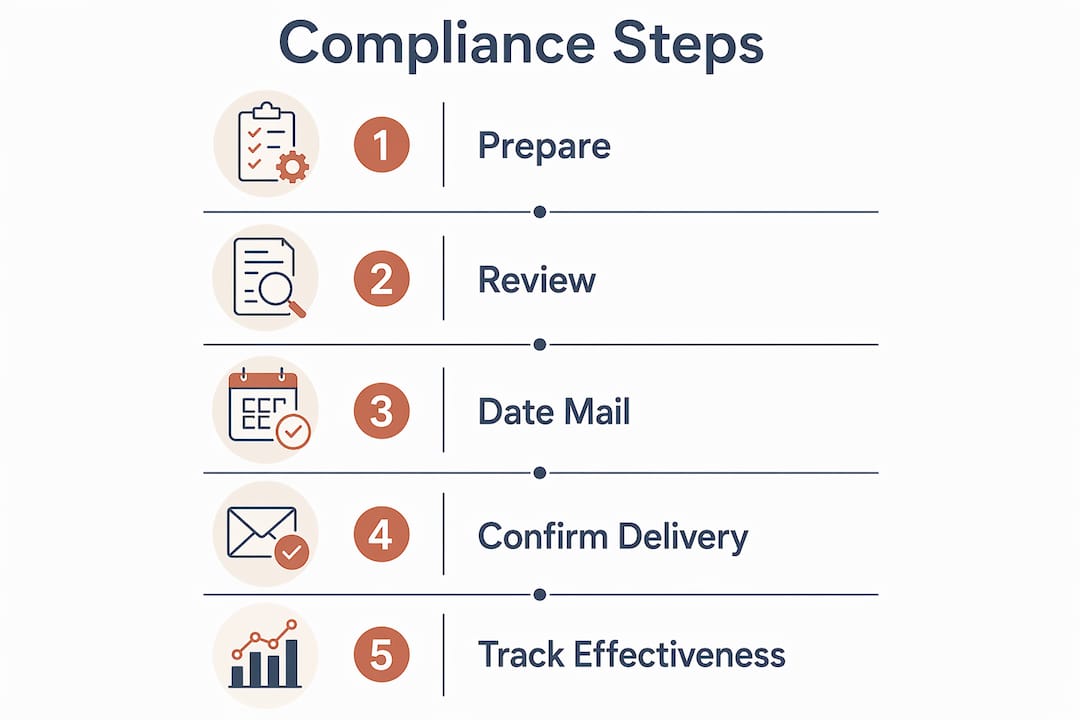
Mailing date vs. effectiveness date
Contracts and statutes use two different standards. "Effective upon receipt" means the clock starts when the recipient actually receives the letter. "Deemed received after X business days" means the clock starts automatically after a set number of days, regardless of actual delivery. Misreading which standard applies is one of the most common and costly errors in legal correspondence.
Courts interpret notice clauses strictly. An incorrect address, wrong delivery method, or miscalculated deadline can invalidate an otherwise well-written notice. Reading the exact notice provision in your contract or statute before drafting is not optional.
Delivery methods and best practices
- Certified mail with return receipt is the most reliable proof of delivery. Return receipt postcards can take 7–14 days to arrive, so plan deadlines with that lag in mind.
- Courier or overnight delivery provides faster confirmation and works well when contracts permit it as an alternative.
- Email is valid only when the contract or statute explicitly authorizes it as a notice method.
- Personal delivery creates immediate effectiveness but requires a signed acknowledgment from the recipient.
- Regular mail alone rarely satisfies legal notice requirements for high-stakes correspondence.
Keep every proof of delivery document in a dedicated file. If a dispute arises, the return receipt or courier confirmation is your evidence that the notice was valid.
Pro Tip: *Calculate your response deadline from the effectiveness date, not the mailing date. Add the transit lag to your calendar as a separate reminder so you never confuse the two.*
How does letter format compliance differ by legal context and letter purpose?
Legal compliance letter formats depend entirely on the letter's legal category. A debt validation letter under the Fair Debt Collection Practices Act (FDCPA) has different mandatory content than a zoning compliance letter or a pre-suit demand. Identifying the correct category before drafting is the first step in getting the format right.
Common legal letter types and their requirements
| Letter type | Core purpose | Key required content | Timing rule |
|---|---|---|---|
| Notice-and-cure | Alert party to contract breach | Specific breach description, cure period | Per contract clause, typically 10–30 days |
| Statutory pre-suit notice | Satisfy legal prerequisite before filing | Statutory citation, demand, deadline | Set by statute, often 30–60 days |
| FDCPA debt validation | Notify consumer of debt and rights | Debt amount, creditor name, dispute rights | Within 5 days of initial contact |
| Regulatory response | Reply to agency inquiry or audit | Reference number, factual response, attachments | Per agency deadline in the original notice |
| Zoning compliance | Confirm property meets local zoning rules | Application, fee, supporting documents | Set by local authority, often unpredictable |
Under the FDCPA, debt collectors must send written validation notices within 5 days of initial contact. Consumers then have 30 days to dispute the debt in writing. A phone call does not satisfy this requirement. Written dispute within 30 days is the only way to trigger the collector's obligation to cease collection and provide verification.
Zoning compliance letters follow a completely different path. Local planning departments set their own timelines, fees, and content requirements. Early preparation matters because review periods vary widely and cannot be predicted with certainty.
For HOA boards, state-specific notice requirements add another layer. California, New York, and other states prescribe exact notice language, delivery methods, and cure periods for violation letters. Using a generic template without checking state law creates real enforcement risk.
What are practical guidelines for writing legally effective compliance letters?
Clear, factual writing is the foundation of an enforceable letter. Segmenting facts, legal rules, and recommended actions into distinct paragraphs improves both persuasiveness and practical outcomes. A reader who can quickly locate the key demand and the deadline is more likely to respond than one who has to parse dense, mixed paragraphs.
Writing guidelines that protect enforceability
- State the purpose in the first sentence of the first paragraph. Do not bury the reason for the letter.
- Present facts in chronological order with specific dates, amounts, and references. Vague statements like "on several occasions" weaken the record.
- Cite the specific contract clause, statute, or regulation that gives the letter its legal basis.
- State the demand or request in plain language. Clear, bounded deadlines of 14–30 days improve enforceability and settlement leverage.
- Avoid admissions. Phrases like "we may have contributed to this issue" create liability without adding value.
- Use a firm but neutral tone. Emotional language reduces credibility and can be used against you.
- Proofread for formatting consistency. Inconsistent fonts, spacing, or margins signal carelessness.
Pro Tip: *Include a specific calendar date as your deadline rather than "within 30 days." A date like "by june 13, 2026" removes any ambiguity about when the clock expires and makes the demand easier to enforce.*
Courts and opposing counsel read legal letters looking for weaknesses. A letter that presents facts clearly, cites the legal basis accurately, and states a specific demand with a concrete deadline gives the recipient no room to claim confusion. That clarity is your legal leverage.
Key takeaways
Properly formatted legal letters must follow defined structural, timing, and delivery rules to be valid and enforceable under contract or statute.
| Point | Details |
|---|---|
| Structure is mandatory | Every legal letter needs sender and recipient blocks, a "Re:" subject line, and a formal closing with signature. |
| Timing rules override mailing dates | Calculate deadlines from the effectiveness date, not the date you drop the letter in the mail. |
| Delivery method must match the contract | Certified mail with return receipt is the most reliable proof; email is only valid when explicitly authorized. |
| Letter type determines content | FDCPA, zoning, pre-suit, and notice-and-cure letters each require different mandatory elements and timelines. |
| Specific deadlines strengthen enforceability | Use a concrete calendar date in your demand, not vague terms like "promptly" or "as soon as possible." |
Why I think most people get legal letter compliance backwards
Most guides on legal letter compliance spend the majority of their time on fonts and margins. That is the wrong priority. After reviewing hundreds of legal correspondence disputes, the pattern is clear: letters fail because of timing and delivery errors, not because someone used Arial instead of Times New Roman.
The most dangerous mistake I see is treating the mailing date as the legal trigger. A board member or contract manager mails a notice on the last possible day, calculates the response deadline from that date, and then discovers the contract says "effective upon receipt." The entire timeline shifts, the deadline passes, and the right to enforce is gone. That is not a formatting problem. It is a failure to read the controlling clause before drafting.
The second overlooked issue is vague demands. A letter that says "please remedy this situation promptly" gives the recipient no clear obligation and gives a court nothing to enforce. A letter that says "cure the breach described above by april 30, 2026, or we will exercise our right to terminate under Section 12.3" is a different document entirely. The specificity is the legal weapon.
My honest advice: read the notice provision in your contract or the relevant statute before you write a single word. Identify the required delivery method, the effectiveness rule, and the minimum notice period. Build your timeline backward from the deadline. Then write the letter. The formatting standards matter, but they are the last thing to check, not the first.
> *— Blake*
Hoaletterai makes compliant HOA letters faster and more accurate
Writing legally compliant HOA violation letters takes time, and the margin for error is real. Hoaletterai is built specifically for HOA boards and property managers who need professional, state-specific compliance letters without the back-and-forth of manual drafting.

The platform generates letters with the correct structure, state-specific language, and clear formatting built in. Built-in checks catch common errors before the letter goes out. USPS mailing is available directly through the platform, so delivery proof is handled in the same workflow. Browse HOA violation letter laws by state to find the exact notice requirements for your jurisdiction, or use the violation letter generator to produce a compliant letter in minutes.
FAQ
What is a legally compliant letter format?
A legally compliant letter format includes a sender block, recipient block, "Re:" subject line, structured body paragraphs, and a formal closing with a handwritten signature and typed name. Font, margin, and spacing standards also apply, typically 12-point Times New Roman or Arial with 1-inch margins.
Does the delivery method really affect legal enforceability?
Yes. Courts interpret notice clauses strictly, and using the wrong delivery method can invalidate an otherwise correct letter. Certified mail with return receipt is the most widely accepted proof of delivery for legal correspondence.
What is the difference between mailing date and effectiveness date?
The mailing date is when you send the letter. The effectiveness date is when the letter legally triggers rights and deadlines, which is controlled by the contract or statute. "Effective upon receipt" and "deemed received after X days" are two different standards that produce different deadline calculations.
How do FDCPA debt validation letters differ from other compliance letters?
FDCPA debt validation letters must be sent within 5 days of initial contact and must include the debt amount, creditor name, and the consumer's right to dispute. Consumers have 30 days to dispute in writing. A phone dispute alone does not satisfy the FDCPA requirement.
What deadline language makes a legal letter more enforceable?
Specific calendar dates outperform vague terms like "promptly" or "within a reasonable time." A demand that states a concrete date, such as "by may 15, 2026," removes ambiguity and gives a court a clear standard to enforce.
Recommended
- Formal Notice Formatting Standards Explained for HOA Boards | HOA Letter AI
- HOA Compliance Letter Formatting Explained for Boards | HOA Letter AI
- Institutional Letter Formatting Guidelines Explained | HOA Letter AI
- California HOA Compliance Guide: State-Specific Rules & Violation Letter Requirements | HOA Letter AI