
A report HOA violation letter needs three things to be enforceable: the exact rule being broken, a factual description of what happened, and a clear deadline to fix it. Send it by certified mail or whatever method your governing documents require, and keep proof. If you want a state-aware template built to cover those bases, HOA Letter AI drafts one in minutes.
TL;DR:
- The violation letter must cite the exact rule with section number and provide a clear, factual description of observed violations with dates and locations.
- A firm cure deadline, usually 10 to 30 days, must be set based on violation severity and governing documents, along with instructions for requesting a hearing.
- Sending certified mail with proof of delivery, attaching photos, and logging all communication details create a defensible enforcement record.
- Enforcing violations consistently across homeowners is more crucial than wording, and following state-specific rules prevents legal challenges.
- Using templates that include all legal requirements simplifies compliance and reduces errors in the violation process.
HOA Letter AIDraft Clearer HOA Violation LettersCreate professional compliance letters with state-specific context, community rules, built-in checks, and a one-page preview.Create a compliance letter
Table of Contents
- What every enforceable violation letter needs
- Templates for courtesy, formal, and final notices
- Sending the letter and keeping a defensible file
- What happens if the owner doesn’t comply
- Why consistency matters more than clever wording
- Draft state-compliant letters without starting from a blank page
- Where to check the legal details
- Sources
- FAQ
What every enforceable violation letter needs
A violation letter that skips the fundamentals invites disputes, delayed compliance, and sometimes a voided fine. Six elements separate a letter that holds up from one that gets challenged.
Start with the rule itself. Cite the exact CC&R, bylaw, or rule section number, and quote the language when the wording matters. According to The HOA Guide, a violation letter should cite the exact CC&R section, describe the violation clearly, and give the owner a specific deadline to fix it. Vague phrasing like “you are in violation” weakens compliance, while quoting the actual rule language increases the odds of a voluntary fix.
Then describe the violation in neutral, factual terms: what was observed, where, and on what date and time. Avoid characterizing intent or tone. This is where sample municipal letters are instructive: St. Louis County’s sample violation letter shows the basic structure, including inspection date, violation description, required action, and a required compliance date.
- Cite the rule by section number and quote it when precision matters.
- Describe the facts with dates, times, and location, not opinions.
- Set a cure deadline, typically 10 to 30 days depending on the violation’s severity and your CC&R minimums.
- List only authorized consequences, confirmed against your governing documents and state law.
- Include hearing or appeal instructions so the owner knows how to contest the notice.
- Document everything, from photos to proof of delivery, before the letter ever goes out.
Cure periods vary by violation type and by what your governing documents allow. A satellite dish placement might warrant a short window; a structural modification might need longer. CommonKeel notes that many states and most CC&Rs require written notice and a reasonable opportunity to cure before fines can be levied, and some statutes specify exact hearing timing and notice content.
Pro Tip: Before you name a consequence in the letter, check your CC&Rs and state statute for the maximum fine or remedy allowed. Boards that threaten unauthorized penalties risk having enforcement thrown out entirely.
Consistent enforcement matters as much as the letter’s wording. All Property Management advises documenting violations through independent observation or photos rather than relying solely on resident reports, since uneven enforcement is the most common ground for a legal challenge. For a full breakdown of what your state requires, our state-by-state notice and fine rules hub is worth checking before you send anything.
Templates for courtesy, formal, and final notices
Not every violation deserves the same letter. Escalation should be visible in tone and stakes, not just repeated wording.
- Initial courtesy notice. Friendly tone, short cure window, used for first-time or minor issues like an unmowed lawn or a trash can left out past pickup day.
- Formal violation notice. Cites the specific rule, lists the observed facts, sets a firm cure deadline, and includes instructions for requesting a hearing.
- Final notice. States plainly that this is the last step before fines, suspension of privileges, or referral to the board for further action.
Each template needs a few fields filled in correctly to stay enforceable: the CC&R section number, the observation date and location, the specific cure deadline, and the hearing request process. Skipping the hearing language is the most common mistake, especially on formal and final notices where it often matters most legally.
- Initial notice mistake: using threatening language before a friendly reminder has even had a chance to work.
- Formal notice mistake: citing “the rules” generally instead of the exact section number.
- Final notice mistake: failing to state what happens next (fine amount, hearing date, or referral) in specific terms.
A downloadable warning letter template covers the courtesy stage, and our broader templates library has versions for formal and final notices, plus fine and welcome letters. For a fuller walkthrough of tone and structure, see how to write an HOA violation letter with a rule-cited example.
Sending the letter and keeping a defensible file
Certified mail with return receipt is the standard for anything beyond a first courtesy notice, since it creates proof the owner received the letter if the case ever reaches a hearing or court. Standard mail or a permitted electronic method may work for early, low-stakes notices, but check your CC&Rs for required delivery methods first.
- Keep the signed original letter and a copy of what was mailed.
- Save the green card or electronic delivery confirmation, per The HOA Guide.
- Attach dated photos and inspection notes tied to the observation.
- Log who sent it, when, by what method, and the next follow-up date.
Pro Tip: Close the file the same way every time: send a short acknowledgment when the violation is cured, and note the outcome in your enforcement log. A clean paper trail protects the board as much as it protects the homeowner.
What happens if the owner doesn’t comply
Most enforcement follows a fixed sequence, and skipping a step is where boards run into trouble.
- Courtesy notice for a first or minor issue.
- Formal notice citing the rule and setting a firm deadline.
- Hearing right, offered even when not strictly required by statute.
- Board determination based on the evidence presented.
- Fines or other remedies, limited to what governing documents and state law allow.
Before any fine is imposed, confirm the amount and process against your CC&Rs and state statute. CommonKeel points out that boards should check for statutory limits on fines, since threatening or imposing an unauthorized penalty can invalidate the entire enforcement action. Complex cases, especially ones involving disability accommodations or other protected classifications, deserve attorney review before a hearing is even scheduled.
- Run the hearing fairly, giving the owner a chance to respond to the letter, photos, and inspection notes.
- Escalate carefully, since attorney referral, lien filing, or collections require thorough documentation of every prior notice and response.
Our violation process guide walks through hearing logistics and fine documentation in more depth.
Why consistency matters more than clever wording

Most boards don’t lose enforcement fights over a badly worded letter. They lose because the same violation got a warning for one owner and a fine for another. A rule-cited, state-aware template only closes half the gap: the other half is treating every homeowner the same way every time.
I’ve seen boards spend more energy perfecting letter tone than checking whether their state requires hearing language at all, and that’s backward. Get the cure deadline, the citation, and the hearing rights right first. Consistency and documentation do the rest.
— Blake
Draft state-compliant letters without starting from a blank page
Writing a defensible violation letter by hand means cross-checking CC&Rs, state notice rules, and hearing requirements every single time. HOA Letter AI builds those checks into the drafting process, with a free one-page preview before you commit to anything.
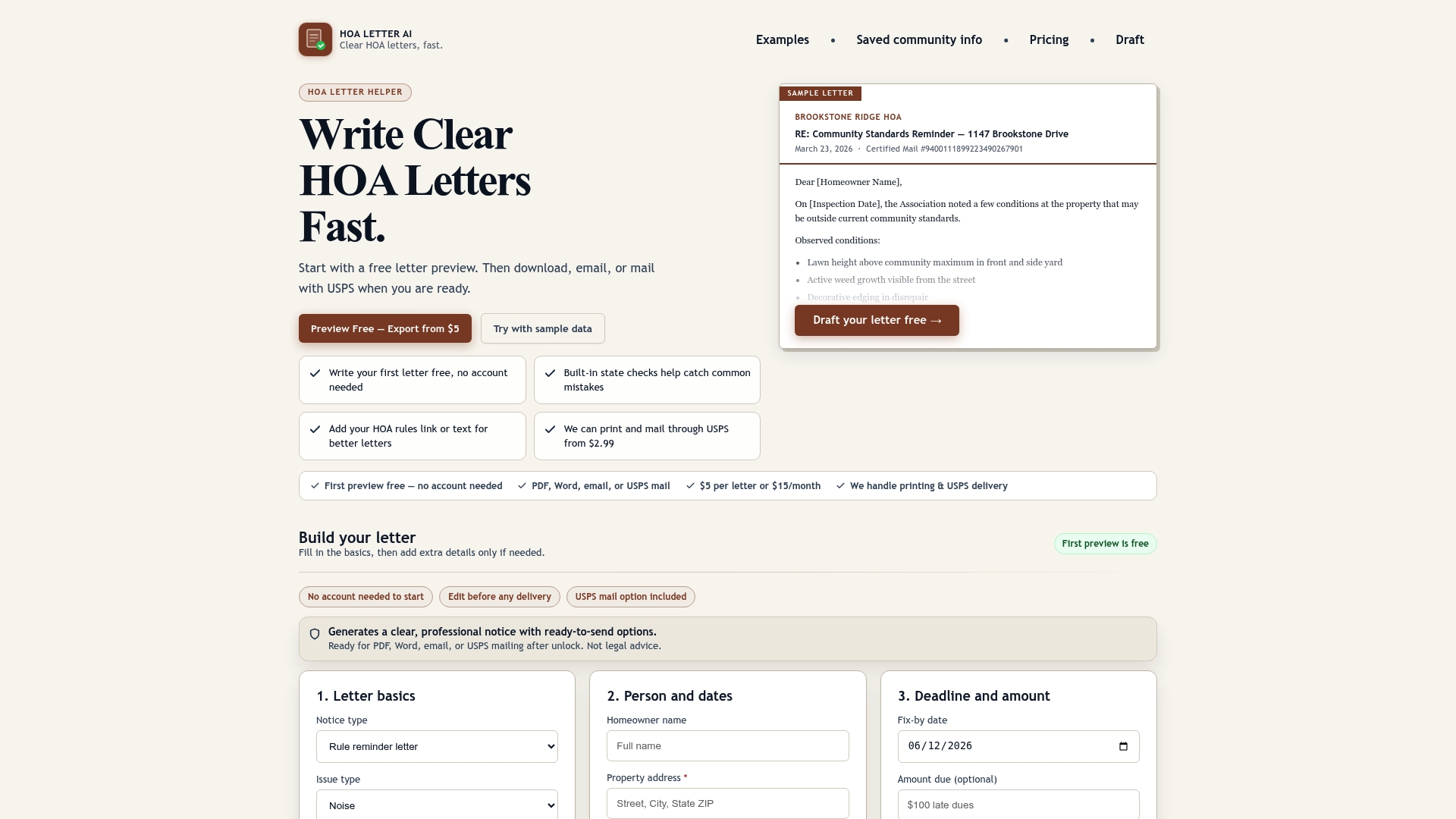
Boards and property managers can generate a single letter for $5, unlock a homeowner response letter for the same price, or run a self-serve board lane for $15 a month. Property management teams managing multiple communities can use PM Starter at $199 a month or PM Pro at $399 a month, both built around reusable community profiles at Hoaletterai. Add optional USPS mailing starting at $2.99 when you want delivery and proof handled without a trip to the post office.
Where to check the legal details

For state-specific notice and fine rules, use our state law hub and templates library. For insurance questions tied to property damage penalties, see this HO-6 condo insurance guide, and for fair housing concerns during enforcement, review this housing discrimination overview.
Sources
- Free HOA Violation Letter | The HOA Guide
- The HOA Violation Process: Notice, Hearing, and Fines
- Sample violation letter | St. Louis County (municipal sample)
- Writing a Friendly HOA Violation Letter (Template) | APM
FAQ
How should I respond to a HOA violation letter?
Read the cited rule and cure deadline carefully, then either fix the issue within the timeframe or request a hearing if you disagree with the notice. Keep a copy of your response and any photos supporting your position.
How do I write a complaint letter to my HOA about a neighbor?
Describe the specific rule you believe is being violated, include dates and factual observations rather than opinions, and ask the board to investigate. Avoid emotional language and let the board’s own inspection and documentation process take it from there.
Can I legally push back on my HOA if I disagree with a rule?
You can request records, attend board meetings, and formally contest a violation through your association’s hearing process. Governing documents and state statute define your specific rights, so review both before escalating.
Are HOA violations serious?
They can be, since unresolved violations may lead to fines, suspended privileges, or in rarer cases a lien on the property. The severity depends on the specific violation and what your CC&Rs authorize as a remedy.