
Send a concise, evidence-backed selective enforcement letter the moment your HOA enforces a rule against you but not against comparable neighbors. Its main value is creating a dated record that can halt unequal treatment or support later remedies. Before you send anything, gather basic proof of the comparable violations, then deliver the letter by certified mail or documented email so the record is provable.
TL;DR:
- Sending a documented, timely letter with specific comparable violations can prevent or overturn fines based on selective enforcement.
- Evidence should include a detailed timeline, photographs with timestamps, witness statements, and proof of past approvals or tolerances granted to others.
- The letter must cite governing rules precisely, include relevant exhibits, and request a clear remedy within 10 to 14 days, delivered via traceable methods.
- State statutes and community rules set strict notice requirements, making early action and good documentation crucial to preserving legal rights.
- Significant violations often arise when enforcement tracks protected classifications, which can elevate the dispute to federal Fair Housing Act claims.
HOA Letter AIDraft Clearer HOA Compliance LettersCreate professional compliance letters with guided drafting, state-specific context, community rules, built-in checks, and delivery options.Visit HOA Letter AI
Table of Contents
- What Counts as Selective Enforcement in an HOA?
- What the Law Says About Fines, Notice, and Discrimination
- Building the Evidence File Before You Write Anything
- Drafting the Letter: What to Include and How to Send It
- What Happens After You Send the Letter
- When to Bring in an Attorney
- The Risks of Sending a Selective Enforcement Letter
- What a Strong Outcome Actually Looks Like
- Negotiating With the Board After You’ve Sent the Letter
- How Selective Enforcement Rules Differ by State
- A Practical Take on What Actually Works
- Draft a Precise Letter Without Starting From a Blank Page
- FAQ
- Sources
What Counts as Selective Enforcement in an HOA?
Selective enforcement happens when a board applies a rule to you while ignoring the same violation next door, or grants exceptions to some residents while denying them to others. It generally falls into two patterns: targeting (one household gets cited repeatedly while others don’t) and preferential treatment (a board member or ally gets a pass).
Common, searchable examples include:
- Parking: one driveway gets a citation for an overnight trailer while three others on the same street do not.
- Landscaping: a homeowner is fined for an overgrown lawn while a board member’s yard, equally overgrown, draws no notice.
- Architectural approvals: identical fence or paint-color requests are approved for one owner and denied for another.
- Pet rules: breed or weight restrictions are enforced against new residents but not against longtime owners with the same dog.
- Yard sales: frequency limits are cited against one household while others run sales monthly without comment.
Not every inconsistency is unlawful. A board can legitimately treat a grandfathered structure differently from a new one, or respond to a complaint-driven case differently from one no neighbor ever flagged. The distinction that matters is whether the difference in treatment tracks a legitimate, rule-based reason or simply tracks who the person is.
What the Law Says About Fines, Notice, and Discrimination
Three legal layers typically govern an HOA dispute: the state statute, the community’s CC&Rs and bylaws, and, when protected-class treatment is suspected, federal fair housing law. Statute outranks the CC&Rs, and a board cannot enforce a private rule in a way that violates state notice requirements.
- State statutes often impose strict notice periods before a fine or hearing, and courts have held that boards must comply exactly, not just substantially, with those timelines.
- CC&Rs and bylaws define the specific rules and the board’s enforcement discretion, but they operate inside the boundaries the statute sets.
- When enforcement tracks a protected class, such as race, familial status, or disability, the dispute can escalate from a private contract issue into a federal civil rights matter.
One documented case shows how far strict compliance can go: an appellate court enforced a statutory notice requirement for HOA fine hearings and found that missing the notice window can void a fine or lien even when the underlying violation was real. Separately, a federal appellate opinion addressing selective enforcement and Fair Housing Act claims found that selective enforcement tied to discriminatory intent can plausibly support a claim under the Act in certain factual scenarios. That shift in forum changes both the available remedies and the board’s exposure.
Building the Evidence File Before You Write Anything
A persuasive letter rests on a file you build before you type a word. Attorneys who handle these disputes consistently say the comparables and the timeline, not the complaint itself, decide whether a board takes you seriously.
- Start a dated timeline listing every HOA notice, email, and board communication you’ve received, in chronological order.
- Photograph each comparable violation with a visible timestamp, then label the file with the address, date, and violation type.
- Capture any board exceptions, variance approvals, or meeting minutes that show the same conduct being permitted elsewhere.
- Collect witness statements from neighbors willing to confirm what they observed, even a short signed note helps.
- Convert everything to PDF and build a one-page exhibit index that lists each attachment by letter (Exhibit A, B, C) with a one-line description.
Store the finished packet as a single PDF with a clear filename convention, like LastName_SelectiveEnforcement_2026.pdf, so it’s easy to share with the board, a mediator, or an attorney later.
Pro Tip: When a board approves something verbally, confirm it by email the same day with wording like “This confirms our conversation on [date]: if this is inaccurate, please respond in writing.” That single habit, recommended by HOA attorneys, turns a disputable conversation into a dated exhibit.
Drafting the Letter: What to Include and How to Send It
The letter itself should read like a short legal memo, not a complaint. Open with the exact CC&R or bylaw provision at issue, then lay out the factual timeline in plain, dated sentences.
- Cite the specific rule by section number and quote the relevant language directly from the governing documents.
- Reference each exhibit by letter and summarize what it shows in one sentence, rather than describing it at length in the body.
- State the remedy you want: a correction, a written explanation of the inconsistency, or equal enforcement going forward.
- Set a specific deadline, typically 10 to 14 business days, for a written response.
- Avoid accusations, emotional language, or admissions that you violated the rule; stick to what the record shows.
Sending the letter through more than one traceable channel strengthens the record if the dispute escalates:
| Delivery method | What it proves | Best used for |
|---|---|---|
| Certified mail, return receipt | Date sent and date received, signed | Formal notice to the board |
| Email with read receipt | Timestamped delivery and open | Follow-up or routine correspondence |
| Hand delivery with signed acknowledgment | In-person receipt confirmed by a witness | Small communities with in-person boards |
A ready-to-adapt structure is available in our HOA violation response letter template, which walks through the same sections in order.
What Happens After You Send the Letter
Most communities offer at least one step short of a lawsuit, and using it on the record works in your favor even if it doesn’t resolve the dispute.
- Informal dispute resolution (IDR), available under some state frameworks such as California’s Davis-Stirling Act, gives the board a formal chance to respond and creates a paper trail that can later support a bad-faith argument(https://www.lscarlsonlaw.com/articles/selective-enforcement-hoa-attorney) if the board ignores it.
- A HUD or DOJ fair housing complaint becomes the right path when the inconsistent enforcement tracks a protected characteristic; the Department of Justice’s Fair Housing Act overview explains what conduct qualifies and how a federal complaint proceeds.
- Mediation or arbitration clauses in your CC&Rs may require a neutral session before litigation; these tend to produce a settlement or a written record rather than a binding ruling.
- Litigation becomes realistic when the board ignores the letter and the IDR step, and courts in these cases look for the same comparables and documented timeline you built for the letter itself.
When to Bring in an Attorney
A few signals mean it’s time to stop handling this alone: a lien or foreclosure threat, retaliatory citations after you raise the issue, or any pattern suggesting the enforcement tracks race, disability, familial status, or another protected characteristic.
- An attorney will review your exhibit file for gaps, specifically whether the comparables are strong enough and whether the timeline is airtight.
- Expect a demand letter, an administrative filing, or a lawsuit as the next formal step, depending on what the evidence supports.
- Costs vary by case complexity, but many housing and HOA attorneys offer an initial consultation to assess whether your file is strong enough to act on.
The Risks of Sending a Selective Enforcement Letter
Putting your complaint in writing is generally the right move, but it’s worth understanding what can happen next. A letter that names specific neighbors or board members by address can create friction in a small community, and some boards respond to formal pressure with increased scrutiny rather than correction.
A poorly worded letter can also backfire. If you admit to violating the rule while arguing the enforcement is unequal, that admission becomes part of the record the board can use against you later. This is why tone and precision matter more than volume: a letter that sticks to dates, exhibits, and the specific rule provision protects you far better than one that argues your case emotionally.
There’s also a timing risk. If your HOA operates under a jurisdiction with strict statutory notice periods for fines, sending your letter too late in the fine process, after a lien has already attached, narrows your options considerably. Sending it early, as soon as you’ve documented at least one solid comparable, preserves more paths forward.
Finally, if your letter raises a fair housing concern and the board’s attorney reviews it, expect the response to come through counsel rather than directly from the board. That’s a normal escalation, not a sign you’ve made a mistake. It simply means the dispute has moved to a more formal track, and your documentation becomes more valuable, not less.

What a Strong Outcome Actually Looks Like
Successful outcomes rarely look like a dramatic reversal. More often, a well-documented letter produces one of three results: the board quietly corrects the inconsistency without admitting fault, the board issues a written explanation that turns out to reveal a legitimate distinction you hadn’t considered, or the board offers an informal resolution during the IDR step rather than risk a longer dispute.
Court decisions examining selective enforcement claims consistently turn on the same factor: how well the homeowner’s comparables and documentation held up under scrutiny. A state appellate case discussing selective enforcement alongside related claims illustrates this pattern: outcomes hinge on factual comparables and the board’s stated rationale, not on how forcefully the complaint was worded. The homeowners who fare best are the ones whose exhibit files could stand on their own without additional explanation.
In communities governed by Florida law, selective enforcement can also function as an affirmative defense against a board’s own enforcement action, meaning a well-documented pattern of inconsistency can stop a fine or lien before it’s finalized, as Florida condo attorneys have explained in practice guidance on the defense’s elements.
Negotiating With the Board After You’ve Sent the Letter
Once the board responds, or fails to respond by your deadline, the negotiation phase starts. Keep the same tone you used in the letter: factual, specific, and unemotional.
If the board offers a partial fix, such as correcting your case but not addressing the comparable, ask in writing for the policy going forward, not just the one-time correction. A board that corrects your citation without changing its practice will likely repeat the pattern.
If the board disputes your comparables, ask for the specific written basis for distinguishing your case, since many boards cannot actually produce one. Silence or a vague answer here strengthens your position if the dispute escalates to IDR or mediation.
Avoid ultimatums in early negotiation rounds. A reasonable, documented request for equal treatment carries more weight with a neutral mediator or a judge than a letter that opens with the threat of a lawsuit.
How Selective Enforcement Rules Differ by State
The baseline concept, that a board can’t apply rules unevenly without a legitimate reason, holds across jurisdictions, but the procedural rules around it vary significantly. Some states impose strict statutory notice periods before a fine can be enforced, and courts in those states have shown little patience for boards that miss the deadline even by a few days. Other states leave notice procedures largely to the CC&Rs, which means the governing documents themselves become the controlling authority.

States also differ in whether they provide a formal informal dispute resolution process, like California’s Davis-Stirling framework, or leave mediation entirely optional. Because these differences affect which arguments and deadlines apply to your situation, checking your own state’s notice and fine rules before you finalize your letter is a necessary step, not an optional one. Our state-by-state notice and fine requirements page summarizes these variations, including the Pennsylvania-specific rules on our Pennsylvania HOA violation letters page.
A Practical Take on What Actually Works
Boards respond to calm, specific documentation far more consistently than to anger. The letters that get results read like a short brief: rule cited, dates listed, exhibits labeled, deadline stated. The ones that get ignored tend to lead with frustration and leave the comparables vague.
Housing discrimination research adds another layer worth knowing: inconsistent treatment sometimes tracks characteristics a board would never admit to considering, which is part of why documented bias in housing-related decisions remains a live concern in enforcement disputes, not just a theoretical one.
— Blake
Draft a Precise Letter Without Starting From a Blank Page
Our service helps turn a documented complaint into a letter that cites the right CC&R section, organizes exhibits, and matches state notice rules automatically.
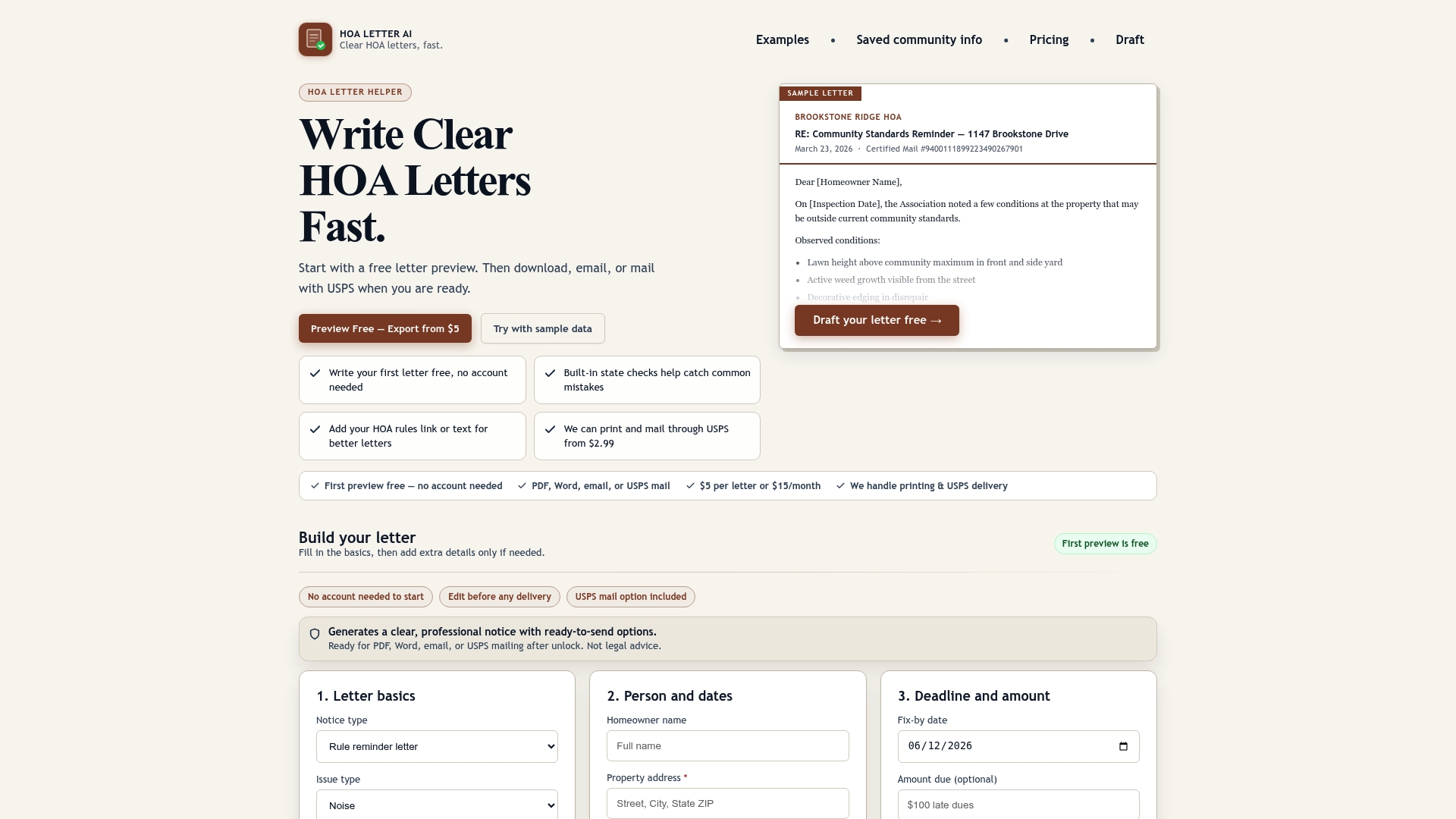
When you’ve gathered your comparables and timeline, our guided drafting flow produces a precise letter in minutes rather than hours, with an optional USPS certified-mail fulfillment add-on starting at $2.99 so your delivery record is as solid as your evidence file. A single letter unlock is $5 on our pricing page, with no account required to preview it first.
This article is general information, not a substitute for advice from a qualified lawyer. Consult a qualified legal professional about your own circumstances before acting on anything here.
FAQ
Is It Illegal to Ignore HOA Fines?
Ignoring an HOA fine is generally not a criminal matter, but unpaid fines can accrue, lead to a lien, and in some states escalate to foreclosure risk. Whether a specific fine is enforceable depends on whether the board followed its state’s statutory notice rules, and missed notice deadlines have voided fines in at least one documented appellate case.
How Do I Write an HOA Special Assessment Letter?
A special assessment letter should state the reason for the assessment, cite the governing document provision authorizing it, and include the amount, due date, and payment instructions in plain terms. Attach any supporting board resolution or vote record as a labeled exhibit so owners can verify the assessment was properly authorized.
What Is the Maximum Fine an HOA Can Charge in Florida?
Florida fine limits and notice procedures are set by state statute and vary by violation type and community structure, so the figure depends on the specific statute governing your association. Check our state notice and fine requirements page or consult the statute directly before assuming a flat cap applies to your case.
Can an HOA President Remove a Homeowner From the Community?
An HOA president cannot unilaterally evict or remove a homeowner; removal from a property generally requires a lien, foreclosure, or court process initiated through proper legal channels. A board president’s authority is limited to what the CC&Rs and state statute allow, and any action outside that scope can itself become evidence in a selective enforcement or improper-process claim.
What Should I Do if the HOA Ignores My Selective Enforcement Letter?
If the board doesn’t respond by your stated deadline, move to the next available step, such as requesting informal dispute resolution where your state or CC&Rs provide for it, or consulting an attorney to evaluate a formal complaint. Keep your original letter and delivery proof, since a documented non-response often strengthens your position in mediation or litigation.
Sources
- Navigating Selective Enforcement in HOAs: Essential Steps for Homeowners | LS Carlson Law
- United States Court of Appeals opinion (11th Circuit) relating to selective enforcement and FHA claims
- Fair Housing Act overview — U.S. Department of Justice Civil Rights Division
- Dwork v. Executive Estates (case summary) — strict notice requirement for HOA fines