The main HOA enforcement policy types are courtesy notices, formal written notices with cure periods, monetary fines, suspension of privileges, liens, and injunctive relief. The approach that holds up when a homeowner pushes back in court or arbitration is a written, graduated enforcement policy paired with a published fine schedule and consistent recordkeeping.
Boards that skip the graduated structure and jump straight to fines are the ones most likely to lose enforcement disputes. Florida’s Section 720.305 spells out notice and hearing requirements before certain fines or suspensions can stick, and similar due process rules exist in most states. Before adopting anything, boards should check:
- A published fine schedule with per-occurrence or per-day amounts and escalation rules
- A documented notice sequence: courtesy notice, formal notice, cure period, hearing
- Consistent recordkeeping that shows every homeowner was treated the same way
Key Takeaways
A defensible HOA enforcement policy combines a graduated notice-to-fine sequence, a formally adopted fine schedule, and documentation consistent enough to survive a selective-enforcement challenge.
| Point | Details |
|---|---|
| Use graduated tools | Start with courtesy notices, then formal notices with cure periods, before moving to fines, suspension, or liens. |
| Adopt a written fine schedule | Specify amounts, escalation tiers, and cure periods, then formally adopt and distribute it to every homeowner. |
| Follow the five-step sequence | Inspection, notice, cure period, hearing, and fine imposition preserve legal defensibility at each stage. |
| Document everything the same way | Record dates, inspectors, CC&R citations, photos, and delivery proof to avoid selective-enforcement claims. |
| Check state law before enforcing | Florida, California, and Texas each impose different notice and hearing requirements before fines take effect. |
Table of Contents
- What Are the Different Types of HOA Enforcement Policies?
- What Are the Steps in the HOA Enforcement Process?
- How Do You Create a Legally Defensible Fine Schedule?
- What Is Selective Enforcement and How Do You Avoid It?
- What Should an HOA Enforcement Policy Document Include?
- How Templates Reduce Costly Enforcement Mistakes
- Ready to Standardize Your Board’s Enforcement Letters?
- What the Research Actually Supports About Enforcement
- Frequently Asked Questions
- Sources
What Are the Different Types of HOA Enforcement Policies?
Not every violation calls for the same response, and treating a first-time landscaping lapse the same as a repeated safety violation is how boards end up defending themselves instead of managing their community. Each enforcement tool exists for a reason, and knowing when to use which one is most of the job.
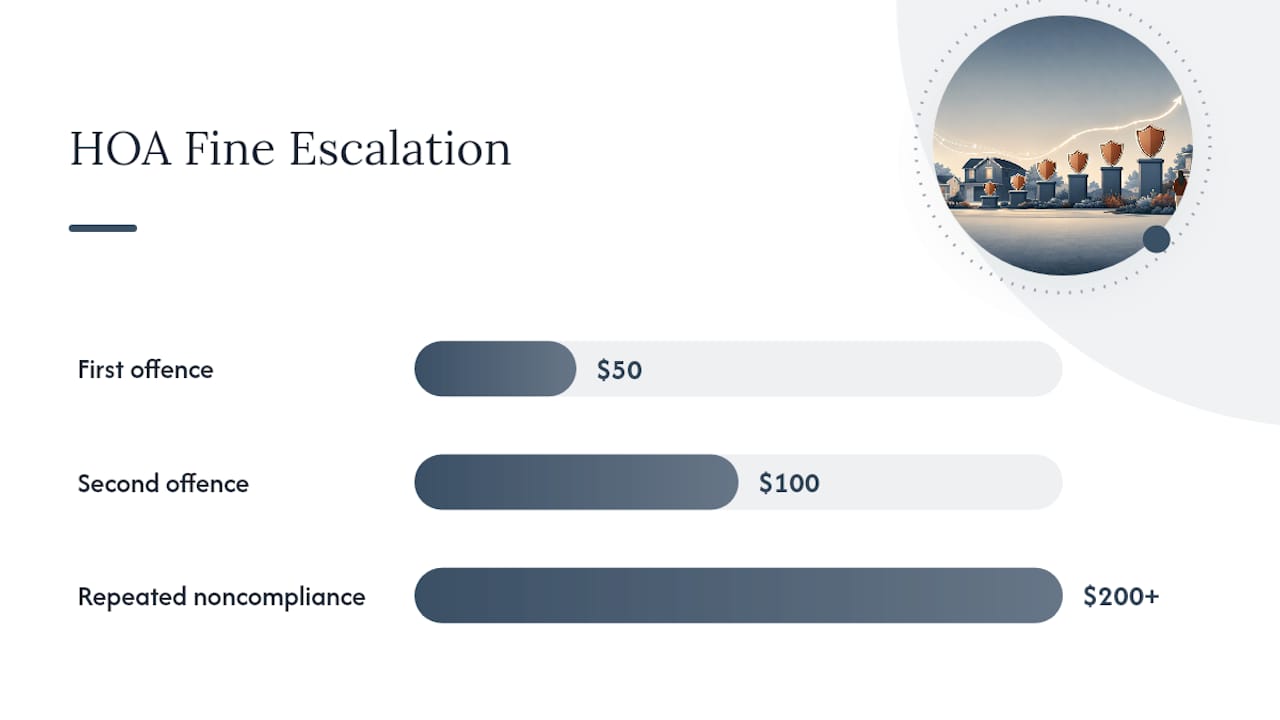
Monetary fines are the most common tool, typically structured per-occurrence (a flat fee each time a violation is observed) or per-day (accruing daily until the homeowner cures it). Most fine schedules escalate: $50 for a first offense, $100 for a second, $200 and up for repeated noncompliance within a set window. That escalation pattern gives homeowners a real incentive to fix the problem early rather than treat the fine as a cost of doing business.
Suspension of privileges pulls access to common-area amenities, pool passes, or clubhouse reservations. It cannot be used to cut off essential services like utilities or, in most states, access to a homeowner’s own unit. Suspension procedures generally require the same hearing rights as fines, so boards can’t treat this as a shortcut around due process.
Liens come into play when fines or assessments go unpaid long enough to become a collections matter. Whether unpaid fines themselves are lienable, as opposed to just unpaid assessments, varies by state and sometimes by the association’s own governing documents. This is one of the areas where boards most often assume their state’s rules mirror a neighboring state’s, and get it wrong.
Injunctive relief means going to court to force compliance, and it’s reserved for situations where administrative remedies have failed or the violation poses an ongoing risk, structural changes made without architectural approval, for example. Litigation is expensive and slow, so it belongs at the end of the enforcement chain, not the beginning.
Administrative tools, courtesy notices, voluntary compliance plans, and periodic inspections, do the quiet work of catching problems before they need any of the above.
Pro Tip: Build your fine schedule around the escalation pattern, not just the top-dollar amount. A board that fines $500 on the first offense looks punitive; one that starts at $50 and climbs looks reasonable, and reasonable schedules survive legal challenges more often.
What Are the Steps in the HOA Enforcement Process?
A documented, consistent five-step sequence protects the board more than any single tool in the enforcement kit. Skip a step, and you’ve handed a homeowner’s attorney their opening argument.
- Intake and verification. Record who observed the violation (a board member, manager, or resident complaint), the date, and specific facts. Photos matter more than descriptions, because “the fence looks bad” won’t hold up but a timestamped image will.
- Courtesy notice. This is the first, informal touch. Give homeowners 14 to 30 days to fix the issue before anything formal happens. Courtesy notices resolve roughly 80% of first-time violations, which tells you most people aren’t defiant, they’re unaware.
- Follow-up inspection and formal notice. If the courtesy notice gets no response, re-inspect and issue a formal notice citing the specific rule violated, the required corrective action, a firm cure deadline, and the consequences of noncompliance.
- Hearing. Most states require an opportunity for the homeowner to be heard before a fine is finalized. Document who attended, what was presented, and the board’s decision in the minutes.
- Fine imposition and escalation. If the violation persists after the hearing, apply the fine per the published schedule and track the account. Unresolved balances escalate toward collections or, where state law allows, a lien.
A few habits separate boards that survive challenges from boards that don’t:
- Never fine without first sending a notice and offering a cure period, even for repeat offenders
- Track every notice’s delivery method and date, not just its content
- Keep a running ledger per property so escalation decisions are based on documented history, not memory
The HOA Rule Enforcement Checklist for Board Members walks through this sequence in more detail if your board is building a process from scratch.
How Do You Create a Legally Defensible Fine Schedule?
A fine schedule only protects the board if it’s actually enforceable, and that means more than picking dollar amounts that feel fair. It has to specify the violation category, the amount per occurrence or per day, the cure period, and the escalation path, and it has to be formally adopted and distributed to every homeowner, not just posted on a bulletin board.
Amounts should scale with severity and repetition. A trash-can-left-out violation shouldn’t carry the same fine as an unapproved structural addition. Most boards use a tiered structure: a modest fine for a first offense, roughly double for a second within a set period, and a cap that prevents fines from becoming punitive rather than corrective.
State law shapes what’s actually enforceable, and the differences catch boards off guard more often than any other part of the process. Florida’s Section 720.305 caps certain fines and requires a hearing before they take effect. California’s Davis-Stirling Act imposes its own notice and hearing sequence. Texas Property Code Sections 209.006 and 209.0062 set specific notice-and-cure requirements that differ from both. Assuming your state’s rules match what you read in a national blog post is how fine schedules get thrown out.
Adopting a schedule and distributing it annually matters because it removes a homeowner’s ability to credibly claim ignorance when a fine shows up. Before you rely on any fine schedule, run it through this checklist:
- Was the schedule formally adopted by board resolution or vote, per your governing documents?
- Was it distributed to every homeowner, not just posted?
- Does every fine tier come with a stated cure period and hearing right?
- Have you confirmed your state’s specific notice and hearing requirements apply to this schedule?
Boards that want the specifics on how a fine schedule should read can check the HOA Fine Schedule for Homeowners guide for a breakdown of common structures.
What Is Selective Enforcement and How Do You Avoid It?
Selective enforcement happens when a board fines one homeowner for a violation it routinely lets others slide on, and it’s one of the most common defenses raised against HOA fines. Waiver doctrine works alongside it: if a board hasn’t enforced a rule consistently for years, a court may decide the association waived its right to enforce it at all. Both defenses can void a fine entirely, regardless of how clear the violation was.
The fix is boring but effective: document everything, every time, the same way. Each violation record should include the date of observation, the inspector’s name, a factual description, the specific CC&R or bylaw citation, a photo, and proof of delivery for any notice sent.

Retention matters as much as capture. Keep records for several years, since disputes and legal challenges often surface long after the original violation. When a hearing comes up, assembling a complete evidentiary packet, notices, photos, delivery confirmations, and prior correspondence, turns a subjective complaint into a defensible case file.
Boards should also document remedial agreements, payment plans, and accommodation requests in the same system. An informal handshake deal that isn’t written down looks exactly like inconsistent enforcement to an outside observer, even when the board’s intentions were reasonable.
Pro Tip: If two homeowners commit the same violation and only one gets fined, write down why. “First offense, no prior notices on file” is a defensible reason. Silence is not.
What Should an HOA Enforcement Policy Document Include?
A written enforcement policy needs to do more than list fine amounts. It should tie directly back to your CC&Rs and bylaws, stating clearly where the board’s enforcement authority comes from and which categories of rules it applies to.
- Scope and authority. Reference the specific governing document sections that grant enforcement power.
- Violation categories with examples. Landscaping, architectural changes, parking, noise, pets, and short-term rentals each need their own trigger definitions, since a “noise violation” means something different at 2 p.m. than at 2 a.m.
- Required notice language. Every notice needs the rule citation, a factual description of the violation, the corrective steps required, a specific cure deadline, hearing rights, and contact information for questions.
- Escalation timelines and triggers. Spell out exactly how many unresolved notices lead to a fine, and how many unpaid fines lead to collections or a lien.
- Distribution and acknowledgment. Note how the policy itself, and each individual notice, gets delivered and documented.
The HOA Violation Notice Checklist for Board Members covers the exact notice fields in more depth if you’re drafting from a blank template.
How Templates Reduce Costly Enforcement Mistakes
Most enforcement failures aren’t legal disputes over whether a violation occurred. They’re procedural: a missing cure deadline, a notice that skipped the required hearing-rights language, no proof the letter was ever delivered. State-aware templates catch these gaps before they become a homeowner’s defense, since auto-inserted CC&R citations and required statutory language remove the guesswork from drafting.
HOA Letter AI builds this into its drafting process with a one-page preview and USPS mailing integration, so boards get a documented delivery trail alongside the letter itself. That combination, correct language plus proof of service, is what most enforcement disputes actually turn on.
Templates work well for routine notices: courtesy letters, formal cure notices, standard fine notifications. Consult legal counsel when a case is likely to set precedent, involves a disability accommodation request, or heads toward litigation. For everything in between, a state-aware template beats drafting from scratch:
- Courtesy notices for first-time violations
- Formal notices with cure periods and hearing rights
- Fine notifications tied to an adopted schedule
Boards ready to standardize their process can start with the HOA Warning Letter Template for the first-notice stage.
Ready to Standardize Your Board’s Enforcement Letters?
Every enforcement dispute this article covers traces back to the same weak point: notices that were vague, undocumented, or missing required language. HOA Letter AI’s violation letter generator lets you preview a state-aware notice for free before you commit to sending it, with the citation and cure-period language built in automatically.
Property managers handling multiple communities can set up reusable profiles under the property manager plan, while individual boards can generate a single letter without a subscription. If you’re not sure which notice requirements apply where your community sits, the HOA Violation Letter Laws by State reference breaks down notice and fine rules by jurisdiction before you draft anything.
What the Research Actually Supports About Enforcement
The conventional advice on HOA enforcement treats fines as the centerpiece and legal compliance as an afterthought. That’s backwards. The boards that win disputes aren’t the ones with the toughest fine schedule, they’re the ones with the most boring paperwork: a photo, a date, a delivery confirmation, and a notice that used the same language for every homeowner who committed the same violation.
What gets underestimated is how much a courtesy notice actually does. Boards skip it because it feels like a wasted step before the “real” enforcement begins, but it resolves most first-time issues and builds the documented history that protects you later if the same homeowner reoffends.
If you take one thing from this article, prioritize consistency over severity. A $50 fine applied the same way every time beats a $500 fine applied selectively, because the second one is the fine that gets thrown out.
Frequently Asked Questions
What are the most common types of HOA enforcement policies? The main types are courtesy notices, formal written notices with cure periods, monetary fines, suspension of privileges, liens, and injunctive relief. Most boards use them in that order, starting with the least severe option.
Can an HOA fine a homeowner without a hearing? In most states, no. State-law constraints like Florida’s Section 720.305 require notice and an opportunity for a hearing before certain fines take effect, and boards that skip this step risk having the fine invalidated.
How much can an HOA fine a homeowner? Fine amounts depend on the association’s adopted fine schedule and state law, which sometimes caps amounts or requires proportionality. There’s no universal figure, since fine caps and escalation rules vary by state and by the association’s own governing documents.
What is selective enforcement in an HOA? Selective enforcement happens when a board fines one homeowner for a violation it routinely overlooks in others. It’s one of the most successful legal defenses against HOA fines, which is why consistent documentation matters as much as the fine itself.
How long should an HOA keep enforcement records? Boards should retain violation records, notices, and delivery confirmations for several years, since enforcement disputes often surface long after the original incident. A complete evidentiary packet with dates, photos, and citations strengthens the board’s position at any later hearing.
Sources
- Florida Senate — Statutes (2025) Section 720.305
- HOA Fine Policy Guide — Fine schedule, process & enforcement | Hivepoint
- HOA Violation Tracking: How to Run a Fair, Consistent Enforcement Process | AffordableHOA