
HOA covenant enforcement is the association’s legally bounded process for requiring homeowners to follow the community’s recorded covenants, conditions, and restrictions (CC&Rs) and any board-adopted rules. Authority flows from two sources: the Declaration/CC&Rs recorded with the county and applicable state statutes. For enforcement to hold up legally, three things must be true: the rule must appear in the governing documents or be authorized by statute, the board must apply it consistently across all homeowners, and the association must follow a documented notice and hearing process before imposing penalties.
The typical escalation path looks like this:
- Written notice identifying the violation and citing the specific CC&R section
- Cure period giving the homeowner a deadline to correct the issue
- Hearing if the homeowner contests or fails to cure
- Fines imposed per the board’s adopted fine schedule
- Lien placed on the property for unpaid assessments or fines (where authorized)
- Litigation or injunctive relief as a last resort
Covenant enforcement follows this escalation structure in virtually every U.S. community association, though the specific timelines and fine caps vary by state.
Table of Contents
- What are HOA covenants, CC&Rs, and governing documents?
- When can an HOA legally enforce a covenant?
- What enforcement tools does an HOA have?
- How does the enforcement process actually work, step by step?
- What are the board’s duties, and what defenses can homeowners raise?
- What violations do HOAs most commonly enforce?
- What can homeowners do when cited or when the HOA won’t enforce?
- What should a defensible enforcement file contain?
- Key Takeaways
- Why documentation is the real enforcement strategy
- Useful sources and further reading
What are HOA covenants, CC&Rs, and governing documents?
Before getting into enforcement mechanics, the vocabulary matters. These terms get used interchangeably, but they are not the same thing.
Covenant / restrictive covenant: A legally binding promise attached to a parcel of land. The key phrase is “runs with the land,” meaning it binds not just the person who signed it but every future owner of that property. When you buy into an HOA community, you accept the covenants whether or not you negotiated them.
Declaration / CC&Rs: The Declaration of Covenants, Conditions, and Restrictions is the foundational governing document, recorded in the county land records. It sets out the major restrictions (architectural standards, use limitations, assessment obligations) and is the hardest document to amend, typically requiring a supermajority vote of all homeowners. HOA enforcement power is contractual and statutory; the Declaration is the contract, and state law is the statute.
Bylaws: Govern how the association itself operates: board elections, meeting procedures, quorum requirements. Bylaws do not usually contain property-use restrictions.
Rules and regulations: Board-adopted policies that fill in operational details the CC&Rs left open (pool hours, move-in procedures, trash bin placement). The board can typically adopt or amend rules by a board vote alone, without a homeowner vote, which makes them faster to change but also easier to challenge if they conflict with the CC&Rs.
The hierarchy of authority is straightforward: federal and state law sits at the top, followed by the recorded Declaration/CC&Rs, then the bylaws, then board-adopted rules. A board rule that contradicts the CC&Rs is unenforceable. A CC&R provision that violates state or federal law is equally void.
Pro Tip: When a board wants to restrict something not addressed in the CC&Rs, adopting a rule is faster than amending the Declaration. But if the CC&Rs are silent on a topic, a board rule covering it can still be challenged as exceeding board authority. Check your state’s HOA statute and the Declaration’s rule-making grant before adopting new restrictions.
When can an HOA legally enforce a covenant?
The short answer: a covenant is enforceable when it is authorized by the governing documents, not preempted by higher law, and applied through proper procedure. Courts in the U.S. generally uphold properly adopted, consistently enforced HOA rules, treating them as private contractual obligations that buyers accepted at closing.
Several categories of limits can make a covenant unenforceable:
- Conflict with state or federal law — A covenant requiring something illegal, or prohibiting something a statute protects, fails automatically. The Fair Housing Act voids restrictions based on race, religion, national origin, sex, disability, or familial status, regardless of when they were recorded.
- Federal OTARD protections. The FCC’s Over-the-Air Reception Devices rule restricts an HOA’s ability to ban certain satellite dishes and antennas, making blanket antenna prohibitions unenforceable in most cases.
Beyond those categorical limits, three equitable defenses can block enforcement even of a valid rule:
Laches: The equitable doctrine of laches can bar an enforcement action when an association unreasonably delays asserting its rights and the homeowner relies on that inaction. An HOA that ignores a fence violation for eight years and then suddenly demands removal faces a real laches argument.
Waiver / estoppel: If the board has consistently allowed a practice, it may have waived the right to enforce the rule against it. Estoppel prevents the board from taking a position that contradicts its prior conduct when a homeowner relied on that conduct.
Selective enforcement: Enforcing a rule against one homeowner while ignoring identical violations by others is the most common legal challenge boards face. Courts take it seriously.
What enforcement tools does an HOA have?
HOAs have several tools available, and the right one depends on the severity of the violation, the homeowner’s response, and what the governing documents authorize. HOAs may enforce rules and, in extreme cases, pursue liens or foreclosure where authorized, but every step must comply with state and federal law.

| Enforcement Tool | When Typically Used | Key Legal Preconditions |
|---|---|---|
| Written notice / warning | First response to any violation | Must cite specific CC&R or rule section; state law often sets minimum notice content |
| Fines | After cure period expires uncured | Fine schedule must be adopted and published; many states cap fine amounts or require hearings first |
| Suspension of privileges | Ongoing or repeated violations | CC&Rs or bylaws must authorize suspension; cannot suspend voting rights in most states |
| Lien on property | Unpaid fines or assessments | Lien authority must be explicit in CC&Rs; statutory procedure (notice, recording) must be followed |
| Injunctive relief / lawsuit | Violations that fines cannot remedy (e.g., illegal structure) | Requires board authorization; outside counsel typically needed |
| Foreclosure | Unpaid assessment liens, rarely fines alone | Highly state-regulated; many states require judicial process or minimum debt thresholds |
State statutes can set procedural requirements and fine limits; California, for example, has capped certain fines and restricted late fees through recent legislative changes. Before imposing any penalty, boards should confirm their state’s current rules, since what was permissible two years ago may now require additional steps.
Pro Tip: Involve outside HOA counsel before placing a lien or filing suit. Administrative remedies (notices, fines, hearings) are well within a board’s self-managed capability, but lien recording errors or procedural missteps in litigation can expose the association to attorney’s fees and damages. The cost of a brief legal review is almost always less than the cost of a procedural defect.
How does the enforcement process actually work, step by step?
Covenant enforcement follows a structured process: notice, cure period, hearing if contested, fines, and escalation to liens or litigation if the violation persists. Here is what that looks like in practice.
1. Detection and documentation A board member, property manager, or resident reports a potential violation. The inspector (or manager) photographs the issue, notes the date, time, and exact location, and identifies the specific CC&R or rule section at issue. No enforcement action is defensible without this baseline record.
2. First written notice The association sends a written notice to the homeowner identifying the violation, citing the exact governing document section, and setting a cure deadline. Most state statutes require this notice be sent by first-class mail; some require certified mail for fines. The notice must be sent to the address on record.
3. Cure period The homeowner gets a reasonable time to correct the violation. Typical cure periods run for a reasonable time for most violations, though some states set minimums by statute. During this window, the board should not impose fines.
4. Re-inspection After the cure deadline, the board or manager re-inspects. If the violation is corrected, the file closes. If it persists, the association moves to the next step.
5. Hearing notice and hearing Before imposing fines in most states, the board must offer the homeowner a hearing before the board or a hearing panel. The hearing notice typically must be sent within a reasonable advance period prior to the hearing. At the hearing, the homeowner can present their side; the board considers the evidence and issues a written decision.
6. Fine imposition If the violation is upheld, fines begin accruing per the adopted fine schedule. Many associations use a per-day or per-occurrence structure. The board must have published the fine schedule before the violation occurred.
7. Lien (if fines go unpaid) Unpaid fines that meet the threshold in the CC&Rs or state statute can be converted to a lien on the property. The association must record the lien with the county and send the homeowner notice. Lien recording is a public record and affects the homeowner’s ability to sell or refinance.
8. Litigation or injunctive relief For violations that money cannot fix (an unpermitted addition, a prohibited business operation), the association may seek a court injunction requiring removal or cessation. This step requires board authorization and legal counsel.
| Stage | Typical Timing | Key Documentation |
|---|---|---|
| First notice sent | Day 1 | Inspection notes, photos, notice copy, delivery proof |
| Cure period | — | Calendar entry, re-inspection date set |
| Hearing notice sent | After cure expires | Certified mail receipt, hearing date confirmed |
| Hearing held | a reasonable cure period after notice | Minutes, homeowner’s response, board decision |
| Fines begin | Per board resolution | Fine schedule, written decision |
| Lien recorded | After unpaid threshold met | Lien document, county recording receipt |
One timing risk boards often underestimate: waiting too long to act. Most states have a statute of limitations on contract claims, and unreasonable delay can trigger a laches defense. If a violation has been visible for years without action, get legal advice before sending a notice, because the homeowner’s first response may be that the association waived its right to enforce.
What are the board’s duties, and what defenses can homeowners raise?
Boards have a duty to enforce rules consistently; inconsistent or arbitrary enforcement weakens authority and creates legal liability. That duty has two sides: the board must enforce, and it must enforce fairly.
Board duties in enforcement
The board’s fiduciary duty requires it to act in the community’s best interest, follow the procedures in the governing documents, and treat homeowners evenhandedly. Skipping the hearing step, applying fines before the cure period expires, or targeting one homeowner while ignoring identical violations by neighbors are all procedural failures that can void an enforcement action.
The Business Judgment Rule
Courts generally defer to board decisions under the Business Judgment Rule, which protects reasonable, good-faith decisions made within the board’s authority. The rule is not a blank check. It does not protect arbitrary, discriminatory, or self-interested decisions. A board that can show it followed its governing documents, obtained relevant information, and acted in the community’s interest will usually survive a legal challenge. A board that cannot show any of those things will not.
Common homeowner defenses
- Conflict with higher law: — The rule violates the Fair Housing Act, state solar access law, the FCC’s OTARD rule, or another superior authority.
Pro Tip: Boards should conduct periodic community-wide inspections rather than responding only to neighbor complaints. Complaint-driven enforcement is the fastest path to a selective enforcement claim. A documented, scheduled inspection program shows the board is applying the rules uniformly, not targeting individuals.
What violations do HOAs most commonly enforce?
Most enforcement activity clusters around a handful of recurring violation types. Here is what boards typically see and how enforcement usually starts.
- Pet violations — Unleashed dogs, waste not cleaned up, prohibited breeds or weight limits. Boards must be careful here: the Fair Housing Act requires reasonable accommodations for assistance animals, regardless of the pet restrictions in the CC&Rs.
- Short-term rental violations — As platforms like Airbnb expanded, many associations added rental restrictions. Enforcement often involves verifying rental activity through listing sites and sending notice. State law in some jurisdictions limits an HOA’s ability to ban short-term rentals retroactively.
- Satellite dishes and antennas — A homeowner who installs a dish covered by the FCC’s OTARD rule has federal protection. The HOA can regulate placement for safety or aesthetics within limits, but cannot ban the dish outright.
One scenario that trips up boards: a homeowner requests a disability-related accommodation (a ramp, a grab bar, a service animal) that technically violates a covenant. The Fair Housing Act requires the association to engage in an interactive process and grant reasonable accommodations. Enforcing the covenant without that analysis is a federal fair housing violation.
What can homeowners do when cited or when the HOA won’t enforce?
Getting a violation notice is not the end of the road. Homeowners have real procedural rights, and boards that skip steps are vulnerable.
When you receive a notice
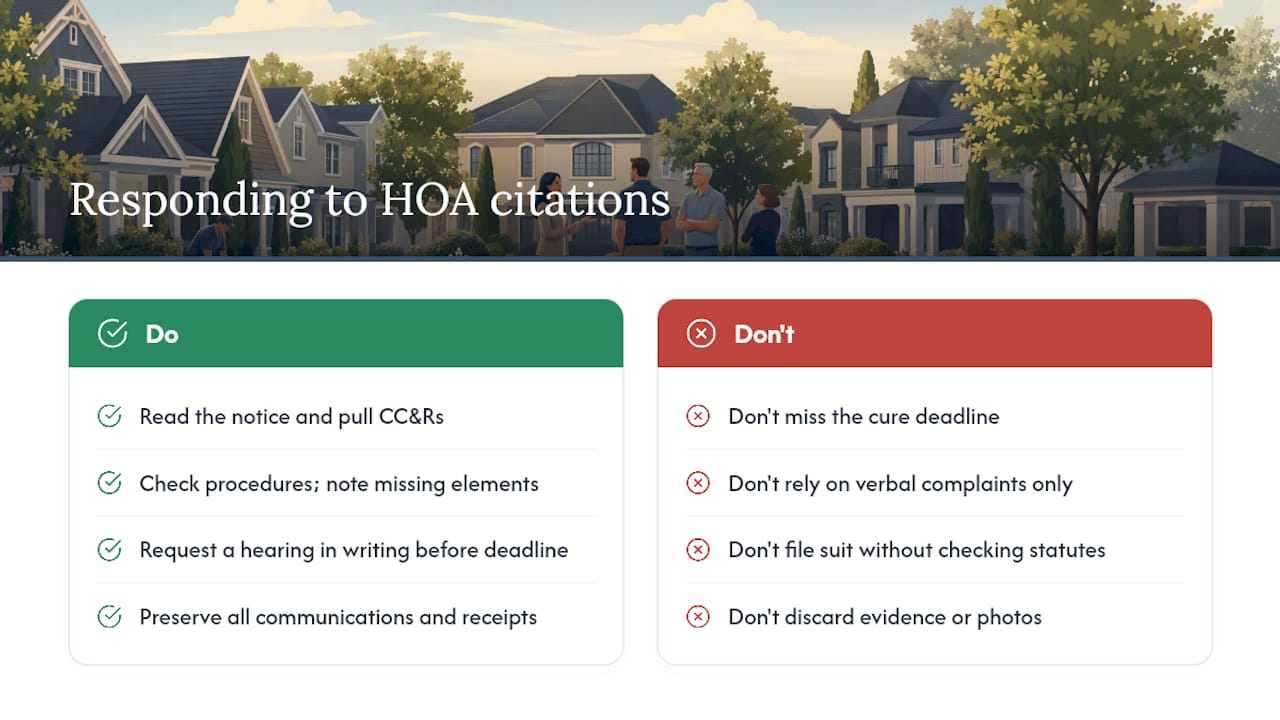
Read the notice carefully and pull out your CC&Rs. Confirm that the cited rule actually exists in the governing documents and that the notice cites the correct section. Check whether the board followed its own procedures: was the notice sent to the right address, does it include a cure deadline, does it reference the fine schedule? If any of those elements are missing, note them in writing.
If you believe the violation finding is wrong, request a hearing in writing before the cure deadline. Most state statutes and governing documents give you that right. At the hearing, present your evidence calmly: photos, dates, prior board communications, any approval you received. Get the board’s written decision after the hearing.
If the HOA refuses to enforce against a neighbor
Document your requests. Send written complaints to the board citing the specific CC&R section and the neighbor’s violation. If the board ignores repeated written requests, you have grounds to demand enforcement through mediation or, in some states, through a direct legal action. Some state HOA statutes give individual homeowners standing to sue for enforcement of the CC&Rs when the board refuses to act.
Alternative dispute resolution
Many state HOA statutes require or encourage mediation before litigation. Mediation is faster and cheaper than a lawsuit, typically running a few hundred to a few thousand dollars depending on the mediator and the complexity of the dispute. Some CC&Rs require binding arbitration. Check your governing documents and your state’s HOA statute before filing suit.
Pro Tip: Preserve every communication: emails, certified mail receipts, photos, text messages, and meeting minutes. If a dispute escalates to mediation or litigation, the homeowner or board with the cleaner paper trail almost always has the stronger position. Date-stamp your photos and keep copies off-site.
What should a defensible enforcement file contain?
A notice that gets challenged in court or at a hearing will be judged on what the board can prove, not what it remembers. Consistent enforcement and written documentation are the primary defenses against selective enforcement and waiver claims. Here is what every enforcement file should contain.
Documentation checklist for each violation:
- Inspection date, inspector’s name, and property address
- Photographs with date and time stamps
- Specific CC&R or rule section violated (quoted, not paraphrased)
- Copy of the notice sent, including the cure deadline stated
- Proof of delivery (certified mail green card, first-class mail log, or electronic delivery confirmation)
- Re-inspection notes after the cure deadline
- Hearing notice sent to the homeowner (if applicable), with delivery proof
- Signed hearing minutes recording the homeowner’s response and the board’s decision
- Copy of the fine schedule in effect at the time of the violation
- Any correspondence from the homeowner (responses, requests, appeals)
- Lien document and county recording receipt (if escalated)
What a defensible notice must include:
A violation notice should state the homeowner’s name and property address, the date of the inspection, the exact CC&R or rule section at issue (e.g., “Section 4.3 of the Declaration”), a plain-language description of the violation, the cure deadline, the fine that will apply if uncured, and the homeowner’s right to request a hearing. Vague notices (“your property is not in compliance”) invite challenges and rarely survive a hearing.
HOA Letter AI generates state-aware violation letters that cite the relevant CC&R section, include the required statutory language for your state, and produce a one-page preview before you send. The violation notice checklist and step-by-step enforcement letter guide are practical starting points for boards building a repeatable process.
For record retention, keep enforcement files for at least as long as your state’s statute of limitations on contract claims (commonly three to six years, though some states are longer). Mailed notices should be retained with their delivery confirmation. Digital copies stored in a cloud system with access logs are preferable to paper-only files.
Key Takeaways
HOA covenant enforcement is only as strong as the documentation behind it: authority must come from the CC&Rs or state law, application must be consistent, and every step from first notice to lien must be recorded in writing.
| Point | Details |
|---|---|
| Authority comes from CC&Rs and state law | A rule not grounded in the Declaration or statute cannot be enforced, regardless of board intent. |
| Consistent enforcement is a legal obligation | Selective enforcement is the most common defense homeowners raise and the most preventable board mistake. |
| Documentation protects both sides | Every inspection, notice, hearing, and decision must be in writing with delivery proof. |
| Homeowners have real procedural rights | The right to a hearing, to cure, and to challenge improper adoption or selective enforcement are legally protected. |
| State law shapes every step | Fine caps, notice timelines, lien procedures, and ADR requirements vary by state; check your state’s HOA statute before acting. |
Why documentation is the real enforcement strategy
Most HOA enforcement disputes are not really about the fence or the paint color. They are about whether the board followed its own rules. Boards that lose in mediation or court almost always lose on process, not on the substance of the violation.
The selective enforcement defense is powerful precisely because it is easy to raise and hard to disprove without records. A board that inspects only when neighbors complain, sends notices inconsistently, and keeps no written file cannot demonstrate that it treated everyone the same. A board with a documented inspection schedule, a published fine schedule, and a complete notice file can.
The Business Judgment Rule gives boards real protection, but it requires a process to protect. Boards that skip hearings, impose fines before cure periods expire, or send notices that omit required elements are not exercising business judgment. They are creating liability.
One thing I see consistently overlooked: the homeowner side of documentation. Homeowners who receive a notice and do nothing, or who respond only verbally, lose the paper trail that would support a selective enforcement or waiver defense. Responding in writing, requesting hearings in writing, and keeping copies of everything is not paranoia. It is the minimum a homeowner needs to protect their rights if the dispute escalates.
The practical fix for boards is straightforward: standardize the process. Use a written inspection log, a consistent notice template that cites the CC&R section and states the cure deadline, and a hearing minutes form. HOA Letter AI exists precisely to make that standardization accessible without a law degree. State-aware templates that include mandatory language, a notice-completeness checker, and USPS mailing integration remove the most common procedural errors before the notice goes out.
Useful sources and further reading
| Resource | What it covers |
|---|---|
| HOA Violation Letter Laws by State | State-by-state notice timelines, fine caps, and required notice language for U.S. HOAs |
| Covenant Enforcement in Common Interest Communities | Practical legal overview of enforcement authority, documentation duties, and selective enforcement defenses |
| HOA Rules Enforcement — HOA Start | Plain-language explanation of board enforcement powers and contractual authority |
| FCC OTARD Rule | Federal rule limiting HOA bans on satellite dishes and over-the-air antennas |
| Laches — Cornell Law School | Definition and application of the laches equitable defense in enforcement disputes |
| NAR: Navigating HOA Rules | Overview of HOA authority, lien and foreclosure risk, and Fair Housing Act compliance |
| HOA Rules and Regulations Guide — ManageCasa | State-specific procedural requirements, fine limits, and recent statutory changes |
| HOA Covenant Enforcement Guide — HOAPPM | Board duties, consistency obligations, and practical enforcement management |
| HOA Warning Letter Template | Ready-to-use courtesy notice template with state-aware language for boards and managers |
This article is general information, not legal advice. HOA laws vary significantly by state, and governing documents differ by community. Confirm current rules with your state’s HOA statute or a qualified HOA attorney before taking enforcement action.