
A formal written communication policy is the HOA’s official rulebook for every notice, violation letter, and template your board sends — defining who can write them, what they must contain, how they get delivered, and how long you keep them. Get it right and you have consistency, legal defensibility, and an audit trail. Skip it and every enforcement letter becomes a liability.
Three standards shape best-practice HOA correspondence:
- OABC structure (Opening, Agenda, Body, Closing) for clear, scannable letters
- NARA letter-format guidance for heading, salutation, and signature requirements
- EPA correspondence principles for concision, responsiveness, and cautious date references
Table of Contents
- Why does an HOA need a formal written communication policy?
- What must every HOA communication policy include?
- How does the OABC letter structure work for HOA notices?
- What US legal requirements apply to HOA enforcement letters?
- How do you adopt and enforce a communication policy?
- Practical templates and a notice-completeness checklist
- What timelines and costs should boards plan for?
- Key Takeaways
- What consistent policy enforcement actually changes
- HOA Letter AI cuts drafting time and enforces your policy automatically
- Authoritative sources and next steps
Why does an HOA need a formal written communication policy?
Boards that operate without written communication rules tend to discover the problem the hard way: a homeowner appeals a fine because the notice cited the wrong CC&R section, or a lien gets challenged because no one can prove the letter was delivered. A formal communication policy closes those gaps before they become legal disputes.
Pro Tip: When tone matters most — a final notice before lien, for example — keep the action and deadline front and center. Homeowners comply faster when they know exactly what to do and by when.
The practical stakes:
- Homeowner confusion drops when every letter follows the same structure and cites the same rule sections
- Appeal risk falls because a policy-compliant letter is harder to challenge on procedural grounds
- Auditability improves because the policy mandates delivery proof and retention schedules
- Recordkeeping becomes routine rather than reactive, which matters if a dispute reaches a hearing or court
Tone calibration matters too. Overly formal language can read as cold and invite pushback; too casual and the letter loses authority. The policy sets the middle ground.
What must every HOA communication policy include?
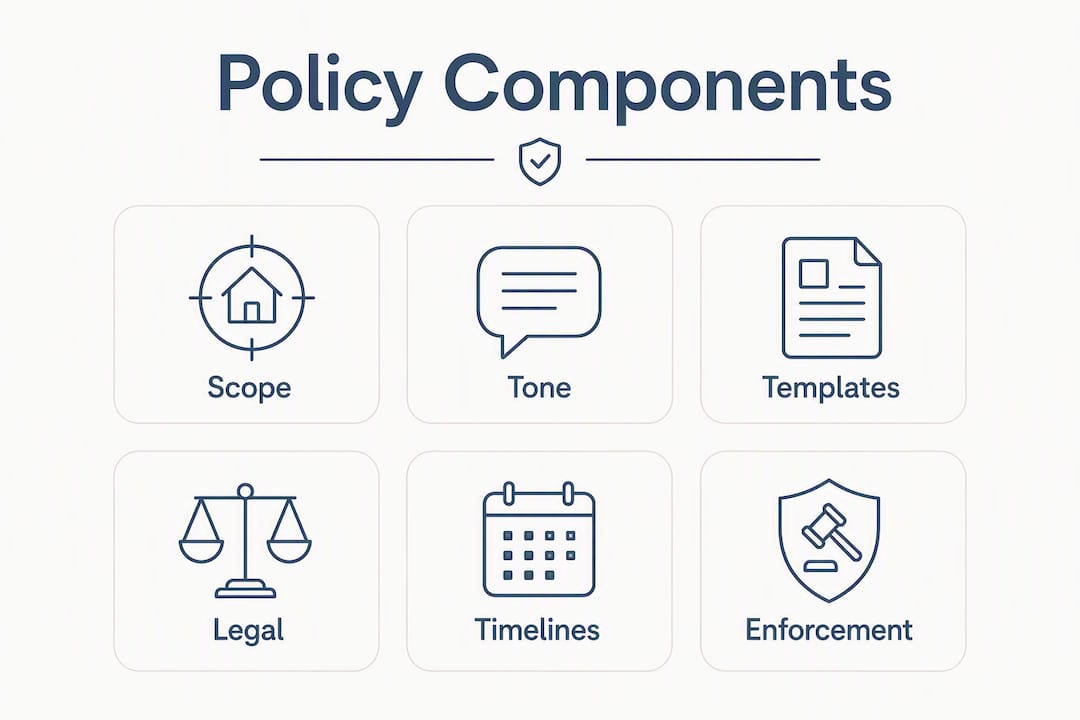
Six components belong in every policy document, regardless of community size.

| Component | What to define |
|---|---|
| Scope and applicability | Which committees, staff, and third-party managers may send official notices |
| Authorized senders | What requires a board vote vs. a manager signature |
| Standard templates | Violation notices, hearing notices, fine letters, and mandatory language |
| Approval workflow | How templates are reviewed, approved, and version-controlled |
| Delivery methods | U.S. Mail, certified mail with return receipt, email with read receipts |
| Recordkeeping | Storage location, file-naming convention, and retention period |
Policy drafting benefits most from version control and an approval workflow — these two controls alone cut the errors that generate appeals.
Notice-completeness checklist (run this before every enforcement letter goes out):
- Recipient’s full legal name and property address
- Rule or CC&R section cited, with exact language
- Date of discovery or observation
- Action required and specific deadline
- Delivery method and tracking reference
- Authorized signature with title
- Enclosure list (photos, prior notices, fine schedule)
How does the OABC letter structure work for HOA notices?
OABC — Opening, Agenda, Body, Closing — is the fastest way to make a letter’s purpose clear in the first two sentences. For HOA enforcement letters, it also keeps the tone factual and the action obvious.
- Opening: State the purpose and reference the property address and rule
- Agenda: One sentence that tells the reader what the letter covers and what they need to do
- Body: Facts of the infraction, CC&R citation, prior notices if applicable, and fine schedule
- Closing: Specific deadline, contact information, and next step if no action is taken
Template skeleton:
[Community Name] — [Notice Type] Date: [Date] | Property: [Address] | Account: [ID]
Opening: This letter concerns a violation of [CC&R Section X.X] observed at the above property on [date of discovery].
Agenda: Please review the details below and take corrective action by [deadline].
Body: On [date], [describe infraction factually]. Per Section [X.X] of the CC&Rs, [quote or paraphrase the rule]. Failure to correct by the deadline may result in [fine amount / hearing / lien].
Closing: Contact [name/title] at [phone/email] with questions. If no action is taken by [deadline], the board will proceed with [next step].
Authorized by: [Name], [Title], [Community Name] HOA
Pro Tip: In infraction letters, passive voice used sparingly (“a violation was observed” rather than “you violated”) reduces immediate defensiveness while keeping the letter factual. Reserve active voice for the action required.
“Effective correspondence answers the question directly and attaches background only when necessary for reviewers — over-explaining incoming communications is one of the most common drafting pitfalls in enforcement letters.” — U.S. EPA Correspondence and Communication Manual
What US legal requirements apply to HOA enforcement letters?
State notice rules vary widely — statutory timelines, required wording, and service methods differ enough that a letter valid in Texas may be procedurally defective in Florida. Verify these before any enforcement action.
| Legal check | What to confirm |
|---|---|
| Notice period | Minimum days between notice and fine or hearing (varies by state) |
| Form of service | First-class mail, certified mail, or personal delivery as required by statute |
| Hearing rights | Whether the homeowner must receive a hearing opportunity before fines accrue |
| Fine limits | Maximum per-violation and per-day amounts set by state law |
| Lien timelines | Minimum unpaid balance and notice period before recording a lien |
Additional compliance checks:
- Board authorization: confirm whether your state requires a board vote to levy fines or whether manager authority is sufficient
- Signature requirements: some states require the board president’s signature on hearing notices specifically
- Avoid ephemeral date references (“last week’s meeting”) in official letters; use specific calendar dates or relative phrases that stay accurate through mailing delays
- Keep letters concise — a letter that over-explains the infraction creates more surface area for dispute
How do you adopt and enforce a communication policy?
The adoption path runs six steps, and the whole process typically takes four to eight weeks from first draft to published policy.
- Draft — Assign a board member or manager to produce a first draft using the components above
- Legal review — Have HOA counsel check state-specific notice requirements and mandatory language (one to two hours of attorney time is usually sufficient)
- Board vote — Adopt the policy by formal resolution at a noticed board meeting
- Publish — Post the policy in the community portal or distribute to all homeowners
- Train — Walk managers and committee chairs through the template library and approval workflow; onboarding staff to standard formats takes one session
- Audit — Review compliance quarterly: spot-check five to ten letters against the notice-completeness checklist
Implementation checklist for managers:
- Template library stored in a shared, access-controlled folder
- Each template labeled with version number and approval date
- Delivery integrations confirmed (USPS certified mail account or fulfillment service)
- Recordkeeping folder structure matches the retention schedule in the policy
- Escalation ladder documented: courtesy notice → violation notice → hearing notice → final notice → lien referral
Practical templates and a notice-completeness checklist
Four template types cover the full enforcement escalation:
- Courtesy notice — First contact, no fine yet; cite the rule and request correction within 14–30 days
- Violation notice — Fine has been assessed or will accrue; include fine amount, CC&R citation, and deadline
- Hearing notice — Homeowner has requested or is entitled to a hearing; include date, time, location, and rights statement
- Final notice before lien — Unpaid balance meets the statutory threshold; include total owed, lien timeline, and attorney contact
Pro Tip: Name template files with a consistent convention: [NoticeType][Version][ApprovalDate].docx — for example, ViolationNotice_v3_2026-03.docx. This makes version control auditable at a glance.
| Template field | Required? |
|---|---|
| Recipient full legal name | Yes |
| Property address | Yes |
| CC&R section cited | Yes |
| Date of discovery | Yes |
| Action required + deadline | Yes |
| Delivery method noted | Yes |
| Authorized signature + title | Yes |
| Enclosure list | When applicable |
Mandatory language to include: the specific rule text or a direct paraphrase, the fine schedule reference, and the homeowner’s right to request a hearing. Boilerplate to cut: vague phrases like “as you may be aware” or “please be advised that” — they add length without adding information. The plain-language formatting rules from the Los Angeles County English Usage Guide put it simply: if a sentence doesn’t help the reader act, remove it.
What timelines and costs should boards plan for?
Most routine notices take a few days to prepare and deliver. Contested enforcement — hearings, appeals, lien referrals — adds several weeks depending on state timelines and homeowner response.
Typical cost items:
- First-class postage: under $1 per letter
- Certified mail with return receipt: roughly $8–$10 per piece
- Attorney review of a new template set: typically one to three hours of counsel time
- Per-letter software or fulfillment fees: varies by platform and volume
- USPS mailing fulfillment (outsourced): adds per-piece handling cost but eliminates staff time
| Notice type | Typical timeline |
|---|---|
| Courtesy notice (routine) | Draft to delivery: a few days |
| Violation notice with fine | Draft to delivery: around a week |
| Hearing notice | Statutory minimum varies; allow several weeks |
| Final notice before lien | Statutory minimum varies; allow multiple weeks |
Attorney review pays for itself on the first template set. After that, built-in mandatory-language checks in a compliant template are usually sufficient for routine notices — reserve attorney time for escalations and policy updates.
Key Takeaways
A formal written communication policy gives HOA boards the consistency, legal defensibility, and audit trail that enforcement letters require.
| Point | Details |
|---|---|
| Adopt standard templates | Use OABC structure for every notice type and version-control each template with an approval date. |
| Confirm state notice rules | Statutory timelines, service methods, and fine limits vary by state — verify before any enforcement action. |
| Assign signing authority | Define in the policy which notices require a board vote and which a manager can sign independently. |
| Set retention rules | Store delivery proofs and signed letters in a named, access-controlled folder per your retention schedule. |
| Run quarterly audits | Spot-check five to ten letters against the notice-completeness checklist each quarter to catch drift early. |
| HOA Letter AI | Enforces mandatory language, maps to state notice rules, and handles USPS delivery — preview free before committing. |
What consistent policy enforcement actually changes
The biggest shift boards report after adopting a formal policy isn’t fewer violations — it’s fewer arguments about the notices themselves. When every letter cites the same CC&R section in the same format, homeowners have less procedural ground to contest. The dispute moves to the facts, which is where it belongs.
The sticky problem most boards underestimate is the first six months after adoption. Staff revert to old habits, managers draft outside the template library, and one off-format letter can reopen procedural questions the policy was meant to close. The fix is simple but requires discipline: run the notice-completeness checklist on every letter, not just the ones that feel complicated. A courtesy notice sent in the wrong format is still a procedural gap.
For boards facing homeowner pushback on the policy itself, the most effective response is transparency. Publish the policy, explain that it protects homeowners as much as the board, and point to the hearing-rights language as evidence. Resistance drops when people see the policy as a guarantee of fair process rather than a tool for enforcement.
HOA Letter AI cuts drafting time and enforces your policy automatically
Drafting compliant enforcement letters from scratch takes time your board and management team don’t have. HOA Letter AI builds the policy controls directly into the drafting process: a template library with mandatory-language checks, state-aware notice rules pulled from HOA violation laws by state, USPS mailing fulfillment, and a notice-completeness checker that flags missing fields before anything goes out.
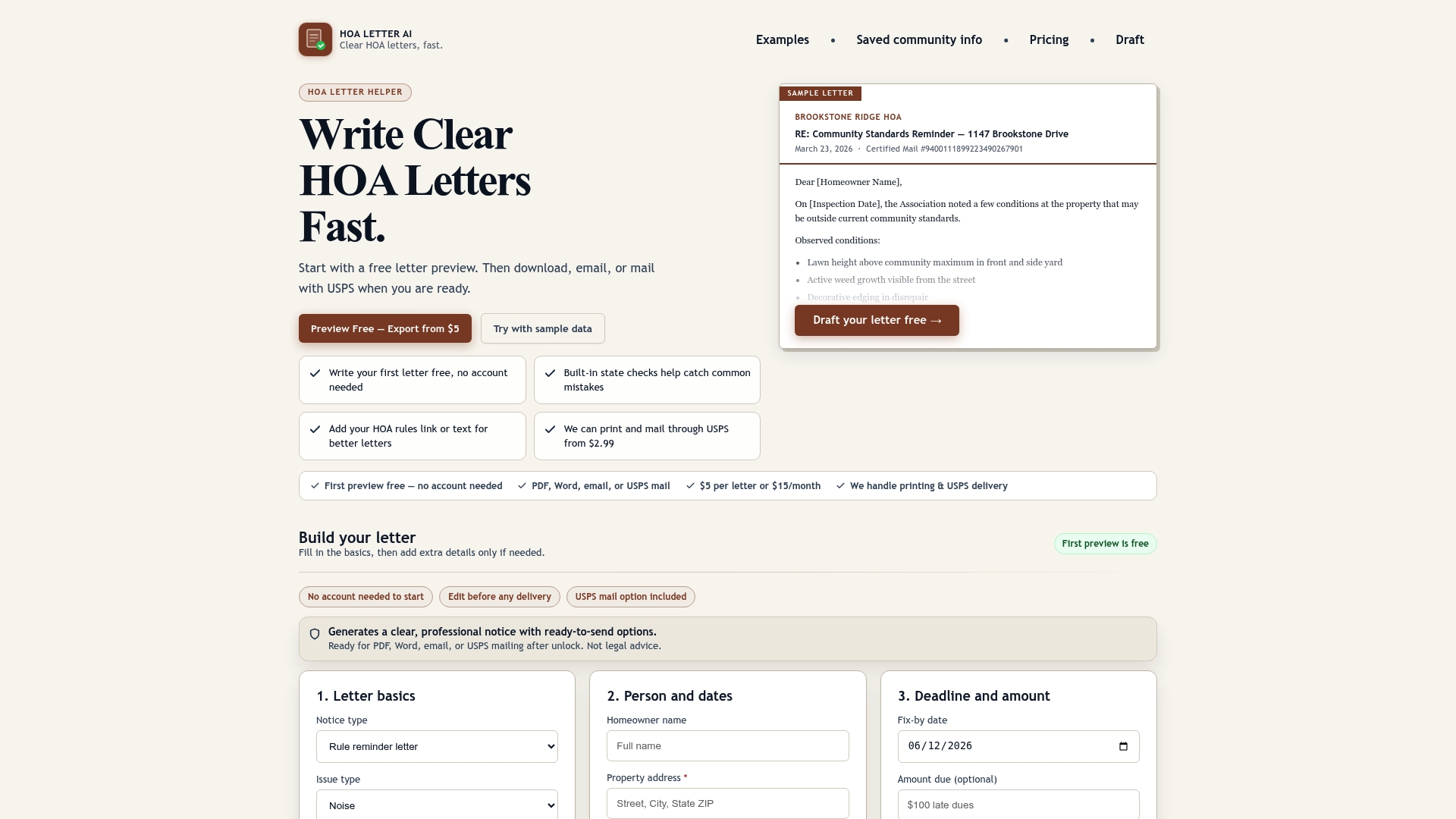
Property managers get reusable community profiles so every letter starts with the right CC&Rs already loaded. Boards get a free one-page preview before paying anything. The violation letter generator takes the OABC structure described in this guide and applies it to your community’s specific rules in minutes. Preview your first letter free and see whether it meets your state’s requirements before you send it.
Authoritative sources and next steps
Where to verify state-specific rules:
- HOA violation notice requirements by state — start here for statutory timelines and mandatory language
- Your state’s HOA or condominium act (search “[State] homeowners association act” on your legislature’s website)
- HOA counsel for a one-time review of your template set and policy document
Style and format references:
- UNC Chapel Hill Business Writing Guide — OABC structure and letter parts
- NARA letter-format guidance — heading, salutation, and signature standards
- EPA Correspondence Manual — concision, responsiveness, and date-reference cautions
- HOA Letter AI compliance formatting guide — practical checklist for HOA-specific letters
Recommended next steps:
- Run a state notice check using the HOA laws page above
- Have counsel review your template set once before publishing
- Publish the policy and train staff in one board-meeting session
- Set a calendar reminder for a quarterly audit using the notice-completeness checklist