
A well-written welcome letter does more than say hello. It tells a new hire that someone prepared for their arrival, thought through the details, and cares about their first impression of the company. Get that right, and you’ve already done something most onboarding processes miss.
What are standard onboarding letters and why do they matter?
Standard welcome and onboarding letters are formal, structured communications sent to new hires after they accept a job offer and before their first day. Unlike an offer letter, which handles compensation and employment terms, a welcome letter focuses on tone, arrival logistics, and reassurance. The goal is relational: make the employee feel expected, not processed.
These letters typically include:
- A warm, personalized greeting using the employee’s name and role title
- Confirmation of start date, time, and office location
- A brief first-day agenda or onboarding schedule overview
- Instructions on what to bring, including I-9 acceptable documents such as a passport or driver’s license plus Social Security card
- A named contact for questions before day one
- A closing line that signals genuine enthusiasm, not corporate autopilot
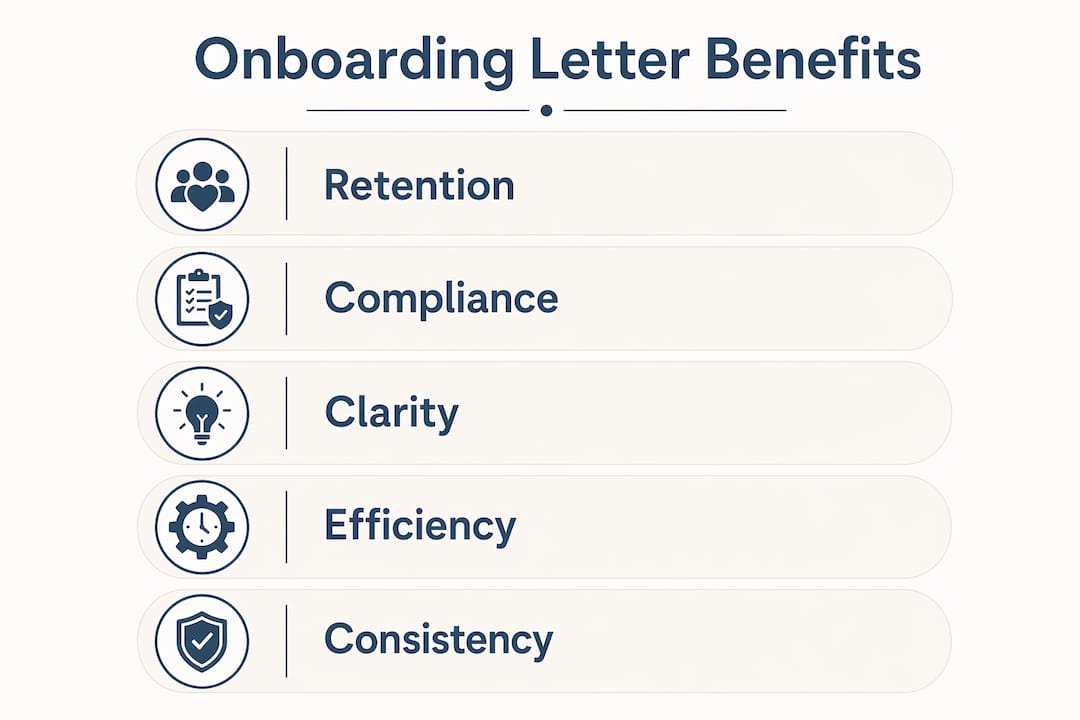
Research shows that a strong onboarding process improves employee retention over multiple years. The letter is where that experience begins. Standardizing the format across your organization means every new hire gets that same strong start, regardless of which manager or HR rep sends it.
Why standardized welcome letters give HR a real advantage

Consistency is the underrated engine of good onboarding. When every welcome letter follows the same structure, you eliminate the risk of one department sending a polished, detailed note while another sends a two-line email with no logistics.
The benefits of standardized letter writing for staff onboarding go beyond aesthetics:
- Retention lift: Structured onboarding communication is directly tied to longer employee tenure, as the retention data above shows.
- Fewer errors: A fixed template means critical details like start time, parking instructions, and document requirements don’t get accidentally omitted.
- Brand consistency: Every letter reflects the same professional tone, which reinforces how the company presents itself from day one.
- HR efficiency: Templates cut drafting time dramatically. HR can focus on personalization rather than rebuilding the same letter structure from scratch each time.
- Culture signaling: A letter that matches how your team actually communicates, whether formal or conversational, sets an accurate expectation before the employee walks in the door.
The benefits of standardized letters extend to compliance as well. When your format includes a standard reminder about required documentation, you reduce the chance of a new hire showing up unprepared for I-9 verification.
What every effective onboarding letter must include
Five core elements define an effective welcome letter: enthusiasm, role and logistics confirmation, a first-day overview, contact information, and a list of documents to bring. Miss any one of these and the letter starts to feel incomplete.
Here’s what to cover, in order:
- Personalized welcome: Use the employee’s name and mention their specific role. “We’re excited to have you join us as our new Marketing Coordinator” lands differently than a generic opener.
- Role and start confirmation: State the job title, start date, start time, and office address or remote login details. No ambiguity.
- First-day agenda: A short numbered list of what to expect works better than a paragraph. New hires scan for this information.
- Documents to bring: Reference the I-9 requirement explicitly. Two forms of identification are required by federal law, and a reminder here prevents a frustrating first-day delay.
- Pre-start contact: Name a specific person, not just “HR,” with an email or phone number for questions.
- Optional personalization: One sentence about why this person was chosen, referencing something specific from their background, makes the letter feel human rather than automated.
Keep the language clear and jargon-free. A new hire reading this letter is already managing first-day nerves. Plain, direct sentences reduce that load rather than adding to it.
How to write and format a professional onboarding letter
Follow the block format standard
The block format is the default for professional business letters in the United States: 1-inch margins on all sides, left-aligned text throughout, no first-line paragraph indentations, and 1–1.15 line spacing between paragraphs. It looks clean, reads easily, and signals professionalism without effort. For a deeper look at applying this structure, the complete format guide at Hoaletterai covers the specifics in detail.

Write in a sequence that mirrors the reader’s questions
New hires reading a welcome letter are mentally asking: Am I expected? When do I show up? What happens when I get there? What do I bring? Who do I call if something goes wrong? Structure your letter to answer those questions in that order. Don’t open with a company history paragraph. Open with the welcome, then move immediately to logistics.
- Greeting and personalized welcome
- Role and start date confirmation
- First-day schedule or agenda
- What to bring (documents, dress code)
- Pre-start contact name and details
- Warm closing
Formatting choices that help new hires absorb information
Bold subheadings and bullet points help new employees find key logistics quickly without reading every word. Use them for the first-day schedule and the documents checklist. Keep paragraphs short, three to four sentences at most. A wall of text in a welcome letter signals that the company doesn’t think about the reader’s experience.
Pro Tip: Balance the template structure with one or two role-specific sentences added by the hiring manager. HR owns the format and legal accuracy; the manager adds the human touch. That split keeps quality consistent without making every letter feel identical.
Timing: send it within the right window
Send the letter after offer acceptance but before the start date, ideally within one to two weeks of the accepted offer. That timing window keeps the communication relevant and gives the new hire enough lead time to prepare without feeling forgotten between signing and day one.
Deliver it as a PDF
Exporting as a PDF preserves your formatting exactly as intended and prevents the recipient from accidentally editing the document. A Word file sent by email can reflow, lose fonts, or arrive looking nothing like what you drafted.
Common pitfalls to avoid
- Overly long letters that bury key logistics in culture paragraphs
- Missing the start time or office address
- Generic language with no mention of the employee’s actual role
- Tone that doesn’t match how the company actually communicates day to day
- Sending the letter too close to the start date, leaving no time for questions
| Pitfall | Fix |
|---|---|
| No start time listed | Include exact time and arrival instructions |
| Generic greeting | Use employee name and job title |
| Missing document reminder | Add I-9 document list explicitly |
| Tone mismatch | Match letter tone to company culture |
| Sent too late | Send within 1–2 weeks of offer acceptance |
Ready-to-use templates for standardized onboarding letters
Template 1: Standard HR welcome letter (formal tone)
[Date]
Dear [Employee Name],
Welcome to [Company Name]. We are delighted to have you joining us as [Job Title] on [Start Date]. Your background in [specific skill or experience] stood out during the hiring process, and we are confident you will make a strong contribution to the [Department Name] team.
Please arrive at [Office Address] on [Start Date] at [Start Time]. When you check in at the front desk, ask for [HR Contact Name], who will walk you through your first-day schedule.
Here is what to expect on your first day:
- Sign employment paperwork and complete onboarding forms
- Set up your workstation, email, and system access
- Meet with your direct manager, [Manager Name]
- Team introduction and office tour
- Review of company policies and employee handbook
Please bring two forms of identification for I-9 verification. Acceptable documents are listed at USCIS.gov. Our dress code is [business casual / formal].
If you have any questions before your start date, please contact [HR Contact Name] at [email] or [phone number]. We look forward to welcoming you in person.
Sincerely, [Your Name] [Your Title] [Company Name]
Template 2: Manager-sent welcome letter (semi-formal tone)
[Date]
Hi [Employee Name],
The whole team is excited to have you joining us as [Job Title] on [Start Date]. I wanted to reach out personally before your first day to make sure you have everything you need.
Plan to arrive at [Office Address] by [Start Time]. I will be there to meet you, and we will spend the morning getting you set up and introduced to the team.
A few things to bring:
- Two forms of ID for your I-9 paperwork
- Any signed documents from HR if you haven’t returned them yet
- Comfortable shoes. We do a full office tour on day one.
Our dress code is [business casual]. If you have any questions at all before you start, my email is [manager email] and my cell is [phone number]. Don’t hesitate to use either.
Looking forward to seeing you on [Start Date].
[Manager Name] [Title] [Company Name]
Digital vs. printed delivery: what works and when
| Factor | Digital (email/PDF) | Printed letter |
|---|---|---|
| Speed | Immediate delivery | Requires mailing time |
| Formatting integrity | High when sent as PDF | High when printed correctly |
| Personalization feel | Moderate | High for executive hires |
| Compliance record | Easy to archive digitally | Requires physical filing |
| Best for | Most standard hires | Senior roles or formal cultures |
Digital delivery as a PDF attachment covers the vast majority of onboarding situations. Printed letters still carry weight for executive hires or organizations with a formal culture where a physical letter signals respect. Either way, automating the distribution process reduces manual effort and keeps timing consistent across all new hires.
Legal and compliance notes to build into your templates
Every U.S. onboarding letter should remind new hires to bring I-9 documentation. Beyond that, avoid including specific salary figures or benefit details in the welcome letter itself. Those belong in the offer letter. If your state has specific requirements around written employment notices, consult your legal team before finalizing the template. Building a reusable letter template library with pre-approved language for each scenario saves time and reduces legal exposure across repeated hires.
Customizing templates without losing standardization
The structure stays fixed. The personalization lives in two places: the opening line that references the employee’s specific background, and a short paragraph from the hiring manager that speaks to the team or role context. HR controls the format, the legal language, and the timing. Managers add one or two sentences that make the letter feel like it came from a person, not a process. That split is what keeps letter templates in organizations both consistent and human.
Hoaletterai builds professional letter templates with clear formatting, built-in compliance checks, and delivery options that remove the friction from this exact process. If you’re managing onboarding letters at scale, the letter generator gives you a structured starting point you can customize and send without rebuilding from scratch each time.
Key Takeaways
Onboarding staff to standard letter formats works best when HR controls the structure and managers add the personalization, keeping every letter both consistent and genuinely welcoming.
| Point | Details |
|---|---|
| Retention impact | Structured onboarding communication is directly tied to longer employee tenure, making the welcome letter a retention tool. |
| Block format is the standard | Use 1-inch margins, left-aligned text, and no paragraph indentations for all professional onboarding letters. |
| Timing window matters | Send within 1–2 weeks of offer acceptance, before the start date, for maximum impact. |
| PDF delivery preserves quality | Exporting as PDF maintains formatting and prevents accidental edits by recipients. |
| Split ownership works best | HR owns the template and compliance language; managers add one personalized section per hire. |