
Professional letter structure is the standardized arrangement of key elements in a formal letter to ensure clarity, professionalism, and effective communication. Most professional correspondence follows the full block format, a layout recognized by communication experts and institutions as the clearest and most consistent approach to formal writing. Getting this structure right signals competence before the recipient reads a single word of your message.
The stakes are real. A well-formatted professional letter establishes immediate credibility and signals seriousness to the recipient. That credibility is built not just by what you say, but by how the letter looks on the page. Whether you are writing a business proposal, a legal notice, or an HOA compliance letter, the same structural principles apply.
What is professional letter structure, and why does it matter?
Professional letter structure is the formal arrangement of components that every business or official letter should include, in a specific sequence. The full block format avoids indentation and keeps all text left-aligned, creating a clean, consistent appearance regardless of whether the letter is printed or read on screen. Communication professionals and institutions widely recognize this format as the standard for external correspondence.
Structure matters because it removes ambiguity. A recipient who opens a properly formatted letter immediately knows who sent it, when it was written, what it is about, and what action is expected. That clarity is not accidental. It is the direct result of following a proven format.
Professional letters are the most formal communication medium, typically limited to 1–2 pages to maintain professionalism in external correspondence. That constraint forces writers to be direct and purposeful, which is exactly what formal correspondence demands.
What are the essential components of a professional letter?
The full block format uses 7–9 distinct sections to ensure uniform alignment and readability. Each section has a specific role and a specific position in the letter. Skipping or misplacing any one of them weakens the overall impression.
Here are the core elements of a properly structured formal letter:
- Sender's information. Your name, title, organization, address, phone number, and email go at the top of the letter. This block tells the recipient exactly who is writing and how to respond.
- Date. Place the date two lines below the sender's block. Write it out fully, for example, "March 12, 2026," to avoid any ambiguity between date formats.
- Recipient's information. Include the recipient's full name, title, organization, and mailing address. This block mirrors the sender's information in format and placement.
- Formal salutation. Use "Dear [Full Name]:" with a colon, not a comma. The colon signals formality and is the standard in American business correspondence.
- Subject line. A brief, bolded subject line placed between the salutation and the first paragraph tells the reader exactly what the letter addresses. Not all formats include this, but it is standard in business and legal letters.
- Body paragraphs. The body contains three logical sections: an opening that states the letter's purpose, a middle section with supporting details, and a closing paragraph that states the expected next step.
- Complimentary close. "Sincerely," "Respectfully," or "Best regards," followed by a comma, signals the end of the letter. Place it two lines below the final body paragraph.
- Signature block. Leave four lines after the complimentary close for a handwritten signature, then type your full name and title below it.
- Enclosure notation. If you are including additional documents, add "Enclosure:" or "Enclosures: (2)" two lines below the signature block. This prevents confusion about missing attachments in formal letters.
Following this framework assures clarity and consistent message delivery across every type of professional correspondence.
How is the full block format used to structure a professional letter?
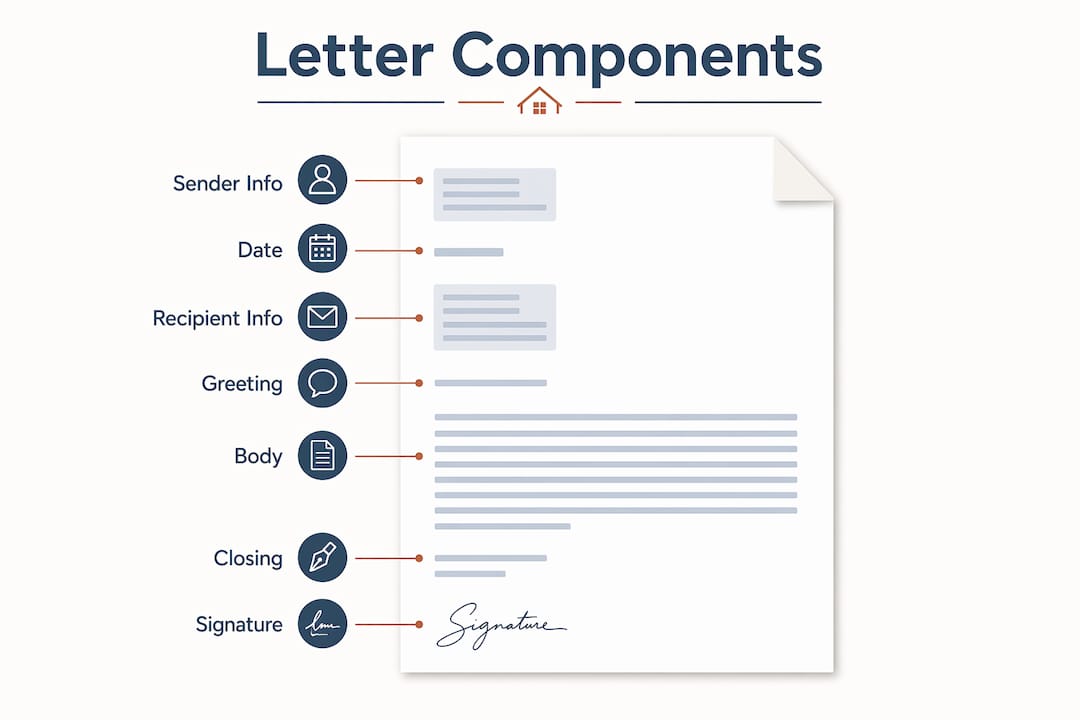
The full block format is the most widely used layout for formal letters in American business writing. Every element, including the sender's address, date, recipient's address, salutation, body, and closing, aligns to the left margin. No indentation appears anywhere in the letter. That consistency makes the format easy to read and impossible to misformat.
Pro Tip: *If you are unsure which format to use, default to full block. It is the only format where you cannot make an indentation error, because there are no indents to manage.*
Spacing follows a clear rule. Use single line spacing within each paragraph and double spacing between each block or section. This separation gives the eye a clear path through the letter without wasting space on a short document.
Font choice also carries weight. Standard fonts such as Times New Roman, Cambria, Arial, or Helvetica in 10–12 point size are recommended for clarity and professionalism. Decorative or script fonts undermine the formal tone immediately.
The table below compares the three most common letter formats so you can see where full block stands out:
| Format | Indentation | Alignment | Best use |
|---|---|---|---|
| Full block | None | All left | Business, legal, HOA letters |
| Modified block | Date and closing centered | Mixed | General business |
| Semi-block | Paragraph indents | Mixed | Less formal business |
Full block wins for most professional contexts because it avoids inconsistent presentation across devices or printed formats, ensuring readability every time. For HOA boards and property managers who send compliance letters regularly, the full block format is the only practical choice. You can explore official correspondence formats in more detail to see how this applies across different letter types.
What are best practices and common mistakes in professional letter writing?
The structure of a formal letter is only as effective as the writing inside it. Formatting gets the reader's attention. Clear, direct language keeps it.
These are the practices that separate effective professional letters from forgettable ones:
- Write one idea per paragraph. Each paragraph should address a single idea, contributing to the letter's overall purpose. Mixing multiple points in one paragraph forces the reader to work harder than necessary.
- Use a personalized salutation. "Dear [Full Name]" is safer and more professional than impersonal greetings. If you do not know the recipient's name, use "Dear Hiring Manager" or the relevant title. "To Whom It May Concern" is outdated and signals a lack of effort.
- End with a clear call to action. The closing line is an opportunity to reiterate your message and clarify next steps politely. Tell the recipient exactly what you want them to do and by when.
- Proofread for both content and formatting. A typo in a formal letter damages credibility as much as a formatting error. Read the letter twice: once for meaning and once for layout.
- Match your tone to your purpose. A letter requesting a meeting uses warmer language than a legal notice. Both are formal, but the degree of warmth differs.
Pro Tip: *Print a draft of your letter before sending it. Errors that are invisible on screen become obvious on paper, especially spacing and alignment issues.*
The most common mistake writers make is burying the main point in the second or third paragraph. Readers of formal letters expect the purpose to appear in the first sentence of the body. State it directly, then support it. For compliance letters in particular, formatting best practices require that the violation or issue appear at the top of the body, not after two paragraphs of background.
How to adapt professional letter structure for various contexts and audiences?
The full block format provides the skeleton. The content, tone, and level of detail change based on who you are writing to and why. Adapting correctly shows professional judgment.
- Business letters. Keep the tone direct and the length tight. State your purpose in the first sentence of the body. Business readers expect efficiency, so cut any background that does not directly support your request or message.
- Legal letters. Legal correspondence demands precision above all else. Every claim should be specific, every date exact, and every referenced document named clearly. Include enclosure notations for every attachment. Legal letters often require letter format compliance with state or federal standards, so verify requirements before sending.
- HOA compliance letters. These letters must balance authority with respect. The recipient is a neighbor or community member, not an adversary. State the violation clearly, cite the relevant rule, and give a specific deadline for correction. The tone should be firm but not hostile.
- Personal formal letters. Letters of recommendation, formal complaints, or letters to elected officials follow the same structural rules but allow slightly warmer language. You can use the recipient's first name in the salutation if you have a prior relationship.
- Letters with enclosures. When attaching documents, list each enclosure by name in the enclosure notation. Write "Enclosures: Lease Agreement, Inspection Report" rather than just "Enclosures: (2)." Named enclosures prevent disputes about what was included.
Adjusting the salutation is the fastest way to signal the right level of formality. "Dear Ms. Chen:" is more formal than "Dear Jennifer:" and both are more professional than "Hi Jennifer." Choose based on your relationship with the recipient and the seriousness of the subject. For HOA boards managing formal notices, formal notice formatting standards provide specific guidance on matching tone to the type of notice being sent.
Key Takeaways
A professional letter's effectiveness depends on following the full block format, placing each component in the correct sequence, and matching tone and detail to the specific audience and purpose.
| Point | Details |
|---|---|
| Full block is the standard | All elements align left with no indentation, ensuring consistent readability across print and digital formats. |
| Seven to nine components required | Every formal letter needs sender info, date, recipient info, salutation, body, closing, and signature at minimum. |
| Personalized salutations matter | Use "Dear [Full Name]:" and avoid "To Whom It May Concern," which reads as impersonal and outdated. |
| Close with a call to action | The final paragraph should state exactly what you want the recipient to do and by when. |
| Adapt tone to context | Business, legal, and HOA letters share the same structure but require different levels of formality and detail. |
Why letter structure still separates good writers from everyone else
I have reviewed hundreds of formal letters over the years, and the ones that fail almost always fail in the same two places: the opening and the closing. Writers spend the most energy on the middle, where they explain their case, and then rush the beginning and end. That is exactly backwards.
The opening sentence of the body is the most important sentence in the letter. If it does not state the purpose clearly, the reader spends the rest of the letter guessing what you want. The closing is the second most important part, and most writers treat it as an afterthought. A strong closing tells the recipient the next step, the deadline, and how to reach you. A weak closing says "Thank you for your time" and nothing else.
The full block format has survived the shift to digital communication because it removes every formatting decision from the writer's plate. You do not have to decide whether to indent. You do not have to wonder where the date goes. The format answers those questions for you, which means your energy goes into the content where it belongs.
One more thing I have noticed: writers who resist formal structure often do so because they think it feels stiff or impersonal. The opposite is true. A well-structured letter reads as confident and prepared. An unstructured letter reads as uncertain, regardless of how warm the language is. Structure is not a cage. It is the frame that makes your message stand up straight.
> *— Blake*
Professional letter templates that handle the structure for you
Writing a formal letter from scratch takes time, especially when state-specific language or legal compliance is involved. Hoaletterai removes that burden for HOA boards and property managers by generating properly formatted, state-compliant letters in minutes.

Every letter Hoaletterai produces follows the full block format automatically, with correct spacing, a clear subject line, and a structured body that places the violation or notice at the top where it belongs. The platform includes built-in checks that catch common formatting errors before the letter goes out. For boards managing compliance letters across an entire community, Hoaletterai also offers direct USPS mailing, so the letter goes from screen to mailbox without extra steps. Explore California HOA violation letter requirements and ready-to-send templates to see how the format works in practice.
FAQ
What is the full block format in a professional letter?
The full block format is a letter layout where every element aligns to the left margin with no indentation. It uses single spacing within paragraphs and double spacing between sections, making it the cleanest and most consistent format for formal correspondence.
How many components does a professional letter need?
A standard professional letter includes 7–9 distinct sections, covering sender information, date, recipient information, salutation, subject line, body paragraphs, complimentary close, signature block, and an optional enclosure notation.
What font should I use in a formal letter?
Use Times New Roman, Cambria, Arial, or Helvetica at 10–12 point size. These fonts are widely recognized as professional and readable in both print and digital formats.
Is "To Whom It May Concern" still acceptable?
No. "To Whom It May Concern" is considered outdated in professional correspondence. Use "Dear [Full Name]:" when you know the recipient, or "Dear Hiring Manager:" when you do not.
Where does the enclosure notation go in a professional letter?
Place the enclosure notation two lines below the signature block. List each document by name to prevent any confusion about what was included with the letter.
Recommended
- Types of Official Correspondence Formats: 2026 Guide | HOA Letter AI
- Compliance Letter Formatting Best Practices: 2026 Guide | HOA Letter AI
- Professional HOA Letter Formatting Guide for Boards | HOA Letter AI
- Letter Format Compliance Legal Requirements: 2026 Guide | HOA Letter AI
Drafting support for HOA notices
Use the HOA letter drafter to turn this guidance into a resident-ready notice, compare reusable HOA letter templates, or review the property manager workflow for higher-volume enforcement work.