
A style guide ensures every HOA letter is consistent in format, tone, and required legal language — so letters read as professional, reduce resident disputes, and take far less time to produce. That single function covers a lot of ground: formatting rules, mandatory phrases, a short terminology list, and ready-to-use templates. Boards that adopt a short guide focused on templates see faster drafting, fewer editing cycles, and a stronger defense against selective-enforcement claims.
The immediate benefits break down cleanly:
- Consistency across board terms, even when volunteers rotate
- Legal defensibility through uniform wording and required statutory references
- Time savings by eliminating the “how do we say this?” conversation every drafting cycle
- Professionalism that residents recognize and respect
The next step: adopt a short guide and lock in your standard templates before the next enforcement cycle.
Table of Contents
- Why HOAs specifically need a style guide for letters
- What every HOA letter style guide should include
- How to create, approve, and roll out a style guide
- Template skeletons and a pre-send checklist
- Legal and compliance notes for U.S. HOA boards
- How to keep the style guide current and measure its impact
- How Hoaletterai supports your style guide workflow
- Common HOA letter types and style considerations for each
- How to handle sensitive or dispute-related letters professionally
- Key Takeaways
- What boards get wrong about style guides
- Sources and further reading
Why HOAs specifically need a style guide for letters
Board turnover is the hidden cost most associations underestimate. A new treasurer or secretary inherits no institutional memory of how violation notices were worded last year; which means enforcement language shifts from term to term. That inconsistency is exactly what residents cite when they claim selective enforcement.
A shared vocabulary for boards solves this at the source. When every board member uses the same term for a rule violation and the same sentence structure for a courtesy warning, the letters look like they came from the same organization, not three different volunteers. According to brand strategy guidance, a style guide acts as a neutral arbiter, preserving a consistent voice regardless of who is drafting on a given day.
Consistent formatting also reduces resident confusion. A letter that looks official, follows block-style conventions, and uses the same salutation every time signal that the board operates by procedure, not personal preference. That perception matters in disputes.
Efficiency note: UX research from Nielsen Norman Group describes style guides as a productivity tool that prevents rework by making the right choice the easy choice. For volunteer boards drafting letters after work hours, that framing is exactly right.
What every HOA letter style guide should include
The guide does not need to be long. It needs to be specific. These are the elements that actually get used.
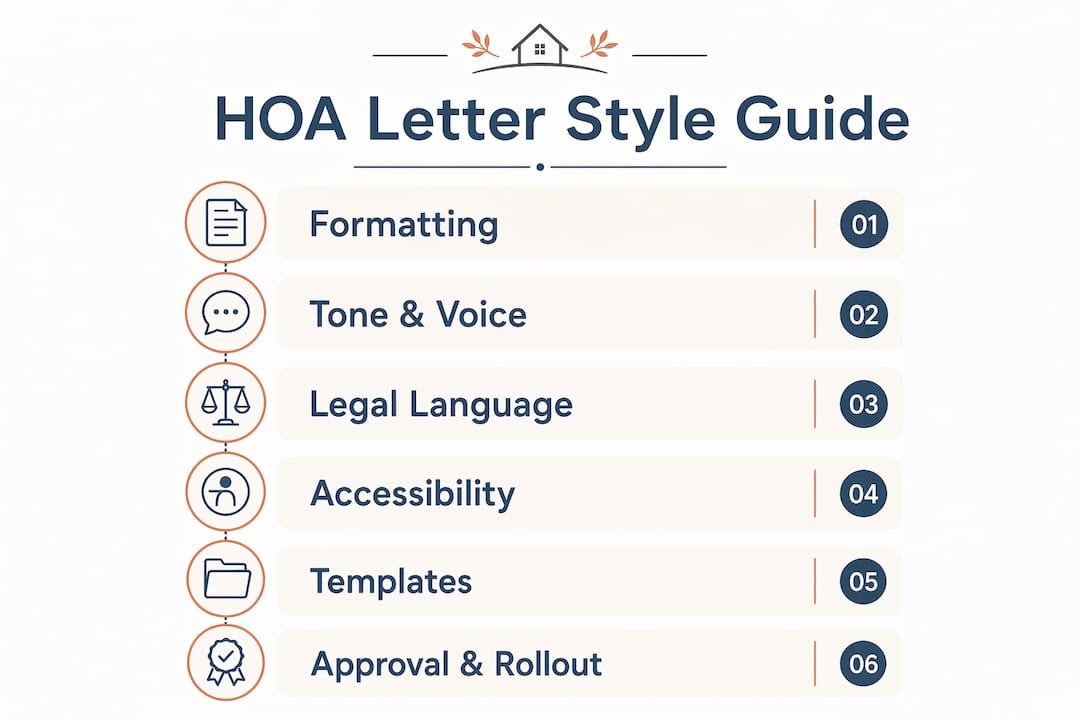
Formatting standards
Follow block style: left-aligned text, single spacing within paragraphs, one blank line between sections. The HUD correspondence handbook prescribes Times New Roman at 12-point with one-inch margins as the standard for official letters. That is a reasonable baseline for HOA correspondence. Specify sender block, date, recipient block, subject line, salutation, body, complimentary close (“Sincerely,”), and signature block in that order.

For HOA compliance letter formatting, consistency in these elements is what makes a letter look authoritative rather than improvised.
Tone and voice rules
Keep the tone neutral and procedural. Avoid accusatory language. The goal is to describe the observed condition, cite the applicable rule, and state the required action in a factual manner.
Required legal language and state-specific placeholders
Every enforcement letter should include a placeholder for the specific bylaw or state statute being cited. Use brackets: or. Fill these only after confirming the citation with your governing documents or counsel.
| Element | Standard | Notes |
|---|---|---|
| Font | Times New Roman, 12 pt | Per HUD and Purdue OWL guidance |
| Margins | 1 inch all sides | Standard for official correspondence |
| Spacing | Single, blank line between sections | Block style |
| Salutation | “Dear [Resident Name]:” | Colon, not comma, for formal letters |
| Complimentary close | “Sincerely,” | Consistent across all letter types |
| Rule citation | [CC&R Section X.X] |
Placeholder; confirm before sending |
| State language | [State-specific notice language] |
Confirm with counsel or state guidance |
Accessibility and readability
Style guides should specify font choices and readability targets with residents who have disabilities in mind. Aim for a moderate reading level that is accessible to most residents. Avoid all-caps text blocks. Use a clear, legible font size.
Pro Tip: Target a Flesch-Kincaid grade of 8–10 for compliance letters. Paste your draft into a free readability checker before sending. Letters that residents can actually read generate fewer follow-up calls.
How to create, approve, and roll out a style guide
This does not require a committee or a consultant. Four steps, one to four board meetings.
- Designate an editorial owner. One board officer or the property manager holds the guide and approves changes. Without a named owner, the guide drifts.
- Draft a minimum viable guide. Start with AP Style or Chicago as your base reference, then layer in HOA-specific rules: your terminology list, your required phrases, your template list. Keep it to 1–3 pages. A List Apart’s guidance is clear that practitioners recommend short guides focused on templates and mandatory language, not exhaustive grammar rules.
- Get board approval and version-stamp it. A simple vote, a date stamp (e.g., “Adopted March 2026”), and a version number. Store the guide in a shared digital folder and inside your drafting tool.
- Onboard volunteers and managers. A 20-minute walkthrough with sample letters is enough. The guide does the rest if it is embedded in the workflow rather than sitting in a binder.
Pro Tip: Nielsen Norman Group recommends connecting style guide updates directly to the production workflow. For HOAs, that means the guide lives inside the letter tool, not in a separate document volunteers have to remember to open.
Template skeletons and a pre-send checklist
Four templates cover the vast majority of HOA enforcement correspondence.
Violation Notice (first contact)
[Date] | [Resident Name and Address] | Re: Violation of [CC&R Section X.X] Dear [Resident Name]: The board has observed [describe condition] at [property address], which appears to be in violation of [CC&R Section X.X / Community Rule Y]. Please correct this condition by [date, typically 14–30 days]. Contact [board contact] with questions. Sincerely, [Board Officer Name and Title]*
Courtesy Warning (pre-fine, softer tone): Same structure, but open with “This is a courtesy notice” and omit fine language.
Fine Notice: Add the fine amount, the applicable fine schedule section, and the payment deadline. For state-compliant fine language, insert the required statutory notice language in the designated placeholder before sending.
Collection Escalation: Reference prior notices by date, state the outstanding balance, and include the collection sequence steps your governing documents require.
Pre-send checklist:
- Block format applied, 12-point Times New Roman, 1-inch margins
- Correct resident name and property address confirmed
- Rule citation filled in (not left as a placeholder)
- State-specific notice language inserted and verified
- Complimentary close and board officer signature present
- Proof of service method selected (certified mail or hand delivery with log)
Pro Tip: Run the checklist as a literal checkbox in your drafting tool. A missed rule citation is the most common reason a violation notice gets challenged.
Legal and compliance notes for U.S. HOA boards
Insert state-specific mandatory language only after confirming it with counsel or an authoritative state HOA statute. This is not optional. State requirements for notice periods, fine procedures, and hearing rights vary significantly, and a letter that omits required language may be unenforceable.
Seek legal review in three situations: the first time you use a new enforcement template, any letter involving lease restrictions or collection action, and any time a resident formally disputes a notice’s content.
Recordkeeping matters as much as wording. The HUD correspondence handbook details how to control correspondence status and preserve proof of service. For HOAs, that means certified mail receipts, delivery logs, or posting records kept with a copy of the letter.
Pro Tip: Certified mail with return receipt is the safest service method for fine notices and collection letters. Keep the green card with the letter file. If a resident claims they never received the notice, you have proof.
This article is general information, not legal advice. Confirm your state’s specific HOA notice requirements with a licensed attorney or your state’s HOA statute before sending enforcement letters.
How to keep the style guide current and measure its impact
An annual review is the minimum. Schedule it after your fiscal year closes, when the board has a natural moment to assess what worked. Ad hoc updates should follow any significant rule change or after a dispute that exposed a gap in the guide’s language.
Three metrics worth tracking:
- Time-to-draft: How long does it take to produce a compliant letter from scratch? A good guide should cut this noticeably after the first few uses.
- Editing cycles per letter: If every draft goes through three rounds of revisions, the guide is not doing its job.
- Resident disputes citing inconsistent wording: Track these separately. A reduction over 12 months is the clearest signal the guide is working.
After each major mailing, a short feedback form to the drafting team (two or three questions) surfaces problems before they become patterns. Version-stamp every update so you always know which guide was in effect when a letter was sent.
Style guides are most effective when they are living documents connected to the actual drafting workflow, not static files reviewed once and forgotten.
How Hoaletterai supports your style guide workflow
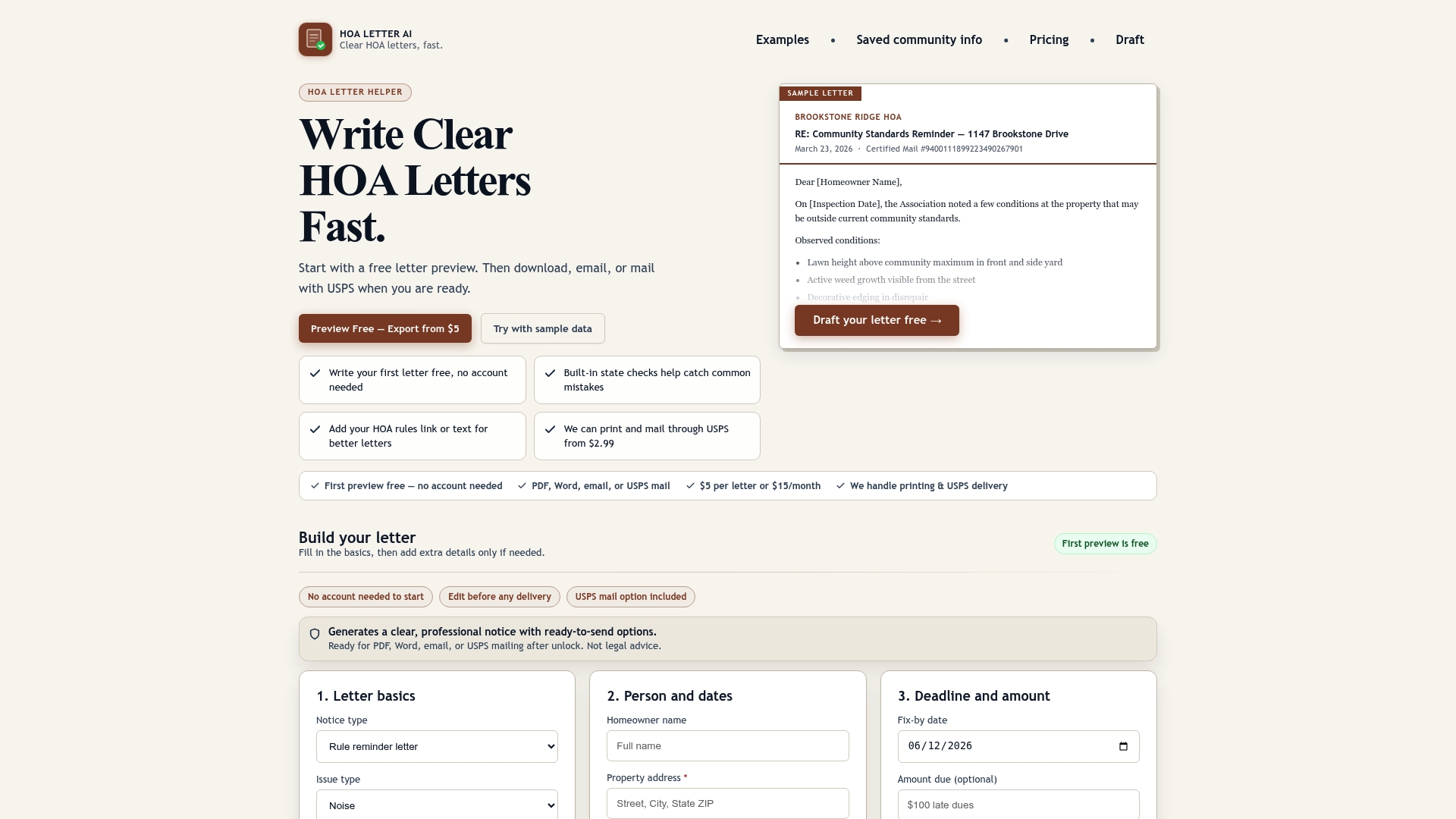
Hoaletterai (HOA Letter AI) is built around exactly the workflow this guide describes. The platform’s core features map directly to the style guide elements boards need most:
- State-specific language integration: Mandatory notice language is built into templates by state, so the placeholder is filled correctly before you send.
- One-page preview: Review the formatted letter before it goes out, with the same block-style layout your style guide specifies.
- USPS mailing option: Send certified mail directly from the platform, with delivery tracking for your proof-of-service records.
- Built-in error checks: The tool flags missing rule citations and incomplete fields before you can finalize a letter.
- Template library: Violation letters, warning notices, fine notices, and more, all pre-formatted to the standards in this guide.
The workflow automation built into Hoaletterai means the style guide is not a separate document volunteers have to remember. It is enforced at the point of drafting.
Pro Tip: Store your approved style guide in the Hoaletterai shared folder so every board member drafting a letter sees the current version without hunting for it.
Try the HOA violation letter generator to preview a formatted letter in under two minutes.
Common HOA letter types and style considerations for each
Different letter types carry different risks, and the style guide should flag those differences explicitly.
Violation notices require the most precise rule citations. Every sentence that describes the observed condition should be factual and specific, not interpretive. “The lawn at [address] has not been mowed and exceeds the 6-inch height limit in Section 3.4” is defensible. “Your yard looks neglected” is not.
Courtesy warnings should be noticeably warmer in tone than formal violation notices. The style guide should include a separate tone note for these: acknowledge the resident, describe the concern briefly, and invite resolution before any formal action.
Fine notices carry the highest legal exposure. The specific rule citations and state-required hearing rights language must be present. The style guide should mark these fields as mandatory, not optional.
Meeting notices and general announcements follow the same block format but allow a slightly less formal tone. The style guide should specify whether these go out on letterhead and whether they require a board officer signature.
Assessment and collection letters escalate in formality with each stage. The style guide should define the sequence: courtesy reminder, formal demand, attorney referral notice. Each stage has its own template with its own required language.
How to handle sensitive or dispute-related letters professionally
When a resident has already pushed back on a prior notice, the next letter carries more weight. The style guide should include explicit guidance for these situations.
Stick to facts and procedure. A dispute-related letter is not the place to address a resident’s tone or prior behavior. Describe the outstanding violation, reference the prior notice by date, and state the next procedural step. Nothing more.
Avoid language that implies personal judgment. Phrases like “despite repeated warnings” or “your continued failure” escalate tension without adding legal weight. The style guide should flag these as prohibited phrasing and offer neutral alternatives: “Following the notice dated [date], the condition at [address] remains unresolved.”
For letters responding to a homeowner’s formal dispute, the board’s response should acknowledge receipt, state the board’s position with the applicable rule citation, and describe the next step in the dispute resolution process. Keep it short. A long defensive letter reads as uncertain.
The style guide should also specify who signs dispute-related letters. A consistent signature authority (board president or property manager) signals that the response is official, not reactive.
Key Takeaways
A style guide is the single most practical tool an HOA board can adopt to make compliance letters consistent, legally defensible, and faster to produce.
| Point | Details |
|---|---|
| Keep the guide short | A short guide focused on templates and mandatory phrases gets used; a lengthy grammar manual does not. |
| Name an owner | Designate one board officer or manager to approve all guide updates and version-stamp every change. |
| Embed it in the tool | Store the guide inside your drafting platform so volunteers encounter it during drafting, not after. |
| Annual review minimum | Review the guide after each fiscal year and after any significant rule change or resident dispute. |
| Track three metrics | Monitor time-to-draft, editing cycles per letter, and resident disputes citing inconsistent wording. |
What boards get wrong about style guides
The most common mistake is treating the style guide as a writing project rather than an operational tool. Boards spend weeks drafting a 15-page document covering comma rules and capitalization preferences, then wonder why no one uses it.
The guides that actually get followed are the ones that answer one question: “What do I do right now to send this letter correctly?” That means templates, required phrases, a short terminology list, and a checklist. Everything else is noise.
The second mistake is the static PDF. A guide locked in a binder or emailed as an attachment gets ignored within two board terms. The operational fix is embedding the guide in the drafting tool so it is impossible to miss. Accessibility matters too: a guide that specifies 8-point font or uses a low-contrast color scheme fails the residents it is supposed to serve.
Assign one owner. Keep it to three pages. Put it in the tool. Those three decisions determine whether the guide gets used or gets forgotten.
Sources and further reading
- Purdue OWL — Basic Business Letters: The standard reference for block-style letter formatting, font, and margin guidance.
- HUD Correspondence Handbook: Government-level formatting standards and recordkeeping procedures; a useful model for HOA official correspondence.
- Nielsen Norman Group — Front-End Style Guides: Research-backed case for living, workflow-integrated style guides and their productivity benefits.
- A List Apart — Creating Style Guides: Practitioner guidance on keeping guides short, template-focused, and actually usable.
- Masketi — Style Guides: What They Are and Why Every Brand Needs One: Brand strategy perspective on style guides as neutral arbiters and consistency tools.
- Helen Brown Group — Your Organization Needs a Style Guide: Practical guidance on accessibility, readability targets, and embedding guides in workflows.
- Hoaletterai — HOA Letter AI: Templates, state-specific language, one-page preview, and USPS mailing for U.S. HOA boards.
Style guides reduce the time spent reinventing formatting and wording, and UX research confirms they function as a productivity tool that preserves effort by preventing rework.