
A state-specific HOA letter has to name the exact rule being enforced, give a real cure deadline, and go out through a delivery method you can prove in court. Skip any one of those three and the letter is little more than a strongly worded email. The precise wording, the number of days you give, and how you’re allowed to deliver it all depend on your state’s statutes and whatever your recorded declaration actually says.
TL;DR:
- Using state-specific HOA templates ensures letters include correct legal authority citations, appropriate cure periods, and meet procedural requirements, reducing legal vulnerabilities.
- California, Texas, and Florida each have unique statutes that alter notice timing, hearing rights, and enforcement procedures, requiring tailored language in HOA letters.
- Proper delivery methods, especially certified mail with tracking, are vital for establishing proof of notice and protecting enforcement actions.
- Including detailed violation descriptions, precise rule references, and clear consequences in every letter helps prevent disputes and appeals.
- Combining consistent, legally sound templates with thorough recordkeeping minimizes enforcement disputes and strengthens the HOA’s legal position.
Table of Contents
- Why State-Specific HOA Letters Matter More Than Generic Templates
- What Belongs in Every Compliant HOA Letter
- How California, Texas, and Florida Change the Wording
- Which Template to Use and How to Fill It In
- Delivering, Logging, and Escalating HOA Letters Correctly
- Our Take on Building a Defensible Notice System
- Draft State-Aware HOA Letters Without Starting From Scratch
- Sources
Why State-Specific HOA Letters Matter More Than Generic Templates
A generic template treats every community the same way, but the law doesn’t. Enforcement authority in HOA world runs through a hierarchy: state statute sits on top, then the recorded declaration (your CC&Rs), then bylaws, then whatever rules the board adopted on its own. A letter that skips a rung in that ladder, citing a board rule when the statute actually controls, for instance, can get thrown out on a technicality even when the underlying violation is real.

California is the clearest example of why this matters. The Davis-Stirling Act sets specific notice and hearing procedures that override whatever a board’s internal rules say, if the two conflict. A California board that mails a fine notice using a generic 15-day cure period borrowed from a Texas template, without checking whether Davis-Stirling requires something different, is building the letter on the wrong foundation.
Using the wrong template creates three recurring legal exposures:
- Unenforceable fines. A fine imposed without proper statutory notice can be voided even if the violation itself was legitimate.
- Selective-enforcement claims. Homeowners who get inconsistent letters, different cure periods for the same violation type, different citation formats, can argue the board is enforcing rules arbitrarily.
- Procedural defects. Missing a required hearing offer or citing the wrong CC&R section gives a homeowner’s attorney an easy technical challenge that has nothing to do with whether the violation happened.
Boards and management firms that standardize on state-aware templates report fewer selective-enforcement disputes because every letter follows the same citation format and cure-period logic. That consistency is the paper trail that protects the board when a homeowner pushes back.
What Belongs in Every Compliant HOA Letter
Every enforceable letter, whether it’s a courtesy reminder or a formal demand, needs the same skeleton underneath the specific wording. Here’s the order that holds up under scrutiny:
- Owner and property identification. Full name, unit or lot address, and a case or file number you can reference later if the dispute escalates.
- Association identification and date. The HOA’s legal name, the letter’s date, and who signed on the board’s behalf.
- Precise authority citation. Name the exact CC&R article, bylaw section, or statute. “Article VII, Section 3.2 of the Declaration” reads very differently in front of a judge than “per our community rules.”
- Detailed violation or delinquency description. Who observed it, what exactly happened, when, where on the property, and what evidence supports it, photos, inspection notes, a neighbor complaint with a date attached.
- Cure period language. State the number of days and define what “cure” actually means, remove the item, pay the balance, submit a modification request. Minor issues like trash cans left out commonly get 10 to 14 days; major repair items often get 20 to 30, though the range depends heavily on the specific violation and your CC&Rs. Confirm the exact number against your governing documents and state law before you send anything.
- Consequences and appeal rights. List only the consequences your CC&Rs or state law actually authorize, fines, liens, collection referral, and state clearly how the homeowner can request a hearing or appeal.
- Delivery and recordkeeping instructions. Note the delivery method, tracking number if applicable, and where the file copy lives.
Pro Tip: Keep a single master citation sheet for your community, every CC&R article number and the matching statute reference, so whoever drafts the next letter isn’t hunting through a 40-page declaration under deadline pressure.
Skipping the cure-period specificity is a common drafting mistake boards make. Using vague phrases like “Please correct this promptly” is not a clear deadline and can lead to disputes… Violation letter guidance from The HOA Guide consistently stresses a firm date, not a vague timeframe, precisely because vague deadlines are what get challenged first.
How California, Texas, and Florida Change the Wording
The core structure above doesn’t change state to state. The sentences inside it do, and getting those sentences wrong is how boards end up defending an otherwise valid violation notice on a technicality.
California boards need to check whether Davis-Stirling’s statutory notice and hearing timing applies before defaulting to whatever the CC&Rs say, since the Civil Code provisions can set the floor. Recording rules also matter more here than in most states. A sample authority line might state the specific civil code section and declaration article governing the notice. A sample cure-period line would specify the number of days to cure or request a hearing consistent with applicable civil code notice requirements. For a deeper breakdown of what changes for California communities, see Detailed California guidance.
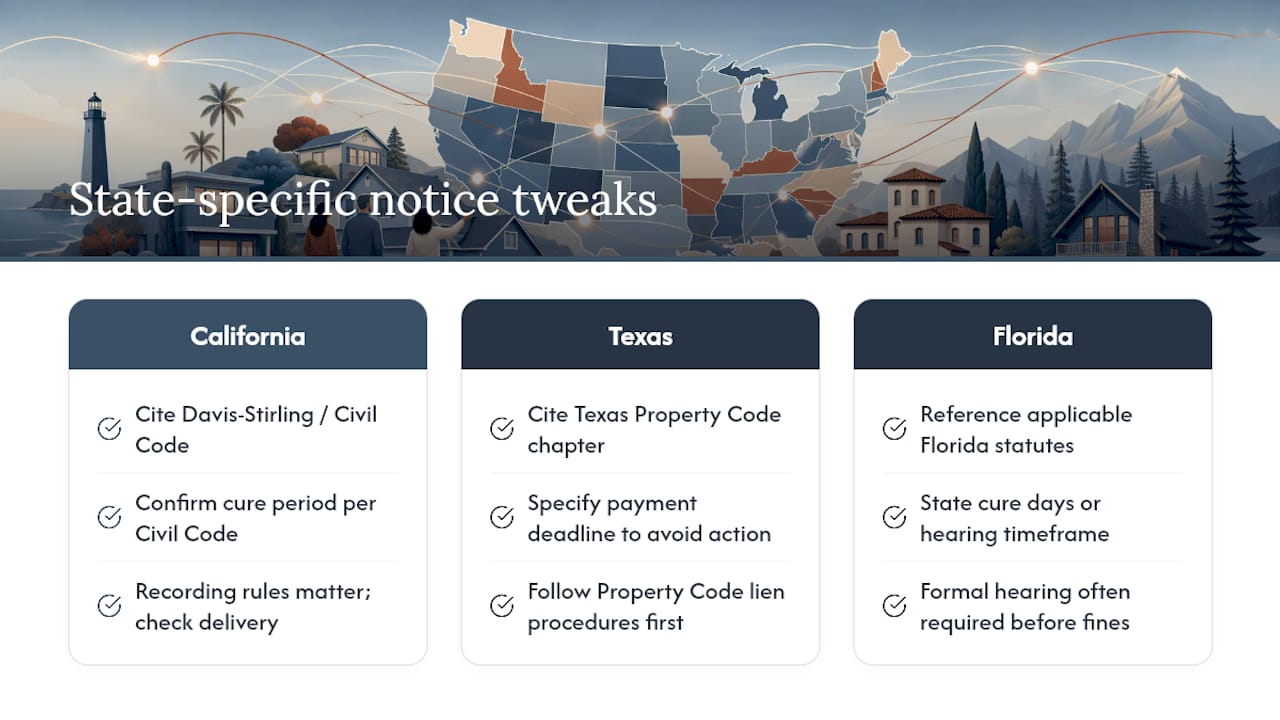
Texas boards work under a different framework entirely. The Property Code sections governing property owners’ associations spell out specific procedures for assessment notices, delinquency handling, and lien filing that a board has to follow before a lien becomes enforceable. A sample line might cite the relevant Texas Property Code chapter and applicable bylaws sections regarding assessment delinquency. For the cure period, the notice would specify a deadline for payment to avoid further collection action under applicable law. Texas-specific procedural details live at HOA Letter AI’s Texas resource page.
Florida boards face statutory hearing and fine procedures that are stricter than what many CC&Rs assume. Florida generally requires a formal hearing opportunity before a fine over a certain threshold can be levied, and the notice has to spell that out. A sample authority line would reference the applicable Florida statutes and declaration articles. A cure-period sample would state the number of days allowed to cure a violation or request a hearing before the board’s fining committee. Florida-specific template adjustments are covered at HOA Letter AI’s Florida resource page.
Templates must be adapted, never used verbatim across states, swap the authority citation, confirm the cure-period requirement against local law, and make sure the consequences listed actually match what your CC&Rs and state statute authorize. A cure period copied from another state’s template, or a fine threshold that ignores a state-mandated hearing right, is exactly the kind of detail that turns a valid violation into a losing enforcement case.
The pattern across all three states is the same: identify the controlling statute first, then check whether it changes your cure period, hearing requirement, or delivery rules before you touch the CC&R citation. Real before-and-after examples of state-specific notice language make the difference concrete if you want to see full letters side by side.
Which Template to Use and How to Fill It In
Four letter types cover almost every enforcement situation a board runs into, and picking the wrong one is almost as damaging as writing the right one badly.
- Courtesy reminder. Use this for a first-time, low-severity issue, an unmowed lawn, a trash can left out overnight. No formal cure deadline is usually needed, though naming the rule (“per Section 4.1 of the Rules”) sets the precedent for escalation later.
- Formal violation notice. Use this once a courtesy reminder has been ignored or the violation is more serious. Required fields: specific rule citation, detailed description with evidence, a firm cure date, and hearing rights language. Sample: “Pursuant to Article VI, Section 2, you are required to remove the unauthorized structure within 20 days of this notice.”
- Demand for payment. Use this for delinquent assessments once informal reminders have failed. It needs the exact amount owed, the statutory or CC&R basis for the assessment, and a cure period before lien or collection referral. Sample: “This demand is made under Section 209.0064 of the Texas Property Code. Payment of $840.00 is due within 30 days to avoid lien filing.”
- Hearing notice. Use this when a homeowner has requested, or state law requires, a hearing before a fine takes effect. It needs the hearing date, time, location or dial-in details, and a statement of the homeowner’s right to present evidence.
| Template type | Primary use case | Required unique field |
|---|---|---|
| Courtesy reminder | First-time minor issue | Rule citation (informal) |
| Formal violation notice | Repeat or serious violation | Firm cure date + hearing rights |
| Demand for payment | Delinquent assessments | Exact amount owed + statutory basis |
| Hearing notice | Pre-fine hearing requirement | Date, time, and evidence rights |
Never include a consequence your governing documents don’t actually authorize. If your CC&Rs don’t mention self-help remedies like towing or utility shutoff, don’t threaten them, that’s an easy way to hand a homeowner’s attorney a bad-faith argument. Have an attorney review any letter tied to a lien filing, a large dollar demand, or a homeowner who has already threatened legal action; the demand letter guidance from The HOA Guide specifically flags attorney review as a checkpoint before high-stakes letters go out. For a ready-to-adapt starting point on the fine side, HOA Letter AI’s fine notice template walks through the same field-by-field logic.
Delivering, Logging, and Escalating HOA Letters Correctly
The strongest letter in the world doesn’t matter if you can’t prove the homeowner received it. Certified mail with return receipt requested is the standard for a reason: it’s what most CC&Rs and state statutes point to when they talk about starting a cure-period clock, and it’s the delivery method that holds up when a dispute reaches a hearing or a courtroom. Email or hand delivery can supplement certified mail, especially for a courtesy first notice, but they shouldn’t replace it once fines or liens are on the table.
Keep a simple delivery log for every letter that matters. At minimum, track:
| Field | Why it matters |
|---|---|
| Date mailed | Starts the cure-period clock |
| Delivery method | Establishes proof standard used |
| Tracking/receipt number | Confirms delivery in a dispute |
| Date received (or attempted) | Documents actual notice |
| Observer/photos attached | Supports the violation description |
Pro Tip: Photograph the violation the same day you mail the notice, not a week later. A dated photo tied to a certified mail receipt is close to bulletproof documentation if the case ever reaches a hearing.
A reasonable escalation cadence looks like: courtesy reminder, then formal notice 10 to 30 days later if uncorrected, then a demand letter or hearing notice after that, then attorney involvement or lien filing only after every prior notice has been documented and delivered properly. Rushing that sequence, or skipping the hearing offer, is what turns a solid enforcement case into a losing one.
Our Take on Building a Defensible Notice System
Boards spend far more energy debating fine amounts than they spend making sure the notice itself would survive a challenge. That’s backwards. A fine that’s technically defensible at $50 beats an aggressive $500 fine built on a letter that cites the wrong CC&R section or skips a required hearing offer.
The conventional advice, “just use a template,” undersells how much state law actually diverges. A Florida hearing requirement and a Texas lien procedure aren’t interchangeable footnotes; they’re structurally different obligations that change what the letter has to say. Boards that treat every state the same are the ones who lose enforceability fights on procedure, not merit.
If you take one thing from this: fix your citation and delivery method before you worry about wording tone. A perfectly polite letter that cites the wrong authority or gets delivered by regular mail when certified mail was required does nothing for you. Get the legal skeleton right first. The tone can be firm or gentle; the structure has to be correct every time.
— Blake
Draft State-Aware HOA Letters Without Starting From Scratch
Building every letter from a blank page, then cross-checking it against your state’s statute and your own CC&Rs, is exactly the kind of repetitive legal work that eats a board member’s weekend. HOA Letter AI handles the state-specific groundwork for you: guided drafting walks you through the required fields, state checks flag citation and cure-period issues before you hit send, and a one-page preview shows exactly what the homeowner will receive.
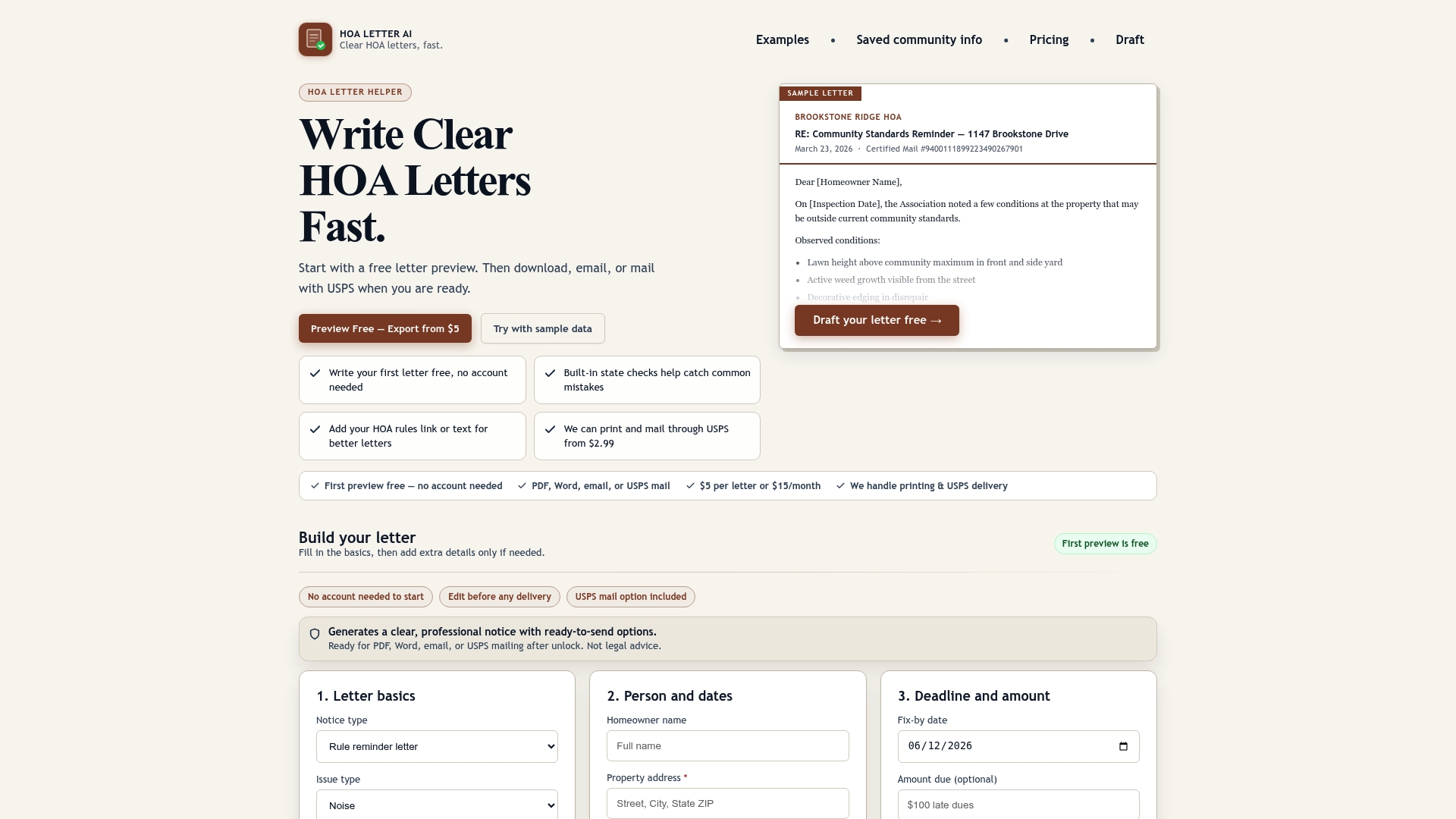
Property management teams handling multiple communities tend to do best on the $15-per-month unlimited-letters plan, since volume makes a subscription cheaper than paying per letter. Individual board members or smaller self-managed associations often prefer the one-time per-letter option, no recurring cost for occasional use. Either way, you can start with a free preview through the violation letter generator before committing to anything, and USPS mailing integration means you’re not printing, stuffing, and standing in a certified mail line yourself. Browse the state-by-state notice requirements to see exactly what your community’s letters need before you draft the next one.
Sources
- California Legislative Information — Civil Code (Davis‑Stirling references)
- Texas Statutes — Property Code / Property Owners’ Associations
- Free HOA Violation Letter Template | The HOA Guide
Recommended
- HOA Fine Notice Template — State-Compliant Fine Letter for HOA Boards
- Colorado HOA Violation Letters — Notice Requirements, Fine Rules & Templates
- California HOA Violation Letters — Notice Requirements, Fine Rules & Templates
- Washington HOA Violation Letters — Notice Requirements, Fine Rules & Templates