
A compliant state-specific HOA notice names the exact rule or CC&R section, states observable facts with dates, gives a calendar cure deadline, and follows the state-prescribed service and hearing process. Miss any one of those four elements and the fine may not hold up.
Before you draft anything, take three steps: pull your governing documents to confirm fine authority exists, look up your state statute to check delivery method and timing requirements, and photograph the violation with a date stamp. Those three actions determine what the notice must say and how it must travel.
Every notice needs these non-negotiable elements:
- Exact rule citation: the CC&R section or bylaw number, not a paraphrase
- Observable facts: “grass measured 10 inches on May 3, 2026” not “yard looks unkempt”
- Calendar cure deadline: a specific date, never “within a reasonable time”
- Next enforcement step: what happens if the violation is not cured by that date
- Delivery method: certified mail, personal service, or email where the statute permits
- Hearing rights: a clear statement of the owner’s right to request a hearing, if required by state law
Use a calendar date throughout. Attach dated photos and keep a delivery log entry for every notice sent.
Key Takeaways
State-specific HOA notices must cite the exact rule, state observable facts with dates, set a calendar cure deadline, and follow the state-mandated service and hearing process — every element is required for the fine to hold up.
| Point | Details |
|---|---|
| Cite the exact rule | Name the CC&R section number and quote the operative sentence in every notice. |
| Use observable facts | Replace opinion words with measurements and dates (“grass at 10 inches on May 3”). |
| Follow state service rules | Florida and Idaho require certified mail; Texas requires verified or certified mail per §209.006. |
| Give a calendar cure date | A specific date is enforceable; “within a reasonable time” is not. |
| HOA Letter AI | Provides state-aware templates, a notice-completeness checker, and USPS mailing integration for boards and managers. |
Table of Contents
- How state notice requirements vary and why it matters
- Annotated template examples for Maine, Minnesota, Florida, and Texas
- How to format and serve a legally compliant HOA notice
- Pre-send compliance checklist
- Common legal pitfalls in notice drafting and how to avoid them
- How to adapt a template to your state and governing documents
- When to get legal review and how these templates were sourced
- Reaching out to homeowners before sending a formal notice
- Enforcement works best when it is fair, consistent, and documented
- HOA Letter AI makes state-specific notices faster and more accurate
- Sources
How state notice requirements vary and why it matters
State statutes set the floor for HOA enforcement procedure. Your CC&Rs may authorize fines and suspensions, but the state controls how much process you must give a homeowner before those remedies kick in. Boards must check both layers because a declaration that authorizes fines does not override a statute that requires a hearing first.
The variables that change most from state to state:
- Cure period: how many days the owner gets before a fine can begin
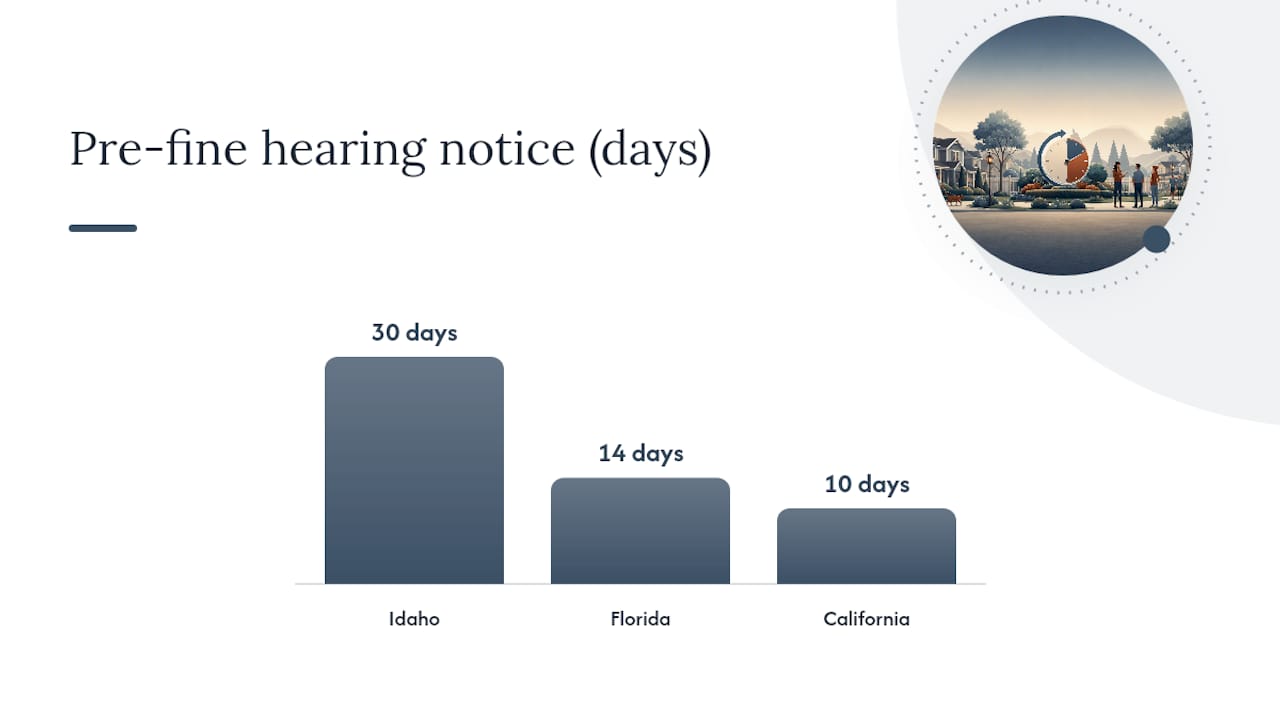
- Pre-fine hearing notice window: how far in advance you must notify the owner of a hearing
- Service method: certified mail, verified mail, personal service, or email where allowed
- Fine caps: per-day and aggregate limits set by statute
- Lienability: whether unpaid fines can become a lien on the property
- Hearing committee composition: who may sit on the committee and who is disqualified
Florida, California, and Texas each embed specific procedural protections into statute. Skipping those steps risks voiding fines or creating attorney-fee exposure for the association.
| State | Pre-fine hearing notice | Service method | Fine cap (per day / aggregate) | Fines stop during cure? |
|---|---|---|---|---|
| Florida | 14 days written | Certified mail or personal service | $1,000 (unless docs allow more) | Yes, while curing |
| Texas | Reasonable time to cure first | Verified or certified mail | Set by governing documents | Yes, for curable violations |
| Idaho | 30 days before vote meeting | Personal service or certified mail | Set by governing documents | Yes, by statute |
| California | 10 days pre-fine hearing | First-class or certified mail | Published penalty schedule required | Yes, while curing |
| Maine | Per governing documents | Certified mail recommended | Per governing documents | Best practice |
| Minnesota | Per governing documents | Certified mail recommended | Per governing documents | Best practice |
Annotated template examples for Maine, Minnesota, Florida, and Texas
The four templates below are skeletons. Replace bracketed placeholders with your community’s actual data before sending.
Maine
Maine does not have a single comprehensive HOA statute governing all associations, so notice requirements flow primarily from the association’s own declaration and bylaws. The Maine state guide from HOA Letter AI provides template language aligned with those governing-document requirements.
NOTICE OF VIOLATION Association: [Association Name] | Date: [Date] | Reference ID: [Case #] Owner: [Full Name] | Property: [Address]
You are in violation of Section [X.X] of the Declaration of Covenants, Conditions, and Restrictions, which requires [exact rule text].
Observed condition: [Specific observable fact, e.g., “boat trailer parked in driveway since April 10, 2026”].
Required action: Remove the trailer from the driveway by [Calendar Date].
If this violation is not cured by the deadline above, the Board may impose a fine of $[amount] per [day/occurrence] and pursue additional remedies authorized under the Declaration.
You have the right to request a hearing before the Board. Submit your written request to [contact] within [X] days of this notice.
Notice sent by: [Certified Mail / Personal Service] on [Date].
Annotation: The rule citation (Section X.X) and observable-fact language are mandatory for enforceability. The calendar cure date and hearing-rights statement follow best practice even where Maine statute does not specify the exact window.
Minnesota
Minnesota’s Common Interest Ownership Act governs many associations. The Minnesota guide from HOA Letter AI maps the statutory requirements to template language boards can adapt directly.
The skeleton mirrors the Maine template above with one addition: Minnesota associations subject to the Common Interest Ownership Act should confirm whether their documents require a specific pre-fine notice period and include that window in the hearing-rights paragraph.
Florida
Florida Statute §720.305 requires at least 14 days’ written notice of the right to a hearing before a fine is imposed. Fines are capped per statutory limits unless governing documents authorize higher amounts. The hearing committee must be independent — no board officers or their relatives.
NOTICE OF VIOLATION AND RIGHT TO HEARING Association: [Association Name] | Date: [Date] | Reference ID: [Case #]
You are in violation of Section [X.X] of the Declaration: [exact rule text].
Observed condition: [Observable fact with date, e.g., “fence painted a non-approved color as of May 1, 2026”].
The Board intends to impose a fine per statutory limits, beginning [Date — at least the minimum notice period from this notice].
You have the right to appear before the Fining Committee. To request a hearing, contact [name/address] in writing within 14 days of this notice. The committee is composed according to statutory requirements, excluding officers or relatives as specified.
Annotation: The 14-day window and independent committee language are mandatory by statute, not optional. Omitting either clause gives the owner a procedural defense.
Texas
Texas Property Code §209.006 requires written notice sent by verified or certified mail. The notice must describe the violation, specify the cure steps and deadline, and inform the owner of the right to request a hearing. Curable violations must receive a reasonable cure period before any fine begins.
NOTICE OF VIOLATION — CERTIFIED/VERIFIED MAIL
Violation: Section [X.X] of the Declaration — [exact rule text]. Observed: [Observable fact with date]. Required cure: [Specific action, e.g., “Remove the structure by June 15, 2026”].
This is a curable violation. You have until [Calendar Date] to complete the required action. If you are an active-duty servicemember, you may have additional rights under the Servicemembers Civil Relief Act.
To request a hearing, submit a written request to [contact] within [X] days.
Annotation: “Verified mail” in Texas means mail with a tracking number that confirms delivery. The Servicemembers Civil Relief Act reference is required by §209.006 when the owner may be on active duty.
Pro Tip: For any state, replace subjective adjectives with measurements. “Unsightly landscaping” loses in a hearing; “grass measured 10 inches on May 3, 2026” does not.
How to format and serve a legally compliant HOA notice
Every notice needs a consistent header block and a statement of service. The header should include:
- Association name and mailing address
- Case or reference ID (for your records and the homeowner’s file)
- Date of notice
- Board member title or property manager name and contact
Attachments that strengthen enforceability: dated photographs labeled with the case ID, the inspection log entry showing when the condition was observed, a timeline of any prior courtesy notice, and the delivery confirmation (return receipt, tracking number, or personal-service affidavit). The documentation standards for HOA notices exist precisely because courts and arbitrators look at the paper trail first.
Service options by state type:
- Certified mail with return receipt: accepted in all states; creates a signed delivery record
- Verified mail (Texas): mail with a tracking number confirming delivery
- Personal service: required or permitted in Idaho and some other states; use an affidavit of service
- Email: permitted in a small number of states and only where the homeowner has consented in writing
Close every notice with a statement of service: “Notice sent by certified mail, return receipt requested, on [Date], to [Address].” Keep the receipt in the homeowner’s file.
Pro Tip: A graduated sequence — courtesy notice, formal notice, hearing/final notice — resolves most violations without litigation and builds the record you need if a fine is ever challenged.
Pre-send compliance checklist
Run through this list before every notice leaves your office:
- [ ] Rule citation matches the exact CC&R or bylaw section number
- [ ] Violation described with observable facts, specific measurements, and a date
- [ ] Dated photographs attached and labeled with the case reference ID
- [ ] Cure deadline is a calendar date, not a relative timeframe
- [ ] Service method matches the state statute (certified, verified, personal service, or email where allowed)
- [ ] Hearing rights paragraph included if required by state law or governing documents
- [ ] Prior courtesy notice logged and referenced in this formal notice
- [ ] Violation confirmed as curable or uncurable; cure language matches that determination
- [ ] Servicemembers Civil Relief Act language included where required (Texas) or where owner may be on active duty
- [ ] Copy saved to association records and homeowner file with delivery proof attached
Common legal pitfalls in notice drafting and how to avoid them
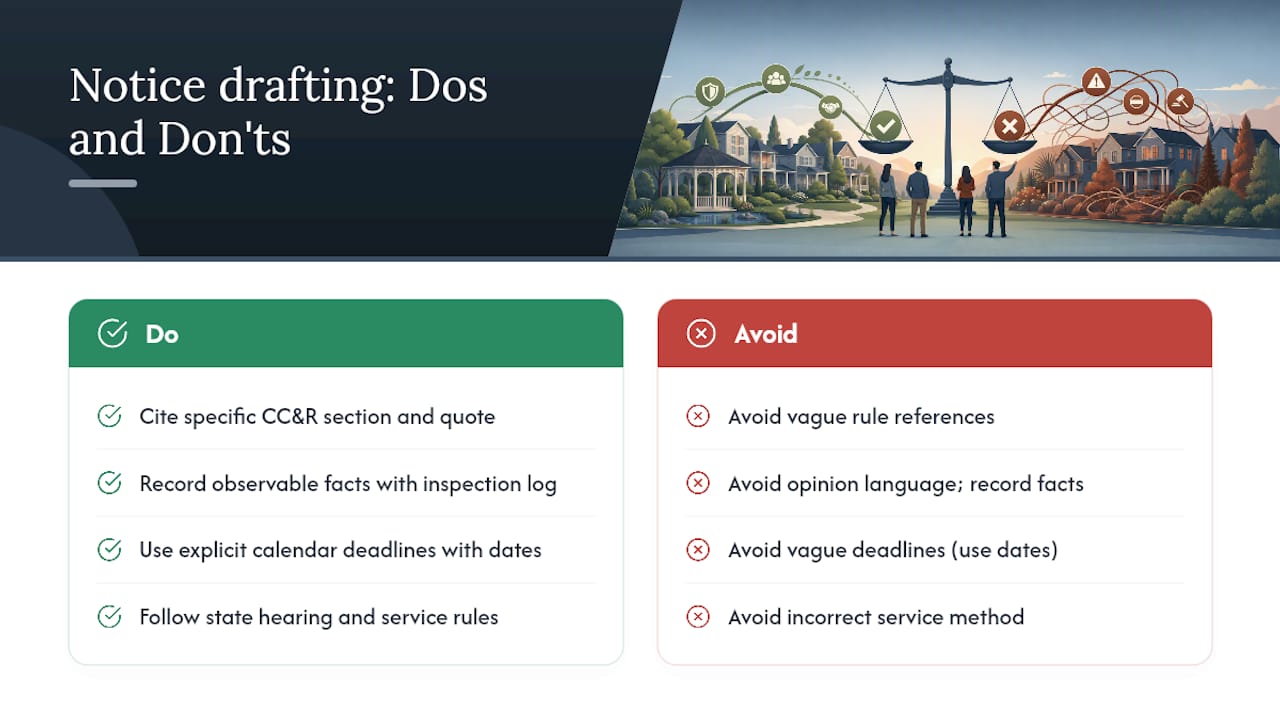
Most enforcement failures trace back to a small set of drafting and procedural mistakes.
Vague rule references. Citing “community standards” instead of a specific CC&R section gives the owner a legitimate argument that the rule is undefined. Fix: always cite the section number and quote the operative sentence.
Opinion language instead of observable facts. “The yard is unsightly” is an opinion. “Grass measured 10 inches on May 3, 2026, per inspection log entry #47” is a fact. Opinions lose at hearings; facts hold up.
Missing a calendar deadline. “Within a reasonable time” is unenforceable. A specific date is not.
Wrong service method. Sending a Texas notice by first-class mail instead of verified or certified mail voids the notice under §209.006. Idaho requires personal service or certified mail under §55-3206. Choosing the wrong method means starting over.
Skipping the hearing process. California, Florida, and Texas each require specific pre-fine procedural steps. A fine imposed without the required hearing is vulnerable to challenge and may be voided entirely.
Inconsistent enforcement. Fining one owner for a violation while ignoring the same condition on another lot creates a selective-enforcement defense. Document every inspection and apply the same standard across the community.
Procedural compliance is the key determinant of enforceability. Getting the notice elements right matters far less if the board skips the state-mandated hearing or service steps.
How to adapt a template to your state and governing documents
Follow these steps before sending the first formal notice under any new enforcement policy:
- Read the specific state statute. Identify required service method, cure period, hearing notice window, and fine caps. Use the state-by-state HOA laws overview as a starting reference.
- Read your declaration and bylaws. Confirm that fine authority exists and that the amounts and remedies you plan to use are authorized.
- Confirm fine authority and caps. Where state law sets a cap (Florida: $1,000 aggregate), your notice must reflect that limit unless your documents explicitly authorize more.
- Choose the service method required by statute. Pick one method and use it consistently across all enforcement steps to reduce procedural disputes.
- Insert the exact rule citation and clear cure language. The cure instruction must tell the owner precisely what action to take, not just that a violation exists.
Pro Tip: Run a final check with association counsel when the notice imposes a new fine schedule, when you intend to place a lien, or when the owner has raised a disability or safety issue that may affect the cure obligation.
When to get legal review and how these templates were sourced
Templates are drafting aids, not legal opinions. Get counsel involved when:
- You are adopting a new enforcement policy or penalty schedule for the first time
- The enforcement action involves a lien or foreclosure-related remedy
- An owner alleges selective enforcement or a fair housing issue
- The violation involves a disability accommodation or safety concern
- You are modernizing fine schedules that have not been updated in years
These examples were drawn from state statutes (Florida §720.305, Texas §209.006, Idaho §55-3206), practice guides from Gavelhouse, BuildingLink, and KindHOA, and the HOA Letter AI state guides for Maine and Minnesota. They reflect statutory language as of the date of publication and are intended as drafting aids only — not a substitute for attorney review where the seriousness of the remedy requires it.
The role of legal review in template use is worth understanding before you send a notice that triggers a lien right or a suspension.
Reaching out to homeowners before sending a formal notice
A courtesy contact before the formal notice resolves a large share of violations without escalation. A brief letter or door-hanger that describes the observed condition, cites the rule, and asks for voluntary compliance within a set window costs almost nothing and creates goodwill. Log it the same way you would a formal notice: date, method of delivery, and the homeowner’s response if any.
When the courtesy contact goes unanswered, the formal notice references it directly (“As noted in our courtesy contact of [Date]…”). That reference strengthens the enforcement record and signals to any reviewing body that the association acted in good faith. Notice language that reduces conflict tends to be specific, factual, and free of accusatory framing — the same qualities that make a notice legally defensible.
Enforcement works best when it is fair, consistent, and documented
Boards that enforce selectively — or that skip steps because a violation seems obvious — create more legal exposure than boards that follow a slower, documented process. The homeowner who receives a notice that cites the exact rule, describes what was observed, and gives a real deadline to fix it is far less likely to fight it than one who gets a vague letter with no statutory basis.
The states with the most detailed enforcement statutes (Florida, Texas, California) are also the states where HOA litigation is most common. That is not a coincidence. Detailed statutes exist because enforcement disputes happened first. Following the process is not bureaucratic overhead; it is what makes the fine stick.
For boards in Maine and Minnesota, where statute is less prescriptive, the governing documents carry more weight. That means your declaration and bylaws need to be specific enough to support enforcement — and your notices need to track those documents precisely.
HOA Letter AI makes state-specific notices faster and more accurate
Drafting a compliant notice from scratch means cross-referencing your CC&Rs, your state statute, and your enforcement history every single time. HOA Letter AI cuts that process down to minutes.
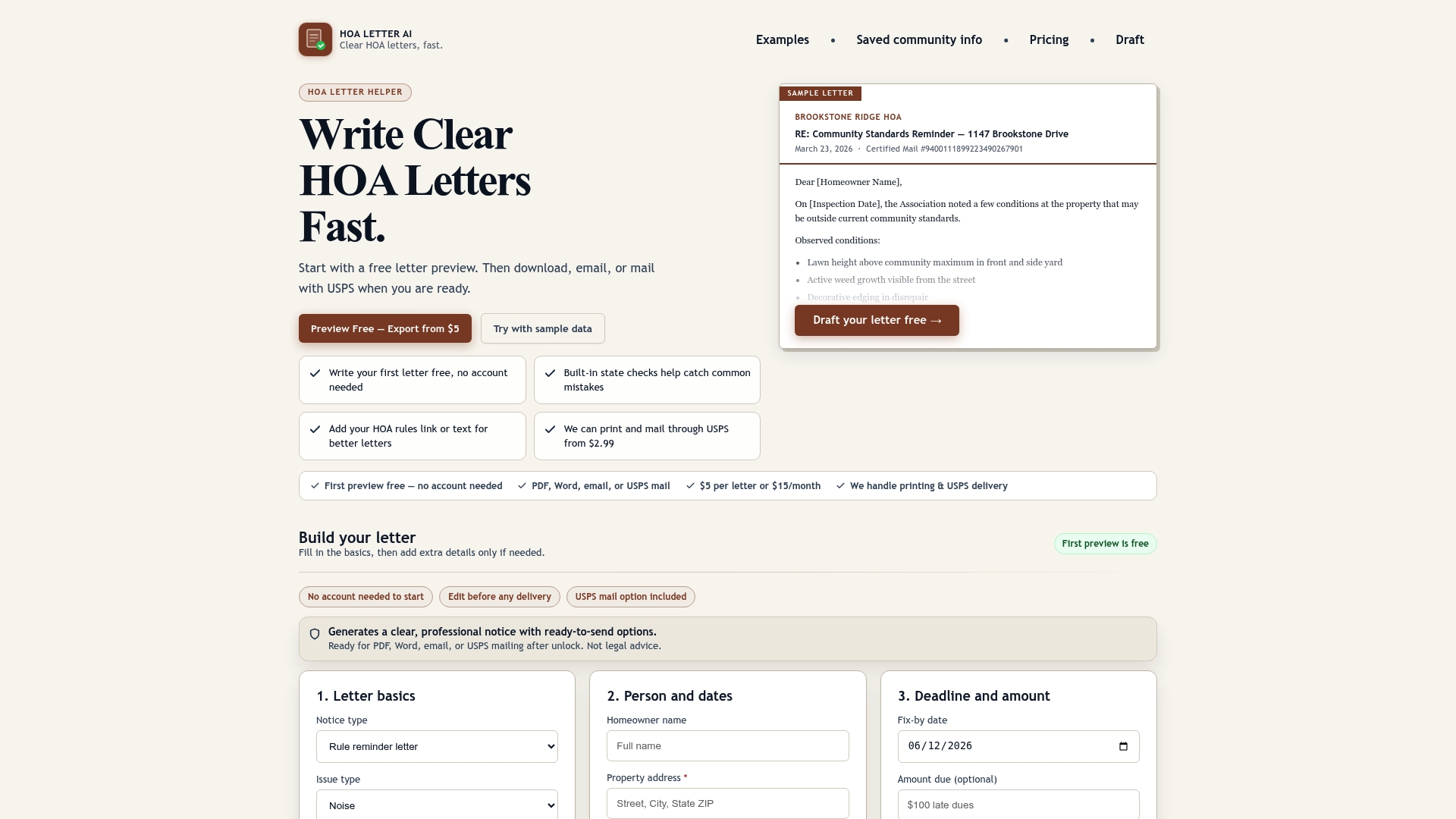
The tool pulls in state-specific context for Maine, Minnesota, and other states, flags missing required clauses before you send, and integrates USPS mailing so certified mail goes out without a trip to the post office. Property managers get unlimited letters on a subscription; individual boards or homeowners can unlock a single letter for a one-time fee. The HOA warning letter template gives you a one-click preview before you commit to sending. Check pricing for property management teams if your portfolio spans multiple communities.
Sources
Bookmark these sources when customizing a template for your state:
- 720.305 Obligations of members; remedies at law or in equity; levy of fines and suspension of use rights.—
- Texas Property Code Section 209.006 (statutory notice and cure requirements)
- How to Write an HOA Violation Notice (Step-by-Step)
This article provides general drafting guidance and is not a substitute for legal advice. Confirm current statutory requirements with your state’s official code and consult qualified association counsel for enforcement actions involving liens, foreclosure, or fair housing concerns.