
State-aware HOA compliance letter templates create a consistent, legally defensible notice workflow for routine covenant enforcement. They reduce escalation risk, preserve due-process rights, and generate the audit trail boards need if a dispute reaches a hearing. For most violations — landscaping, parking, visible exterior noncompliance — a well-built template is enough. Attorney review belongs in the picture when statutes conflict, liens are contemplated, or civil-rights claims surface.
What templates guarantee:
- Consistent statutory language, CC&R citations, and cure deadlines across every notice
- A recordable, deliverable paper trail that survives selective-enforcement challenges
- Plain-language clarity that reduces homeowner defensiveness
What they don’t replace: formal legal analysis when governing documents conflict with state statute, or when high-risk remedies like foreclosure are on the table.
Immediate action: draft with a state-aware template, confirm your state’s notice period and delivery requirements, send with trackable proof, and archive the complete file.
Pro Tip: Add a single line citing the exact CC&R section number in every template. Boards that omit the citation lose hearings on procedural grounds far more often than on the underlying facts.
Table of Contents
- What do HOA compliance letter templates actually do for your board?
- When is a template enough — and when do you need an attorney?
- What must every state-aware HOA notice template include?
- How should you deliver notices and preserve proof?
- Why “boring on purpose” is the right drafting standard
- What does a compliant enforcement workflow look like?
- How do state-aware template tools reduce enforcement errors?
- A quick checklist and two template snippets you can use today
- Key Takeaways
- The part most boards underestimate
- HOA Letter AI: state-aware letters, built-in checks, and proof of delivery
What do HOA compliance letter templates actually do for your board?
The core benefit is consistency. When every notice follows the same structure — association letterhead, owner details, factual description, rule citation, cure deadline, consequences, hearing rights — boards eliminate the variation that lets homeowners argue they never received proper notice. Boards that use standardized templates and keep delivery logs are more likely to prevail in disputes, precisely because the record is clean.

Templates also speed enforcement. A manager handling dozens of communities can generate a compliant notice in minutes rather than drafting from scratch each time. That speed matters when cure periods are running.
Core benefits at a glance:
- Consistent CC&R and statute citations across all notices
- Faster drafting with fewer omissions
- Defensible recordkeeping that supports hearing arguments
- Plain-language framing homeowners can read and act on
- Reduced selective-enforcement exposure when the same template applies to every owner
The limits are real, though. A template cannot substitute for case-specific legal analysis. If your governing documents say one thing and your state HOA statute says another, a legal compliance resource for English-speaking clients may help navigate such conflicts. The same applies to complex architectural disputes or any enforcement path that ends in a lien.
Pro Tip: Build three template tiers: courtesy notice, official notice, and final/hearing notice. Using the same letter for a first-time landscaping reminder and a pre-lien warning is a common HOA letter writing mistake that undermines your enforcement sequence.
When is a template enough — and when do you need an attorney?
Templates handle routine enforcement well. Minor landscaping violations, parking infractions, visible exterior noncompliance — when the governing documents and state statute align and the remedy is a fine, a solid template covers it.
Red flags that require attorney review:
- Your CC&Rs and state statute conflict on notice periods or hearing rights
- The enforcement path leads to a lien or foreclosure
- A homeowner raises a fair-housing or civil-rights claim
- The dispute involves contested property rights or easements
- A complex architectural change requires board discretion beyond written rules
- Late assessments are involved — covenant violation templates and collection notices follow entirely different legal paths with different statutory protections
A simple decision rule: if the outcome of getting it wrong is a lien, a lawsuit, or a discrimination complaint, stop and call counsel. If the outcome is a fine on a clear rule violation with no statutory conflict, a state-aware template is your tool.
Pro Tip: When you do involve an attorney, note it in the board minutes with the reason. That record protects the board if the enforcement decision is later challenged.
What must every state-aware HOA notice template include?
A defensible violation notice requires specific elements. Miss one and a hearing officer may dismiss the notice on procedural grounds before the underlying violation is even considered.
Mandatory elements for every template:
| Element | What to include |
|---|---|
| Date | Date the letter is generated and sent |
| Association and owner details | Full association name, owner name, property address |
| Factual description | Observable conditions with specific dates observed |
| Rule citation | Exact CC&R section or rule number |
| Required corrective action | Specific steps the owner must take |
| Cure deadline | A calendar date, not “within 30 days” |
| Consequences | Fine amount, escalation path if uncured |
| Hearing rights | How to request a hearing and the deadline to do so |
State law adds layers. California’s Davis-Stirling Act specifies hearing procedures and fine schedules that must appear in notices. Florida’s Chapter 720 governs HOA enforcement timelines and requires specific notice language before fines can be imposed. Other states have their own wrinkles on delivery methods and appeal language. A template that works in Texas may be deficient in Colorado.
Pro Tip: Never use a template for lien or foreclosure steps without a state-specific legal review first. Recorder rules and statutory prerequisites for those remedies vary sharply by state.
How should you deliver notices and preserve proof?
Delivery method determines legal weight. Certified mail with return receipt, personal service, and registered mail provide the strongest evidentiary footing. Email or portal delivery is acceptable only when the owner has consented in writing or the governing documents explicitly authorize electronic notice.
| Delivery method | Legal weight | When to use |
|---|---|---|
| Certified mail, return receipt | Strongest | Formal notices, pre-lien, hearings |
| Personal service | Strongest | When certified mail is refused or returned |
| First-class mail | Moderate | Courtesy notices when CC&Rs allow |
| Email / owner portal | Acceptable only with consent | When governing docs or owner consent authorize it |
Every violation file should capture: date and time of delivery, method used, tracking number or portal log, and recipient signature or delivery confirmation. That proof is what you present at a hearing when an owner claims they never got the letter.
Pro Tip: Keep a delivery log as a separate document in the violation file, not just a note in the letter. Attach it to the file the day you send — not after a dispute arises.
Why “boring on purpose” is the right drafting standard
Management experts recommend neutral, factual language to reduce homeowner defensiveness and litigation risk. The phrase “boring on purpose” captures it well: describe what you observed, cite the rule, state the deadline. Nothing more.
Do:
- “On [date], the association observed [specific condition] at [address].”
- “This condition is inconsistent with Section 4.3 of the CC&Rs, which requires [specific standard].”
- “Please correct this condition by [calendar date].”
Avoid:
- Rhetorical questions (“How many times must we remind you…?”)
- Character judgments (“Your continued disregard…”)
- Threats beyond the stated consequences
- Legalese that isn’t required statutory language
The single most effective drafting tactic is this combination: factual observation + explicit CC&R citation + a calendar cure date. That structure reduces emotional responses and lowers the chance the owner escalates to counsel. For professional formatting guidance on structure and required fields, the format itself signals professionalism before the owner reads a word.
Pro Tip: Build reusable sentence blocks for each element: one for the observation, one for the citation, one for the cure action, one for hearing instructions. Swap in the specifics and the letter writes itself.
What does a compliant enforcement workflow look like?
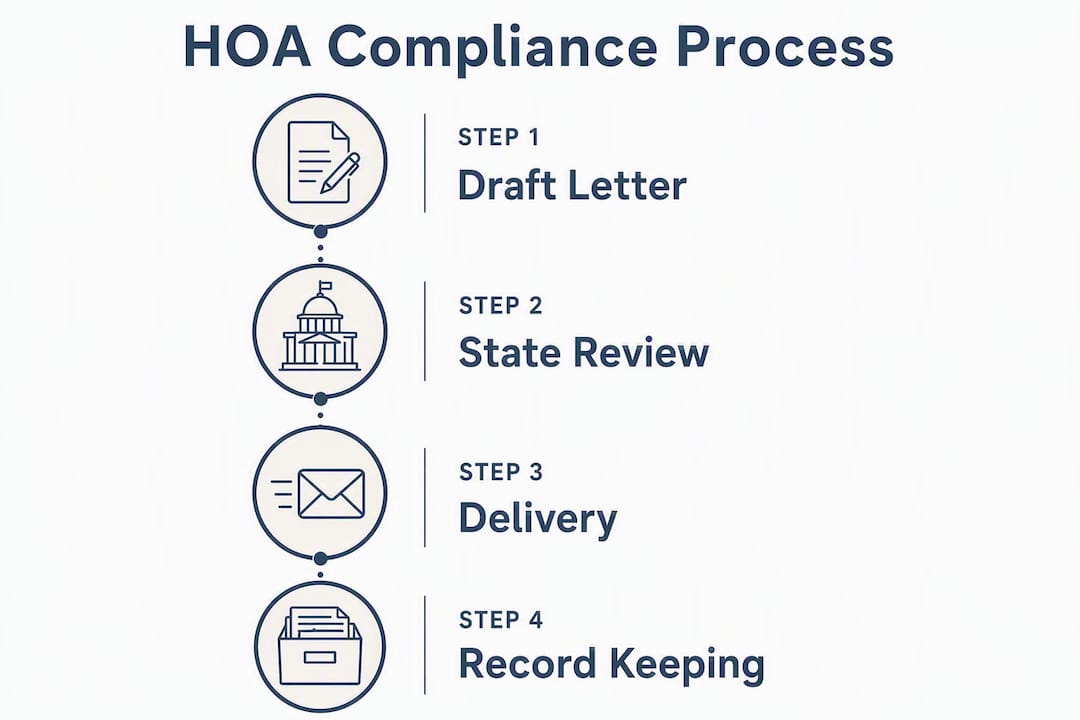
Enforcement follows a documented sequence: complaint or inspection, written notice, cure period, hearing if contested, fine, and possible lien if unpaid. Skipping steps or enforcing selectively creates legal vulnerability.
- Complaint or inspection — document with wide and detail photos on the date observed
- Select the right template tier — courtesy, official, or final/hearing notice
- State and legal check — confirm notice period and delivery method for your state
- Board sign-off or manager send — per your authorization policy
- Deliver with proof — certified mail or authorized method; log immediately
- Follow-up inspection — photograph the property after the cure deadline
- Hearing if requested — owner has the right to be heard before a fine is imposed
- Archive the complete file — every document, photo, and log in one place
For a detailed step-by-step enforcement timeline, including typical cure periods by violation type, that guide covers the sequencing boards most often get wrong.
Record fields every violation file must contain:
| Field | Purpose |
|---|---|
| Date and time observed | Establishes the violation timeline |
| Inspector name | Accountability and witness identification |
| Photos (wide + detail) | Visual evidence for hearings |
| Template version used | Version control for procedural defense |
| Delivery proof | Certified receipt, tracking number, or portal log |
| Owner response notes | Documents any communication from the owner |
| Hearing records | Outcome, board decision, any fine imposed |
Pro Tip: Retain violation files for at least seven years, or longer if your state’s statute of limitations on HOA enforcement actions exceeds that. Digital storage with a consistent folder structure — one folder per property, subfolders by year — makes retrieval fast when a dispute surfaces.
How do state-aware template tools reduce enforcement errors?
Volunteer boards make the most errors at two points: selecting the wrong template type and omitting state-required language. State-aware tools that integrate statute insertion, required hearing language, delivery recommendations, and completeness checks lower the need for routine counsel and reduce the mistakes that trigger disputes.
HOA Letter AI addresses these risks directly:
- State-required text insertion — pulls mandatory language for your state automatically
- CC&R citation helpers — prompts you to cite the exact rule section before the letter is finalized
- Notice-completeness checker — flags missing required elements before you send
- One-page preview — lets you review the full letter before committing to delivery
- USPS mailing integration — sends certified mail and captures proof in the same workflow
- Reusable community profiles — property managers can store community rules and apply them across every letter
For compliance letter templates built for property managers, the reusable profile feature alone eliminates the re-entry errors that plague multi-community portfolios.
One caution: these tools are aids, not substitutes for counsel when statutory conflicts or complex remedies are in play.
Pro Tip: Run the completeness checker on every letter before delivery, even when you’re confident in the content. The check takes seconds and catches the omissions that cost boards hearings.
A quick checklist and two template snippets you can use today
Compliant notice checklist:
- [ ] Association name and letterhead
- [ ] Owner name and property address
- [ ] Date of observation with specific facts
- [ ] Exact CC&R or rule section cited
- [ ] Required corrective action described specifically
- [ ] Cure deadline as a calendar date
- [ ] Fine amount and escalation consequences
- [ ] Hearing rights and request deadline
- [ ] Delivery method and proof captured
Courtesy notice snippet (first-offense, educational tone):
Formal notice snippet (official notice with required elements):
Store both snippets in a shared template library with version numbers and the date last reviewed. When state law changes, update the library and note the revision. For downloadable state-aware templates, HOA Letter AI’s template library includes state-neutral and state-specific versions boards can adapt immediately.
Pro Tip: Mark every template with a version number and review date in the footer. When a board member asks which version was used for a specific notice, you’ll have the answer in seconds.
Key Takeaways
State-aware HOA compliance letter templates are sufficient for most routine enforcement when they include mandatory elements, match state notice requirements, and are delivered with documented proof.
| Point | Details |
|---|---|
| Templates cover routine enforcement | Minor violations with clear CC&R alignment don’t require attorney drafting. |
| Mandatory elements are non-negotiable | Every notice needs a factual description, exact rule citation, calendar cure date, and hearing rights. |
| Delivery proof is your hearing defense | Certified mail or authorized electronic delivery with a logged receipt protects the board. |
| “Boring on purpose” reduces escalation | Neutral, factual language lowers emotional responses and litigation risk. |
| HOA Letter AI automates state compliance | State-required language, completeness checks, and USPS mailing are built into the workflow. |
The part most boards underestimate
The boards that struggle most with enforcement aren’t the ones with bad rules. They’re the ones with inconsistent records. A notice that was sent but not logged, a cure deadline expressed as “30 days” instead of a calendar date, a template that was edited informally by a board member who meant well — these are the gaps that turn a $200 landscaping fine into a three-hour hearing.
The “boring on purpose” standard isn’t just about tone. It’s about removing every element that gives a homeowner something to argue about other than the violation itself. When a letter is factual, specific, and procedurally complete, the conversation stays on the violation. When it isn’t, the conversation shifts to the letter.
The other thing worth saying plainly: template version control is board governance. If your enforcement letters aren’t versioned, reviewed annually, and approved by the board, you don’t have a template system — you have a collection of documents that may or may not reflect current law. That distinction matters when you’re sitting across from a homeowner’s attorney.
HOA Letter AI: state-aware letters, built-in checks, and proof of delivery
Drafting compliant HOA notices from scratch takes time most boards and managers don’t have, and the cost of a procedural error is a lost hearing or an attorney bill that dwarfs the original fine.
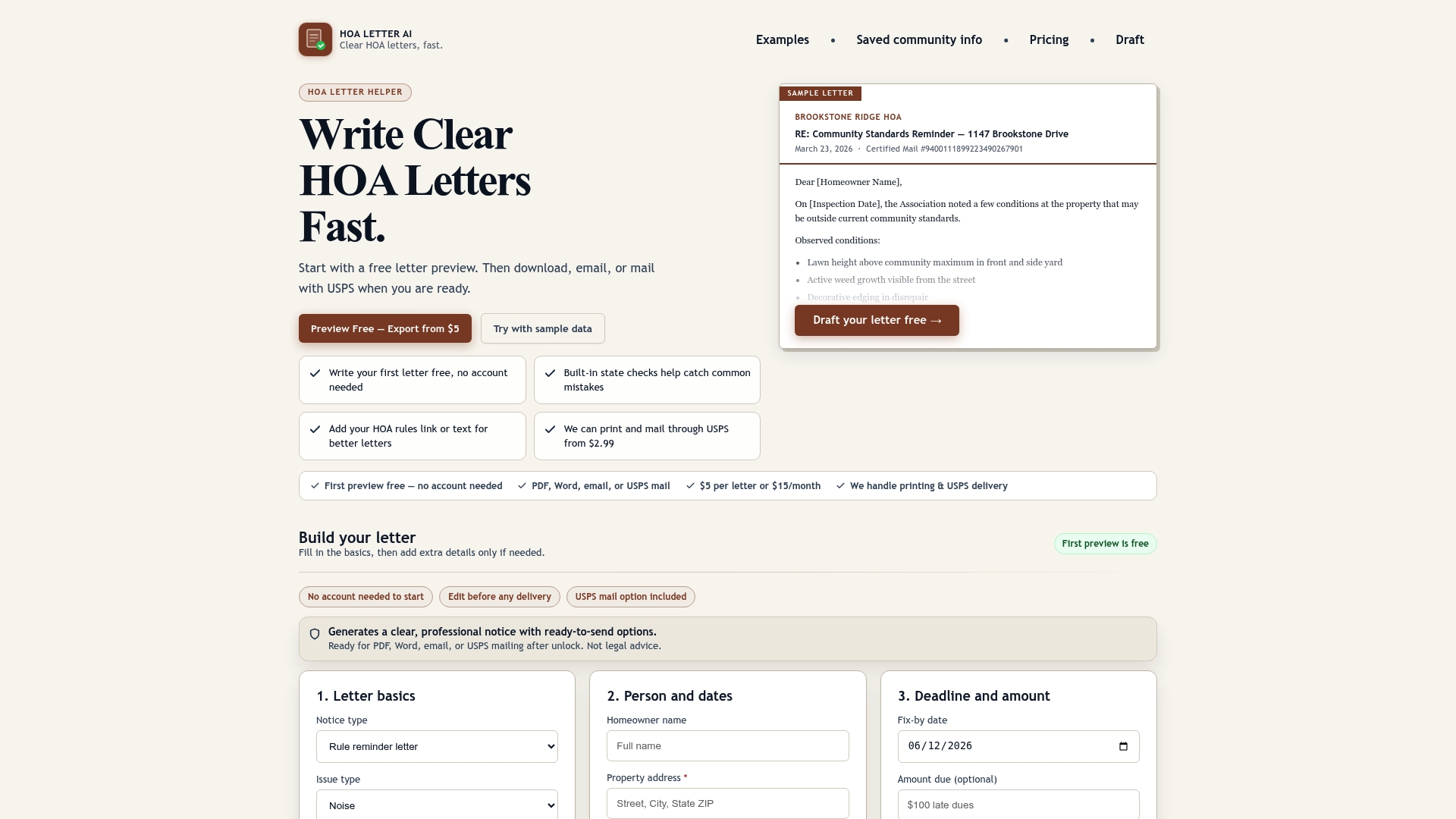
HOA Letter AI generates state-aware violation letters with mandatory language already inserted, flags missing required elements before you send, and handles USPS certified mailing with proof capture in the same workflow. Property managers get reusable community profiles; homeowners get a notice-completeness checker and editable response letters. Every letter includes a one-page preview so you can confirm the content before it goes out.
Check your state’s notice requirements and preview a compliant violation letter free before you commit. For a full view of state-by-state notice rules, fine timelines, and required language, the HOA violation letter laws by state guide covers all 50 states.
This article is general guidance, not legal advice. Confirm current requirements with your state’s HOA statute or a licensed attorney before taking enforcement action.