
What are compliance letter templates and why do property managers need them?
Compliance letter templates for property managers are pre-formatted documents that deliver clear, consistent, and legally defensible notices to residents about rule violations or policy enforcement. They are not just time-savers. They are your first line of legal protection.
Without a standardized template, two managers in the same office can send wildly different notices for the same violation, creating fair housing exposure and inconsistent enforcement records. A well-built template eliminates that gap.
Here is what these templates must accomplish:
- Satisfy the Fair Housing Act, ADA, and applicable state landlord-tenant laws
- Reference specific lease clauses or community rules by section number
- State the violation, required remedy, deadline, and consequences in plain language
- Maintain a professional, non-confrontational tone that holds up in court
- Create a paper trail that supports eviction proceedings if compliance fails
Governing bodies like the Michigan State Housing Development Authority (MSHDA) and the California Apartment Association (CAA) publish jurisdiction-specific forms precisely because generic templates routinely fall short. Understanding why property managers send violation letters in the first place is the foundation for building templates that actually work.
Table of Contents
- Key legal and regulatory considerations before you use any template
- How to structure and write an effective compliance letter
- How to build and maintain a master library of property compliance documents
- How Hoaletterai makes compliance letter generation faster and more reliable
- Timing and delivery methods that make compliance letters legally effective
- Hoaletterai gives property managers a faster path to compliant letters
- Key Takeaways
Key legal and regulatory considerations before you use any template
Compliance requirements vary by state, property type, and local ordinance, so verifying template language against current landlord-tenant laws, FHA standards, and ADA regulations is not optional. A template that was legally sound in 2022 may cite repealed language today.
The risks of using outdated or generic forms are real. Courts have dismissed eviction proceedings because the underlying notice cited a statute that no longer existed. That is an expensive lesson.
Key legal checkpoints before deploying any template:
- Confirm notice period requirements for your state (cure windows range from 3 days to 30 days depending on violation type and jurisdiction)
- Verify FHA and ADA language for properties receiving federal assistance, using HUD Form 50059 standards where applicable
- Source templates from reputable state apartment associations or official housing authority sites, which provide jurisdiction-specific compliance forms
- Have legal counsel review any customized language, especially for multi-state portfolios
- Check local ordinances separately from state law; cities like Los Angeles and Chicago layer additional tenant protections on top of state statutes
For California managers, the CAA offers more than 200 rental housing forms developed by its compliance and legal team. For Florida HOA boards, Chapter 720 and Chapter 718 impose specific notice requirements that differ from general landlord-tenant rules.
How to structure and write an effective compliance letter
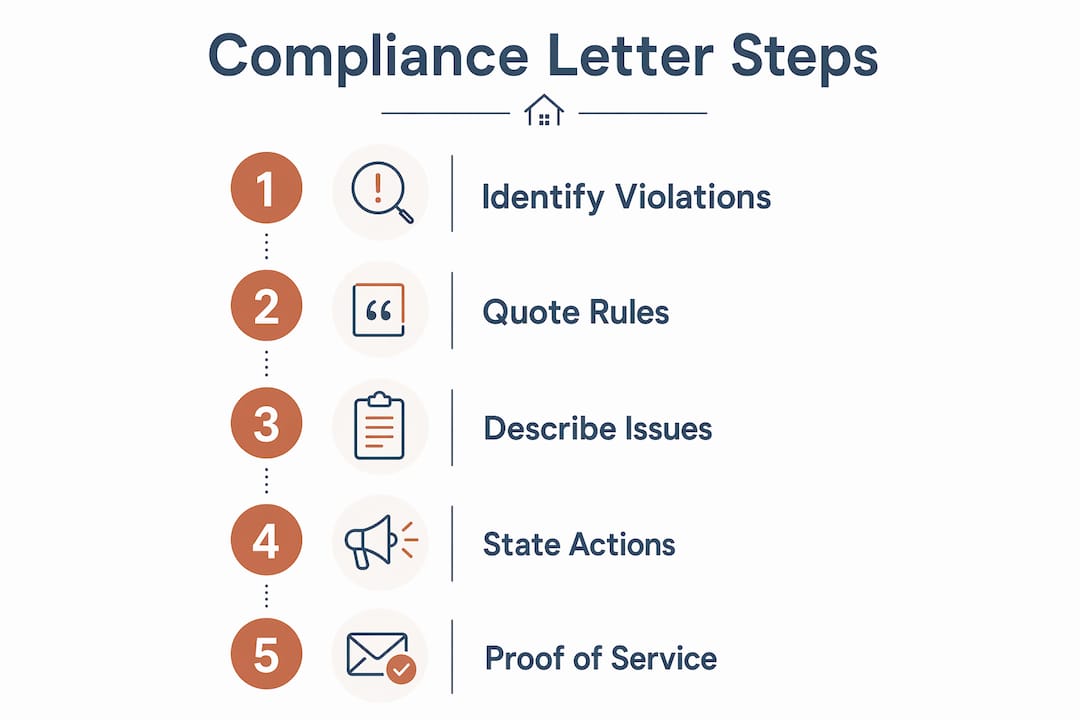
Effective compliance letters follow a formal structure: writer identification, rule citation, violation description, required remedy steps, compliance deadline, consequences, and a dated signature. Every component earns its place.

The single most common drafting mistake is vagueness. Quoting the exact lease clause or community rule verbatim, with the section number, removes ambiguity and gives the resident no room to claim confusion. “Violation of Lease Agreement, Section 5.2: Unauthorized Pets” is defensible. “Pet policy violation” is not.
Tone matters as much as content. Clear, professional language promotes voluntary compliance and reduces litigation risk by avoiding anything that reads as confrontational or retaliatory. You want the resident to fix the problem, not hire an attorney.
Standard components for every tenant notification letter:
- Header: Property management company name, address, contact information
- Resident identification: Full names of all tenants on the lease, unit number, property address
- Violation details: Date of violation, factual description, exact lease or rule section cited
- Required action: Explicit steps the resident must take to cure the violation
- Compliance deadline: A firm date aligned with state law requirements
- Consequences: Plain statement of what happens if the deadline passes (lease termination, eviction proceedings)
- Signature: Property manager’s name, title, and date
Pro Tip: Add a “Proof of Service” section to your internal copy. Record the date, time, and delivery method (hand-delivered, certified mail, email with read receipt). This proof of service record is a critical element of a defensible audit trail if the matter escalates to court.
How to build and maintain a master library of property compliance documents
One-size-fits-all templates are insufficient for any portfolio managing more than a handful of units. A tailored master library matched to specific violation types keeps your communications legally appropriate and tonally consistent across your entire team.
Build your library around violation categories: noise complaints, unauthorized occupants, unauthorized pets, property damage, parking violations, lease payment issues, and HOA rule infractions. Each category may require different cure windows and different language under your state’s statutes. Lease violation notice examples organized by violation type give your staff a clear starting point without improvising under pressure.
Maintenance practices that keep your library current:
- Schedule an annual legal review of every template, timed to coincide with your state legislature’s session end
- Create state-specific versions or addenda for every jurisdiction where you operate
- Standardize formatting across all templates so any team member can use them without training
- Integrate templates into property management software like Yardi or AppFolio to auto-populate resident data and reduce manual entry errors
The CAA’s integrated forms upgrade, available for members with 200 or more units, demonstrates exactly this model: forms built for direct import into major platforms, eliminating transcription errors and keeping language current. For property managers dealing with facade maintenance compliance or other physical property obligations, the same principle applies: standardized documentation protects you when disputes arise.
How Hoaletterai makes compliance letter generation faster and more reliable
HOA Letter AI is built specifically for the workflow property managers and HOA board members actually face: multiple violation types, state-specific language requirements, and the need to get a professional letter out quickly without calling an attorney every time.
The platform’s key features for compliance letter management:
- State-specific language customization: Select your state and community rules, and the letter reflects the correct legal language for that jurisdiction
- Built-in error checks: Flags common drafting mistakes before the letter goes out, reducing the risk of a legally defective notice
- One-page preview: Review the complete letter before sending, so formatting and content are confirmed in a single step
- USPS mailing option: Send directly from the platform without managing envelopes, postage, or a separate mailing service
- Consistent formatting: Every letter your team generates follows the same professional structure, supporting fair and defensible enforcement
Pro Tip: Use Hoaletterai’s state-specific templates as your baseline, then add your community’s exact rule citations in the violation details field. This combines legal currency with the specificity that makes notices harder to dispute.
Timing and delivery methods that make compliance letters legally effective
A perfectly written compliance letter can still fail if it arrives too late or through the wrong channel. State law governs both the notice period and the acceptable delivery methods, and courts scrutinize both.
Most states recognize three delivery methods: hand delivery, first-class mail, and certified mail with return receipt. Some jurisdictions, including Florida under Chapter 720, permit email delivery only when the resident has previously consented in writing. Defaulting to certified mail is the safest baseline for any formal compliance notice because it generates a trackable delivery record.
Timing rules to follow:
- Send immediately after documenting the violation. Delays weaken your position and can signal selective enforcement.
- Calculate the cure deadline from the delivery date, not the violation date. Most statutes start the clock when the resident receives the notice, not when you wrote it.
- Account for mailing time. If your state allows three days to cure, mailing a letter the day before the deadline effectively gives the resident no time, which courts have used to void notices.
- Keep copies of every letter sent, including the delivery confirmation, in the resident’s file and your compliance log.
For multi-state portfolios, the state-specific HOA violation requirements published by Hoaletterai cover notice periods and delivery rules by jurisdiction, which is a faster reference than parsing each state’s statutes individually.
Hoaletterai gives property managers a faster path to compliant letters
Drafting compliant notices from scratch takes time your team does not have, and generic templates carry legal risk you cannot afford.
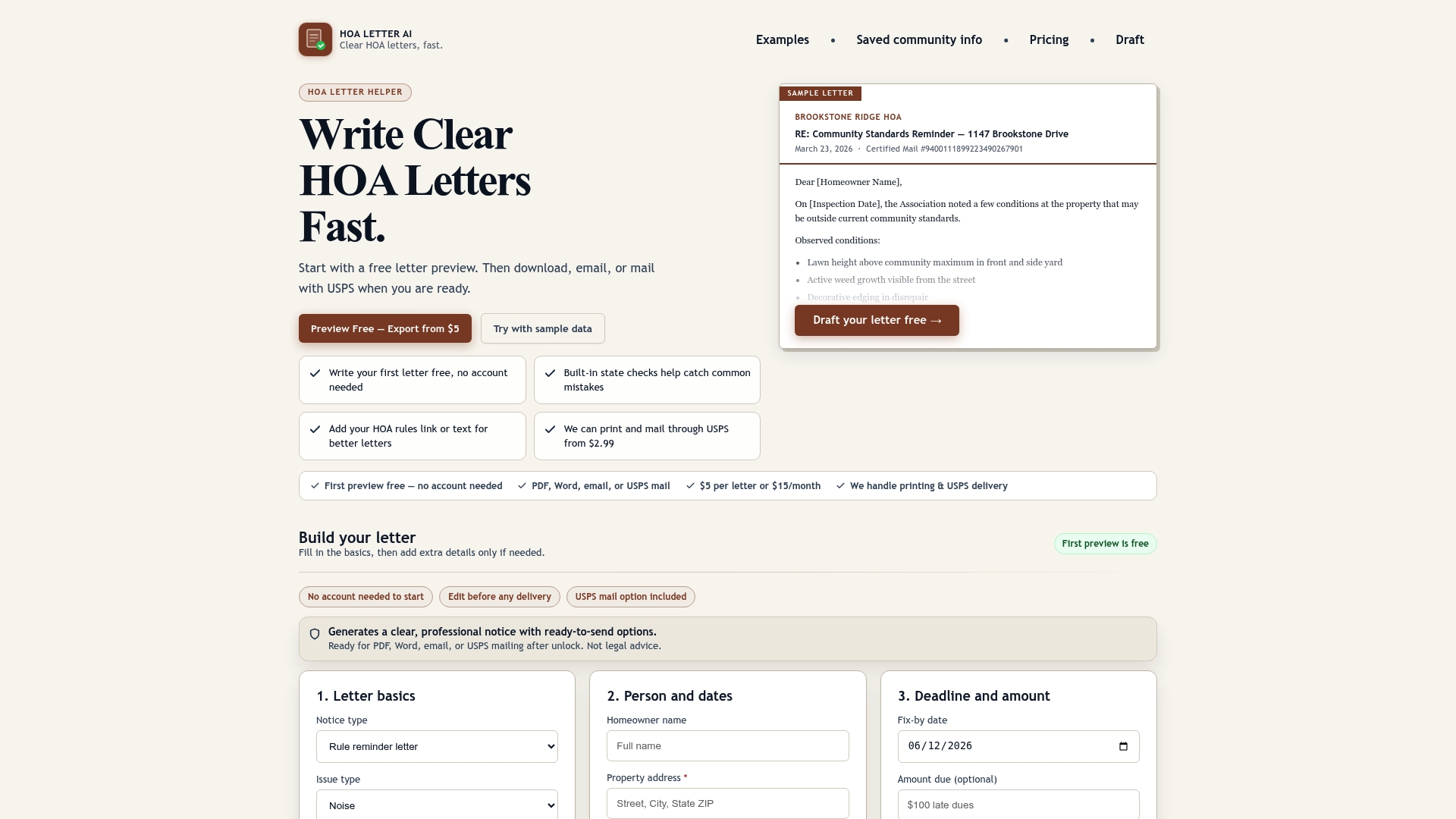
HOA Letter AI generates state-aware drafts you review in minutes, with built-in checks, USPS mailing, and customizable community rules already built into the workflow. You get a professional, legally current letter without the back-and-forth with outside counsel for routine violations. Property managers handling high-rise cleaning compliance notices or standard lease violations use the same platform to maintain consistent documentation across their entire portfolio.
Start with a free preview at hoaletterai.com and see your first letter before you commit.
Key Takeaways
Compliance letter templates for property managers must combine jurisdiction-specific legal language, a formal structure with verbatim rule citations, and a documented delivery method to be legally defensible.
| Point | Details |
|---|---|
| State law governs every template | Verify notice periods, delivery methods, and required language against your state’s current landlord-tenant statutes. |
| Verbatim rule citations are non-negotiable | Quote the exact lease clause or community rule with its section number to remove ambiguity and support enforcement. |
| Proof of service protects you | Record the date, time, and delivery method on your internal copy to build a defensible audit trail. |
| A master library reduces risk | Organize templates by violation type and review them annually so outdated language never reaches a resident. |
| Hoaletterai speeds up the process | The HOA Letter AI generates state-specific, professionally formatted compliance letters with built-in checks and USPS mailing. |
Recommended
- Why Property Managers Send Violation Letters: 2026 Guide | HOA Letter AI
- Notice of Non-Compliance Property: What Owners Must Know | HOA Letter AI
- Compliance Letter Formatting Best Practices: 2026 Guide | HOA Letter AI
- Standardized Compliance Letter for HOA Boards | HOA Letter AI
Drafting support for HOA notices
Use the HOA letter drafter to turn this guidance into a resident-ready notice, compare reusable HOA letter templates, or review the property manager workflow for higher-volume enforcement work.